
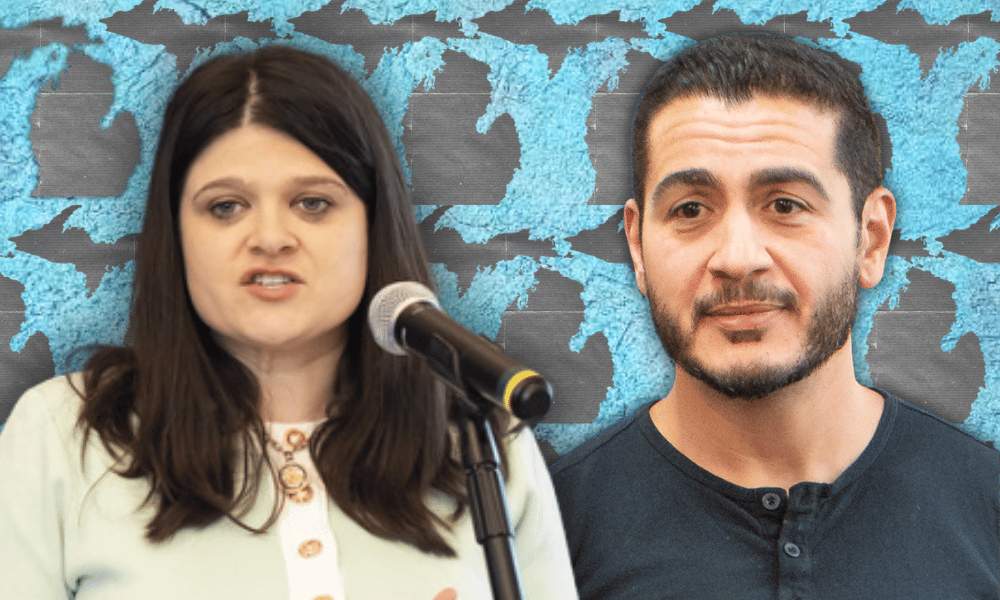
America can rarely handle an outrageous Democratic woman. If the national electorate doesn’t vote for qualified and temperate women like Hillary Clinton or Kamala Harris, it’s all the more rare they go for female politicians who are more bombastic and loud (think Katie “Get outta my fucking shot!” Porter) or who come to be seen as unhinged when stories emerge (e.g., stapler hurler Amy Klobuchar eating a salad with a hair comb). With her signature scratchy, faux-folksy accent and her rough-and-tumble persona, Michigan Representative Haley Stevens could have been seen as lovably tolerated, until she suddenly endorsed Republican Mike Rogers last week, seemingly imploding her political future and misreading the blue tsunami that later swept over the country.
“I’m gonna be working on our behalf,” she said in July to a crowd of Michiganders, “and you better believe I’m gonna be doing it with a little bit of joy, a little bit of enthusiasm, a little bit of energy, and a little bit of stick it to ‘em!” Stevens immediately stuck out as a notable character in this year’s crowded campaign field. As a working-class moderate, she chatted with TMZ, blinked unsteadily on the debate stage and, above all, remained steady in her support for the Jewish state. “Israel comes to me in my dreams!” she bellowed in a surfaced clip from a 2023 Hanukkah celebration that was later ridiculed and remixed. “I see Israel’s future!” (Stevens is not Jewish.)
Stevens was hyper-animated by her primary opponent Abdul El-Sayed, the former director of the Wayne County Department of Health, Human & Veterans Services with a doctorate in public health, whose Mamdanian campaign rested on cutting off funds to Israel and improving America’s deteriorating public health system. It was a bitter race that—like others in New York and Colorado—kept coming back to Israel, fueled by the October 7, 2023, massacre and the devastation of Gaza that came after it. The American Israel Public Affairs Committee (AIPAC) poured around $30 million into Stevens’ campaign to thwart El-Sayed, their biggest investment in a single race. With AIPAC more unpopular than ever, El-Sayed used it to his advantage. “Just last week, our friend here voted to send $3.3 billion of your tax dollars to a foreign government,” he said during an August debate. “That is the pro quo that comes with the quid of $30 million spent by AIPAC.”
His campaign cycle was marred by Islamophobia and racism, with the president refusing to pronounce his name correctly, calling him a “jihadist,” and JD Vance accusing him of having “zero attachment to [this nation’s] land.” (El-Sayed was born in Michigan.) Meanwhile, the conclusion of El-Sayed’s statement about the Temple Israel synagogue attack in March—“hurt people hurt people,” referring to the assailant’s Lebanese family being killed by an Israeli airstrike—led some to accuse El-Sayed of antisemitism. “I love Judaism and I love the Jewish people,” he said at an August event, pushing back on the accusation. “AIPAC and Israel are not the same as Judaism…The most dangerous thing is expanding antisemitism to include criticism of Israel.”
Michigan, home to large Jewish and Muslim populations, was an intensified microcosm for the kind of campaigning that might prove viable in the 2028 presidential election. In the wake of the Uncommitted Movement that cost Harris votes in 2024 over her handling of the Israel-Gaza war, some bet on the moderate Stevens as the best shot for Democratic survival, assuming El-Sayed too radical to defeat Republican Mike Rogers. There was also the matter of El-Sayed’s criticism of AIPAC that some thought played into antisemitic tropes. (Zohran Mamdani also got into hot water when he called the organization “monsters.”) Democrats figured the worse sin was not calling out a lobbying firm but doubling down on support for the U.S.-Israel relationship at a moment of nationwide skepticism.
“Israel comes to me in my dreams!” she bellowed in a clip that was later ridiculed and remixed. “I see Israel’s future!” (Stevens is not Jewish.)
In a rebuke to the establishment, El-Sayed narrowly won the primary. AIPAC pledged that they “remain determined to ensure that voters reject Dr. El-Sayed and his radical anti-Israel agenda in November,” and started pouring $9 million into the Rogers campaign. (Axios reported that Rogers asked AIPAC not to fundraise on his behalf, perhaps seeing how its close ties with the Stevens campaign backfired.)
Despite her loss, including her vacated representative seat, Stevens had a great summer after throwing her support behind El-Sayed. She became engaged: “My personal life’s pretty good,” she told TMZ DC. “It’s like a rom-com. It’s cute.” Later, during a TMZ livestream where she acted more Saturday Night Live character than politician, she called a reporter “cute, handsome and little,” vying for his job while cracking up the staff room with her physical comedy. “This is cool stuff!” she excitedly told CNN when discussing the primary wins of her party, soon after her own loss. “It’s a good time to be a Democrat.”
Things changed in late October with a controversial ad produced by Rebellion PAC in support of—but with no connection to—El-Sayed’s campaign. “You’re gonna have to put those eggs back,” a woman tells her husband while shopping for groceries. “We have to set those $7 aside for killing Palestinians.” Despite El-Sayed’s support for ending military aid, the ad was generally seen as tasteless and arguably antisemitic, and he distanced himself from it, albeit not to the degree many Jewish voters felt was warranted. Incidentally, Rebellion PAC is helmed by Cenk Uygur, a left-wing media figure and the uncle of controversial livestreamer Hasan Piker. Piker had initially campaigned with El-Sayed, but El-Sayed distanced himself after winning the primary, due to Piker’s controversial statements regarding October 7 and 9/11.
Stevens, who said that the ad “blames our close ally Israel for everything Michiganders cannot afford,” was set to appear at a church event with El-Sayed the Sunday before Election Day, but was disinvited by fellow representative Debbie Dingell. So, Stevens joined Mike Rogers instead. “We cannot stand with Hasan Piker,” she told reporters afterward, officially endorsing Rogers in a video from her car afterward. “I don’t belong in Abdul’s campaign.” Most of her staff immediately resigned, and she gave an awkward CNN interview with Anderson Cooper later that night. El-Sayed steered clear of the whole thing. “I don’t think about Haley Stevens,” he said. “None of this matters.”
He turned out to be right. On Election Day, El-Sayed trounced Rogers by seven points (making his May prediction come true), becoming the first Muslim senator and joining a cadre of progressive candidates—James Talarico of Texas, Annie Andrews of South Carolina, Adam Hamilton of Kansas, along with other soon-to-be governors and representatives. Michigan’s Jewish vote—predicted by Jewish Insider to switch to Rogers—held mostly steady according to an exit poll. While nearly one in four Jewish voters who supported Elissa Slotkin in 2024 crossed party lines to vote for Rogers, El-Sayed kept 65 percent of their votes.
When Stevens defected, some Jewish voters saw her as putting principles over party and applauded her efforts, but her strategy left the broader electorate curious. Instead of looking to where the Democratic Party was heading, with its slew of candidates speaking to frustration about tax dollars funding foreign wars, the cost of healthcare and Trump’s obsession with ballrooms and butts, she misread the moment and hid behind, of all people, a Republican. “Haley Stevens really jumped from her perfectly nice spot on a lifeboat *onto* the Titanic *after* it had hit the iceberg,” one person on X wrote. Her reputation as a Democrat, just like John Fetterman’s, won’t hold strong.


If Israel was a minor player in the 2024 election, it was brought center stage last week: “Democrats Would Be Insane Not to Break With Israel Now,” read a Nation op-ed, noting the wins of candidates like El-Sayed and Troy Jackson who railed against foreign funding. Republicans seem to be catching on, too. In his lengthy election post-mortem, Vice President Vance said that it’s necessary to “change our relationship to Israel.” Some pro-Israel politicans held their ground, most notably in Florida, where Jared Moskowitz and Debbie Wasserman Shultz both won their house races despite Republican redistricting, and DSA member Angie Nixon lost her senate bid (though it was much closer than expected). And moderates like Hakeem Jeffries and Chuck Schumer will rise to be power players again. But the election of candidates remotely critical of the country is a stunning reversal of years of U.S. policy and allyship.
Public AIPAC backing “is becoming a kiss of death to candidates,” Usamah Andrabi, a communications director, told Mother Jones in June. (She worked on campaigns for Colorado’s Melat Kiros and New Yorkers Claire Valdez and Darializa Avila Chevalier, who all won.) Sensing a shift in October, AIPAC announced they’d halt endorsements and public backing. In a J Street poll post-election, only 13 percent of Jews said they’d view an AIPAC-endorsed candidate more favorably, a tough number considering the $55 million they poured into losing races, according to Responsible Statecraft.
At least Stevens can go back to her dreamy rom-com life. It was rumored that her fiancé, Jason Turkish, played a large part in her endorsement of Rogers. A Jewish donor to AIPAC, he announced a week before Election Day he’d be voting for Rogers. But in her statements and reported conversations with various Democratic leaders, Stevens remained committed to El-Sayed as late as Saturday. “I am voting straight Dem!!!!,” she wrote in text messages obtained by POLITICO. “I had a dream last night we won…And I believe he will win! P.S. it was a happy dream.”
Stevens dismissed the “sexist” allegations that Turkish coerced her, but the last-ditch switch still raises questions, despite her claims she was doing so in the name of Jewish safety. In an interview with the New York Times, she said she was considering converting to Judaism; a fitting culmination of treating those voters like a monolith. Maybe once she joins, she’ll see that’s a false assumption.
(Top image credit: Jewish Democratic Council of America, Conlan Houston, CC BY-SA 4.0, via Wikimedia Commons)