
 Ghaith al-Omari is a senior fellow at the Washington Institute for Near East Policy and former executive director of the American Task Force on Palestine. He served as advisor to the negotiating team during the 1999 to 2001 permanent status talks, in addition to holding various other positions within the Palestinian Authority. Nadine Epstein is the editor-in-chief of Moment magazine, founder of the Moment Institute and was cofounder of the Moment Institute for Middle East Fellows. This interview is adapted from a full-length MomentLive! Program, “Inside the Palestinian Authority.”
I’m going to start with the topic of annexation. There are far-right Israeli government ministers who are pushing to annex the entire West Bank. What’s the chance of this really happening? And did the recent warning from the United Arab Emirates (UAE) that doing so would threaten the Abraham Accords lessen the chances?
I would say it’s not just the far-right ministers—this seems to be the center of gravity in the Israeli cabinet. The region looks at annexation as the death of the two-state solution, and while no one is under any illusion that it’s going to happen tomorrow, next week or next year, it continues to be the ultimate objective. What we saw from the UAE is very telling because the UAE is not one of those countries that likes to do big statements. The Jordanians, the Egyptians—they will make these big statements every second morning, but the UAE has always preferred quiet diplomacy. They’ve always been a trailblazer as well; the Abraham Accords would not have happened had the UAE not brokered the deal. If the UAE now decides to suspend the Abraham Accords, this will have ripple effects in the Abraham Accords countries, and Jordan and Egypt would most likely reconsider their peace treaties with Israel. The Emiratis have a lot of sway in Washington, as do the Saudis, who are very clear that annexation is incompatible with normalization. So the real question now is whether or not these countries can get Washington and the Trump administration to take a position on this.
“Hamas wants a one-state outcome, and the PA obviously looks at it differently.”
Nearly eight decades after the 1947 Partition Plan, something like 147 of 193 UN member states support a two-state solution, and now countries are suddenly recognizing the Palestinian Authority as a state. Does this really get us closer to anything?
First, I don’t subscribe to the idea that recognizing a Palestinian state is a reward to Hamas. (I say this because this is very much the narrative coming from Washington and Jerusalem.) The wave of recognition you mention is indicative of a real concern among those countries that the possibility of a two-state solution may be on its last legs, and the question of annexation creates more urgency. To my mind, it’s also an expression of a failure of U.S. policy. In the past, the world tended to organize around U.S. initiatives—even in the first Trump administration, when he came up with “the deal of the century.” Even though most countries did not like what was in his peace deal, at least there was something to work with. Today, we see a vacuum. If Washington doesn’t come up with its own initiative, not only in Gaza but on the wider Palestinian-Israeli conflict, this vacuum is going to be filled by others who don’t necessarily share Washington’s priorities but also don’t have the tools to do something meaningful.
So you’re saying there can’t be a Palestinian state or two states without the United States being on board.
Absolutely. The Israelis will not buy in unless the United States is on board. Bottom line, the unknown is always scary, and the Israelis are uncomfortable. The only guarantees they will ever accept are from Washington. Why? Because the only country that Israel trusts is the United States.
And of course there are divisions in the Palestinian world, certainly a major one between Hamas and the Palestinian Authority.
It’s beyond divisions. It’s actually diametrically opposite views of what the future is, of what the nature of Palestinian society and the state is. Hamas wants a one-state outcome, and the PA obviously looks at it differently. One of the reasons why we saw the French and the Saudis sign onto the Arab League’s “New York Declaration” is due to the fear that the center of gravity in Palestinian politics has been shifting toward Hamas. Hamas might not be particularly popular among the Palestinians, certainly not in Gaza, but when people talk about the Palestinians, the first thing that pops to mind is Hamas. The declaration is very clear that the Palestinian Authority is the legitimate representative of any two-state solution, and it calls on Hamas to disarm and to give up governance of Gaza. Of course, the negotiations are happening with Hamas; the Israelis are willing to release prisoners in conversations with Hamas, while the PA has nothing to show for its efforts.
I know Abbas. I worked for him. I have not been in touch with him for many years, but fundamentally, I think he agrees that what Hamas did is wrong. But there’s a lethargy, a feeling that he’s too weak to say anything, that a 90-year old man at this time in his career is not going to change, and everyone who works with him is tainted by his failures. We have to have very fundamental change. Short of that, I fear that things continue to drift in favor of Hamas.
I know that Abbas finally anointed a successor. Is the PA in a stronger position now?
No. As an Arab diplomat friend said to me, Hussein al-Sheikh represents continuity—if the continuity you’re looking for is corruption, inefficiency, ineffectiveness and lack of credibility.
The PA needs fundamental reforms, and we know that this is not impossible. When Salam Fayyad was the prime minister of the PA, reforms happened at an amazing and meaningful pace, but that was at a time when the U.S., under George W. Bush, prioritized reform. I dealt with President Bush on this issue directly. So reform can be done, but you need to have individuals who are not tainted by corruption. Appointing someone from the same clique simply sends the wrong message.
If there was an election tomorrow, which there won’t be, would Hamas win? Because in addition to being a powerful force in Gaza, Hamas is also a powerful electoral force in the Palestinian Authority.
The further away you are from Gaza, the more popular Hamas is. And yet, Hamas has been trying to agitate the West Bank since October 7, and the West Bank people are basically saying thank you, but no thank you. As far as the voting booth, I simply don’t know. All I know is, as the old joke goes, if you’re being chased by a shark, you don’t have to swim faster than the shark, just faster than the next guy. And the next guy in this particular case is the PA. If it doesn’t present a credible alternative to Hamas, Hamas will win, almost by default. Of course, as you say, this is all hypothetical; I don’t see elections happening any time in the foreseeable future.
Is it possible to actually eradicate Hamas as a military and political force in Gaza?
Yes, I think it’s possible. Hamas has already been deeply degraded in terms of its military capabilities; it no longer exists as a military force but rather as an insurgency. David Petraeus put it best when talking about Irag—you need to hold and you need to build. You need to hold territory to make sure Hamas doesn’t reemerge, but also you need to build an alternative today. I have no doubt that anyone who comes to Gaza once the war is over and starts giving people the most basic necessities—food, shelter, sanitation, health, education, etc.—would be welcomed by the Palestinians. If this new entity can continue acting in a credible way, then Hamas would wither on the vine. Hamas’s ideology will always find its adherents, but the trick is to keep them both small in number and outside the political system.
So if you were the State of Israel, what would you do right now?
I would articulate a day-after scenario. I know that the Israeli military has been wanting to do this, but the political echelon has been blocking them. We know that Israel had been engaging in quiet diplomacy with the United Arab Emirates on exactly this issue, but the Emiratis felt that the Israelis were not articulating their vision. You have to commit to sending not only money, but frankly, personnel, into Gaza. You have to commit to pressuring the Palestinian Authority to clean up its act and all of that. But again, Israel has to leverage its military achievements to build an international and a regional coalition that will move their vision forward.
Of course it’s very hard for Israel to think of a day after without resolving the hostage issue. And some members of this Israeli government don’t want to see any Palestinian address in Gaza.


Today, I think the Arabs look at Israel as a force of instability. The way Israel is dealing with the Syrian regime—flawed as it may be—they don’t understand why Israel is undermining it. Similarly, with what happened just this week in the attack on Qatar. Qatar doesn’t have that many fans among Arab officials, yet it is part of the Gulf Cooperation Council. Some in the Israeli opposition understand that they need to rehabilitate not only their image but the foundations of relations with the Arab countries. A new Israeli government wouldn’t give the Arabs or the Palestinians everything they want, but it certainly would put Israel on a different path when it comes to its image, not only in the Arab world but in Europe as well.
Yet, there was some tacit support for the Israeli attack on Iran.
That was a mixed bag. I remember talking to a Saudi friend, an official who said they were not happy because they’re trying to basically calm things down. Yet they also understood the logic of Israel’s attack on Iran. Cutting Iran down to size has always been an Arab objective, not only an Israeli objective. It’s very different when it comes to Qatar. The question right now for many of the Arab partners is, are we next? And that’s not good for maintaining trust.
Likewise, intra-Arab relations have always been characterized by mistrust. To use an American football analogy, they need a coach and a quarterback to organize them, and only the U.S. can do that. But until very recently, the U.S. was not willing to do this. Until very recently, the U.S. has only been focused on the hostage deal. We’ve started seeing a shift. There was a meeting a few weeks ago in the White House with President Trump, Secretary of State Marco Rubio, Jared Kushner and Tony Blair to discuss exactly the “day-after” questions. So I think there is a realization in Washington. I just hope that this realization gets translated into policy and into staffing.
Something I think a lot about in the middle of the night is how October 7 was such a world-changing event. Has Hamas, in a way, won this war? Has it achieved its goals?
I don’t know, because so much of this is about who defines the narrative. Honestly, one thing that we Palestinians have never been good at is learning lessons from our failures. I hope there will be Palestinian voices that will raise difficult questions: Was it worth it, morally? Was it worth it to go and kill people—civilians, families—in their homes in Israel? To rape? But also to ask political questions. Hamas is trying to spin what’s happening in Gaza as a victory in the same way that Arafat spun what happened in Beirut in 1982 as a victory. Are there going to be courageous Palestinian voices who will come out and say, no, actually, it was not a victory? That losing tens of thousands of civilians and having Gaza flattened is not a victory but a tragedy?
Diplomatically, I think Hamas has lost. We have to capitalize on this.
I feel like Hamas has won the propaganda war and the narrative war in that much of the world views the situation in Gaza as Israel’s fault and has forgotten Hamas’s role. Do you agree?
Partly. I think where Hamas won is in the ability to create an identification between the Palestinian cause and Hamas. And, frankly, this is where we all failed to show that Hamas doesn’t speak for the Palestinians. This is one of my core criticisms of the Palestinian Authority. But I think it’s more complicated. There was tremendous sympathy and understanding for Israel’s actions after October 7, and what I would hear from European Arab friends, diplomats and elites was a sense that Israel might have been overdoing it, but fundamentally, Israel was right. At a certain point this shifted. I think it was the beginning of this year, partly in March, when Israel basically made no effort to build on the ceasefire. But the real shift happened in May when Israel decided to stop humanitarian aid into Gaza. That was when more people started to ask: What is the aim of this war?
In Israel today, I see a dismissiveness of some of these issues. On the one hand, it’s understandable. Israelis have not yet reached the post-traumatic phase. They feel under tremendous threat. Yet, when criticism comes from your closest allies, from the UK, Canada, Australia, it’s prudent to listen.
I want to go back to the humanitarian crisis in Gaza. We’re being told more aid is getting in right now, which I hope is true, but it’s hard to know what’s true and what’s not true. What sources do you trust to understand what’s happening in Gaza?
None. I don’t trust the Gaza Health Ministry. I don’t trust the Israelis. I don’t trust the UN. I do believe that most journalists are doing their best to be as accurate as they can. But is there famine in Gaza? What I do know is there’s not enough food in Gaza. What I do know is that basic services in Gaza are not available. We end up in these side fights and forget that, no matter what, there is a major humanitarian crisis happening. Did 200 trucks or 150 trucks go in a day? I don’t know. I know it’s not enough.
The humanitarian crisis has been recast as an argument over whether or not it’s a genocide. And that’s one of the most unuseful ways of talking about this. It solves nothing.
I agree with you 100 percent. Personally, I don’t see it meeting the legal definition of a genocide. The bar is very, very high, and not by accident. There’s a case in the International Court of Justice, which, by the way, is the least politicized body in the international system. It’s a true legal body. We know there are serious questions about the objective of this war, because there are Israeli soldiers who have been uploading videos claiming violations of the rules of war in Gaza. We know all of this, but to shift to “Is it genocide?” “Is not genocide?” is counterproductive. It distracts from the real problem: how to end this war, how to push Israel to enforce its own codes of ethics in this war. And frankly, it also distracts from what Hamas is doing. They do embed themselves among civilians. They do use civilian facilities. The least useful thing is to get into a debate about labels. That doesn’t help anyone. Doesn’t move the needle. And most importantly, it doesn’t help the people.
And so here we are. There’s this incredible tragedy all around for Palestinians in Gaza, for people living under the Palestinian Authority, for people living in Israel. Are there any silver linings?
As I’ve said, I do hear a different tone coming from the White House right now—a different sense of urgency and a different understanding of the magnitude of the problem. And it’s starting to sense more and more pressure from the Arab countries.
Many people I know have reached a place where they no longer believe a two-state solution is possible. But it does seem as if the only silver lining, and not one that Hamas was imagining or envisioning at all, would be a reinvigoration of this conversation. A fresh current toward this possibility.
If you want to talk to an Israeli about a two-state solution, you have to start by explaining to them how this will give them security. This was always the case, by the way. But also that solution has to address the Palestinians in the sense that part of it is building good governance, and part of it is articulating moral clarity in rejecting violence and accepting Israel, not only as a reality but also the Jewish connection to the land. So I agree with you. The diplomat in me is happy with this push, but if it’s not grounded in reality and does not recognize the complexity of this reality, then it will fall flat.
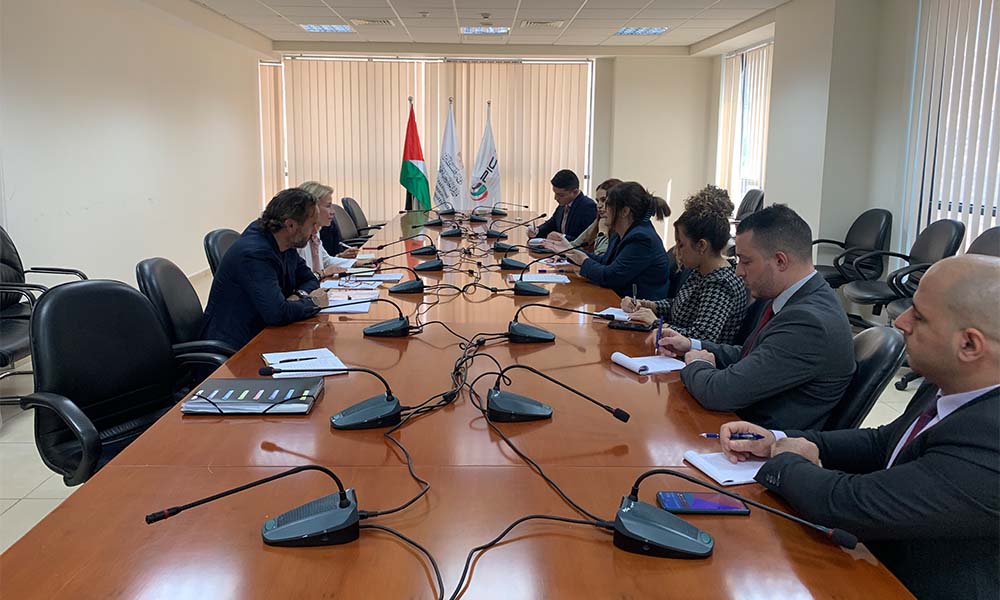
Opening image: Meeting with the Palestinian Authority: State Minister of Foreign Affairs H.E. Dr Varseen Shaheen, Ramallah, 14 September 2024. Credit: OSCE Parliamentary Assembly (CC BY-SA 2.0)