

Jewish Politics & Power is published every other week. Sign up for our newsletter for updates.
1. A White House victory lap
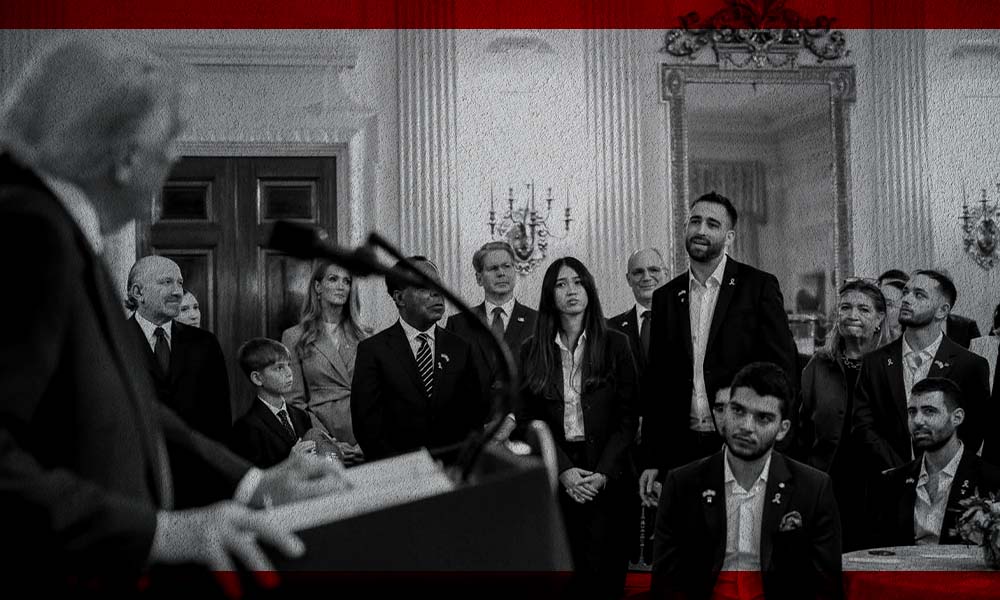
The State Dining Room was already full when President Trump walked in. The audience was made up of 17 recently released Israeli hostages, all visibly uncomfortable in their brand-new suits; nine former hostages who had been released in earlier deals; family members; and top administration officials. “Why is everybody filming?” asked 5-year-old Emma Cunio, who was kidnapped to Gaza with her twin sister and her mother and whose father, David, had just been released in October. Her mother tried to explain that the president of the United States was about to enter. Special envoy Steve Witkoff worked the room, stopping for selfies with the hostages he had helped bring home. Jared Kushner stood at the side of the room, schmoozing with guests.
“You’re not a hostage anymore, today you’re heroes,” Trump told the group in a short address from the podium. He praised their courage and resilience, highlighting some of their stories, including that of Matan Angrest, whom Trump praised for his bravery, describing him as “a living testimony to the toughness, heart and faith of the Jewish people.” The president greeted former hostages Noa Argamani and her boyfriend Avinatan Or, calling them a “beautiful couple.”
For Trump, it was a rare moment of good news in a week dominated by the Jeffrey Epstein files and by tumbling approval ratings. Five weeks after the ceasefire deal he had brokered, the meeting was a great opportunity to remind America and the world of Trump’s most significant achievement since returning to the White House in January. But it’s not only about Trump’s personal achievement. The Gaza deal being celebrated has reached a key crossroad. After the successful completion of the first phase, which included the release of all living hostages and return of the bodies of those deceased (three of whom are yet to be found and returned), a partial withdrawal of IDF forces from the Gaza Strip; and an influx of humanitarian aid, it is now time to launch phase two. This stage, which requires setting up an international stabilization force, launching a “peace committee” to manage Gaza, disarming Hamas and completing Israel’s withdrawal, is much more complicated. Last week, Trump’s team managed to get the UN Security Council to approve a resolution providing an international mandate for these actions. But that’s not enough. Now comes the hard work of turning these promises into reality, work that will require loads of goodwill on the part of Israel and Hamas, a massive mobilization of the international community and, perhaps most importantly, a willingness of Trump administration officials to get their hands dirty and push all sides to make it happen.
Last Thursday’s festive reception at the White House can help recharge the process, reminding all parties—including those within the United States—that there’s still a lot of work to be done to make sure that this plan doesn’t fizzle out and that Trump’s single major foreign policy victory doesn’t end up being a temporary fix.
2. From Gaza tunnels to DC halls of power
Five weeks ago the hostages were still in Hamas tunnels in Gaza. Last week they were on Capitol Hill, at the White House and on the streets of New York. “I couldn’t believe it. I tried to keep my eyes open and not even blink for a second, so I don’t miss anything,” said released hostage Segev Kalfon after the meeting. He handed Trump a letter thanking the president for his work to bring the hostages back home. “In the most difficult moments, when hope faded away, the thought of big America and of your leadership helped me believe that one day, I will be able to leave Hamas captivity. You, Mr. President, were the light for me in the darkest moments in the dark tunnels,” the letter read.
This appeared to be a sentiment shared by all. When Witkoff came up with the idea of flying the newly released hostages to the White House, all enthusiastically approved, seizing on the opportunity to thank Trump personally for their return. They even brought gifts: Released twins Gali and Ziv Berman gave Trump the mezuzah from their home in Kfar Azza which was burnt by Hamas on October 7; Eitan Mor’s gift to the president was a silver dreidel, a symbol of the victory of the Jewish people. Trump gave each of the hostages a presidential challenge coin.
The gratitude to Trump was authentic, not political. Trump had successfully branded the deal as his personal achievement, and Israelis credited him with its success. (More hostages were released during the Biden presidency, but the former president did not try to make the case that it was his own achievement, thus missing out on the opportunity to become a national hero in Israel.)
For the hostages, coming to Washington provided a chance to thank those behind their release, and to show the world how they prevailed after two years of unthinkable suffering.
By doing so they also sent a message, perhaps unintended, to Israelis: They made the journey to Washington to thank Trump for their release, but few of them took the short trip to Jerusalem to thank Netanyahu, who is widely seen as not having played a helpful role in ending their ordeal. For the former hostages, their savior resides in Washington, not in Jerusalem.
3. Trump’s and MBS’s bromance
There were horses and cannons, a military jet flyover, and a star-studded dinner. Trump pulled out all the bells and whistles last week to show his guest, Saudi Crown Prince Mohammed Bin Salman (MBS), that America wants the Middle Eastern kingdom to be its top ally in the region.
Trump played the role of the gracious host. Bin Salman was the rich uncle who came with a bag full of dollars to spend in the United States.
It all worked out perfectly. The series of White House meetings produced the expected results both publicly and privately. On the public level, Trump’s show of support and his over-the-top gestures, including his volunteering to defend MBS when reporters inquired about the Saudi prince’s role in the murder of journalist Jamal Khashoggi, drove home the message that Saudi Arabia is more than just another U.S. partner, it is a top ally. Behind closed doors, these gestures translated into mega-deals: Bin Salman agreed to round up the already huge Saudi commitment of $600 billion in U.S. investments to $1 trillion, and Trump agreed to make Saudi Arabia a “major non-NATO ally,” to sell the kingdom advanced F-35 fighter jets and hundreds of tanks, and to advance civil nuclear energy cooperation between the two countries.
The two leaders simply ignored tough questions that have mired relations between the United States and Saudi Arabia in the past: Trump didn’t press on human rights issues and made only a very general and non-specific ask regarding future normalization between Saudi Arabia and Israel. With those thorny issues out of the way, the path to cooperation is open, with both sides ready to reap its rewards.
4. Did Trump turn his back on Israel?
While Israel was not a party to the talks between the United States and Saudi Arabia, there were a few issues that came up during MBS’s visit to Washington that raised concerns in Jerusalem.
First, the prospects of normalization. Israel’s top priority is having Saudi Arabia join the Abraham Accords. Trump would also like to see that happen. But the visit yielded no more than a very general comment on that subject from Bin Salman, who said, “We want to be part of the Abraham Accords, but we want also to be sure that we secure a clear path to a two-state solution.” Trump, at the Oval Office meeting, responded: “I think I got a positive response,” but in fact it is a very conditional “yes.” In practice, nothing seems to have changed in the Saudi approach: First there needs to be movement toward a two-state solution, and only then will the kingdom move toward normalization.
The second issue has to do with Trump’s willingness to sell Saudi Arabia F-35 fighter jets. For decades, Israel has insisted on maintaining a qualitative military edge (QME) over its neighbors, meaning that Israel expects the United States not to provide other countries in the region with advanced weaponry that might put Israel’s advantage at risk. There’s even a U.S. law that codifies this commitment. The F-35 deal seems to run counter to this American promise and could be a source of concern for Israel, which already has F-35 jets.
Does this mean Israel has lost its years-long battle? Yes and no.


Sure, the deal, if and when it materializes, would erode Israel’s advantage and deal a blow to its attempts to ensure that no other country in the region can challenge Israel militarily. But the Netanyahu government chose not to pick a fight over it, perhaps because Bibi knows he doesn’t have a chance to stand up to Trump, or simply because these are the types of conflicts that are best resolved in private, where Israel can request more advanced weapons for its own needs, or push to limit the Saudi deal.
Still, the words of Trump during his meeting with MBS ring as a game changer: “They’ve been a great ally,” he said of Saudi Arabia. “Israel’s been a great ally, and we’re looking at that exactly right now. But as far as I’m concerned, I think they are both at a level where they should get top of the line.”
5. And then Mamdani used the G word
On Friday, with hundreds of reporters waiting outside, New York City’s mayor-elect Zohran Mamdani made his way to the White House. While many expected fireworks when the two politicians who had spent the past weeks attacking each other finally met, the meeting actually went very well. So well that Trump and Mamdani even seemed friendly, with the president brushing away reporters’ references to Mamdani’s statements calling him a “fascist” and a “despot,” and with the mayor-elect smiling and focusing only on the joint goal to see New York flourish and help deal with the affordability crisis.
A notable moment came when Mamdani was asked by reporters about his claim that Israel has committed genocide in Gaza. “I’ve spoken about the Israeli government committing genocide, and I’ve spoken about our government funding it,” Mamdani replied, before pivoting to the issue of how New Yorkers’ taxpayer dollars should go to their own purposes. There’s nothing new with Mamdani’s approach, but supporters of Israel might have expected Trump to say something on the issue. The president, however, remained silent and did not intervene, interject or comment on the use of the term “genocide” relating to Israel.
It’s not a policy issue. Trump has repeatedly expressed his support for Israel’s actions in Gaza, even when calling for an end to the war. However, it’s a matter of public perception. Once the accusation of genocide is made in the Oval Office without any rebuttal, it gains a certain measure of legitimacy, which is exactly what supporters of Israel have been trying to prevent.
Top image Credit: The White House via Instagram