
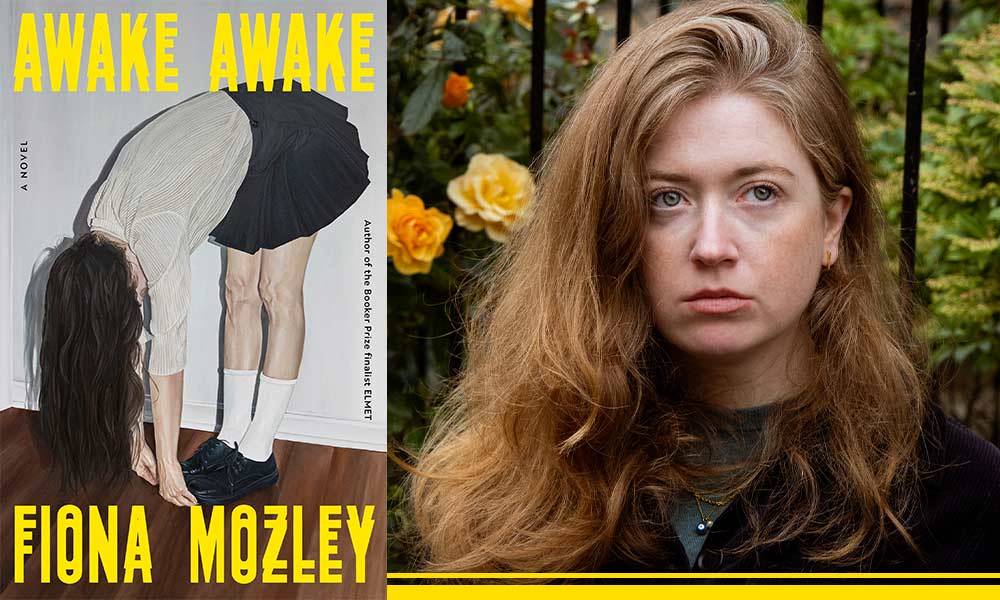
“Maybe we should pour every effort into remembering every horror of the past,” Mary, the narrator of Fiona Mozley’s cheeky and propulsive new novel, Awake Awake, thinks. “Then again, maybe we should try hard to forget.”
This indecisive reflection mirrors a split self, one that is fully operative but not quite existing in reality. Mary’s diagnosis doesn’t quite have a name, and even she is blunt about its slipperiness, but its symptoms include believing that your Jewish grandfather was the one to secretly assassinate Hitler. Mary knows the historical record doesn’t confirm this, but, of course, that’s just proof that the British government is covering this fact of history up. She was told all of this at a literary event a few years ago, cornered by two arrogant men who bestowed this newfound history on her. It’s entirely possible, too, that she hallucinated them, but Mary and her brother, Jos, start to give in to the delusions, warning friends their phones are bugged. One day, a friend phones her to say that this elaborate fabrication was just the plot of a Curb Your Enthusiasm episode. “Mary,” he tells her, “your psychosis was triggered by Larry fucking David.”
Nevertheless, her belief persists. Sitting down with a therapist to mine her memory and explore her coming-of-age in a tense geopolitical moment—her teenage friend group at a crossroads over the Iraq War and the plight of the Kurds—Mary, now 30, begins the detective work of unraveling a family narrative that may or may not be real. She feels disconnected from her Jewish side and writes as a way of getting to a truth about herself. The same could be said of Fiona Mozley herself.
She was born in East London, then raised in York, and studied history at Cambridge before briefly moving to Buenos Aires. Awake Awake brims with questions about how we dissect and interpret the past, without the additional stickiness that events like the Holocaust can extract. Containing the slyness of her previous novels, the Man Booker Prize-nominated Elmet (2017) and Hot Stew (2021), but with a psychoanalytic metafiction, Awake Awake is a tense alternate history about a mind that, at its core, is at odds with itself.
Moment chatted with Mozley about psychosis, the trouble with origin stories and the creative process’s “controlled hallucinations.”
I found your novel wonderfully Freudian. You write about memories, global politics and the construction of a mind whose foundations are questionable. When did you start thinking about these ideas?
I wrote various versions of novels, but the things I kept coming back to were one I wanted to write about the early 2000s, and one that was a counterfactual of my granddad’s World War II experiences. These two things wouldn’t shift. The novel about the early 2000s would examine that era politically, the Iraq War protests, the post-9/11 era, through the lens of a small town in England, which happens to be my hometown, York. I realized I was writing about the influence collective memory and shared understanding of history—inaccurate or accurate—would have on contemporary discourse, like World War II on the Iraq War, certainly in this country. Then-Prime Minister Tony Blair, again and again, talked about not wanting to appease Saddam Hussein. In British political discussions, the idea of being a Neville Chamberlain and appeasing a threatening dictator is the worst thing you can be. Everybody wants to be Churchill, nobody wants to be Chamberlain.
At the root of this psychosis is a deep-seated wish, partly about revenge and connecting her to her grandfather.
Having a novel’s narrator transparently question her own memory is a squirmy, mischievous strategy. This makes everything she details afterward come with scrutiny—was this intentional?
Yeah, I’ve always been drawn to unreliable narrators, and Mary is pretty up-front in her unreliability. She doesn’t know what to believe and what not to believe—she describes herself as being split in two. She has memories of being told, at a literary event, these outlandish things concerning her grandfather. The part of her that exists in the real world, with her friends and the people around her, can appreciate the absurdity. These memories don’t correspond to what we know about history. But the other side wants to believe this conspiracy; there’s a grandiosity about them there’s an emotional charge that’s so enticing to her that she can’t quite let go of them. She exists in the everyday world, and she also has this parallel experience where she thinks her granddad airdropped into Berlin and killed Hitler. The novel she’s writing is somewhere in between the two.
Her brother, Jos, is affected more severely by psychosis—he has visions of Nazis and bugged laptops. Why did you want to differentiate their two experiences?
Jos’s experience is much more typical of psychosis or schizophrenia, whereas Mary’s is tied to memories, rather than hallucinations. I didn’t want it to be clear-cut for the reader. I wanted to be a bit tricksy with them. With Mary’s, it’s more of a literary device, where I could play with memory. Mary describes herself as a high-functioning lunatic. She’s not very kind to herself, describing her condition.
I thought it was interesting that, in a conversation with her therapist, Mary mentions that the men who said her grandfather killed Hitler are like her “guardian angels.” Why do you think she relies on them perhaps more than on her internal memories?
They’re telling her something she wants to hear. At the root of this psychosis is a deep-seated wish, partly about revenge and connecting her to her grandfather. But she’s also the passive member of her friend group. Her other friends are very politically engaged, they get up and do things. Mary consistently tells us she doesn’t really care about anything. I wanted to present her as what might be described as the worst possible person in the 21st century—someone apathetic who just doesn’t care about politics. Underneath that, there’s a deep desire to be connected to the world in the way her friends are, and to situate herself in this narrative, situate herself somewhere within history.
I find that I’m always looking for advice on how to live, so I thought it could be the same for Mary. If someone sat me down and said, “Here is the truth about your life,” I’d take it and run, too.
And one of the characters, Eric, describes something that happened to him and Mary as teenagers. Mary scoffs, says that he thinks he’s giving us his origin story. He thinks this is the key that unlocks who he is. She doesn’t believe there’s any such thing, one answer to any given question. But in her memory life, there’s this really neat answer. She has all these unanswered questions about her granddad, mysterious things that were never told to her. These figures have come along and told her the answer, one that wraps things up in a really neat way. She knows to be suspicious of that, since she knows that’s not how the world works, but it’s very inviting, this all-encompassing solution. It removes the pain of not knowing, of complexity, of historical narrative that feels chaotic or random.
There’s certainly a tension in not knowing your own history and, to avoid the confusion, repressing that trauma.
She’s just thinking of putting it to the side. She’s specifically responding to the obsession of her parents’ generation—the boomer generation, very understandably, remains intensely fascinated by the Second World War. Mary’s questioning whether that’s entirely healthy. Maybe she’s going a bit far when she says to just forget it. She’s grown up with parents who have read all the books, constantly bringing conversations back to World War II. I don’t know if that rings true for your parents?
My mother’s Jewish, and my father’s Catholic, so we’re pretty secular. Remember the past, but it’s not the biggest thing.
Yeah, similarly, my dad’s Catholic, and I was raised Catholic, and the connection to my mum’s Jewish side is a bit complex. It wasn’t really even from a Jewish perspective that it was talked about. Maybe it’s a British thing. That generation’s parents were living through the Blitz, they were very involved.


Mary is taking this so seriously, and then she finds out that there was a Curb Your Enthusiasm plot about someone’s grandfather killing Hitler. I love that something so monumental can be triggered by an absolute joke.
Yeah, it was something Larry David said about Hitler being killed by a British Jewish army officer. And something in her brain goes, “Wait, my grandfather was a British Jewish army officer. He was there around that time.” Her friend Eric finds this absolutely ridiculous. Her friends aren’t that nice to her about what she’s experiencing. It’s tough love.
It reminded me of Ottessa Moshfegh’s Death in Her Hands. The narrator is trying to piece together a murder mystery, so she makes up this entire story, when the author would have done that anyway.
Yeah, it’s like a novelist within a novel. It’s playing with autofiction by having some similarities to me and my life and being totally outlandish and off-the-wall in others. It’s drawing the links between the controlled hallucinations that are part of the creative process and the uncontrolled memories that Mary’s experiencing.
(Top image credit: Aleksandra Maciejewska)