
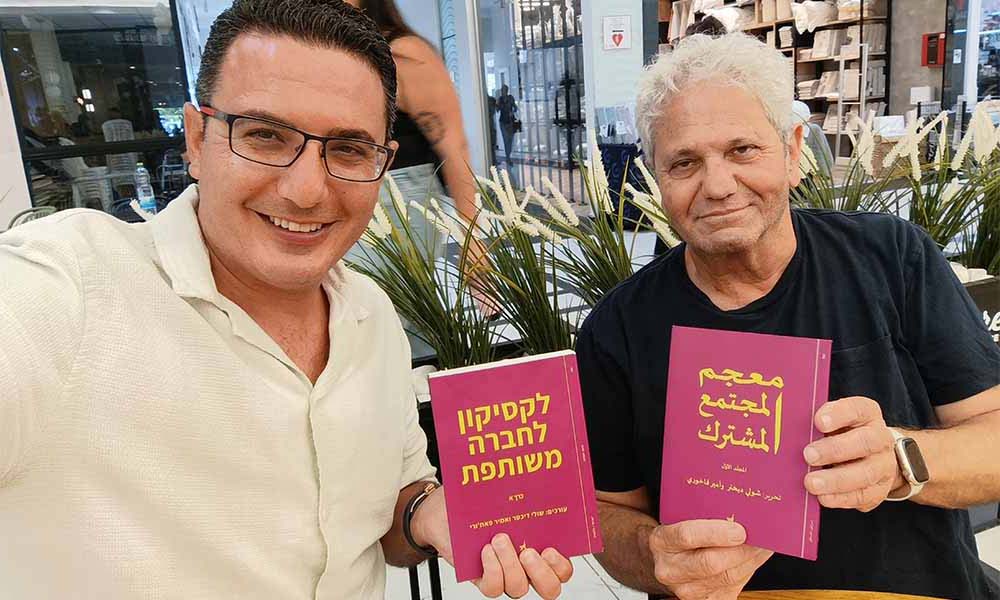
Even Jewish and Palestinian citizens of Israel who are willing to try to build bridges between their two communities often find that not only do they speak two different languages—Hebrew and Arabic—but the ways in which they understand, in either language, crucially important terms and concepts are totally different.
Shuli Dichter, 71, an Israeli Jewish educator and longtime civil society activist, and Dr. Ameer Fakhoury, 40, a Palestinian citizen of Israel legal scholar and sociologist, saw an opportunity to overcome this gap. The two teamed up to write, in both Hebrew and Arabic, the nearly 400-page Shared Society Lexicon. (In Hebrew its title is: לקסיקון לחברה משותפת. In Arabic it is: معجم لمجتمع المشترك, both of which are the same in English.) The first volume (Dichter and Fakhoury are planning to put out three and hope to find funding for an English translation) was published in late August, containing 31 terms and concepts relating to shared society in Israel-Palestine.
Even the term, “shared society,” is a relatively new concept in use among civil society groups. In a shared society, Fakhoury explains, “each side has a strong identity, has the right to national self-determination and is entitled to write its own national story.” Dichter offers a metaphor comparing shared society to an apartment building; each unit is occupied by a family and these families have different backgrounds, beliefs, customs, and so forth. These families can interact in different ways. They can have no interaction and attempt to live completely separate lives. Or they can be suspicious of each other and interact only when they have to. Or, he continues, “the different families can see that their distinctiveness and difference from each other is actually a blessing. They can maintain their own identities and still learn from each other and create shared spaces that benefit everyone.”
But for this to happen, Dichter and Fakhoury believe, the families also have to have a common language and a common set of terms and concepts that everyone understands. “We need to find the ‘architecture’ to build this building,” Dichter explains.
“A shared society means more than just day-to-day life. We are looking for a way to intertwine our identities, based on our commonalities and our differences.”
The Lexicon is neither traditional dictionary nor encyclopedia. Dichter and Fakhoury refer to it as a “political-linguistic project” and believe it is the first of its kind in the field of conflict resolution. Each entry was written by a team of Israeli Jewish and Palestinian citizens, and relates, among other issues, to the histories, current usages, and controversies. Entries include terms and concepts such as “coexistence,” “economic peace,” “active citizenship,” “bilingual education,” “land,” “1948,” “Jewish and Democratic [State],” and many more.
The entries are brief, each about 350 words with additional references. The entry on “1948,” for example, opens by stating that for Jews in Israel and the Zionist movement throughout the world, 1948 is the year of Israel’s independence, but Palestinians and their supporters rarely use the date; rather, they say the Naqba (in Arabic: النَّكْبَة), meaning “the great catastrophe”. The Jews celebrate their political return to their land after two thousand years of exile, while the Palestinians mourn the destruction of 418 Palestinian villages and towns, the expulsion of 700,000 Palestinians from their homes and the failure of their own national movement. The authors further note that until the 1990s, this discrepancy was rarely discussed in meetings between Jews and Palestinians. Jews tended to assume that results of the war were taken for granted, and Palestinians had yet to recover from mourning and assert their own ideas. Over the past few decades, a new discourse has developed and the disparate narratives have taken center place in many organizations. But, the writers conclude, the activists have yet to use this new discourse to create a new form of politics that could lead to reconciliation, especially among the Palestinians who are not citizens of Israel and live outside the formal boundaries of the State.
The entry for “coexistence” (Hebrew: דו-קיום; Arabic: التعايش) digs into the dilemma the word raises. As both a term and a concept, the writers explain, “coexistence” was previously used only when describing the relationships between Jewish and Palestinian citizens within Israel; tensions between all other groups, such as interreligious, class, or ideological differences, are described by a variety of other terms, indicating that the relationships between Palestinian and Jewish citizens are different from all other groups in Israeli society. But as awareness grew of the unequal power relations between Jews and Palestinians, “coexistence,” some claimed, was “the coexistence that exists between a horse (the Palestinians) and its rider (the Jews)” and was actually a way to maintain that inequality. The term fell into disrepute. And yet, paradoxically, the writers continue, although the term was abandoned because of what it came to mean, if understood, applied and implemented differently, it could actually represent the binational character of shared society in Israel.
The topics and concepts have been selected because of their relevance to Israeli-Palestinian context and might not make sense in other countries. For instance, Fakhoury notes, the authors and contributors chose to refer to Arabs who live in Israel who hold Israeli citizenship as “Palestinians within Israeli citizenship.” Israeli citizenship, he explains, “is a legal status that distinguishes between those who live within the formal boundaries of Israel, who do have citizenship, and those who live outside of those boundaries, who do not. But that does not reflect the sense and identity of most Palestinians who live within Israel, who see themselves as deeply connected to Palestinians who live outside of Israel’s borders. As a Palestinian in Israel, I am part of a minority here because of the European powers who redrew our maps, and, later, because of the wars between our peoples. But my family has always lived in the same place. The border crossed over me, I didn’t move across the border.”

Dichter and Fakhoury hope that the book will become an essential tool among the many NGOs, including social and dialogue groups and bilingual schools. These groups, Fakhoury emphasizes, are already serving “as resistance against the depressed resignation pervading Israel and bringing hope that a better future is possible.”
Many Israelis and Palestinians already live “shared lives,” Fakhoury says, “but I hope that the Lexicon will help them to move forward towards a ‘shared society.’” The difference is that “‘Shared life’ is made up of micro-interactions,” he explains. “These are the ways we, Jews and Palestinians in Israel, meet in our everyday interactions—in stores, medical clinics, on the streets, on public transportation,” he says. These interactions have helped us to maintain a peaceful atmosphere within Israel despite the horrible events of the past two years. But a shared society means more than just day-to-day life. We are looking for a way to intertwine our identities, based on our commonalities and our differences.”
As part of their vision, Dichter and Fakhoury also hope that they will expand their ideas to establish a new, interdisciplinary academic field. In this regard, the Lexicon is already being used in several academic settings. For example, Dr. Yoav Kapshuk, head of the Multidisciplinary Studies Department at the Kinneret College at the Sea of Galilee, is using the Lexicon in a research seminar in which the majority of the students are Palestinians.
Dichter acknowledges that the activists reading and using the Lexicon are already committed to the ideas it presents. “In a way,” he concludes, “you could say we are preaching to the choir. But someday that choir will lead us to a better future, and in the meanwhile, we are providing the people who do the work of building a shared society the means to do their work even better.”
(Top image credit: Dr. Ameer Fakhoury and Shuli Dichter)