
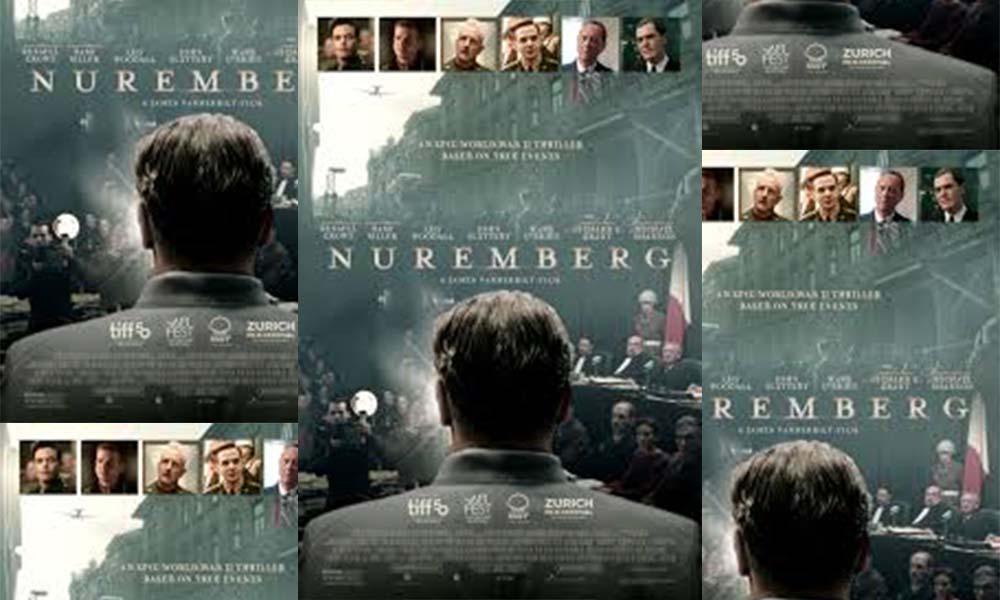
As the smoke was beginning to clear in Europe from the wreckage and devastation of World War II, the allied victors of America, France, England and the Soviet Union agreed to try something radical. They held an international joint tribunal, charging several Nazi officials and members of Hitler’s high command with crimes against humanity. In a groundbreaking legal verdict, they were found guilty and hanged for crimes against humanity. While it may seem like settled history now, it was a risk without a guaranteed victory. The new film Nuremberg, which opened in theaters November 7 and which I recently saw play at the 34th Philadelphia Film Festival, plunges us back into that uncertainty. And it comes at a time when the moral conclusions of history may be more tenuous than we thought, when hate is more and more normalized. (How did we get back here?)
The film opens in 1945 with a long march of war refugees, in search of a place out of the rubble, accompanied by a brigade of American soldiers. The dust is starting to settle on the war. Adolf Hitler, Joseph Goebbels and Heinrich Himmler are all dead. Suddenly, a car with Nazi flags and insignias starts driving toward the soldiers. To their shock, it is Hermann Göring (Russell Crowe), Hitler’s second in command and the Nazi “Reischmarschall.” He is fleeing Germany with his family, but he does not seem too surprised to be caught. Unlike his leader and his colleagues, he has not taken a way out via cyanide pill. He curiously presents as confident and unafraid. While Göring’s military service may be over, it seems like he is already planning another chapter.
Filmgoers feel not so much fear but bafflement at just how delusional and detached from reality that demagoguery and hate can make someone.
Rami Malek (Bohemian Rhapsody) co-stars as Douglas Kelley, the army psychiatrist tasked with determining Göring’s psychological fitness to stand trial, as well as that of his subordinates Rudolf Hess, Julius Streicher and Karl Dönitz. Kelley’s main focus soon becomes Göring.
Kelley quickly and easily diagnoses Göring as a narcissist. He is highly manipulative, with an unquenchable thirst for power and a belief in his inherent right to have power over others. It is not, however, Kelley’s job to prosecute him. That falls to Robert H. Jackson (Michael Shannon), at the time an associate justice of the U.S. Supreme Court.
Göring denies knowledge of the concentration camps and believes the Nazis were entitled to land grabs in Poland based on the theory that they were once a part of Germany. He showcases a cunning ability to deny everything then turn the tables back on his opponents. Kelley shares grave doubts about whether Jackson should let Göring take the stand and give him perhaps his biggest megaphone yet. Jackson, however, believes that the best way to prevent something like the Holocaust from happening again is to have Göring explain himself to a hopefully appalled human race. But could Göring’s powerful skills of manipulation manage to further infect humanity, even if in small but potent corners? This has echoes of today, with high-profile debates about platforming known white supremacists, antisemites and hatemongers on social media, podcasts and in the news. We reflect on an ideology we thought was vanquished, that feels new again in an unwelcoming fashion.
Jewish points of view are largely absent from Nuremberg, despite a scene where a character’s hidden Judaism comes to the fore. But there are some revealing moments when members of the Nazi high command are given actual Rorschach tests. In their interpretations, they show a delusional, pathological hatred of the Jewish people. The filmgoer watches their reactions and feels not so much fear but bafflement at just how delusional and detached from reality that demagoguery and hate can make someone.
Nuremberg is the type of story that deserves to be told and retold, so that future generations will know the history. This is the kind of movie that used to play in multiplexes all the time. A movie for adults. A period piece with modest aspirations. Some would call it middlebrow. Yet the movie feels almost too familiar, an overly “talky” drama with predictable emotional beats, even wandering into the territory of storytelling clichés.
For example, Kelley quickly becomes a little too friendly with Göring, which means either that Kelley is not a particularly skilled psychiatrist or Göring is just too good at being manipulative (perhaps both things are true). Considering the history, it feels a bit stomach-turning to see writer/director James Vanderbilt (who adapted the screenplay from the 2013 book The Nazi and the Psychiatrist by Jack El-Hai) lean into Göring as a sort of secondary protagonist. Films like Silence Of The Lambs come to mind, as their relationship bears similarities to the one between Clarice Starling (Jodie Foster) and the crazed serial killer Dr. Hannibal Lecter (Anthony Hopkins). Yet in The Silence of the Lambs, director Jonathan Demme never lets you forget who Lecter is. The extent to which he is humanized is chilling, not so much normalized as Vanderbilt does with Göring. When Kelley even seems to strike up a friendship with Göring’s wife and daughter, I must say I rolled my eyes a bit.
Russell Crowe gives a strong performance, having embraced his later career shift from leading man towards husky villain roles. The familiarity the viewer has with Crowe feels disarming, underlining Göring’s ease with manipulation. For his part, Rami Malek jumps into the role of the psychiatrist with both feet, but he jumps too hard. Malek may be an Oscar winner, but here, his acting is simply too much for the screen, the kind of scenery chewing more suited to the stage.
Even if the movie falls short in some of the ways I’ve noted, it still feels like an important story to revisit today. I would rather have five more of these cinematic history lessons every year than an 11th installment of Fast & Furious.


One thought on “Film Review | ‘Nuremberg’ Reexamines Essential History with Mixed Results”
I agree with your assessment of the film Nuremberg. Rami Malek almost spoiled it for me. He was the wrong choice for such a potentially juicy role. Is it his age ? or acting skill that made him fail? There were others who fell short but yes, Russell Crowe and the prosecutors at the end saved the day by being believable. Can we send this movie to ALL citizens college age and above so they know what can and really did happen ? Some of them never knew and some didn’t believe and some didn’t care. I think of a different movie scene where a woman is hanging out her wash while children play on a swing set and the crematorium (a field away) is belching smoke from the burning of bodies.