
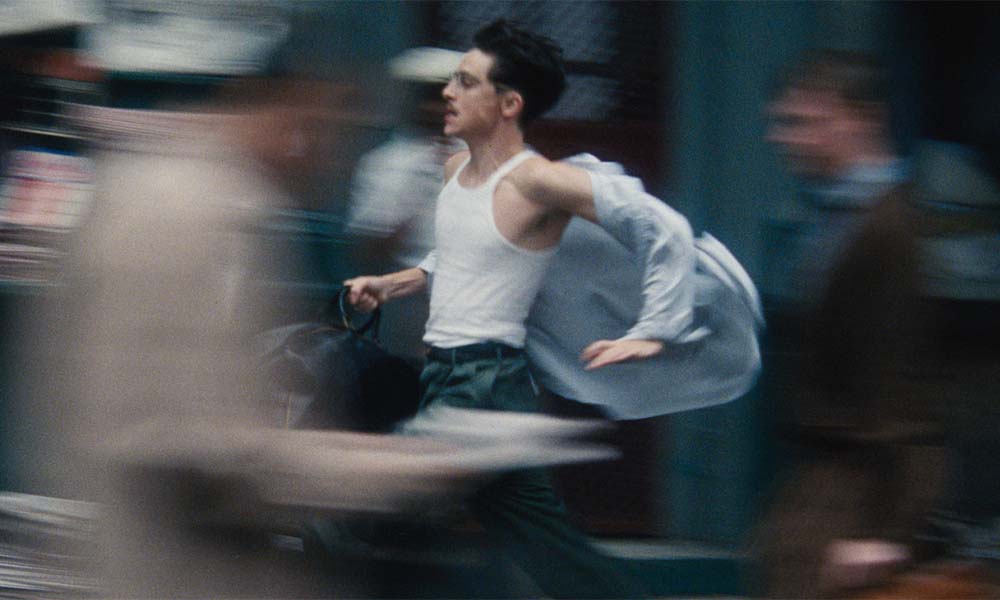
2025 has been, against all odds and preconceived notions to what constitutes a “sport,” a big year for ping-pong. Last fall, E.Y. Zhao’s propulsive debut novel, Underspin, followed one pro through the world of competitive table tennis, and now, Marty Supreme, A24’s newest film helmed by Josh Safdie and starring Timothée Chalamet, loosely narrates the life of ping-pong champion Marty Reisman. That’s two more dramas than I would expect to come out of the game this year.
Mauser is a smart-aleck, wise-guy, shmuck, hero, villain and king, often in one scene alone.
With the exception of his breakout role in Call Me By Your Name, Chalamet has been, for me, a little hard to see past. As a teen cannibal in Bones and All or an enigmatic chocolatier in Wonka, his “transformation” into any role has been a little flimsy. (Admittedly, I didn’t see the Dylan biopic.) “That’s Timothée Chalamet,” I always find myself thinking, instead of whatever character he’s trying to embody. Maybe it’s his ubiquity, maybe it’s his quick-trigger delivery, but, for me, his visage pokes through.
Despite his now Golden Globe-winning performance, that was the case for the first ten minutes of Marty Supreme, where he plays the role of Marty Mauser, a Jewish kid in 1950s New York who’s working as a shoe salesman while training to become a ping-pong world champion. Surrounded by his sexual partner Rachel (Odessa A’zion) and jilted coworker Lloyd (Ralph Colucci), whose bawdy New York accents roll off the tongue, Chalamet wavers at first. But he quickly gets into a groove.
[Read: “The Beautiful Why of Timothée Chalamet about his family’s showbiz roots.]
Written by Ronald Bronstein and Safdie, Marty Supreme is a tale of mid-century Jewish hustle, scrappiness, nerve and charisma via quick pacing and adventurous cinematography. Mauser is a smart-aleck, wise-guy, shmuck, hero, villain and king, often in one scene alone, and can sweet-talk his way out of any situation, whether it be hooking up with a movie star, haggling for money or turning a whole crowd of Japanese spectators into his personal cheerleaders. When journalists ask about Bela Kletzki (Géza Röhrig), the former world champ he’s about to face off in the semifinals, Mauser says he’s “gonna do to Kletzki what Auschwitz couldn’t—finish the job.” The journalists balk. “I’m Jewish, I can say that,” Mauser adds. After a while, you start to believe in his power yourself.
“I am uniquely positioned to become the face of this game,” Mauser says early on, and he plays with the brattiness of Nick Kyrgios and the sprightliness of Danil Medvedev, tennis stars who similarly rile the crowd. Marty’s matches aren’t only sport, they’re spectacle; at one point, he whispers in Kletzki’s ear to have a fun one—they put on a rollicking show before the men hug. True to his word, he’s one of the best, and believes wholeheartedly that his talent is a gift and a burden. As he leaves Rachel to compete in Tokyo’s world championships, he tells her, quite bluntly, that her days are filled with nothing, she doesn’t stand for anything, implying that he’s never once wondered about her worldview, feelings or ambitions (if she even has any). She’s just a pet store clerk with an emotionally abusive husband. He, on the other hand, plays ping-pong. Watch where you’re walking, he says in so many words, I’m destined for greatness over here!
Isn’t it a beautiful thing to believe that about yourself? That you were put on the planet for a purpose and that you’ll do whatever it takes to get there, brushing aside the lowlifes, including your parents, partners (romantic or business) who just don’t get it? Mauser’s debts and schemes and slights and scams are all inevitable because there’s nothing else that’s worth doing.
But the film deals in the humiliations that come with relentlessly pursuing a goal. Any successful podcaster first had to beg for likes from their friends. Any world-famous actor had to send off an audition reel for some unknown person to analyze. Any best-selling writer had to ask their family what they thought of a few choppy, embarrassing sentences. After Mauser fails in one tournament, he tours with the Harlem Globetrotters, performing kitschy table-tennis with Kletzki in their halftime show, including hunched over a miniscule table or pretending to lose against a seal. He is, essentially, a circus clown.
Marty Supreme dresses up all these emotional stakes in propulsive, often marvelous screenwriting. Mauser can mostly get himself out of any situation, but it’s still fun to see him squirm. He charms a bygone movie star, Kay Stone (Gwyneth Paltrow) solely over the phone, telling her about his big match happening that night. “I’ll leave a ticket for you at the box office,” he says, then hangs up (she shows up). He has a brief business alliance with Milton Rockwell, a pen manufacturer played by Kevin O’Leary, who is only slightly more fascistic and controlling here than he is on Shark Tank. Marty hustles a group of ping-pongers, playing the asshole who beats down-on-his luck Wally (Tyler Okonma, the rapper known as Tyler, the Creator), his friend who pretends to have been beaten up during a racial hate crime while driving a taxi. “Don’t be greedy, you fucking Jew,” Wally later tells Mauser, who demands his money ($7.50) back after his bathtub crashes through the floor of a seedy hotel. When they’re recounting their winnings from the scheme, Mauser persuades Wally to hand over his share, promising him ten times that amount after he returns from the upcoming national tournament in Tokyo, hopefully a winner and a global star.


As much as it’s about the depravities and beauty of ambition, Marty Supreme is also sort of a love story and sort of a play on the hero’s journey—if a hero were to take people’s money, steal their dogs, and blow up their own life while hedging a bet on a dinky sport. The magic of Mauser is that each of his ideas seem not only believable but urgent. Safdie’s quick, adrenaline-packed pace renders each decision primal and justifiable; of course he has to get spanked on the ass with a paddle during a glitzy party by the man whose wife he’s having an affair with—he’s going to be the best table tennis player in the world. And when you’re tasked with that, isn’t it your duty to follow it through?
(This post was updated on Jan. 12 due to Chalamet’s Golden Globe win.)
(Top image credit: A24)
5 thoughts on “Film Review | The Depravity of Ambition in ‘Marty Supreme’”
Sounds horrible. Another violent, vulgar blockbuster full of stereotypes of repulsive Jews. That line about Auschwitz: no, even if you’re Jewish, you can’t say that. Anyway people didn’t talk like that in the 1950’s. But that’s the trouble with Hollywood movies: they waste millions of dollars on “authentic” apparel, buildings and furniture, while the scripts are anachronistic insults to one’s intelligence. I’d rather stare at the wall for 90 minutes than watch this movie. Maybe I’d get some good ideas.
Loved the pace of the film…really captures and holds your attention. I had sort of a love-hate relationship with Chalemet’s character.
Absolutely great review, makes me want to see it ASAP. Love the writing.
After watching the “bit too long” Marty Supreme and finding it compelling and well-acted,
I think the yiddish term “Shlemazel” applies the best to “Marty” in his role as “Marty Supreme’
For those not familiar with the term it literally means “without luck”.
I vote for “see it” ! The story line is original and well written – and acted”!
Quick pace, yes, angry movie, yes, a bit dark, yes. Best role for Chalamet? maybe. He trained for the game for 7 years, but he was a better Bob Dillan.