
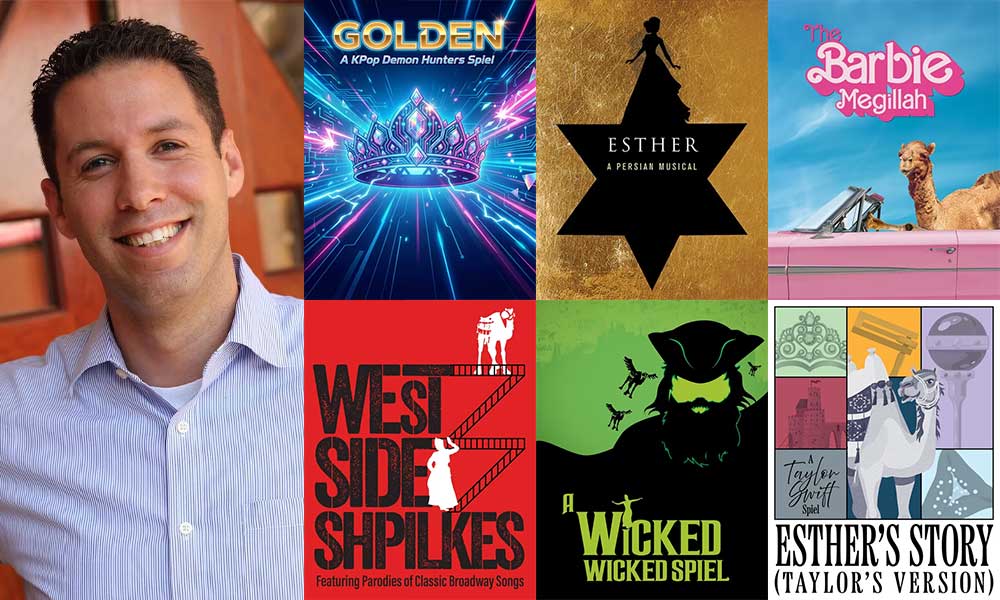
For some, the commandment to be joyous on Purim is fulfilled through food and drink (the Talmud instructs us to imbibe until we do not know the difference between “Cursed be Haman” and “Blessed be Mordecai), but for others joy comes through singing in your synagogue’s rec room in front of your friends and neighbors while wearing a plastic crown from Party City. The Purim spiel is a time-honored tradition in many Jewish congregations. Spiels (meaning ‘plays’ in Yiddish) are parody plays put on during the holiday of Purim as one way to fulfill the commandment to be merry. Their roots can be traced to the 1500s and the plays are often a retelling of the Esther story through song and verse. Nowadays they are often riffs on popular movies or musicals. Those who don’t have the musical chops or the time to write a hit play turn to Jamie Marx, a cantor at Temple Sholom, a Reform synagogue in the Philadelphia suburb of Broomall. Known as “The Spiel Guy,” Marx sells ready-made Purim spiel packages—over 150 this year—to congregations and Jewish groups around the world to adapt for their annual Purim spiels. Marx offers over three dozen spiels with titles such as The Megillah of Oz or West Side Shpilkes. Moment speaks with Marx about how he started writing parodies, what makes a good Purim spiel and why Mamma Mia! is a perennial spiel favorite.
How did you get into the Purim spiel business?
Back in 2016 a lot of my cantorial colleagues were asking around if anyone had written a Hamilton-themed Purim spiel. At that point, I’d never written a Purim spiel, but I’d written a lot of parodies in my life—including a parody of Man in the Mirror when I was eight. At my wife’s suggestion, I asked around if anyone would be interested in my writing one, and a couple dozen colleagues said they’d be thrilled. “Great,” I said, “it’ll be available December 1!” And then I thought, “Oh no, now I have to write it.” I spent the next couple of months writing this Hamilton Purim spiel, and it turned into a pretty big success. And each year I would write a new one and it sort of grew into this thing where eventually we formed a company which has really taken off.
Who uses your spiels?
Truly, they come from all denominations, synagogues, schools, JCCs, even some people who aren’t part of formal communities that buy some of my stuff.
I had always assumed spiels were written by those who performed them…
Historically, you’re right. Every congregation is expected to do a spiel, and these days basically everyone is expected to do a full parody musical. It’s an insane amount of work. Cantors and rabbis and lay leaders kind of get told, ‘Okay, you’re funny. Write a 45-minute to an hour-long thing, and make it great.’ And for the people who are into that, great. But for those people who are like, ‘Oh my god, this is so much work and not my wheelhouse,’ the whole point of what I do is to make it easy on them. I’m trying to give them everything they need so they can just sit down, get a cast, have a wonderful Purim experience with their community and then move on.
We can have a Megillah reading, we can put hamantaschen out, but if there’s no Purim spiel it doesn’t feel like Purim.
What’s your process like? When do you start thinking about what the spiel’s theme should be?
I rely on a couple of things. One, I get emails from people asking about specific themes. I think I got more emails this year about KPop Demon Hunters than I’ve ever received about a theme ever. I also have a running list of ideas. There are some evergreen themes that are always popular. I was surprised to discover that Mamma Mia! is a very consistent seller every year. It’s not particularly new, but it’s music everyone knows and loves, and it’s easy to do costumes for the 1970s. Sometimes there’s a big movie coming up, and I know that’s what my customers are going to want, and so I try to give them what they want.
When do you start writing it? Are you thinking now about next year?
I am already thinking about it. However, most of my writing starts at the end of the summer and goes through the fall. I’ve learned that December and January are usually the months when everyone buys Purim spiels, and so I try to have everything ready. Usually, November 1 is what I aim for. And it takes me a month or sometimes two from start to finish—from sitting down to write my first lines of a parody, all the way through having a polished package product up on my website and marketing ready to go.
What’s the recipe for a good spiel?
The most important thing is a really funny parody. I write everything based around the music. One of the great joys I find in writing Purim spiels is that each one is a midrash on the story. The Bible only gives us the details that we absolutely need in order to understand what’s happening. But the questions around the emotional underpinnings on any given moment in the Esther story, that’s where the fun is—is Esther excited to be queen? Is she angry about being forced to the palace? Is she indifferent to it? I try to have something that surprises people, a little twist, a little angle on a character that maybe shines a new light. So in my Wizard of Oz Purim spiel, I modeled Haman on the Cowardly Lion. It was sort of a funny thing to have Haman, who is the big evil villain, but in the storyline, it’s just that he’s always scared of things, and so he has trouble standing up. And that’s why he’s evil, right? It’s because his insecurity is coming out and he has to punish people for his own feelings of insecurity, which makes for some funny moments, right? After all, we all know how it ends.


What do you think the value of a spiel is for a community?
It is the most unique way to engage in Jewish communal life. When you think about all the ways one can do “Jewish things”—hosting a seder, lighting Hanukkah candles, going to Rosh Hashanah services, sending your kids to religious school, doing Torah study, etc.—those are all seemingly very traditional, kind of standard sort of Jewish things you might do. But to tell someone, ‘Hey, why don’t you sing a silly song and put on a costume and be wacky’—that’s a different way to connect to Jewish life. And even more than that, you’re going to reach people who maybe aren’t sure about their own theology, or don’t believe in God, or didn’t grow up with a lot of rituals or wanting to go to synagogue, and yet they can find this way into Jewish observance in a way that’s different and meaningful to them. And I tell my cast every year, if we don’t have you here putting the show on, we don’t have a Purim. We can have a Megillah reading. We can put hamantaschen out, but if there’s no Purim spiel it doesn’t feel like Purim. Plus it’s something you do as a community—you can go home and light your own Hanukkah candles. You can have a seder for one or two or five or 30, you can pray Rosh Hashanah morning services by yourself, if you really want to, but you’ve got to have a group to put on a Purim spiel. And that is something really special.
One thought on “Every Purim Spiel Is a Midrash”
This piece beautifully connects Purim spiel and Midrash, showcasing how storytelling evolves within communities. I’m curious—how do you see contemporary interpretations influencing future traditions? Also, have any insights from Space Waves inspired your view on narrative in cultural context?