
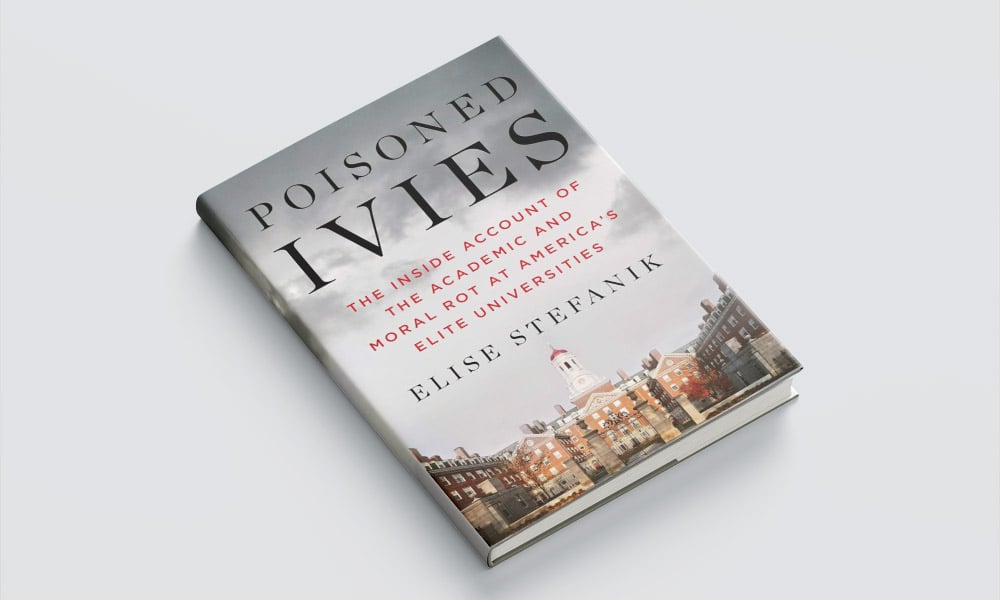
Poisoned Ivies: The Inside Account of the Academic and Moral Rot at America’s Elite Universities.
By Elise Stefanik
Threshold Editions. 241 pp.
Is it good for the Jews if non-Jews join them in fighting antisemitism?
The right answer would seem to be “Yes.” It was good when popes became less hostile to Jews. Also when Christians of other denominations began to denounce antisemitism. And it completely clanged the bell for many Jews when Mousab Yousef, the son of Hamas co-founder Sheik Hassan Yousef, sprang forth as a longtime Shin Bet mole on the side of Israelis. Winning allies in the battle against antisemitism doesn’t seem “to depend on context.”
But then there’s the case of Elise Stefanik.
Stefanik’s first book, Poisoned Ivies: The Inside Account of the Academic Rot at America’s Elite Universities, establishes her as an author, a good thing for her given that she’s about to lose her last official position in Trumpworld.
As the five-term Republican Congresswoman from New York’s 21st District, Stefanik has announced that she won’t run for reelection. Formerly President Trump’s short-lived nominee to be United States ambassador to the UN, and then a short-lived Republican candidate for New York governor, she remains best known for her brief star turn as the aggressive questioner, during a congressional hearing, of the presidents of Harvard, Penn and MIT—two of whom subsequently lost their jobs.
Even warriors against antisemitism might not want her as an ally.
What Stefanik does retain from her time in the limelight—and if you’re not familiar with this, don’t worry, she’ll remind you of it a hundred times in Poisoned Ivies—is what she sees as credit for “The Hearing Heard Around the World,” one that “reset the course of American higher education” and garnered “multiple billions of views.” At that December 5, 2023 hearing of the House Committee on Education and the Workforce, Stefanik repeatedly asked three presidents of elite American universities—Claudine Gay of Harvard, Liz Magill of Penn and Sally Kornbluth of MIT—variants of the same question: “Does calling for the genocide of Jews violate your university’s code of conduct on bullying or harassment?”
All three rejected Stefanik’s demand for a “Yes” or “No” answer, replying at one point, in one way or another, “It depends on the context.” Gay and Magill soon lost their positions—not entirely because of those answers—while Kornbluth hangs on at MIT.
In Poisoned Ivies, Stefanik expands on that viral moment to offer such over-the-top denunciations of top American universities that even warriors against antisemitism might not want her as an ally.
For Stefanik, Ivy League institutions now amount to “hotbeds of radical ideology, groundless elitism, intellectual laziness, and anti-American hatred.” In their “moral decay,” they’ve become “hollow, empty, soulless.” They’re “diseased” and “cesspools of antisemitism.” At some point, the Ivy League “tipped over into madness.” Harvard, her alma mater, is “bereft of freedom of thought.”
As for the problems at elite universities writ large? According to Stefanik, “It’s not just administrators, it’s not just faculty, it’s not just students—it’s the whole university body and ecosystem.” Because “what is so important to understand is that what happened at those schools wasn’t the exception. It was the rule.”
No, actually, it was the exception. A stark weakness of Poisoned Ivies is that Stefanik repeatedly undermines her jeremiads by her reportage elsewhere in the book. For instance, seemingly oblivious to what she’s conceding, she writes, apropos of University of North Carolina students who blocked the U.S. flag from being replaced by a Palestinian flag on their campus, that it was “a reminder that most students are not interested in radical ideology and being terrorized by their fanatical peers.”
Correct. As any fair-minded member and observer of an elite American campus could tell her, that’s true of faculty too. Most students and faculty watch extremist acts from a safe distance and go about their business. It’s Stefanik who needs the reminder.
But that tendency to undercut her generalizations by facts that she reports many pages away from them is constant.
Harvard, as noted, is apparently “bereft of freedom of thought.” But Stefanik reports that in 2022 some 200 Harvard Business School students wrote to the university’s DEI office to ask that it incorporate education about antisemitism into its curriculum. And that roughly 70 Harvard professors, including distinguished psychologist Steven Pinker, launched the Council on Academic Freedom to oppose some of the trends Stefanik decries. “Bereft”?
Further south, in Stefanik’s native New York, “[M]uch of what passes for education at Columbia University is designed to instill hostility toward the United States, our Founders and our founding ideals.” Much? One can only imagine all the hostility taking place in courses in math, biology, chemistry, engineering, German, Italian, contracts, torts, anatomy…
Sloppy exaggerations, alas, are Stefanik’s stylistic signature. “Many professors,” she maintains, “think they can attack students in the classroom.” The word “many” used to mean something. Not in Stefanik’s world.
Even in writing about her hyped-up hearing, Stefanik undermines her judgments by printing, in an appendix, a transcript of its questions and answers. In typical hyperbolic style, she summarizes the testimony of the three presidents as “complete moral bankruptcy.” She writes that “They couldn’t bring themselves to utter a real word condemning the antisemitism that was raging on their campuses.”
But the transcript shows that the “context” answers of the three came only after they’d declared, in regard to calls for genocide against Jews, that “that type of hateful speech is personally abhorrent to me” (Gay), “If it is directed, and severe, pervasive, it is harassment” (Magill), and “I have not heard calling for the genocide of Jews on our campus” (Kornbluth).
To be sure, many rightly criticized the law firm of WilmerHale, which prepared the presidents for the hearing, for steering them into legal nuance and “context” answers. Experts in First Amendment jurisprudence could see that the prepping misfired because of a thoughtless extension, to calls for genocide, of an often questioned but real principle in First Amendment jurisprudence: that threatening speech becomes sanctionable only when directed at specific individuals.
When you call for genocide of a group, however, you’re threatening violence toward every individual member of that group. You don’t have to name names. The overly prepared presidents slipped up on that.
And yet Stefanik, the self-declared high-achieving Harvard honors grad, is hardly convincing as an intellectual judge of the three. Typical of her slipshod handling of quantity adjectives, she doesn’t understand that “fulsome” is a pejorative adjective meaning “excessive,” not a synonym for “plentiful.” She blithely writes that Harvard’s 18th-century curriculum built on the “teachings” of Rousseau. In fact, his child-centered educational theory completely opposed the school’s concentration on book learning and Puritan theology.
And she frequently employs sleight-of-hand rhetorical tricks. She reports, for instance, how more than 30 Harvard student organizations issued a joint statement within a day of October 7 that declared, “We, the undersigned student organizations, hold the Israeli regime entirely responsible for all unfolding violence.”
Institutionally, Stefanik then writes, “Harvard remained silent.” Yet further down the page, she begins a sentence, “Statements like Harvard’s, blaming Israel for Hamas’s terrorist attack…” Subtly, the student statement has become “Harvard’s.”
To worsen the distortion, four pages later she concedes that, within a few days—not as fast as PR experts would have advised—Gay issued a statement that said: “[L]et there be no doubt that I condemn the terrorist atrocities perpetrated by Hamas. Such inhumanity is abhorrent, whatever one’s view of the origins of longstanding conflicts in the region.” Gay added, “[N]o student group—not even 30 student groups—speaks for Harvard University or its leadership.” A few pages later, we learn that a day after the December hearing, Gay declared in a statement: “Let me be clear: Calls for violence or genocide against the Jewish community, or any religious or ethnic group are vile, they have no place at Harvard, and those who threaten our Jewish students will be held to account.”
Was that “complete moral bankruptcy”? Leaving one’s judgment on Claudine Gay as Harvard president aside, Stefanik’s extremist characterizations, as often in the book, don’t sync with facts she herself reports.

Poisoned Ivies, to be fairer toward Stefanik than she is toward her enemies, divides into two parallel narratives of starkly different quality. When Stefanik simply unrolls the results of her and her assistants’ Google and AI searches of antisemitic incidents and left-leaning developments in American higher education (she describes her book as “mainly a catalogue of horrors”), she’s mostly accurate. It’s when she tosses off overall characterizations of the institutions and their faculty and students that she turns wildly hyperbolic and histrionic.
Whence this unfortunate rhetorical reflex? Americans know by now that a core way our Fibber-in-Chief lies is through endless exaggeration. He warned us years ago in Trump: The Art of the Deal: “I play to people’s fantasies…That’s why a little hyperbole never hurts. People want to believe that something is the biggest and the greatest and the most spectacular. I call it truthful hyperbole. It’s an innocent form of exaggeration—and a very effective form of promotion.”
But exaggeration isn’t innocent in serious contexts. No one doubts the spike in antisemitic acts around the world. No one familiar with American academe disputes its political tilt in recent years. Jews don’t need exaggeration that undercuts the power of the facts themselves.
At 41, Stefanik’s future as an appointee in Trumpworld probably isn’t over, even if many feel Trump threw her under the bus in pulling her nomination as UN ambassador (to preserve the GOP’s slim margin in the House, and to give the UN job to Mike Waltz). Having retained her House seat despite the embarrassment, she didn’t even receive the booby prize of a nonexistent post à la Kristi Noem.
Poisoned Ivies, however, proves Stefanik worthy—if Trump decides to toss her a Noem-like bone in the future—of some such ceremonial position as Ambassador to Hyperbole, which they can claim is a small island nation in the Gulf of America.
Carlin Romano, Moment’s Critic-at-Large, teaches philosophy and media theory at the University of Pennsylvania.