
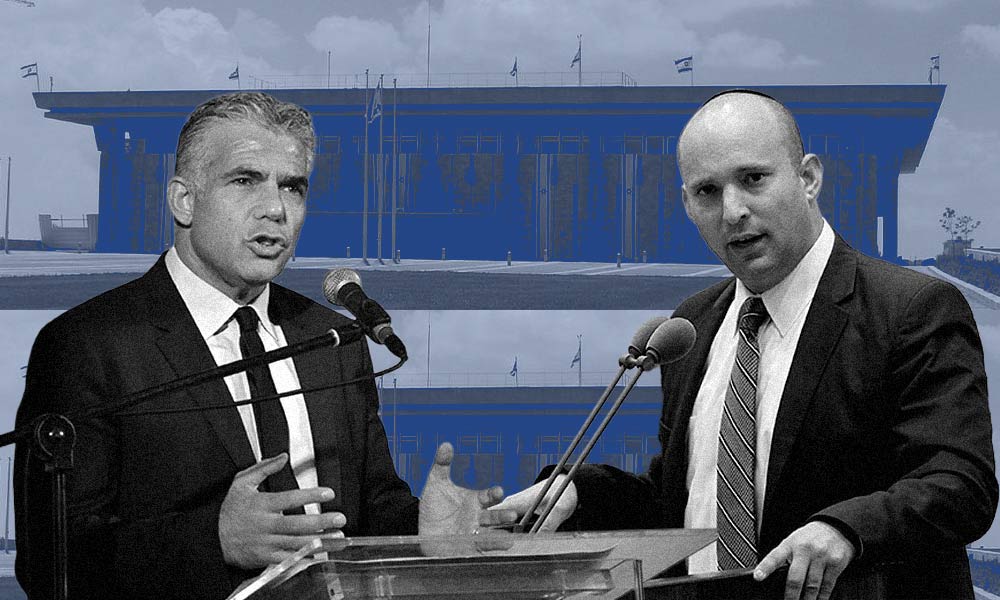
And they’re off.
The gun hasn’t been fired, the line-up hasn’t been determined, and the date of the race hasn’t been set—it’s actually unknown if the race will even take place. Yet the opposition parties are deep into their election campaign sprint.
This past week, the Knesset passed the first reading of legislation to dissolve itself and move to early elections. But before a date can be set, the bill has to go back to committee for modification and then be voted on two more times.
And anyway, “early” is a very relative term in this context: By Israeli law, elections are held every four years, and October 27, 2026, is the very latest legal date, and from various political points of view, there may be no good time to hold the elections before then. Prime Minister Benjamin Netanyahu, who has dissolved his government before when it seemed politically expedient, knows that holding elections in the summer would be a bad idea for vacation-starved Israelis who are hoping they might be able to go abroad this year. September is High Holiday season, and the ultra-Orthodox object to disrupting its sacred atmosphere. Early October will be filled with commemorations of the October 7 massacre, providing the opposition with an excellent opportunity to focus on Netanyahu’s and his government’s responsibilities and failures. How the parties will come to an agreement on the actual date remains unclear.
But even without knowing the date of the elections, every party knows it must hit two marks: 61 seats and 3.25 percent. The 61 seats refers to the simple majority of the 120 seats in the Knesset; since voters choose a party rather than an individual candidate, in order to govern, a party must receive a simple majority of the votes cast, which comes to 61 seats. The 3.25 percent figure refers to the threshold, that is, the percentage of votes cast that a party must receive to get into the Knesset.
Throughout Israel’s fractured political history, no party has ever reached that coveted simple majority. When the votes are counted and no party has reached the crucial 61, the president tasks the party most likely to attract additional seats (which is usually, but not always, the largest party) to form a coalition with other parties to reach at least 61 seats. The head of the party that forms such a coalition will become prime minister.
When planning their campaigns, parties cannot count on polls or surveys to assess what the public wants because these are notoriously inconsistent and contradictory until very late in the campaign. In response, the parties do not focus on platforms, ideology or critical issues. They focus on arithmetic, planning even before the campaign has begun how to cobble together a 61-member coalition. This requires negotiations with smaller parties, each of which has its own demands, red lines, delusions of grandeur and visions of kingmaking. After (often prolonged) negotiations, the parties that join together as a coalition articulate the guidelines for their government. These guidelines are intended to provide every party with “something” that matters to them or their constituencies, but also often demands that they give up on other issues that are important to them, making the coalitions inherently unstable from the outset. Furthermore, the guidelines are often very vague so that the newly formed government can come together despite the often-significant dissatisfactions and differences among the parties.
At least at first glance, the current coalition, headed by Netanyahu, seems vulnerable. The country is still struggling with the security, social and economic consequences of October 7. Furthermore, his coalition is dependent on the support of the ultra-Orthodox parties, which insist on passage of the deeply contentious draft law (or, as it is popularly known, the get-out-of-the-army-free card), which would exempt all ultra-Orthodox men from conscription—even though non-ultra-Orthodox men have served hundreds of days of reserve duty and the government is currently considering passing a law to extend the length of compulsory service for non-ultra-Orthodox. Right now the coalition is so mired in these issues, and so concerned about growing disaffection within their constituent base, it can’t even begin to think about how the coalition might look in the future and how to reach the necessary 61.
But the opposition, widely known as the fix it bloc (a reference invented by the press to the intent to “fix the country” after nearly two decades of Netanyahu’s leadership), can count and is certainly doing so.
The first union of opposition parties during the current coalition’s tenure dates back to 2024, with the merger of what was the historical, left-of-center Labor party, which had once led the country but by 2024 had become almost defunct, and the remains of the Meretz party, which did not even make it into the Knesset in the 2022 elections. Known as “The Democrats,” it may currently be the largest opposition party.
More recently, in late April, Yair Lapid and Naftali Bennett formed the new “Yahad” (“Together”) party. While they have never campaigned together, Lapid and Bennett did form a government that lasted from June 2021 until December 2022, with Bennett acting as prime minister for most of that time.
The merger apparently focuses on the hope that the sum will be greater than its parts and that by combining two very different parties they can attract a broader swath of the electorate than they would if each party ran alone. Lapid emphasizes democratic institutions, economic pragmatism and resistance to religious coercion. He appeals to secular, liberal, middle-class Israelis but struggles to expand this base. Bennett, whose party did not make it into the Knesset in the 2022 elections, has been associated with the national-religious camp, but as prime minister he was pragmatic and worked across ideological lines. By joining forces with Lapid, he is repositioning toward the political center, while hoping to retain as many right-wing voters as possible.
As part of the merger, Lapid gave up the number-one position in the party—which means that he gave up the chance of being prime minister if Yahad succeeds in forming the coalition. He could have credibly demanded this, given that his party holds 24 seats in the current Knesset and Bennett holds none. But he did not, implying that Yahad hopes to generate new energy and unity among parties and constituencies, right as well as left. This strategy echoes the one that brought Peter Magyar to victory in Hungary’s elections over Viktor Orbán, who had ruled Hungary for 16 years—a result widely attributed to the unity of all the anti-Orbán forces.
Assaf Shapira, head of the Political Reform Program at the Israel Democracy Institute, an independent think tank in Jerusalem, agrees. He says that the Bennett-Lapid merger might “motivate disillusioned opposition voters to come out to the polls and stimulate additional mergers and partnerships.”
One of the more interesting possible players in such a merger is Gadi Eisenkot, who, many believe, is most likely to lead the new opposition bloc, rather than Bennett or Yair Golan, head of the Democrats. Eisenkot is a former IDF chief of staff, whose son and two nephews were killed in the fighting in Gaza. Laconic and quiet, and at times even seemingly withdrawn, Eisenkot has no public charisma or rhetorical talents, which might actually work to his advantage: He is the sort of non-politician politician, an everyman, who could attract right-wing and center voters who are disillusioned with Netanyahu but doubt that the diverse Bennett-Lapid merger could work.
“It would be very natural for Eisenkot to join [Bennett and Lapid],” Shapira notes “But should he? Is it worth it for him? Even within the contradictory polls, Eisenkot’s party, Yashar [‘Straight’ or ‘Honest’] is rising.” So Eisenkot, too, faces a strategic decision: independently ride the momentum or consolidate his strength through alliances?
There are additional parties and constituencies that, while unlikely to form mergers, are on the opposition’s make-it-to-61 list. These include Avigdor Liberman’s “Israel Is Our Home,” party. Once associated almost solely with Russian immigrants, the party has broadened its appeal to right-wing voters who object to Netanyahu’s deference to the ultra-Orthodox, especially with regard to the law providing Haredi men with an exemption from the draft. Members of the religious Zionist camp form another potential source. Over the decades, the Religious Zionism party, which, although it supported settlements in the West Bank and opposed the 2005 withdrawal from Gaza, was still considered moderate, at least in terms of its diplomatic and religious orientations and integration into Israeli society. But now, headed by ultra-nationalist Bezalel Smotrich, its orientations on every issue have become increasingly extreme and it is cooperating with the ultra-Orthodox draft-dodging, leaving many of its original voters searching for a new party.
And then there is Benny Gantz, also a former chief of staff, widely regarded to be a centrist. Five years ago, on his first foray into politics, he won the election and the president selected him to form the coalition. But he deferred to Netanyahu, who refused to join a coalition with Gantz unless Gantz agreed that Netanyahu would continue on as prime minister. Due to a series of flip-flops that cost him the trust of the public, and numerous other strategic and tactic errors, he currently seems to be politically nonviable and is unlikely to even cross the 3.25 percent threshold unless he joins with another party. But over the years, he has also formed alliances with both Lapid and Eisenkot, but those ended very badly—so he really doesn’t have very many options within the opposition. He could, of course, join with Netanyahu, which, since leaving Netanyahu’s coalition, he has said he would never do. That would be a cynical move that might offend his potential voters, but would bring him back into the race. Israeli politics, however, can be so volatile that it would be unwise to write him off just yet.
As the potential opposition parties joggle around their permutations, they all seem to agree on two things: They have all declared that they will not include either ultra-Orthodox or Arab parties in their potential coalitions.
With regard to the ultra-Orthodox, Lapid says, “When political parties try to compromise with the ultra-Orthodox, the ultra-Orthodox become more extreme and more demanding. We will form a coalition without them, and we will make sure that young ultra-Orthodox men go into the army and study core curriculum so they can become part of the job market and of Israeli society. Netanyahu has no coalition without them, so he gives in to all of their demands.”

With regard to the Arab parties, the former Bennett-Lapid government’s inclusion of an Arab party (Ra’am) in the coalition they headed marked a political watershed. But it also caused a backlash among some of Bennett’s right-wing voters. However Bennet and Lapid may be wary that the current coalition parties would use their willingness to include Arab parties as a delegitimization tactic. So they, too, face a dilemma: Should they continue emphasizing human rights, democratic values and eventual conflict resolution? Or should they reposition themselves solely around defeating Netanyahu?
As the opposition strategizes the numbers, publicists regularly raise a much broader concern: Will Netanyahu postpone the elections beyond the October 27 deadline? Postponing national elections would seem to be politically unthinkable—but it would not be the first time that Netanyahu has pulled an unthinkable rabbit from his hat. With Gaza unresolved, the war in Lebanon escalating, and Iran a continued threat, security instability could provide Netanyahu with the argument—one he is already including in his rhetoric—that wartime leadership continuity is a national necessity.
But whenever, and if, elections are held, any potential opposition configuration must persuade the public that it is more than merely an opposition to Netanyahu. No group has yet to do this—that is, to articulate a clear governing vision of Israel’s future that would serve as a galvanizing alternative.
The opposition continues to consider the potential mergers, alliances and numbers, seeking to gain votes through diversity and inclusivity. Yet this is precisely their weakness. Not only are they fragile and vulnerable to instability from within—worse, they often appear to be little more than alliances of convenience, and thus reinforce the cynicism that pervades Israeli politics already.
In that scenario, everyone loses the election race—no matter when the starter pistol is fired, who is running or who reaches 61 first.
(Top image credit: Joshua Paquin (CC BY 2.0) / Itzhak Harari/Knesset Archives (CC BY-SA 4.0) / Sapir Academic College)
2 thoughts on “Can Any Israeli Coalition Reach the Needed 61?”
Why aren’t you covering Einat Wilf and the Oz Party?
You are caught in a wrong (not to say misleading) narrative that the term Israeli doesn’t include over 20% of the population of Israel (Arab and other non-Jewish citizens).
Any government that will strive to save Israel from its current devastating situation and wrongdoings should include representatives of the Arab parties in one way or another.