
It often baffled me how my grandmother spent her time. When my brother and I would visit as children, we made camp in the back room of her small house, scattering snacks and blankets in front of the television. Once we settled, she would retreat to the oldest chair in the house: a small wooden hand-me-down from her grandparents, a leftover piece of a Civil War-era dining room otherwise lost to time. She would position that chair so she could see the front yard and her small garden, along the road that wrapped toward our small Georgia town square. Once comfortable, she would stay there for hours, entranced by the birds and the passing cars, or perhaps lost in the memories of her Depression-era childhood. At the time, I did not understand what she was doing. I’m still not sure I do, but I now wonder if she understood something I had not yet learned: that sitting with time is worth practicing.
I lost her in the summer of 2016. At the time, I was serving as reserve deputy sheriff with the Habersham County Sheriff’s Office, my hometown, assigned to patrol in the Georgia foothills of the Blue Ridge Mountains. Patrol was how I spent my summer and winter breaks, my reserve status allowing me to return to Goucher College in Baltimore, MD, when classes resumed.
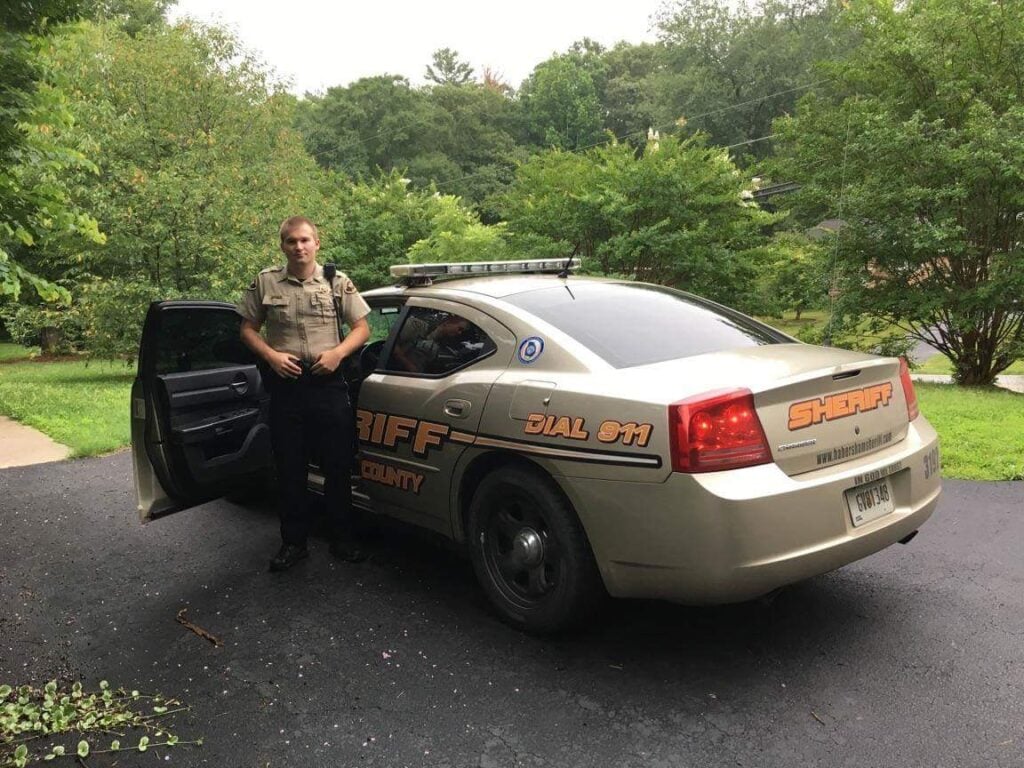
Deputy Duncan outside his grandmother’s house.
When my shift ended that day she died, I drove my patrol car to the nearest church, the Catholic church off 197 South—a mile from my grandmother’s house—and sat in the pews until the sun went down. There was no further time to sit with the loss, as my grandmother had so often sat with the world. We did not hold a funeral service or a gathering of any kind, and in that absence, I could not find God.
That fall, back at Goucher College, another loss came. Collin, a close member of my college friend group, died by suicide. David, the director of campus safety at Goucher, and the man from whom one of my Hebrew names now comes, pulled me into his office to break the news. He also pulled in my closest friend, Jon, so I would not have to receive the news alone.
Our friends drew together immediately. There were eight of us, and for the following week we did not leave one another. When we resumed classes, we did so gradually. Over the next month, our rhythms returned, but they were altered. We held Collin’s family close. We raised money to help cover funeral costs, meeting the family’s needs through donations from our peers. Our fundraising efforts across campus drew the attention of Madison, my now wife. And in the middle of all of that, I felt God. I felt God in David’s office, in the late-night group crying, at the vigil, at the funeral and in the conversations that followed. I felt a constant pull, an unceasing reminder that we are not meant to separate ourselves from our community.
Almost one year later, in the fall of 2017, the largest hurricane in a century hit Habersham County. Hurricane Irma, veering left from the Caribbean, made a catastrophic impact. In the days leading up to the storm, I returned home from Goucher College to meet it. My sheriff had previously allowed me to serve reserve duty as deputy sheriff, encouraging me to attend college in the Northeast in the hope that I could rise beyond what our small Georgia county could offer. But in that moment of crisis, I found that responsibility was not something I could divest myself of.
During the hurricane, the sky turned green and opened into a monsoon. Half the trees in the county fell. Our dispatch center failed, leaving us dependent on person-to-person radio contact. Running from call to call, our small department pulled people from cars and from under trees. We worked drenched, exhausted and determined, racing against nature to hold together a county unprepared for such an impact. In the response to the storm—not in the storm itself—I felt God again, an unflinching message that your responsibility extends beyond yourself.
Those three experiences, in fairly short succession, set me on the path back toward organized religion. I could not fully make sense of the connection between the moments when I felt the Divine, but I was eager to draw those lines. After graduating from Goucher in 2018, I secured a job as a federal police officer and moved to Baltimore with Madison. There, I became a regular attendee at a Presbyterian church, in line with the faith in which I was raised. It was a small rowhouse church off of Light Street, and I became a member in 2021. I participated actively, but the community, responsibility and connection to the Divine that I had glimpsed in those earlier moments did not come together in the way I was searching for.
I need a commitment to continue wrestling, to engage with the call and response, within a community dedicated to the same.
In May of 2023, Madison and I migrated to Columbia, MD, and I began my tenure as head of security at Milton Gottesman Jewish Day School of the Nation’s Capital (MILTON) in Washington, DC. Coming from law enforcement’s unpredictable scheduling rhythms, working on a school schedule seemed ideal. The pre-K–8 environment, with a focus on outside risks instead of student behavior, seemed like a strong fit. I did not, at least consciously, choose MILTON because it was a Jewish institution.
I found myself in the center of a moment whose history and complexity I did not yet fully understand. Five months into my role, October 7 occurred. I remember huddling in the first-floor office with the leadership team, trying to make sense of the next few days. Whatever pressure had existed in my role before October 7 was suddenly compounded. Decisions had to be made quickly. But as things outside seemed to fall apart, the community inside held together more tightly.
That community was my first insight into Judaism. I had been part of many communities before—in police work, sports teams, friend groups—but they paled in comparison to what I witnessed at MILTON after October 7. It was bewildering. Usually, the intimacy and initiative of a community dissipate with size. A group of 100 often pulls together with less force than a group of 10. My experience at MILTON contradicted that. After October 7, I noticed the community rhythm that would push me toward Judaism and then hold me up through the process: the dance between tefillah (prayer), community and responsibility; each one necessary for the others. In a moment of crisis, I watched the people at MILTON lift their eyes in tefillah, turn inward toward each other, find sturdiness and resolve, and then intentionally return to the work. The prayerful pursuit of the Divine lent momentum and stamina to the work here, and the work returned their eyes upward for the cycle to continue.
Witnessing that cycle was a slow revelation to me. The faith tradition I came from was very focused on the strength that comes from individual prayer but less so on the community that holds that prayer, and on the responsibility to act here and now that follows from it. The world I had experienced outside of religious life, meanwhile, was very intent on action—but often with little attention to the guidance, clarity and relief that comes from prayer. At MILTON, I saw both tied together, each feeding the other.
Working at a Jewish school means being tied to the calendar of Judaism: for lives and seasons. Of the life cycle, I was drawn to the mourning process first. When families fracture, traditions and processes are often the first to go—and they don’t return without an intentional effort to rebuild and renew them. The more I read, the more I realized how desperately I needed a mourning process like this, and how much I wanted my children to have one as well. Jewish mourning struck me as the missing framework from my grandmother’s death. It also struck me that the steps of Jewish mourning resembled, in many ways, what my friend group had instinctively done after Collin died.
MILTON brought me into the cadence of Jewish seasons, with explanations and celebrations for each holiday. Over time, I came to understand how important these holidays are in the cycle of reflection, community and responsibility. Pesach as a celebration of the gift of freedom, without which responsibility is impossible, and of the responsibility of a people toward that freedom and the God who gave it. Tisha B’Av through Yom Kippur became a reminder that the center cannot hold, and that responsibility requires self-reflection, and Rosh Hashanah became a celebration of time: the gift of reaching a new moment and the opportunity to begin again. Each offered a new way to more fully engage with myself, my community and the world around us.
I made the decision to begin conversion in March of 2025. There was no single dramatic event that forced the decision. Rather, it came after two years of living near and watching both a community and a Jewish way of moving through the world. Eventually I realized I wanted both for myself and for my family.


The first step for me was to build a Shabbat practice. I had watched colleagues rush out of the parking lot on Friday afternoons, eager to arrive at some unknown celebration. I watched MILTON’s student Kabbalat Shabbat celebration at the conclusion of each week, and I saw the shift in demeanor as Friday settled over the school environment. In speaking with colleagues, I came to understand Shabbat as a cornerstone of their Judaism. Neither Madison nor I understood, at the beginning, the impact a Shabbat practice would have on our lives.
It began modestly. I stopped doing formal MILTON work during Shabbat. This was easy enough; MILTON already expects employees to stay offline during that time. I simply had to oblige. As the practice grew, it came to include blessings to mark the beginning of Shabbat and Havdalah to mark its end. As it grew further, it came to include anything that pushed the “working” muscle in my brain: working, planning, driving, shopping, cleaning. All of it began to fall away for one day each week. As the effects became clear, Madison joined as well.
[Related: “I Offered Life” by JoJo Kalin]
Our Shabbat now includes cleaning the house on Thursday evenings, and on Friday preparing a charcuterie board, pouring wine, and letting conversation stretch into the night. Shabbat has become a runaway truck ramp for the semi-truck that is our week, a forced pause to the momentum built weekly. It is the restful counterweight to the responsibility we carry until sundown on Friday, and the mirror for the moments we do not want to let go of. My soul swells throughout the week leading to Shabbat, neglected in the rush of day-to-day business, peaking on Wednesday and rolling into the embrace of a Friday sunset. A Shabbat done well moves at half-pace. It is both a celebration at the end of the weeks when your heart is full and a forced second beat on the weeks when you are simply happy to have survived. I have found, like learning for the first time that shooting stars are fleeting, to better notice which moments must be paid attention to. These moments often involve family, and they have become punctuated by the Shabbat reminder that this is both temporary and worth celebrating. Whether at home or traveling, the gift does not get left behind.Like any worthwhile practice, Shabbat led me to a deeper connection with other parts of Judaism. My engagement with Torah is far easier during the pause Shabbat creates. Torah, for me, is the overarching narrative of God teaching responsibility and initiative to people, with the hope that we might partner with God in repairing and redirecting the world around us. It is both the story of how we got from there to here and where we should go now, as well as a guidebook on how to do so. I have found the path within it both timely and timeless, offering the steps forward when I have been open enough to look for them.
The author’s conversion celebration at MILTON.
As I engaged with the Jewish calendar in a new way, I learned to navigate a synagogue—not just the physical motions themselves, but how the space itself teaches the rhythm of Jewish life. I found that the experience of being in synagogue often complemented the theme of the moment we were marking: from the staggering scale of Yom Kippur to the joy and release of Shabbat. The classes at synagogue helped me name pieces of Judaism I had already begun to feel but did not yet have language for, and many of those pieces became the foundation of this essay.
My conversations with family evolved as my conversion continued. Both my family and Madison’s were overwhelmingly supportive, but Madison’s had additional pieces to share. Madison’s mother, Lori, was raised Jewish. Lori’s parents were Jewish. Her father, Leon—from whom one of my Hebrew names comes—died when she was twelve, and her mother fell out of practice. Lori later married my father-in-law, John, who is Catholic, and Madison was raised Catholic.
This history was not secret, but it had not been brought to center stage until a few months into my conversion process. For Madison, reckoning with that history has been its own process, and it is her story to tell. But for our family, it added another layer to the path we were already walking. This came full circle two months ago, when Madison and I joined her family for her mother’s first Shabbat in 55 years.
Concluding the process, clarity came to the early moments of my religious life. My grandma’s death, and the grief without ritual that followed. The pull of a community in crisis, responsibility as both non-optional and as a request from the Holy. Judaism gave me a language and a structure for what I had already glimpsed but could not yet name—a covenantal way of moving through the world. I have found in the mitzvot tools both tools for shaping the world around me toward holiness, and disciplines that shape a life—practicing attention, gratitude, restraint and care for others. I have entered into the cycle that I glimpsed three years ago—the wrestling with both the physical world and the Divine that makes Judaism so. That has been both humbling and reassuring.
I do not need every loose end resolved before beginning a new journey. I need a commitment to continue wrestling, to engage with the call and response, within a community dedicated to the same. It is why I choose to join the Jewish people and to bind my life, my home and my future to this sacred rhythm.
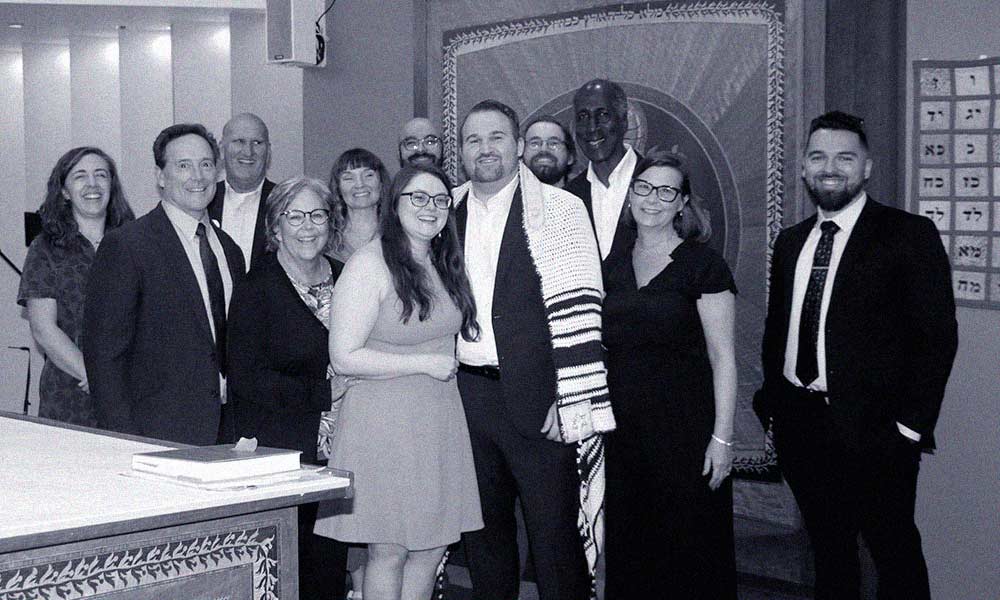
Top image: Duncan Miller with his family after his conversion ceremony.
14 thoughts on “‘We Are Not Meant to Separate Ourselves from Our Community’”
As extended family – grandparents of a Milton student, we are delighted you have joined us, and are extending our blessings, thankful for you.
Thank you Adina! It has been such a blessing to get to work through this journey at MILTON.
Great writing – “runaway truck ramp.” And so sensitive and heartfelt. Just a beautiful story, beautifully told. Wishing you and your family continued success in your journey.
Author, “Suddenly Jewish,” Brandeis Univ Press
Very kind, thank you Barbara.
I also like the runaway truck ramp comment. This was well written and I am impressed with how he tied so many elements together.
Milton School was such a prime mover. Jewish Day Schools help the whole family and staff.
Duncan is a gifted writer and has given us all the gift of having our hearts opened and warmed. This was so thrilling and inspiring. I have to share this with others. I am challenged to follow his path of deep felt love for Judaism and to know our paths are laid out for us. It is up to us to see and recognize our spiritual journey and walk it! May Duncan and his family find blessings, on their paths! MAZEL TOV!
I began reading this article because of interest in the title. I became totally immersed when learning the author is a Goucher graduate …as am I (1960). His is s profound story of finding deep meaning and connection in his life and widening the circle with his wife and in-law family. He/his story is an inspiration.
Marcia! Love hearing from a fellow Gopher. Goucher was such an interesting contrast to police work, but such a warm place to experience this all.
Duncan,
What a beautiful, poignant journey you have taken. Thank you for sharing your experience and your insights. My friend is a colleague at your school and sent your article to me in Australia.
I was so touched to read how you developed a Shabbat practice. And how you were the gateway to your mother-in-law hosting her first Shabbat in 55 year. It gave me quiet pause.
I wish you, your family and your community much happiness and peace.
Warmly,
Alicia
Wow, Australia! Thank you Alicia.
Mazel Tov and thank you for sharing your beautiful story. When it was revealed that your wife was Jewish, too, I got the chills! As a fellow convert I wish you a lifetime of Jewish joy and learning. May your family be messed with the exquisite nachas of raising a Jewish family. If challenges arise, may they only result in your spiritual growth and the increased strength of your faith. love from NYC
Whoops! Meant to write BLESSED!
Thank you Leslie!
Duncan,
What an interesting and heart felt article. I’m a member of Kol Ha Lev, where you will be speaking in October. There was a link to read your story. I’m happy you have found your home. I also work at a Jewish Day school and love it. I work with the Aftercare toddlers. There is never a dull
moment. My daughter is also a Goucher graduate!
I will send her this article. I’m happy for you and your wife and your family! You have found Hashem!
I look forward to coming to hear you. Chag Sameach!