
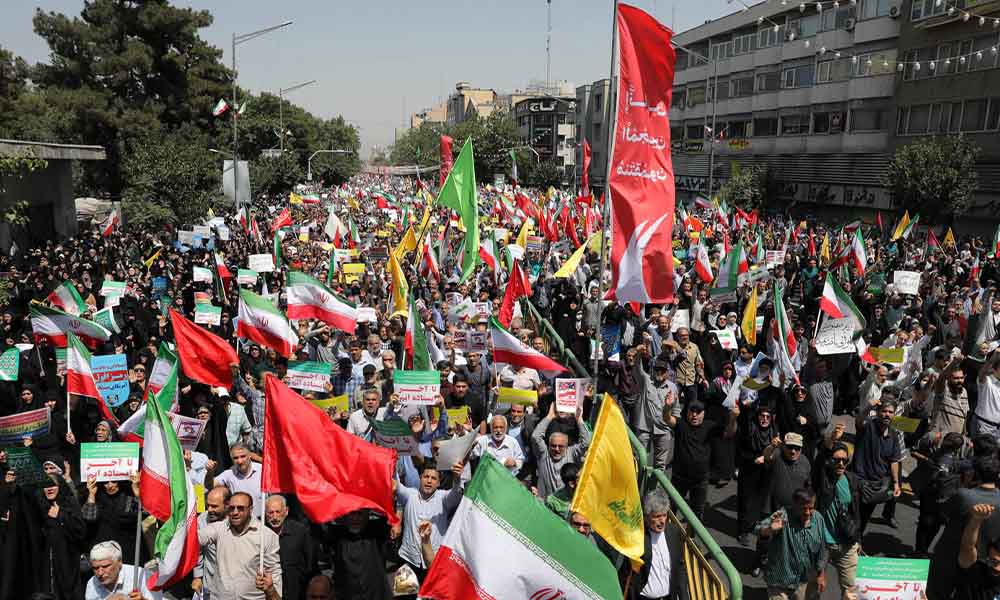
As intense protests over the economy and the regime sweep across Iran for another week, Ayatollah Ali Khamenei and his government have refused to back down and make any concessions. The government has actually doubled downed and accused protesters of being “vandals” who are simply trying to “please the president of the US.”
According to HRANA, an Iranian human rights organization, the death toll is at 646. Some estimates are even higher—an Iranian health ministry official (speaking anonymously) told The New York Times it stands at around 3,000, but Iran International reported 12,000. Part of the ambiguity is due to the total media and communication blackout within the country.
“The ayatollah is unwilling to blame himself for the incompetence of his own regime for these protests,” says Brian Carter, a fellow with the Critical Threats Project of the American Enterprise Institute. “The supreme leader can blame Trump all he wants, but at the end of the day, Iranian protesters are in the streets not because Trump asked them to, but because the value of the currency has fallen off a cliff, the economy has been in the gutter for a long time, and the regime has no serious solutions.”
Trump has spurred protesters on, urging the “patriots” on Truth Social Tuesday morning to “TAKE OVER YOUR INSTITUTIONS!!!” He has cancelled meetings with Iranian officials and promised civilians, “HELP IS ON ITS WAY.”
So far, Khamenei’s only attempt to appease his people has been to ask for unity against threats like the United States and Israel, but the protesters have seen past it.
As demonstrations grow in number, the Iranian regime might be ill-equipped to handle the flow. Since the government deployed the Islamic Revolutionary Guard Corps (IRGC), 133 of its members have been killed, more than in any other wave of protest in Iran’s history.
Some of the structural instability might lie with Israel’s bombing last summer of Iranian military facilities as a means to diffuse their nuclear power. “Iran still hasn’t rebuilt its air defense system and it doesn’t really have an adequate answer to Israeli military supremacy over it,” Carter says. “If push comes to shove, and Israel comes again, they’re gonna have a big challenge on their hands.” Israel’s attack also struck key buildings of Iranian security forces, and so as protests grow, they face bandwidth constraints.
It’s already difficult to manage the number of protests and the number of different priorities,” says Carter.

The last large wave of protests in Iran came in response to the 2022 death of Mahsa Amini, a 22-year-old Iranian woman arrested by Iran’s notorious morality police for not wearing a “proper” hijab. She died suspiciously in a Tehran hospital, prompting widespread, month-long protests that focused on human rights and the country’s limitations of women. The Iranian government tried to quell the protests with localized internet blackouts. Tens of thousands of protesters were arrested, and the movement dwindled by March 2023.
Now, hurting both militarily- and communication-wise, the Iranian government is resorting to its previous playbook with nationwide blackouts.
“The regime usually implements an internet blackout when it’s prepared to launch extremely severe and extremely violent crackdowns,” Carter says, noting that Reuters reported 1,500 deaths after a 2019 blackout meant to squash protests over fuel prices. Carter says that it likely won’t put a stop to the movement (“a lot of this is longrunning frustration with the regime, not just people organizing over Facebook and Instagram and Twitter”).
The government is not backing away from inflammatory rhetoric and theories. Labeling protestors as “terrorists” is a classic strongman tactic, allowing authoritarian regimes to crack down on dissent more fiercely—much like how President Trump calls Democrats and journalists he disagrees with “enemies of the people.”
[Read: “The Strongman’s Sunset? Khamenei’s Reign of Fear”]
And now, as the Institute for the Study of War reports, the IRGC is blaming Israel heavily and has reframed the current protests as an extension of the 12-Day War, even accusing Israel and the United States with arming and equipping the “terrorists” in order to cause chaos.
But those statements are inaccurate, Carter says, and serve only to justify violent repression. It might also be a psychological tactic to “motivate hesitant security officers to forcefully crack down” on civilians—it’s a lot easier to get violent when you think you’re battling an enemy of the state.
While Israel weakened Iran’s security forces during that period, it’s not the underlying cause of the unrest. “This is years and years in the making,” Carter says. “It wasn’t American or Israeli activity that pushed people out onto the streets, it was the failures of the Iranian regime to do what it needed to do to maintain a solid economy and social contract with its people.”
As the protests reach a tipping point, “Iranian security forces don’t have the ability to be everywhere at once and they’re gonna have to start making some really hard decisions,” Carter continues. “This is really a difficult moment for the Iranian regime.”
(Top image credit: Brno Abassi/Avash Media (CC BY 4.0))