

Jewish Politics & Power is published every other week. Sign up for our newsletter for updates.
1. Democratic Majority for Israel has a plan
Rewind ten years. Everything was clear and simple. The Democratic Party had a well-defined consensus on Israel, a big tent in which almost everyone had a place, except for a few on the far-left end of the party. This consensus was made up of several key principles: support for military aid to Israel, efforts to achieve a two-state solution, denuclearizing Iran through a diplomatic agreement and providing support for Israel in the international arena. Within this very broad consensus there was room for criticism of the Israeli government and specifically of Benjamin Netanyahu, a space for those who voiced reservations over instances in which Israel used American-supplied weapons to kill civilians, and even room for those advocating moderate (albeit mostly symbolic) measures against West Bank settlement expansion.
The few who didn’t fit into this tent were left out in the cold, expected to either conform or eventually get primaried out of office.
None of this exists anymore. If there is a consensus, it has shifted way to the left. Military aid to Israel is off the table for many Democrats; any semblance of rapport with Netanyahu is frowned upon; and Israel, in general, is viewed increasingly as a problem, not an ally.
If there is a new Democratic consensus on Israel, it’s coalescing around criticism of its policies and behavior and a willingness or even a desire to punish Israel.
Democratic Majority for Israel (DMFI) is a centrist group established in 2019 whose views are largely aligned with those of AIPAC, although the group does not run negative campaigns or support Republicans contesting Democratic progressives. DMFI is now seeking to formulate a new Democratic consensus over Israel, aimed at reviving the old consensus while accepting some needed changes.
A policy paper the group put out last week outlines principles that are supposed to once again unite Democrats in support of Israel. DMFI’s bottom line is that Democrats should not give in to calls for ending military aid as a means of pressuring Israel. “The leverage argument runs the opposite direction from how it is usually made,” reads the policy paper. “Security assistance is what gives the United States a seat inside Israeli defense planning and procurement. Ending it does not generate pressure; it forfeits the access that makes pressure possible.” The plan divides responsibility for the future of the Middle East equally between Israel, the Palestinians, Arab states and the United States to ensure that “the United States is not the only country absorbing security costs in the region.” The main shift from previous mainstream Democratic policies is the acknowledgement that future military assistance deals should be based on mutual benefits for Israel and the United States, i.e., cooperative projects in which Israel can help the United States with intelligence and defense development while the United States provides access to advanced weapon systems and military cooperation.
This is a paper that Joe Biden would have gladly endorsed. Mild demands of Israel, a larger role for the Arab states, a requirement for Palestinian reform and an ironclad commitment to Israel’s security. But Biden, a self-proclaimed Zionist who was once described as “the last pro-Israel Democratic president,” is no longer in office. Will the party he left behind go back to Biden-style policies?
2. Too late to change?
Every week brings with it further evidence that the shift in the Democratic Party is more than a passing whim and is deeper than an understandable anti-Bibi sentiment.
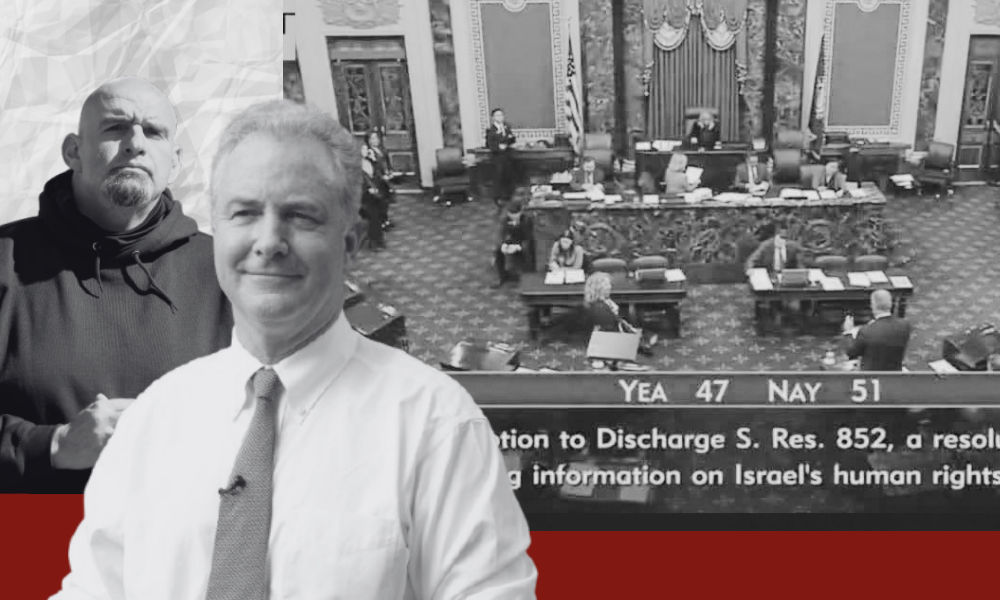
Last week the Senate voted on a measure presented by Maryland Democrat Chris Van Hollen, requiring the State Department to issue a report about violence against U.S. citizens in the West Bank as a condition for approving American military aid to Israel. Nine U.S. citizens have been killed in the West Bank since January 2022, by either settlers or the IDF.
The resolution was rejected by the Senate’s Republican majority, but it’s less about winning or losing and more about the numbers on the Democratic side. All Senate Democrats except Pennsylvania’s John Fetterman voted for the measure. (Republican Rand Paul joined them to make the vote 47-51.) For comparison, two years ago Vermont Senator Bernie Sanders, an Independent who caucuses with the Dems, presented a similar resolution and won only 11 Democratic votes. The shift has never been clearer.
The day after Van Hollen’s measure was introduced, four Democratic senators—Chris Coons of Delaware, Elizabeth Warren of Massachusetts, Ron Wyden of Oregon and Ruben Gallego of Arizona—put forward another, much harsher, piece of legislation. The bill requires sanctioning Israeli individuals and companies involved in building settlements in an area of the West Bank known as E1, an essential corridor for ensuring the viability of a future Palestinian state. The bill isn’t likely to reach a vote before Congress ends its term, but it is worthwhile looking at the original cosponsors. While Warren and Wyden are longtime progressives, Gallego has shifted to the center and Coons is a lifelong moderate. In other words: If there is a new Democratic consensus on Israel, it’s coalescing around criticism of its policies and behavior and a willingness or even a desire to punish Israel, rather than a return to a pro-Israel, pro-aid policy of the previous decade.
3. Could Rahm Emanuel be the face of the new middle road?
Rahm Emanuel has not announced his intention to run for president in 2028, but all signs indicate he is considering it. A former Chicago mayor, White House chief of staff and congressman, Emanuel has increased the intensity of his public appearances, visited key states and made his opinion known on major policy issues. In an interview with NBC on Sunday, he even pushed back on the idea that America isn’t ready for a Jewish president.


Elections are far away and the field is already crowded with potential presidential hopefuls, but were Emanuel to run, he’d likely be the candidate who carries a policy on Israel closest to what DFMI is advocating. In his speeches and interviews, and during his recent visit to Israel, Emanuel presents a vision that could be seen as an updated version of Biden’s pro-Israel policy. At its core stands Emanuel’s belief that Israel is an ally and deserves American military support, coupled with a willingness to show some tough love and not shy away from criticizing Netanyahu. He still views Israel as an asset, not a liability.
4. J Street believes the arc of mainstream leadership bends toward them
Meanwhile, on the other side, J Street is out to prove that there is a new pro-Israel consensus—and that it owns that consensus.
The lobby, which leans to the left and has supported measures critical of the Israeli government and endorsed progressive candidates, launched a communal advisory council last week made up of former officials in mainstream Jewish groups. It includes familiar faces in Jewish organizational life, among them Seymour Reich, a former B’nai B’rith president and chair of the Conference of Presidents; two towering figures from the Reform Movement, Rabbis Eric Yoffie and David Saperstein; John Ruskay, who headed the powerful New York Jewish federation; former CEOs and top lay leaders of key organizations such as the Jewish Council on Public Affairs, the American Jewish Committee, the Jewish Agency and the Jewish Theological Seminar; as well as former Jewish Democratic members of Congress.
While the council may not amount to more than another advisory panel, its high-level membership sends a clear message: Key leaders of the Jewish American world, once wary of siding with the left wing of pro-Israel advocacy, are now coming out publicly in support. What was once outside the boundaries of legitimacy in the Jewish world is now perfectly normal.
5. Is going to shul good politics?
POLITICO conducted a poll last month trying to figure out what kind of a presidential candidate voters would like to see. Not by name but rather by gender, race, age, religion, etc.
The data gathered can also provide a better answer to what is currently a theoretical question: What kind of a Jewish politician has a better chance of winning in either party?
Jacob Kornbluh at the Forward broke down the results, and they’re not surprising: Republicans, the poll suggests, would clearly prefer a candidate who regularly attends synagogue, while on the Democratic side regular participation is a negative.
Now look back at the emerging field of Democratic candidates, where several Jewish politicians could potentially run. One of them, Pennsylvania governor Josh Shapiro, attends synagogue regularly, the other, Rahm Emanuel, less so.
(Top image credit: Senate Democrats; Governor Tom Wolf, CC BY 2.0)