
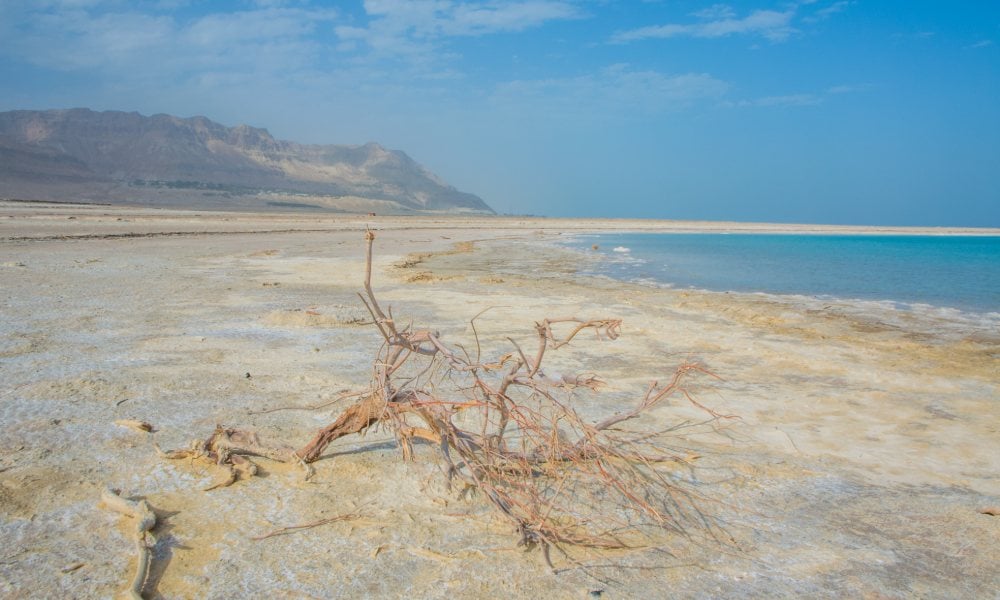
In a region rife with war and political tension, natural beauty still exists. There is no question the Dead Sea is beautiful; the utterly unique blue-green salt lake also holds a history deeply important to the land, people and religions that surround it. Yet in the midst of warring governments and economic distress, the Dead Sea, bordered by Israel, Jordan and the West Bank, faces a man-made environmental crisis that needs attention. Could upcoming Israeli elections create an opportunity to save the region’s shared treasure?
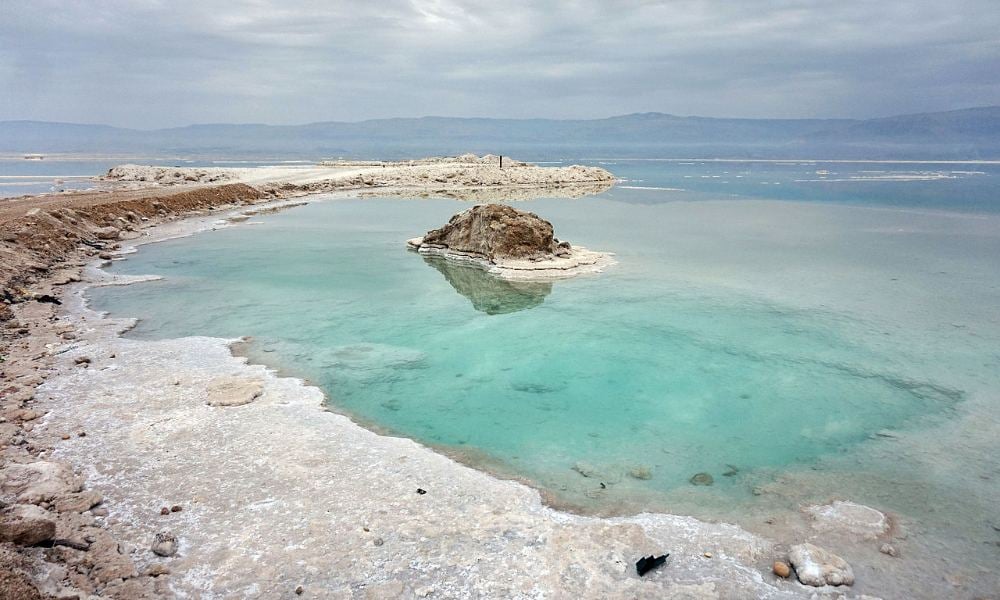
The Dead Sea is receding at a rate of about one meter (four feet) per year. The water surface as of August 2026 was at minus 441.33 meters below sea level, as opposed to minus 392 in 1900. The crisis is a result of water scarcity in the region and commercialization of the mineral-rich lake (“sea” is a misnomer).
“You cannot rehabilitate the river from one side. You cannot save the Dead Sea by working on one corner.”
“There are various directions in which we could take [a solution], but all of them revolve around bringing water to the lake,” says Nir Arielli, a professor of international history at the University of Leeds and author of The Dead Sea: A 10,000 Year History. “All of them, importantly, require international cooperation.” With tensions in the region at a high over the past few years following the October 7 Hamas attack on Israel, the subsequent war in Gaza and with Iran and its proxies, along with the influence of a right-wing Israeli government, diplomatic environmental discussions have taken a backseat. “If the political security temperature in the region changes, then people might have a little bit more bandwidth to sit down and think about this as well,” Arielli says, noting that it’s an issue people care about “no matter on which side of the Dead Sea they reside.”
Experts are hopeful that a potential new Israeli government will be more open to restarting talks with its neighbors, and work on shared environmental issues could be a great place to start. “The environment demands us to work together,” says Gidon Bromberg, co-founder and Israel director of EcoPeace Middle East, an Israeli-Jordanian-Palestinian environmental and peace-building organization. He sees it as a wake-up call for Israelis, Palestinians and the rest of the region. “You cannot rehabilitate the river from one side. You cannot save the Dead Sea by working on one corner. You need all the actors involved.”
The shores of the Dead Sea have been home to human civilization for over 4,000 years. Some of the earliest human settlements were around the basin, most famously Jericho, one of the oldest continuously inhabited cities in the world. During the biblical era, King Herod built the Masada fortress overlooking it. “My generation was bequeathed the Dead Sea as this incredible site of natural beauty and historical significance, and we’re losing it,” Arielli says. “There might be a small briny pond there in a few decades time, but certainly nothing like the Dead Sea that I remember bathing in when I was younger.”
Credit: EcoPeace Middle-East
A coalition of environmental and peace NGOs will participate in a conference for the diplomatic and environmental rehabilitation of the Dead Sea in Israel on October 22, just days before Israeli elections, says Arielli. The conference will bring together delegates from NGOs and think tanks such as the Mitvim Institute and the Society for the Protection of Nature, as well as from universities, including Ben-Gurion and the Technion, Israel’s technology institute. Motti Kaplan, an environmental planner and research associate at the Faculty of Architecture and Town Planning at the Technion, and Tamar Zandberg, former environmental protection minister of Israel, are expected to attend, and invitations have been sent to various government representatives as well.
“The conference is geared primarily toward an Israeli audience, but also, we’re hoping to garner diplomatic support,” says Arielli. “The idea is that we want to create some momentum to make sure that things do happen and things do move forward…We think the time is right to start to make change.”
“For a short period in 2021-22 we saw a rapid advance in cooperation,” says EcoPeace’s Bromberg. Under that government, former Israeli Minister of Environmental Protection Zandberg and the Jordanian Minister of Water and Irrigation Mohammed al Najer signed a memorandum of understanding to rehabilitate the Jordan River. Also in 2022, Israel, Jordan and the UAE signed a climate goal agreement, Project Prosperity, which laid out a plan to use solar energy from Jordan to power Israeli desalination plants. Both initiatives showed promise for environmental collaboration but were halted as political tensions in the area rose.


“Under the current government, relations have reached an all-time low, and there’s absolutely, from my perspective, no likelihood of any cooperation as long as the present Israeli government is in power,” Arielli says. While candidates for this month’s election have not mentioned Dead Sea negotiations specifically, Arielli is hopeful that some incoming actors will be more environmentally minded, or at least open to diplomatic talks on the subject.
The conference takes advantage of the current timing, with the environmental crisis and a potential change in government both imminent. “We have a window of opportunity, and we want to make use of it. And if we fail, at least we can tell ourselves that we tried,” Arielli says.
The Dead Sea is fed into by the Jordan and Yarmouk Rivers, from which Israel, Jordan and Syria have all diverted water for drinking, agriculture, electricity and more. The diverted water makes up around 95 percent of the Dead Sea’s natural inflow, leaving only a small fraction to fill its basins.
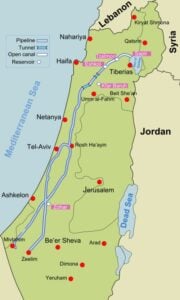 The National Water Carrier was Israel’s first large water diversion project, bringing water from the Sea of Galilee, which sits above the Dead Sea on the Jordan River, to Central Israel, around Tel Aviv, and then down into the southern Negev region, Bromberg explains. The project was used to improve the water supply for a growing population, and Jordan and Syria did the same on the other side.
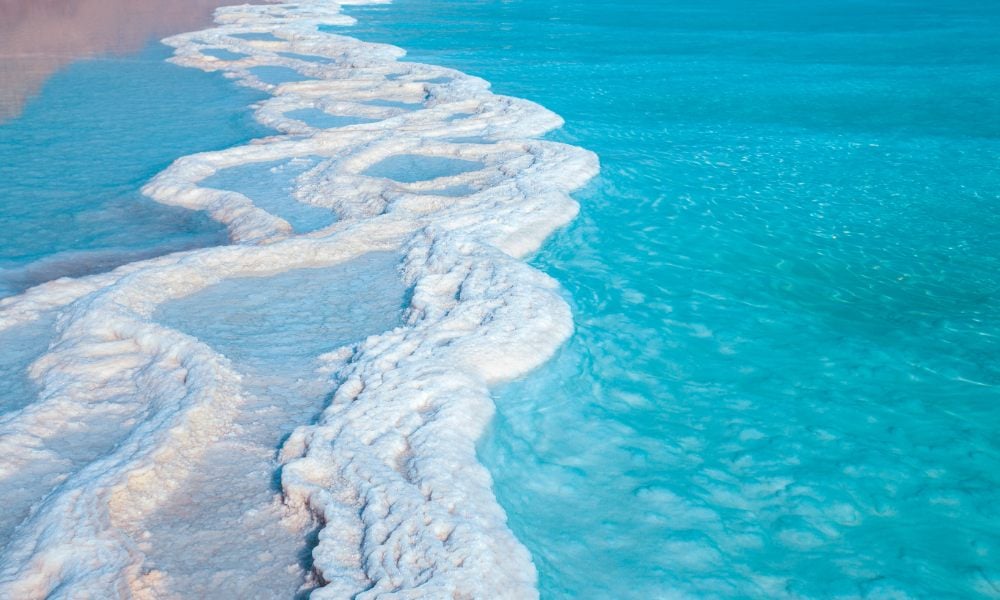
The Dead Sea is extremely mineral rich, most notably in potash—a source of potassium used in agriculture—and in bromine and magnesium, both of which have a wide range of uses. As the terminal lake of the Jordan River, the Dead Sea accumulates salts and minerals with no outlet to flow into, making it 10 times saltier than the Atlantic Ocean. Commercialized mineral extraction has been in effect since the early 19th century; Palestine Potash Limited was granted the Dead Sea concession in 1930 and began mining soon after. After 1948, the Israeli and Jordanian mining industries separated; today, Dead Sea Works operates on the Israeli side and the Arab Potash Company on Jordan’s. Mineral extraction accounts for about 40 percent of the Dead Sea’s depletion, according to Bromberg. And as the Dead Sea continues to shrink, the impact only becomes greater. “No one denies that the region needs water, and no one denies that the region needs jobs,” Bromberg says, “but the work of EcoPeace has become to strike a better balance also with the needs of nature.”
ICL Group, which operates Dead Sea Works, currently functions under a government concession that allows the company access to mine the Dead Sea until March 2030. Arielli and his colleagues hope that as the conditions for the renewal of the concession are worked out, potentially with a new government, stronger environmental protections can be included. This may include holding companies accountable for putting water back into the Dead Sea as it’s taken out for mining purposes, or enforcing a monetary cost for the water taken out.
Credit: EcoPeace Middle-East
Diplomatic ideas have been proposed in the past to rehabilitate the salt lake. The Red-Dead Sea Pipeline, or Red-Dead Conduit, was first proposed in the 1960s, and an agreement was signed by Israel, Jordan and the Palestinian Authority in 2013 to begin work on phase one. The plan involved building infrastructure to transport desalinated water from the Red Sea up to the Dead Sea. The plan, however, was officially scrapped in June 2021 for a number of reasons, including financial cost and priorities—Israel and Jordan are both water-scarce countries, so prioritizing drinking water and agriculture is important—as well as possible environmental consequences. “It threatens to change the composition of the Dead Sea, because it would bring in minerals from the Red Sea that don’t naturally exist in the Dead Sea,” Bromberg says. “So it would have an unknown ecological impact, playing God by mixing two seas.”
The alternative plan that Arielli, Motti Kaplan and colleagues plan to discuss at the upcoming conference would carry desalinated water from the Mediterranean Sea to the Sea of Galilee. This is already happening, Arielli says, but on a small scale. “What Motti is arguing is that Israel is going to need a lot more desalinated water as the population continues to rise, and it would be prudent to keep a lot of this water in the Sea of Galilee as a national reservoir of water,” Arielli explains. “His plan is that we could use some of it for environmental rehabilitation.” Adding water to the Sea of Galilee would in turn replenish the Jordan River. The plan then involves returning treated wastewater into the lower Jordan River, thereby stabilizing the Dead Sea. The plan also proposes using solar energy from Jordan to power Israeli desalination plants. The plan is costly, large-scale and would require diplomatic cooperation, so Arielli and Kaplan have their work cut out for them.
Bromberg sees environmental cooperation as an avenue for bigger things. “Through the fact that environment knows no borders, through the fact that this is an issue of both self-interest and common concern, this is also a pathway to build peace,” he says, “to help advance two-state solution, but also regional integration of Israel being accepted with the rest of the Arab and Muslim world.”
Top image credit: EcoPeace Middle-East