
John Lennon, if you didn’t know, had a slight Nazi obsession. As a boy, he would doodle drawings of Hitler, collect and swap Nazi badges or call himself John “Adolf” Lennon. And in his Beatles days he caught flak for giving Hitler-type salutes, sharing memorabilia with his bandmates and even, during a recording of their hit “Baby, You’re A Rich Man,” changing the lyrics to “Baby, you’re a rich fag Jew.”
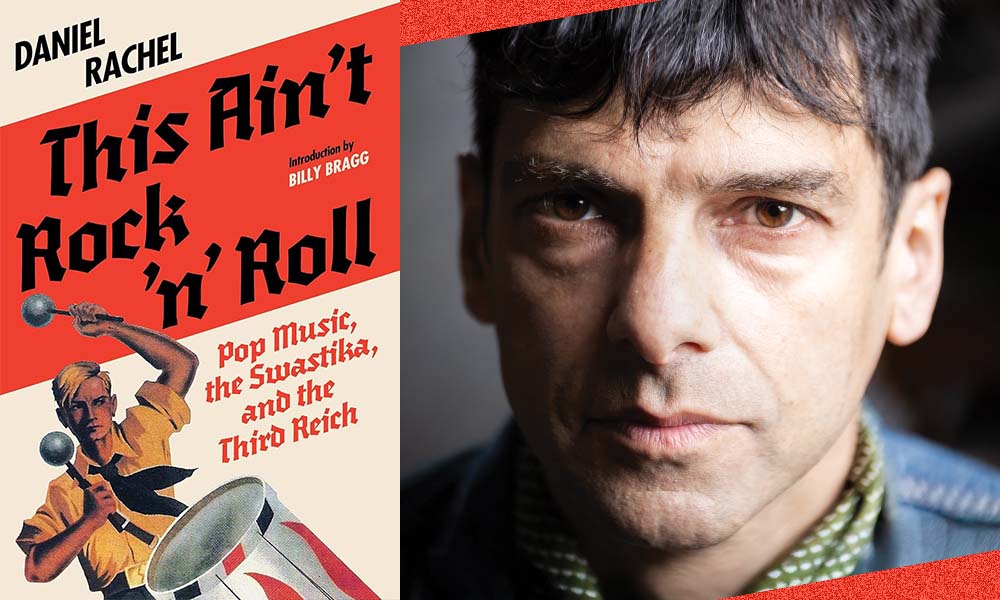
This kind of behavior, Daniel Rachel writes in his far-reaching and meticulous new book, This Ain’t Rock ’n’ Roll, hasn’t always been shamed or minimized. Instead, rock stars to come would pull from the Third Reich in their staging, lyrics, sound and personas to create an uncomfortable flirtation that resulted in the downplay, admiration and even sexualization of the Holocaust. It seems like everyone—from Blondie to Nicki Minaj to the Rolling Stones to Madonna—had gotten tangled up in offensive rhetoric and iconography.
“Sid Vicious would wear a swastika shirt and shove a cream cake into somebody’s face,” Rachel tells me. “I just thought, ‘That’s punk. That’s the attitude.’” Rock ’n’ roll was a fantasy world where onstage characters could be as brash, crass and disrespectful as they wished. Joy Division’s band name was taken from Heinrich Himmler’s initiative of state-sanctioned brothels where SS officers regularly raped women—they later rebranded to New Order, which was the term Hitler used in Mein Kampf to imagine his complete occupation of Europe.
What does this mean for these artists’ legacies? Does artistic intent merit provocation? What about Jewish musicians who try to reclaim a part of their painful history? I spoke with Rachel about these thorny questions, his new book and why rock ’n’ roll’s Nazi problem has been evergreen.
This interview has been edited and condensed for clarity.
I was surprised at the range of bands and artists who, either knowingly or not, used or referenced the Third Reich. How did you start learning about this history, and what drove you to go further?
I started writing about the possibility of music saving the world. It got me thinking about the orchestras in Nazi concentration camps; there were nine in Auschwitz alone. The fact that you could play a violin or accordion or a clarinet might save your life. I realized there were greater writers and academics who had written a plethora on this subject. My passion’s rock ’n’ roll. I thought, ‘How do I write about the Third Reich, which has always interested me, and rock ’n’ roll?’ As a kid, I got into the Sex Pistols, who had a song called “Belsen Was a Gas.” I thought it was great! I saw the humor in it, I’d happily sing it. But at the same time, I was introduced to images of the Holocaust, the liberation of the concentration camps. Seeing these images—the most atrocious ones I’ve ever seen in my life—along with the song was the genesis of these two ideas.
You use German filmmaker Leni Riefenstahl’s Triumph of the Will (1935) as a guidepost for the book, as do many of the artists you write about. Why was the documentary so provocative?
She was an amazing, groundbreaking filmmaker, in the same way some people might say that about Orson Welles or Alfred Hitchcock. She was very close with Adolf Hitler and his inner circle. The joke of the 1930s was that Adolf and Leni were going to have a child together. But what she captured was the brilliance of Hitler’s architect, Albert Speer. He had the ability to create theatrical spectacle, whether it was in the use of flags or color or the 100-foot wingspan of an eagle, or showing how Hitler would talk and how his audience was positioned. Rock stars watched the propaganda film and thought, ‘This was the first rock ’n’ roll concert.’ That comes out of the mouths of David Bowie, Gene Simmons and Mick Jagger. Stars of that status saw the parallel, then began to adopt similar ideas in their dress and stage design. In the mid-1970s, Bowie requested his designer to make his set like Nuremberg rallies.
Some Jewish musicians even incorporated Third Reich iconography to take back its power. Singer and songwriter Serge Gainsbourg drew on his childhood experiences in Nazi-occupied France to release his 1975 album Rock Around the Bunker, which included songs like “Nazi Rock” and “Yellow Star.” What do you make of this strategy?
Gainsbourg was someone trying to positively address the fact that as a young boy in occupied France, he had to assume a different name and flee with his parents into Vichy. He had to wear a yellow star. He tried to address it all in song. He wanted to go further—he wanted to wear an SS jacket on the original cover of Rock Around the Bunker. That’s all fantastic because he has the context and legitimacy to do that. He manages to put that into a record and mock it in the style of the music in so many different ways, such as imagining Eva Braun singing “Smoke Gets in Your Eyes.” He’s a very controversial figure. It’s not surprising the record didn’t sell well, particularly outside of France. But he’s a national hero, particularly to the alternative underground scene.
On the other hand, some non-Jewish musicians, like Michael Jackson, wrote about antisemitism in his song “They Don’t Care About Us” as a means of activism and solidarity. But do you think this could be sort of distasteful?
That’s interesting, because Michael Jackson wrote derogatory terms about Jewish people, then a rabbi at the Simon Wiesenthal Center in Los Angeles called him out on it. To Jackson’s credit—an alleged pedophile, so I have problems talking about him—he changed the lyrics and educated himself, went to a Holocaust center.
Could people profit off it as well? I’m thinking of when you write about the Manic Street Preachers or the Indigo Girls, non-Jews who educated themselves but sing about the Holocaust in songs like “The Intense Humming of Evil” or “This Train Revised.”
Well, you don’t have to be Jewish to write about the Holocaust. It affected millions of people, like the Roma, Sinti, those deemed physically or mentally not of the superior race. They were the first people to be gassed. I’m not one for saying you have to be the person to be able to write about it. I read novels by women—can they not write about male characters? The songwriter from the Indigo Girls wrote with context and sincerity. She was appalled because she didn’t learn about the Holocaust in school. She self-educated, then wrote a song about it based on Woody Guthrie’s “This Train Is Bound for Glory.” I thought that was hugely admirable. I’m curious, do you have a problem with it?
No! I feel like if it happened today people might have a problem. Empathy’s going out the window. People can write about whatever they’d like, I just find it interesting to talk about.
Very interesting. A really big figure in British pop and rock history is Paul Weller, of the Jam and Style Council. He wrote a song about a love affair in Dachau, a concentration camp, and set it amongst human degradation and waste. He’s secular, or maybe has a spiritual background, not in any way Jewish. He’d been to Dachau, and he read about it. The more who write about [the Holocaust] beautifully, sensitively, like him, the better. When you say [history] only belongs to certain people who can discuss it, I think that’s dangerous.


Speaking of sensitivity, in response to south London band Fat White Family’s song “Goodbye Goebbels,” a ballad about an imaginary farewell before his and Hitler’s suicide in their bunkers, frontman Lias Saoudi said, “There’s tenderness in all things. I think it’s your job as an artist to explore whatever you feel like exploring.” I’d agree with this, and I think there is something to be said about following where your creativity leads you.
[winces] When we deal with subjects like the Holocaust—and that band has done many songs about leading figures of the Nazi regime—and they’re not in any way contextualizing their songs, I found that quite challenging. It’s more difficult to read where their positioning is, despite the fact that they have a Jewish guitar player. But that’s ultimately up to the readers and the listeners. The singer of the band did get an advance copy of his part in that chapter, in fact. I thought, ‘There’s no way he’s gonna sanction this being in the book.’ But the only thing he asked was, ‘Can it be added that I now have a Jewish girlfriend?’
So, what’s the difference between a love song set in a concentration camp versus one between Goebbels and Hitler? They’re victims rather than oppressors?
There’s a song by Slayer, “Angel of Death.” At concerts, thousands of fans are screaming that line back, and it’s about Josef Mengele, the doctor in Auschwitz who reportedly operated on children without any anesthetic. All kinds of experimentation to further the cause of medicine regardless of human pain. There’s very exact descriptions of what he does in the verses.
But wouldn’t you say the people in power are more interesting to write about? That there’s more to probe?
Absolutely. And there’s countless explorations in films, books and essays on Hitler, Goebbels, Mengele. In those kinds of arenas, there’s a contextualization, where you see the full story. When it’s presented in pop music, I think there’s a division between atrocity and theatrical spectacle. There’s a sense that it’s cool to do this, it’s against the mainstream. My comparison would be, with what you’re asking, if rock ’n’ roll showed a lynching of a Black man in America from the 1960s. Or we graphically showed images of a rape, or violence against women. I would say that since the death of George Floyd, since the #MeToo movement, rock ’n’ roll is facing up to that, saying, ‘How do we now move forward, now that these have been tropes for seven decades?’ But when it comes to fascism and swastikas, rock ’n’ roll hasn’t said, ‘We have a history that we have to look back to. We made mistakes. We have to take responsibility.’
I see your point. Here’s a quote that caught my eye by Adam Ant: “If people call me a Nazi onstage—that’s fine because I accept that they can call me whatever they want—as an artist.”
I was a big Adam and the Ants fan, and he was one of the hardest artists to write about. I’ve got loads of his records. That made me think: Can we separate the persona on stage from who they are? A fan has to make their own decision. But it’s about patterns of behavior. Adam Ant was one of the biggest pop stars of the 80s, very successful. He was giving elevated status to people who have committed unbelievable crimes. In his song “Deutsche Girls,” he sang about a love affair with his ideal Aryan women. Then saying, ‘It’s because of these films, it’s because of Mel Brooks.’ I don’t know if you can give an audience that kind of license.
The usual retort is “I’m not a fascist! I’m not a Nazi!” but he threw his hands up and said, “well, it’s not up to me.”
Adam Ant was very well-read; he wrote songs about Italy, Futurism and fascism. I don’t know how much was naivete. To tell a journalist your idol is Ilse Koch, the commandant’s wife who ran Buchenwald…what she was responsible for was horrific. People said made human skin into lampshades. And Ant’s writing a song about his love for her and this sadomasochistic fantasy.
I’m glad you brought her up—Koch was basically reinvented as a sex icon that spawned novels and movies. She’s another complicated character.
Yes, she absolutely is. The Nazisploitation films of the ’70s are just sexual romps. I watched Ilse, She Wolf of the SS (1975)—it’s just a pornographic film, except with people wearing Nazi costumes. And yet, many artists cite films like that as a huge influence on what they were doing. It’s great to explore, but you wouldn’t show that film to a Holocaust survivor!
How do you think artists are navigating this landscape now, with so many missteps to learn from?
We’re still excusing the use of Nazi imagery in many ways. Kanye West’s song, last year, had a chorus of “Heil Hitler.” He’s talked about his admiration for Hitler, then he’s apologized, then gone back and said more outrageous things. And to my knowledge, his last couple of albums have sold millions of copies. It’s not just about artists. I think we all have culpability. I’m a fan, I own some of these records. You probably do. If we take Kanye West: he has a manager, people who work around him, a record company, the media who writes about him. We can’t look at an artist as a silo. Decisions have to go through so many permutations and people. And yet they still appear.
This Ain’t Rock ’n’ Roll: Pop Music, the Swastika, and the Third Reich is available now.
Moment Magazine participates in the Amazon Associates program and earns money from qualifying purchases.