
Once, when I was a kid, I was with a group of friends when one of the non-Jewish kids asked us Jewish kids, “Do y’all believe in heaven?”
“I don’t know,” one of my friends said. “Let me call my mom.”
I remember thinking how strange that was. How could someone else tell you what you believe?
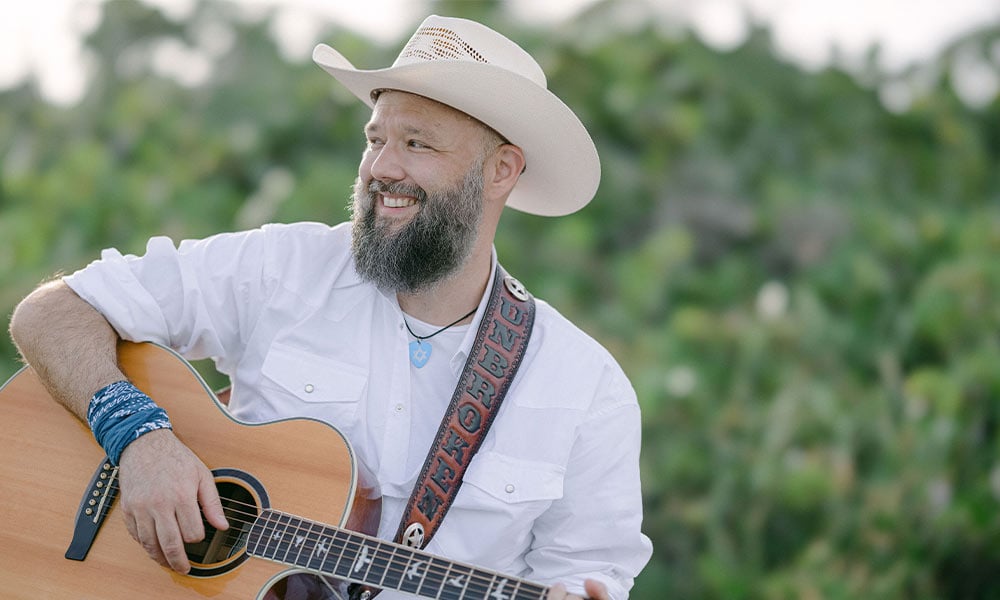
Years later, while talking with Texas country singer-songwriter Joe Buchanan, I found myself thinking about that moment again.
Buchanan grew up believing deeply in God but almost entirely outside organized religion. His parents didn’t want religion in the house, but his grandfather gave him something simpler that never left him. One day, he called his grandson over and told him to look outside.
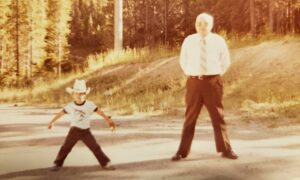
Joe Buchanan with his grandfather. Courtesy of Joe Buchanan.
“You can see God in the world and the way people work,” he said.
Buchanan asked what God wanted from him.
“I don’t know,” his grandfather replied. “Live a good life. That’s all God can ask of you.”
As Buchanan got older, he started looking for something more structured. He went to churches with friends and asked what he calls “a million and five questions.” Too often, honest questions were treated as doubt, and doubt as weakness. Not understanding something could be taken as evidence that his faith simply wasn’t strong enough. Eventually, he stopped looking and figured he and God would “settle up at some point.”
Meanwhile, music was always there.
Buchanan was a lonely kid. On his family’s ranch in South Texas sat a Wurlitzer jukebox filled with George Jones, George Strait, Dolly Parton, Loretta Lynn and, somehow, Survivor’s “Eye of the Tiger.” Those records were his first storytellers, but they were also company. Music was, he told me, “the place I could go to feel welcomed,” the place he could go to feel grounded and present.
The first song he remembers being unable to stop listening to was Marty Robbins’s “El Paso.” To Buchanan, the story of a cowboy, a woman named Feleena, a gunfight and a fatal return was his first epic.
“The music fit the story,” he told me. “The kavanah was in the music itself.”
That stopped me.
Kavanah is the Hebrew word for intention. Of course, Buchanan didn’t know that word as a kid listening to Marty Robbins. He only knew that somehow the sound itself carried the truth of the story. Decades later, Judaism gave him a word for something he had already understood.
Listening to Joe, I found myself thinking about my own experience with Judaism.
Joe had grown up outside Judaism, searching for a tradition that had room for the questions he already carried. I had grown up inside Judaism and gone somewhere else looking for the kind of questioning I thought Judaism had promised me.
Some of my earliest memories are of sitting in synagogue beside my father and grandfather. I remember watching the men around me sway as they prayed and sensing that something real was happening. I didn’t understand it yet, but I knew I wanted to feel it myself someday.
As I got older, I began noticing things I couldn’t have noticed as a little kid. Some people still seemed keenly present in the synagogue, while others appeared to just be going through the motions. I could sense the difference between people who were experiencing something deep and people who simply knew the choreography.
More than anything, I struggled with something else. I was always told that Judaism was a religion of questioning and wrestling, a tradition in which you could challenge ideas and ultimately find your own way. However, as a kid, that wasn’t always how I experienced it. Too often, it felt as though the questions came with the answers already attached.
And then I found jazz.
Jazz became the first place where I experienced what I had always hoped to find in Judaism: a tradition that honored the people who came before me but also welcomed questions and expected me to figure out what I had to say.
Jazz gave me something else, something I didn’t know I needed. I struggled seriously with obsessive-compulsive disorder as a kid, and when things became overwhelming, I would go to the piano and play. Sometimes I’d improvise on two chords for hours. Sometimes I’d sit with a Gershwin ballad and play it as softly and sadly as I could. I wasn’t trying to fix what I was feeling. I was trying to find music that fit it.
Looking back, I think that’s one of the reasons Joe Buchanan’s description of Marty Robbins stopped me. Long before either of us had words like kavanah, we had both discovered that music could carry the truth before we knew how to explain it.
When my bar mitzvah finally arrived, I was already looking forward to the part that had nothing officially to do with becoming a bar mitzvah.
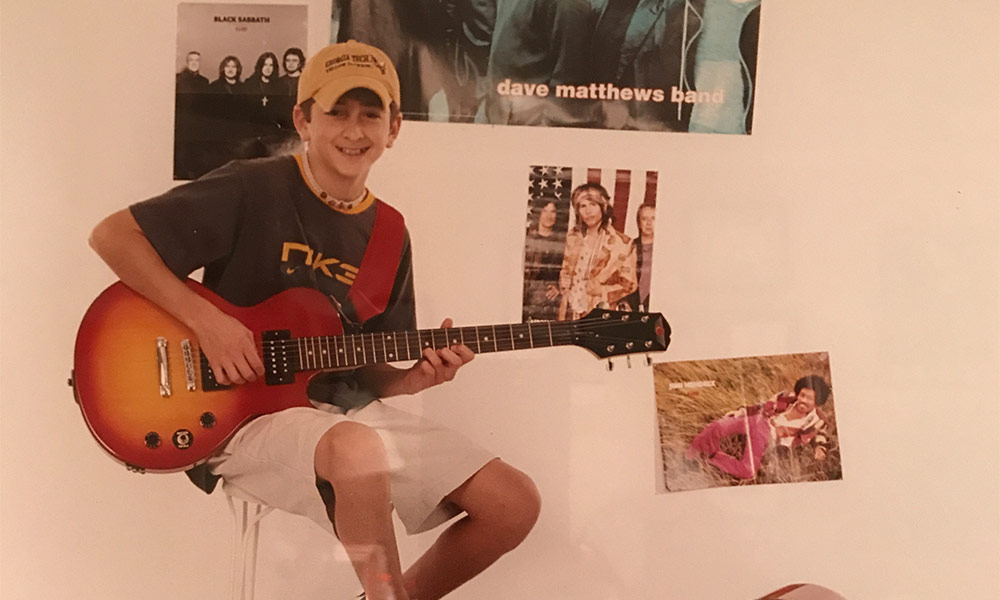
The photo guests signed at Joe Alterman’s bar mitzvah. Courtesy of the author.
I didn’t understand the day as some great entrance into spiritual adulthood. It felt more like a test: Learn the Hebrew, get the trope right, don’t lose my place, try to understand what it all meant but, more importantly, sound like I understood it, and make it to the party.
Which, somehow, I did.
But before the evening party came the part I had been looking forward to all day: going home, picking up my guitar and being by myself. In those days, it was the instrument I felt closest to. The moment I walked out of the synagogue that day, all I felt was relief. The test was over. I would never again be quizzed on my Torah memorization skills. The event that was supposed to feel sacred had felt, to me, more like performance, while the thing that was supposed to be extracurricular felt true.
Today there are Jewish words and melodies I haven’t spoken or sung in years that still feel deeply familiar. At my bar mitzvah, much of the Torah reading felt like memorizing sounds well enough to reproduce them correctly. The songs weren’t so different. I knew the words mostly as sounds that belonged to melodies. Now those same words and melodies connect me instantly to people, places and moments I thought I’d forgotten. What once felt memorized now feels inherited.
Joe Buchanan had been married to his wife, April, for thirteen years before realizing that she was Jewish.
The two were visiting Washington, DC, when they went to the United States Holocaust Memorial Museum. After walking through the room filled with victims’ shoes, they emerged shaken. Standing outside, April told him she wanted to reconnect with her people’s faith.
“What?” Joe asked. “Who are your people?”
“I’m Jewish.”
“Wait. When did you get Jewish?”
“I was born Jewish.”
Joe started to object. “You can’t just be born Jewish.”
“Joe,” April told him, “it’s how it works.”
“You know how it works?”
“You don’t know how it works.”
He considered that.
“That’s true.”
Then April told him their son, Nathan, was Jewish too.
“Does he know that?” Joe asked.
Joe tells the story with perfect comic timing, but the bewilderment was real. He knew April’s mother was Jewish. He had seen a Star of David necklace in April’s jewelry box. He simply had no framework for understanding what either fact meant. April had grown up without synagogue, Hebrew school, Shabbat or much Jewish practice, and Judaism had never really become part of their life together.
Eventually, Joe, April and Nathan walked into a small synagogue in Houston and met Rabbi Stuart Federow. Joe introduced them as plainly as he could: April and Nathan were Jewish. He wasn’t. Nathan had only recently found out he was Jewish. None of them really knew what any of it meant.
Federow looked at Joe and said, “There is one God and there is nothing wrong with you.”
Joe describes what followed as “30 years of therapy all at the same time.”
Federow told him that people do good because goodness puts more good into this world, not because they are purchasing a reward in another one. He told Joe that he was loved by his creator exactly as he was, that no intermediary stood between him and God, and that no one could say for certain what happened after this life.
“This life is the gift,” he told him. “You have to take care of it.”
Joe was stunned.
“Is that it?”
“No,” Federow said. “There’s a lot more than that.”
“Well,” Joe said, “I’m in.”
Then Joe said something that changed the whole story for me.
“This was what I had been looking for and believed in since I was very, very young.”
I thought immediately of his grandfather.
Live a good life.
Years later, Rabbi Federow was now telling him much the same thing. Joe wasn’t discovering a new way to see the world. He was discovering that the way he had seen it all along had a place in Judaism.
“It changed everything,” he told me. “Judaism and the Jewish people helped me get back in my life. I didn’t realize I was outside of my life.”
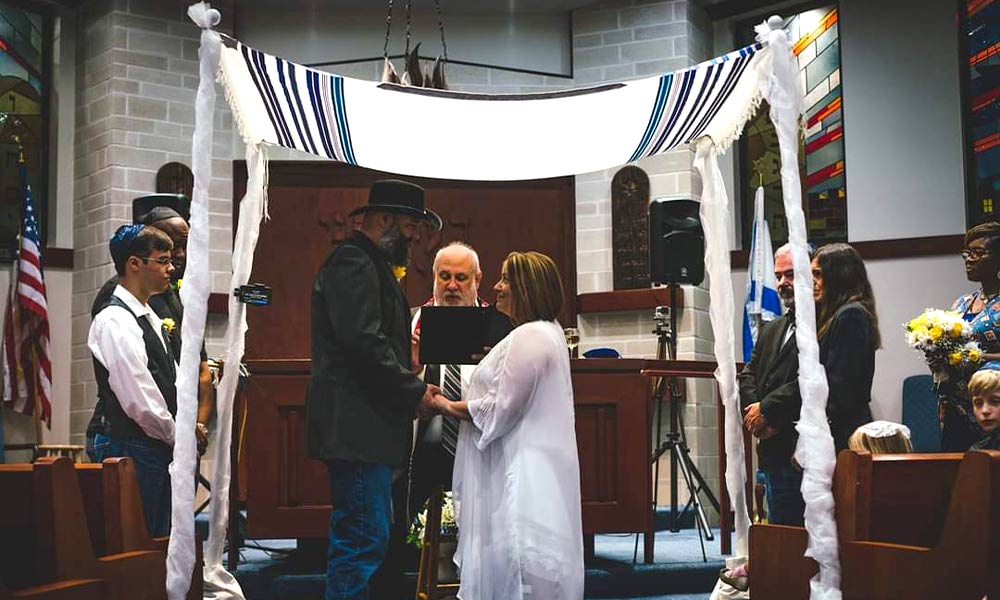
Joe and April Buchanan. Courtesy of Joe Buchanan.
Our paths had been almost the opposite. Joe had grown up outside Judaism, searching for a tradition that had room for the questions he already carried. I had grown up inside Judaism and gone somewhere else looking for the kind of questioning I thought Judaism had promised me.
For a while, I wondered how differently I might have experienced Judaism if someone had introduced it to me the way Rabbi Federow introduced it to Joe. But I don’t think it’s quite that simple. Timing matters too.
Later, in college, I began to notice that jazz could have its own version of the contradiction I had felt growing up. Everyone talked about the importance of being yourself and finding your own voice, but then the gig inevitably became: “Play like McCoy on this tune. Play like Keith on this one. Play like Herbie here.”
There was nothing strange to me about that. Every musician does it. We take things from the players we love, absorb them, mix them together and, over time, they become part of who we are. What felt strange was being told that the goal was individuality while sometimes being given such specific instructions about who to sound like.
Had that been my first experience of jazz—rather than a music that invited me to ask questions, find music that fit what I was feeling and figure out what I had to say—I’m not sure I would have fallen in love with it either.
Maybe Joe needed to encounter Judaism when he did. Maybe I needed to encounter jazz when I did.
Once Joe began studying Judaism, he wanted to understand everything. Hebrew came to him the way song lyrics always had: The first question was, how do I pronounce this? Then, what am I actually saying? Soon, what does it mean?
He wrote songs as part of that journey and discovered that Torah was full of the same kinds of people who had filled the country songs he had loved since childhood—people who made mistakes, wrestled with themselves, fell in love, doubted, hoped, failed and tried again.
“We’re a people with incredible stories,” he told me. “Country music is all about that.”
So he wrote those stories in the language he already spoke: a country love song built around Ani l’dodi v’dodi li—“I am my beloved’s and my beloved is mine”; a setting of Hashkiveinu, the evening prayer for shelter and peace, and songs about figures like Moses and Eve, all unmistakably country while carrying Jewish words and stories.
He doesn’t think of that as blending two worlds. To him, they are simply his world.
“If you take away the words,” he told me, “it’s just country music.
“You can call it Jewish country if you want to, he added. “Just don’t call it Jewgrass.”


Toward the end of our conversation, Joe came back to kavanah. He told me that when he and his band are working on a song, they often stop and ask whether the music fits the heart of the story. If it doesn’t, they keep working. That is especially true when he writes a prayer melody.
“The kavanah in the music itself,” he said, “should match what’s being said.”
The same word had followed him from a jukebox in South Texas to a synagogue in Houston.
Joe’s path into Judaism had begun with questions, and Judaism had never asked him to stop asking them. It had given him somewhere to keep asking.
I still think about my friend wanting to call his mother to find out whether he believed in heaven.
What stayed with me after talking with Joe was that he had found a tradition that trusted him with the questions he had been carrying all along—and where much of what he had believed, felt and even heard in music long before already had a place.
Talking with Joe made me understand my own story differently. Listening to him describe what he had found in Judaism, I began to recognize the very things I had spent years loving in jazz: a tradition that welcomed questions, honored the people who came before you and insisted that your own voice mattered.
I don’t think my story changed. My understanding of Judaism did.
Top image: Joe Buchanan. Credit: Lila Photo