
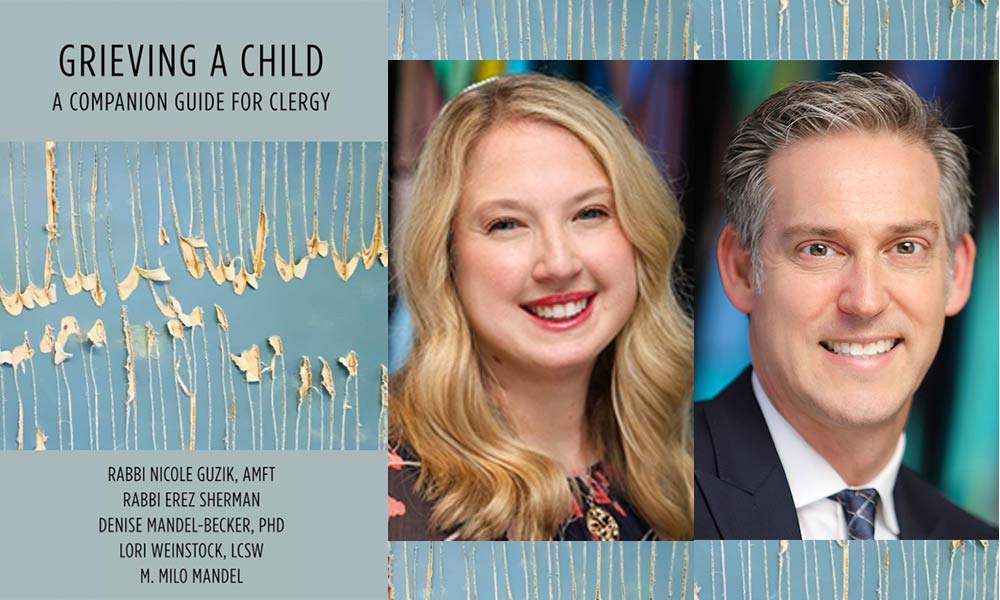
When Rabbi Nicole Guzik was new in her role as co-senior rabbi at Sinai Temple in Los Angeles, she took a group of congregants on the yearly visit to the synagogue cemetery between Rosh Hashanah and Yom Kippur. There she spoke about various loved ones people might be mourning—parents, siblings, aunts, uncles. A few days later she received a phone call from a longtime congregant who had lost his young grandchild. She remembers him telling her, “You know, Rabbi Guzik, I loved your sermon, but I have to tell you, you did not mention one category of loss—children. This is because, thank God, you haven’t really encountered this yet, but you will, and now that I’m telling you, I don’t want you to ever make this mistake again.”
“And I never did,” Guzik recounts.
A few years later that same congregant, Milo Mandel, sat down with Guzik and her husband, fellow Sinai Temple rabbi Erez Sherman. He told them that when his young grandson Jared had died, the rabbis he encountered didn’t have the language to provide comfort and were not sure how to proceed. The three of them decided to create a guide that rabbis and other clergy could use when faced with the unfathomable death of a child. For six years, the two rabbis worked with Mandel and his two daughters—Denise Mandel-Becker, Jared’s mother and a clinical psychologist specializing in child loss, and Lori Weinstock, a clinical social worker—to write a manual that can assist clergy in navigating the many steps involved in this agonizing emotional journey.
What emerged was Grieving a Child: A Companion Guide for Clergy, the first comprehensive pastoral guide designed for those supporting families after the tragic death of a child. The book walks clergy step-by-step through the initial call to the funeral and memorial services to how to support families in the months of grief that follow. Interspersed between the chapters is poetry from Denise Mandel-Becker that offers a window into the grief a parent feels. It takes a practical yet sensitive approach, including sample eulogies, service structures and the precise language to use when communicating with the families.
Moment spoke with Guzik and Sherman about the process of putting together the guide, the way a child’s death affects the entire community and the importance of letting the mourner lead the way.
This interview has been edited and condensed for clarity.
As I was reading this, I had to stop many times, because it made me so deeply uncomfortable. As a society, we are uneasy talking about death, especially when it cuts a very young life short. Why do you think that is?
Guzik: At Sinai Temple, we have a very strong Persian community and a very strong Ashkenazi community, and one thing that’s very similar in both communities is this idea that you don’t talk about death, because if you talk about it, it’s going to touch you. People feel, “Oh, if I speak about someone’s lost child, I might be bringing an [evil] eye on me.” Other people worry that they might be causing the family even more pain. But you can’t bring them more pain. It’s the most horrendous, tragic, traumatic event of their entire lives that will continue to ripple forward, and so mentioning their child’s name can’t bring more pain. Most often, bringing up their child’s name just reminds them that their child is not forgotten.
Sherman: While we were working on this book we had some really interesting conversations about death in the congregation’s preschool, specifically with parents. We found that parents were not, for instance, telling their children when a grandparent passed away. We actually learned a lot from the Mandel family in this regard. Over the years they would continue to speak about Jared, and he was part of their life in the most amazing, beautiful way. Milo unfortunately died a few weeks after our manual was published, and even at his funeral, Jared was not only mentioned but felt like a presence.
Bringing up their child’s name just reminds them that their child is not forgotten.
You’ve mentioned this is the first type of guide written for clergy about the death of a child—why do you think it took until now?
Guzik: With the death of a child, you are so immersed in the pain and the trauma that for a clergy person to revisit some of those moments, it’s like re-opening a wound. It took Milo looking us in the face and saying ‘I need you to do this’ to make us realize how necessary this really is.
Sherman: We learned about rituals of death in rabbinical school, but truthfully, we didn’t learn about this exact situation. However, throughout the six years that we were working on this project, over and over again on our listservs and our private rabbi Facebook groups, the question would come up: rabbis saying a child had died in their community and asking if anybody had any materials or resources. And we were like, “We’re almost there!”
Now that this project is in the world, it’s comforting to know that somebody will have this book on their shelf when questions arise. And even though it’s directed toward rabbis, grief clinicians and others can use it as well, because grieving is a ritual that is personal and communal, and it’s really the mourner who leads the way in what their journey will look like.
That comes up a lot in the book—letting the family or the mourner take the lead as opposed to focusing on rabbinic rules or the traditional order of things. Is that specifically important when it is the death of a child?
Guzik: It’s not that you’re letting the mourner come up with their own mourning guidelines, it’s being so attuned to where they’re at, which can be different at different hours of the day. Maybe what the typical structure of shiva looks like is not appropriate for this family, or maybe it’s exactly what they need. Is this a situation where they are so emotionally depleted that they can’t open their home to the hundreds and hundreds of people that would want to visit? At the same time, you need to be careful about giving too many options so as not to overwhelm the mourner. Instead I would say something like, “I can see that you’re emotionally depleted right now. Here’s what I would suggest…” to lead in that way. I’m also a therapist, and sometimes, when I’m in therapy with someone, I’ll say, I could be mistaken, but here’s what I’m seeing right now, and let the other person say, “Oh no, I’m not feeling that way,” or, “You know, you’re exactly right.” So that’s kind of the approach.


How do you envision this manual being used?
Sherman: You know, in these moments, there’s usually no time to sit down and be like, “Oh, let me think about this.” You are just pushed onto a main stage, and there’s pressure, and so here are resources that say to do these specific things. It’s not just the funeral; as important is actually the day after a shiva ends. We sat in somebody’s home recently, where there had been a tragic death, and they just were screaming, “Why? Why? Why?” and the answer was just holding their hand, the answer is just to be there.
I hope nobody ever needs to take this book off their shelf, but when it is needed, it will be there. And I think what’s unique about it is the joint authorship, that it wasn’t the result of a rabbi telling a family what to do, it was actually a family who came to the rabbi saying, “I want to help you so that when a family goes through this, they have rabbinic support they can lean on.”
Grieving is a ritual that is personal and communal.
Guzik: There are very practical sections for a rabbi who is so busy sitting with the mourner, that they may think to themselves, “How am I possibly going to begin my eulogy?” There are examples of how they could begin, and they could lift it off the page, and I think it would feel genuine. And so, while the manual really speaks to the emotional piece, I think it’s also very much a practical guide for rabbis to use when they should really be spending their time sitting right next to the mourners. It also should make you feel, like, “I’m not alone in this.” Even opening it up while you are sitting in the car after the funeral, and reading the part where it advises taking time for yourself as the clergy person, and knowing that it is ok that I need to take these deep breaths. In fact, I’m honoring the baby or the child’s memory by taking some time for myself, because otherwise it just feels like you’re thrown into an ocean by yourself. No one could understand what the clergy person is going through, so our main goal and hope is that the clergy person doesn’t feel alone in their own emotional journey.
For a layperson, if they read the book, what would you want them to come away with?
Sherman: Guides exist for other Jewish rituals and life-cycle events that come in handy for people. I’m thinking about Anita Diamant’s The New Jewish Wedding, for example, which offers choices—do you want to have the bride circle the groom seven times? Do you want the bride and groom to circle each other, or nothing at all? Here are the options of what’s going to be meaningful to you, to your tradition, to our tradition together, and I think our book is going to be the same type of guide. We didn’t really think about the clinicians until recently: People aren’t just going to their rabbi, they’re going to the heads of their school, counselors. Imagine if a school counselor or principal who didn’t know anything about Judaism or Jewish tradition had this resource in that moment. As we began writing, we realized that it’s coming from a rabbinic voice, but it’s going on to different spheres.
Guzik: Whether for a layperson or clergy, as a manual it’s not really meant to be read straight through. It’s designed so that you can pick it up, open up a section and, for example, when you’re about to walk into a shiva home, read about the things to say and not to say. It’s also valuable for the mourner who is going through this tragedy to know that they’re not alone in their grief, that there’s not one way to mourn, that their grief will come in hurricanes and tsunamis, and also drizzles.
7 thoughts on “‘Letting the Mourner Lead the Way’”
We lost our daughter, Sarah (z”l) in July 2020 at age 38. While she had some health issues, her sudden death came as a shock and had us in a fog for some time. We’ve dedicated ourselves to promote and sustain our daughter’s legacy by funding and engaging on issues she championed : Holocaust education and social justice, early childhood education and inter generational engagement. And we tell the stories of her amazing life.
I am so sorry for your loss.
Our daughter died at age 14 after a 20 month battle with brain cancer. Our clergy actually did an excellent job and we felt very supported by our community at Temple Beth Am. But many people are afraid to talk about a young person’s death. I’m sure this guide will be helpful.
I am so sorry for your loss and glad to hear you were supported by your clergy and community.
We lost our 59 year old son this past May, and after the burial we sat Shiva and received visitors back at the Temple. The outpouring of condolences from virtually every member of the Congregation was so comforting to our family. Yes it’s true, knowing that others share your loss is so meaningful to the mourners, and helps the healing process begin.
We are forever grateful !
I am so sorry for your loss. May you be comforted among the mourners of Zion and Jerusalem.
June 21, 1960 I lost my second baby and second son shortly after delivery. He had problems breathing on delivery and never recovered. He died at 4 days. He went from the small hospital in Glendale that no longer exists to LA Children’s. I only held him for a moment right after delivery. My husband, his father and my father took care of everything. I was not allowed to go to the cemetery for the small service. I was told to forget it and move on.
We moved on, had 3 more sons. Girls were never in the picture until my granddaughters made an appearance. I’m now 93 and am enjoying a large array of grandchildren and great-grandchildren but I have never gotten over the lose of my second son. I take great comfort in knowing that mother today are allowed to grieve and not just told to forget. My 4TH great grand son is 3 days old and all the memories are still there