
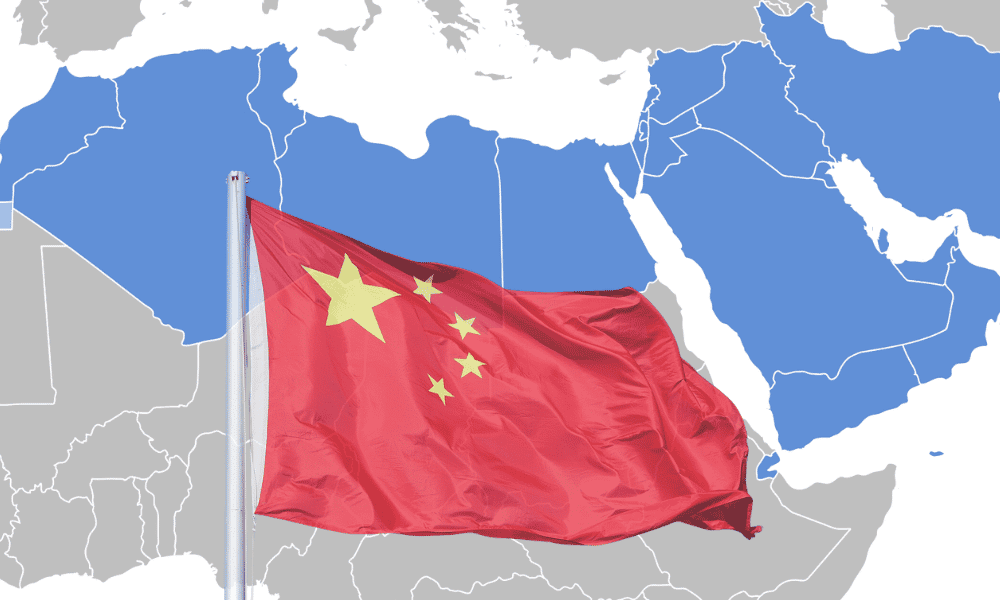
Who has the upper hand in terms of influence in the Middle East? Increasingly, the answer depends on what you’re measuring. Historically, the United States has been the fast mover in this conversation, with its policies and priorities—like war with Iran—profoundly shaping the region. And when it comes to military power, America is still the region’s dominant external actor.
Europe has a role to play, too, on diplomatic topics like peacekeeping in Lebanon and, less successfully, Israeli-Palestinian peacemaking. Even Russia has assumed a higher regional profile ever since the Kremlin waded into Syria’s civil war on the side of the Assad regime more than a decade ago.
More and more, though, another actor—China—is taking center stage in the calculations of regional states.
That’s a dramatic change. Historically, the People’s Republic of China (PRC) has been only a bit player in Middle Eastern politics, limiting its engagement to arms sales and energy purchases. Over the past several years, however, Beijing’s economic and political inroads have begun to change the region’s complexion.
Those are the findings of the Great Powers Index, a new project launched by the Middle East Broadcasting Networks, a U.S. government-funded Arabic-language broadcaster. (Full disclosure: I sit on MBN’s board of directors and have advised on its projects, including this one.) The Index looks at how China has engaged with the region in the past decade across five distinct areas: military, economy, diplomacy, soft power and technology.
The conclusions are striking. First, China’s regional influence is unmistakably growing. A decade ago, China had closer ties than the United States did to just 9 of the 23 states that make up the Middle East/North Africa (MENA) region. By 2025, that number had risen to 12. A large part of the reason is trade; last year, Chinese commerce with the countries of the Middle East and North Africa clocked in at $510 billion, more than two and a half times that of the United States, as a result of Beijing’s heavy investments in the national development priorities of regional states.
A good example is Egypt, which has taken a pronounced eastward turn in recent years. China has turned into Egypt’s largest trading partner, and Chinese firms have poured upward of $10 billion into the country—with most of it flowing to the economic zone the Egyptian government has erected around the Suez Canal (which is central to Cairo’s national development vision). All of which has shifted Egyptian priorities and preferences, to the point of calling into question the country’s historic role as a cornerstone of U.S. Mideast policy.
Second, the PRC is gaining ground in regional tech. Chinese firms are now a major presence in regional telecommunications markets and digital infrastructure, even as companies like Huawei find themselves shut out of Western countries because of security concerns. The numbers reflect this trend: Between 2020 and 2025, China’s tech trade with the Middle East and North Africa increased by roughly 65 percent, reaching $21 billion and decisively eclipsing the region’s technology trade with the United States.
Ominously, this sort of commerce isn’t exactly value-free. Rather, the tech exports of China’s “national champions” are weighted heavily toward surveillance, censorship and monitoring—precisely the sorts of tools Middle Eastern autocrats seek in order to better control their populations. In other words, China’s tech trade has the potential to make the region significantly less free in the years ahead.
Third, Beijing is playing a long game in the information and cultural domains, making its mark with expanded Chinese language instruction and the spread of offcial media outlets bankrolled and directed by the Chinese state. The objective is clear: to cultivate familiarity with Chinese perspectives and normalize a leading political role for the PRC in global affairs.

That tracks closely with the priorities of Chinese President (and Communist Party General Secretary) Xi Jinping. Back in 2013, Xi made “telling China’s story well” a formal Party priority, and since then his government has ramped up its global messaging and outreach with a clear focus on swaying publics in the developing world toward China—and away from the West.
What does all this mean for the region? Middle Eastern states aren’t necessarily abandoning their longstanding partnership with the United States. Regional countries still rely heavily on Washington for their security (although those relationships are now under strain amid the ongoing Iran war and the destabilizing activities of Yemen’s Houthis). But more and more, those same countries are hedging their bets between Washington and Beijing.
That should matter a great deal for an America that’s recalibrating how it thinks about the region, and about its global competition with China. Fundamentally, while Washington is fighting to preserve security and prosperity in the Middle East, Beijing is positioning itself to profit from the region’s future and to shape it according to its own preferences.
Ilan Berman is senior vice president of the American Foreign Policy Council in Washington, DC.
(Top image credit: Furfur, CC BY-SA 4.0)