

Jewish Politics & Power is published every other week. Sign up for our newsletter for updates.
1. A wake-up call for Bibi?
You’d be hard pressed to find a more pro-Israel member of Congress than California’s Brad Sherman. The 15-term Jewish Democrat has long set the standard for traditional pro-Israel voting in the House, supporting military aid to Israel, backing pro-Israel resolutions and even crossing party lines now and then to support measures favoring Israel.
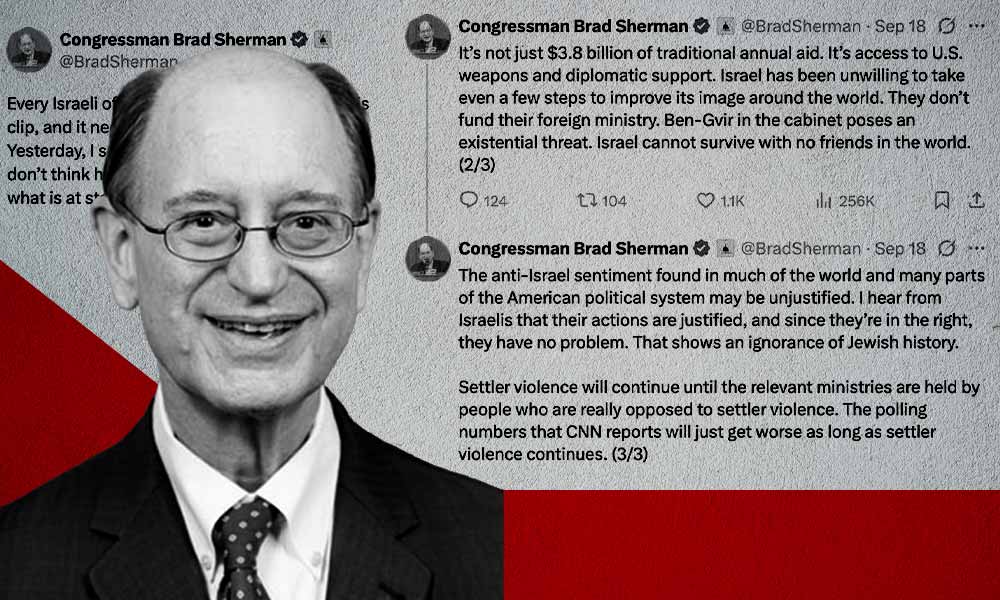
That’s why when Sherman voices his concerns about the state of U.S.-Israel relations, it’s worth paying attention. Last week, he tweeted a stark warning to Israeli leaders, fearing they might not be aware of how the Jewish state is currently perceived in America. He included a CNN poll from July that detailed the sharp decline in support for Israel. In the clip, the pollster passionately points to the figures, exclaiming, “Negative, negative, negative, negative” and concluding that “the general electorate has turned against Israel.”
Sherman suggested in his tweet that “Every Israeli official and voter should watch this clip, and it needs to be translated into Hebrew,” adding that he had just spoken with the Israeli ambassador to Washington,“I don’t think he or the majority of Israelis realize what is at stake.” The veteran congressman pointed out that the erosion of support threatens not only the annual $3.8 billion in military aid, but also access to weapons systems and American diplomatic support. “I hear from Israelis that their actions are justified, and since they’re in the right, they have no problem. That shows an ignorance of Jewish history,” he added.
Offering a way out, Sherman urged Israelis to understand the damage caused by extremists such as far-right cabinet member Itamar Ben-Gvir and called on Israel to curb acts of violence carried out by some settlers in the West Bank.
If Israel loses Brad Sherman, it’s pretty much lost all Democrats.
But that’s not the only reason to listen to his heartfelt plea. Sherman is offering Israel a formula to regain some of the support it has lost: It will have to do away with the far right and take care of extreme settlers. In other words, Israel has to vote out Netanyahu and his government if it ever wants to enjoy some support among Democrats.
Will a future non-Bibi coalition fix the relationship? Not necessarily. It will do very little to win back support of progressives and liberals whose ire toward Israel stems from the ongoing occupation and from Israel’s actions in Gaza. But it could give moderate Dems like Sherman something to work with when fighting for Israel in Congress.
Sherman can already register a small success: His plea was translated, in full, into Hebrew and posted on leading Israeli websites.
2. Israel decries American antisemitism
As much as U.S. politicians criticize the Israeli government, Israeli officials also have a tendency to call out their American colleagues, especially when it comes to what Israel sees as weakness in fighting antisemitism.
Leading the charge is Ofir Akunis, Israel’s consul general in New York, who has repeatedly lashed out at New York City Mayor Zohran Mamdani. Akunis has not only called Mamdani an antisemite and compared his actions to those taken by the Nazis in Germany, he has also accused the mayor of being responsible for the surge of antisemitic incidents in New York. “The mayor is busy inciting against and promoting a boycott of the Jewish state,” Akunis recently told Jewish leaders. “Data released by the New York Police Department points to a sharp increase in antisemitic hate crimes since he took office.”
Mamdani is the leading target of Israeli officials, but he’s not the only one. Following Sunday’s shooting attack at a synagogue in Bellville, Ontario, which targeted Jews gathered for Yom Kippur prayers, the Israeli foreign ministry called out the Canadian government for allegedly not doing enough to counter antisemitism. “Open incitement that goes unaddressed in the public sphere, along with anti-Israel policies, is fueling antisemitism.
A change is needed,” read a statement posted by the Israeli foreign ministry. Amichai Chikli, Israel’s minister of diaspora affairs, took a harsher approach. “How much more must happen before the Government of Canada takes dramatic action against the terror infrastructure, extremist networks and incitement operating in Canada?” he asked on X. “The writing is no longer on the wall. It is now written in blood.”
3. Mamdani takes a step back
A group of some 200 young Jewish students from New York’s most prestigious modern Orthodox middle and high schools gathered Friday outside Gracie Mansion, the official residence of the mayor of New York City, for an hour of prayer against Mamdani. In their speeches, demonstrators spoke out against Mamdani’s views on Israel and voiced their concerns about what they claim is his role in inciting antisemitism in the city.
But Mamdani may be emerging as less of a lightning rod than in his early months in office. After vowing in July to arrest Israeli Prime Minister Benjamin Netanyahu if he set foot in New York and then, after acknowledging that he didn’t have legal authority to do so, encouraging New Yorkers to protest the Israeli leader, Mamdani seems to have changed his tone. In the run-up to this week’s United Nations General Assembly, at which Netanyahu will appear, the mayor not only made it clear that he will not arrest Netanyahu, he also walked back his previous call for rallying against Bibi. “To New Yorkers,” the mayor said, “I have never encouraged them to protest. What I have always told them is that they have the right to do so in the city.”
Mamdani, who on Monday hosted President Trump for a friendly meeting at his residence, is by no means changing his views on Israel. But he could very well be listening to Jewish leaders and politicians pleading with him to tone down his rhetoric.
On Monday, however, the mayor gave an interview to CNN, in which he made it clear that despite dropping his calls for Netanyahu’s arrest, his views on the Israeli leader have not changed. “I described him as I believe him to be—a war criminal and an architect of a horrific genocide of the Palestinian people.”


4. Celebrating High Holidays in an election year
There’s nothing like the holiday season to reach out to Jewish constituents. Especially for those candidates who may have some issues with the community.
Case in point—U.S. Senate candidate from Michigan, Abdul El-Sayed. The progressive Democrat in one of the midterm elections’ most crucial battlegrounds has been battling to win back Jewish voters who are turned off by his staunch anti-Israel views and a problematic comment he made after an attack on a Michigan synagogue.
So he went for a nice Rosh Hashanah meal at the home of two Jewish supporters, identified as Missy and her mother Elaine. In the video of the meeting, posted by El-Sayed’s campaign on social media, the candidate is welcomed with apples and honey, listens to the traditional blessings in Hebrew and marvels over Missy’s noodle kugel (which she makes with apricots, apparently). The clip is warm and fuzzy. El-Sayed loves the food and the traditions and the mother and daughter praise his healthcare policies. Not a word on Israel or Palestine or arms sales.
This type of kugel campaigning has its limits. No Michigan Jew who is upset with El-Sayed’s views on Israel will change their mind just because the candidate showed respect for Jewish traditions. But it could help with those undecided Jewish Democrats who feel unease with the candidate but can now find some comfort in his outreach to the community.
5. JD Vance throws a dinner party
The same is true on the other end of the political spectrum.
Vice President Vance, considered by many a potential 2028 Republican presidential candidate, has also had issues with Jewish supporters because of his criticism of Israel and his isolationist foreign policy views.
Vance took a few steps recently to reach out. He spoke at the Republican Jewish Coalition’s meeting in Las Vegas, then sat down with Jewish radio host Sid Rosenberg, and last weekend, between Rosh Hashanah and Yom Kippur, he hosted a private Shabbat dinner for a couple dozen Republican Jewish supporters.
Just like with El-Sayed’s meeting in Michigan, a Shabbat dinner at the vice president’s residence will not overcome policy differences, nor will it appease those who are concerned about Vance’s friendship with Tucker Carlson. But it is a show of good will and of caring, which Jewish voters can, and probably will, take into consideration.
(Top image credit: U.S. House of Representatives)
2 thoughts on “Brad Sherman’s Warning to Israel”
How can you say its a sign of good will that Vance threw a Shabbat dinner. Total politics. Friendship with Carlson is the true message of his feelings.
Re Vance’s Shabbat dinner. Total hypocrisy. His friendship with Carlson is the real Vance. Not a friend to Israel.