
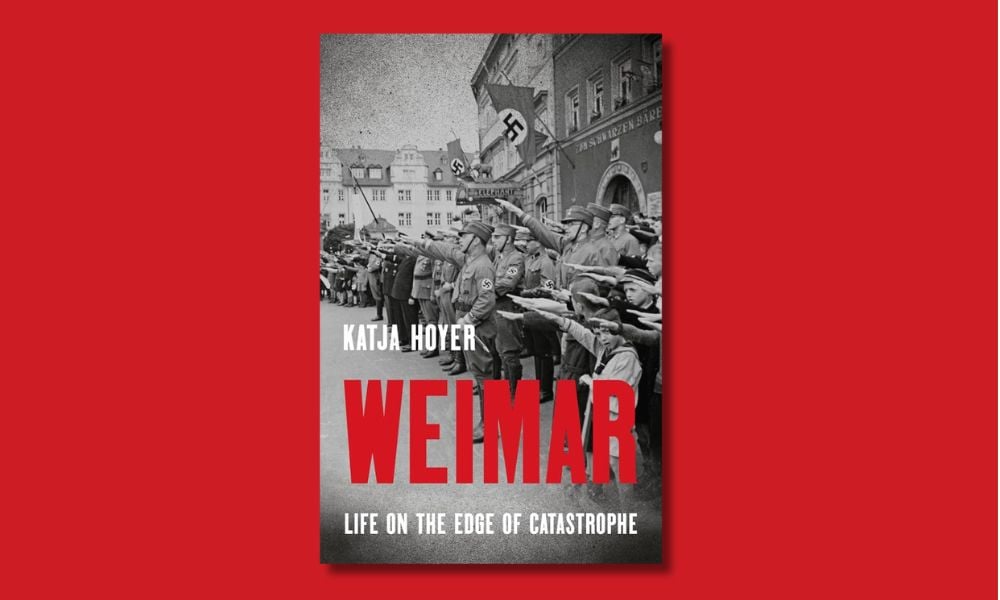
Weimar: Life on the Edge of Catastrophe
By Katja Hoyer
Basic Books, 496 pp.
The small city of Weimar, with just 65,000 inhabitants, located in the very heart of Germany, stands for the best and for the worst of German history. It was the city where Goethe and Schiller created their classical oeuvre of German literature around 1800, where the philosopher Friedrich Nietzsche spent his last years until his death in 1900, and where architect Walter Gropius founded the modernist Bauhaus art school in 1919. Germany’s first democratic constitution was signed in Weimar, and the republic it created was named after the city. At the same time, the Weimar Republic is often used as a synonym for a failed democratic experiment. It was the city in which the Nazis celebrated some of their earliest victories, and on its outskirts they established the infamous Buchenwald concentration camp in 1937.
Katja Hoyer’s highly readable new book portrays the city as “interwar Germany in a nutshell,” as former German president Roman Herzog once called it. It comes at a time when the lessons of the failure of Weimar Germany, and the transformation from a democracy to an authoritarian regime, are important to learn both in Europe and in America. As Hoyer suggests, studying the behavior of the people described in her book “can get us closer to understanding how Nazism took hold and how it was able to spread its pernicious influuence far beyond its fanatical core.” Indeed, this book helps us understand the patterns of thought and the behavior of ordinary Germans.
At the center of Hoyer’s book are not Hitler, Goebbels and Göring, although they appear frequently during their many visits to Weimar, but people like the bookbinder Carl Weirich, the hotel owners Arthur and Rosa Schmidt and the Social Democrat Kurt Nehrling. It is through studying diaries and other original source material that Hoyer presents us with a precise insight into the thoughts of regular Germans of different occupations, religious persuasions and political convictions.
Only after the war disrupted his life and took that of his only son did it dawn on him that the passivity of people like him had enabled the rise of an authoritarian regime.
A few prominent figures also accompany the reader throughout the years. Elisabeth Förster-Nietzsche was the sister and estate manager of the philosopher. She was the one who rearranged his posthumous publications, most prominently his The Will to Power. Much of Förster-Nietzsche’s appeal to Hitler was the result of her distortions of her brother’s work. Even though she was not as fanatical an antisemite as her late husband Bernhard Förster, who had established a German colony in Paraguay based on the idea of Aryan supremacy before he died by suicide, she too held extreme rightwing views. Until her death in 1935, she cultivated close relations with Nazi leaders to finance the Nietzsche Archives she had built in Weimar.
Another prominent figure in the book is Baldur von Schirach, the leader of the Hitler Youth who grew up in Weimar, where his father was the town’s theater director. That same theater was where the actress Emmy Sonnemann was performing when she met Hermann Göring. The two married in 1935, and from then on her only acting role was that of Germany’s unofficial first lady.
As this suggests, Weimar in the interwar period was at the same time a nationally important center and a provincial German town. It was the capital of Thuringia, which had a large Nazi voter base long before the party was successful in the rest of Germany, and which in 1930 became the first state government to appoint a Nazi minister. Weimar is indeed an ideal stage to bring together the lives of the prominent the Bauhaus founders, the Nietzsche followers and the Nazi leaders who visited the town more frequently than any place of comparable size—with those of ordinary Germans.
In Hoyer’s telling, the life of Carl Weirich shows us what many German lives looked like around 1933 and helps us to understand why Hitler was able to come to power and how he consolidated his rule. A middle-class bookbinder, Weirich was neither a committed Nazi nor an opponent of the Nazis. As his diary reveals, the important events in his life were not the political change of guard in 1933, the violence against Jews, the incarceration of political opponents or the restrictions of personal freedom. Rather, he writes of his move to Weimar for professional reasons, the founding of his business, his marriage and the birth of his first child, the early deaths of both, a second marriage, the birth of a son and the move into a bigger house. As long as his family was well and his business flourished, he welcomed the Nazis’ rule. He hailed the annexation of Austria and Hitler’s plan to make Germany great again. He never joined the Nazi party, but he became a supporting member of the SS.
His enthusiasm cooled and he stopped his contributions when the local Nazis decided to tear down his house to build a regional Nazi headquarters. Still, he went along until it was too late to protest. Only after the war disrupted his life and took that of his only son did it dawn on him that the passivity of people like him had enabled the rise of an authoritarian regime.
The lives of Arthur and Rosa Schmidt could have been similar to that of Carl Weirich, were it not for one significant difference in Rosa’s biography. The Schmidts established a successful hotel in Weimar. Even Hitler stayed there several times in the 1920s, and his party used their hotel for frequent mass events they held in the city. The Schmidts enjoyed the economic opportunity. What they did not reveal to anyone was that Rosa had been born in Poland to Jewish parents. They thought for a long time that they could get away with it. When the Nazis stamped the red “J” in German passports and forced Jewish women to adopt the name Sara, Arthur was still able to get “clean” papers for his wife. But when one of their children needed proof of “Aryan descent,” Rosa was doomed. The local authorities found out about her Jewish origins and about the fact that the couple had tried to hide them. Fifteen years after Rosa had hosted Hitler in her hotel, she was deported to Auschwitz and murdered.
What is largely absent from the book are Jewish voices. This is not Hoyer’s fault, as there were very few Jews in Weimar, too few even to build their own synagogue. Hoyer provides witness accounts from those who could escape and reminds us of the fate of those who, like Rosa Schmidt, fell victim to the Holocaust. But most simply did not leave us their stories.
Beginning in 1938, there was, however, a significant Jewish presence of another kind just north of town. While fewer than 100 Jews lived in Weimar, more than 10,000 Jews were brought to Buchenwald within a few hours after the Kristallnacht pogrom of November 1938. Tens of thousands more Jews followed in the last phase of the war, most of them killed either in Buchenwald and its satellite camps or in the death marches in its vicinity. Among them was my uncle Meir, my father’s only brother. He must have walked through Buchenwald’s main gate, which bore the slogan Jedem das Seine (“to each his own”), the letters of which were designed by an inmate who was a former Bauhaus student. Meir probably never got to see the city of Weimar, which was almost completely destroyed by U.S. Air Force bombing in February and March of 1945. An index card of the camp records shows that he was still alive on March 7, 1945, when a Buchenwald administrator noted that he weighed 54 kilograms (119 pounds), was never seriously ill and wore glasses. That was the last documented evidence of his short life. The American soldiers who liberated Buchenwald on April 11 came too late for him.


Hoyer begins her book with an account of April 16, 1945, when thousands of Weimar citizens were taken to the nearby Ettersberg mountain, a once-popular destination for weekend relaxation with splendid views over the town. This tour, though, was not meant for recreation. The Americans wanted the citizens of Weimar to see with their own eyes what had happened over the last eight years at the site right above their town.
Like many others, Carl Weirich walked by the crematorium ovens, the gallows, the instruments of torture and the evidence of medical experimentation. He passed the piles of corpses and the mass graves along the way, and he smelled the indescribable stench of dead bodies. He was also confronted with the last surviving inmates, who looked like living skeletons. When some Weimar citizens closed their eyes, the Americans forced them open. The Germans needed to see what their compatriots had done.
Weirich noted in his diary that it felt to him like “running the gauntlet.” He realized that Germans would be haunted for generations for the crimes he and others had enabled by their passivity, and he expressed disgust and shame about “our German downfall.”
I cannot help giving the last word to one of the rare Jewish voices that survived Buchenwald. While Carl Weirich was relieved to go back to his home in Weimar after touring the concentration camp, Julius Spokojny, a Polish Jew who was 21 when he was liberated in Auschwitz, told me in a recorded conversation many years ago how this “running of the gauntlet” looked from another perspective, from the inmates’ side:
I thought that now they would stay in the camp and we would go to their houses. Since the Germans were responsible for the war and for the murder. Now our liberation had come—so how could it be any different? I looked at every German and said to myself: Now I get his house and he goes to my camp bed. But it turned out that they were sent back home in the evening, as if it didn’t matter what crime had taken place, and we had to stay in the camp. And for years, we had to stay in locked camps.
Michael Brenner is distinguished professor of history and director of the Center for Israel Studies at American University in Washington, DC.