
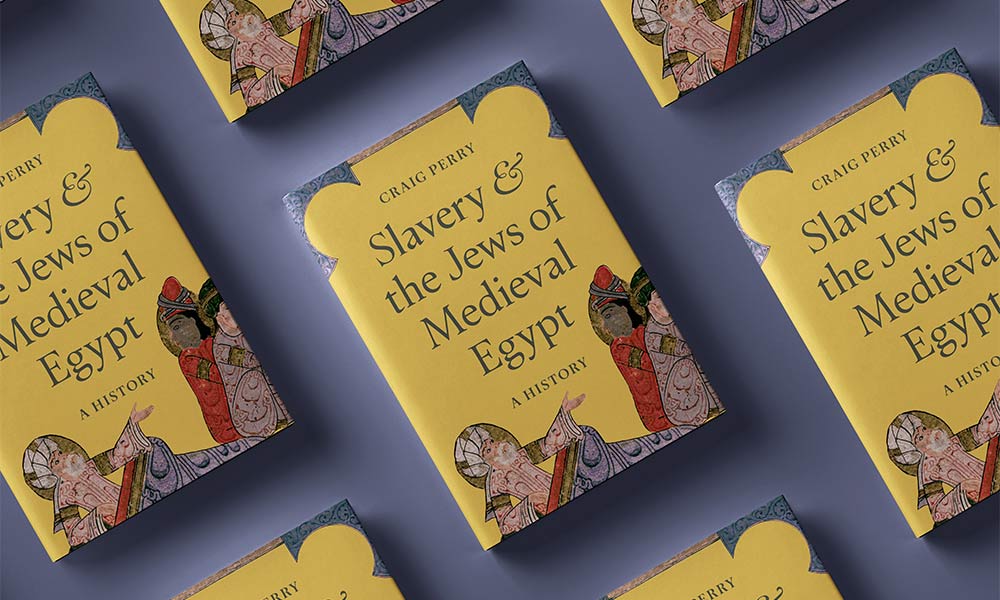
Slavery and the Jews of Medieval Egypt: A History
By Craig Perry
Princeton University Press, 368 pp.
Each year at Passover, Jews gather around the seder table and recite a familiar line: We were slaves in Egypt. But the Haggadah insists on more than memory. “In every generation,” it declares, “a person must see himself as if he personally went out from Egypt.”
Craig Perry’s book Slavery and the Jews of Medieval Egypt asks a question the Haggadah does not. What if, in medieval Egypt, Jews not only remembered slavery but practiced it? What if, no longer slaves themselves, they were slaveholders?
Tracing references preserved mostly in the Cairo Geniza—the vast cache of manuscript fragments preserved in a synagogue in Fustat, the old city of Cairo, and unearthed in the early 20th century—Perry’s book gives us a picture of a society where well-off Jews, like their non-Jewish neighbors, had household slaves. Based on his research, you can imagine a seder in Fustat where the family recited the story of Pharaoh while an enslaved woman poured the wine. The image is unsettling not because it is uniquely Jewish but because it is not.
Perry, an assistant professor at Emory who co-edited the medieval volume of the Cambridge World History of Slavery, is interested in the interplay of identities—what happens when you stop analyzing Jews primarily as Jews and see them also as Arabic speakers, Egyptians, even slave owners. The Jews of Fustat were not culturally isolated. They inhabited the same linguistic and commercial universe as their Muslim and Christian neighbors.
Under Islamic rule, Jews were dhimmi, protected but politically subordinate non-Muslims. Being a dhimmi might not matter on most days. But when it mattered, it mattered absolutely, and the people who lived under that designation did not control when it would be activated.
They lacked sovereignty but retained communal autonomy and legal standing. They could not rule, yet they could own property, conduct business and, under certain conditions, own slaves. Jews were pharmacists, merchants, physicians and gravediggers, not confined to a single despised trade. They shared courtyards with Muslim and Christian neighbors. That integration is precisely what made slaveholding possible and unremarkable.
Perry told me the idea for the book came from a brief reference he found in the Geniza documents to a woman who is never named: a Jewish man’s concubine who bears a child and is then apparently either abandoned or banished. It’s the kind of detail one can mine only from a unique resource like the Cairo Geniza. Written largely in Judeo-Arabic, Arabic rendered in Hebrew characters, these documents comprise the everyday paper trail of a medieval Jewish community: petitions, contracts, bills of sale, manumission deeds, merchant letters. What makes them unusual is that they were not written for posterity. They are not chronicles or legal codes composed by elite men describing how things ought to be. They are ephemeral records, family letters, commercial receipts, court filings, that preserve a kind of unguarded daily life. Someone writes to a relative and mentions, in passing, that the slave girl did this or the slave girl did that. That level of granularity does not exist in any comparable medieval archive.
You can tell a story about liberation every year and still live inside a system that enslaves other people.
Using such references, Perry reconstructs the commercial architecture of slave-owning in medieval Egypt. The system operated under sharia. Islamic law determined who could be enslaved, how slaves were bought and sold, and what rights, if any, the enslaved possessed. It set the terms under which Jews, as dhimmi, could participate: they could own non-Muslim slaves but not Muslim ones, a restriction that gave enslaved people a potential lever and gave the Islamic state ultimate authority over the institution. Jewish law overlapped with this framework and sometimes diverged from it, but it did not govern the system.
This was not the plantation economy of the American South. It was smaller in scale, domestic in character, and governed by overlapping religious legal systems rather than racial codes. Slavery persisted across the Islamic world into living memory: Qatar abolished it in 1952, Saudi Arabia in 1962, Oman in 1970.
Perry’s focus, though, is the household. He examines a dispute involving a Jewish man named Abū l-Faraj and his wife, centered on the wife’s enslaved servant. Abū l-Faraj removed the woman to his sister’s home and “maintained her as needed.” Perry reads the language as implying illicit concubinage. In their legal writings, Maimonides and his son Abraham were clear: Sexual relations with an enslaved woman were forbidden unless she was freed and married. But the documentary record reveals anxiety precisely because the practice occurred.
One of the central tensions of the book, Perry told me, is that sexual concubinage was lawful in Islamic law. Under the Quranic doctrine of milk al-yamīn, “those whom your right hands possess,” male owners had recognized sexual access to enslaved women. A concubine who bore her master’s child became umm al-walad, mother of the child, and her children were born free Muslims with full inheritance rights. Some Jewish men in Fatimid Egypt wanted that privilege. They kept trying different legal strategies to obtain it, and the Jewish authorities in Egypt kept saying no. The doctrine is not a dead letter. ISIS explicitly revived milk al-yamīn in 2014 to justify the mass enslavement and sexual trafficking of Yazidi women and girls in Iraq and Syria. The case illuminates not only the frictions between law and practice within the medieval Jewish community but the gravitational pull of Islamic norms on Jewish domestic life, a pull whose force has outlasted the medieval period by centuries.
The Geniza does not preserve the sustained voice of the enslaved. They appear only in fragments, filtered through the records of the people who owned them. In one letter Perry discusses, a dying Jewish mother writes to her sister with final instructions: Take care of my little daughter, give her an education, and whatever you do, do not separate her from my slave woman, the Black woman and her son, because they are very fond of my daughter. The Arabic is al-sudaniyya, literally “the Black woman,” since “Sudan” carried no national meaning in medieval Egypt. The tenderness is real. So is the fact that the woman and her child are being transferred as property.
One letter reports that a slave woman refused to be sold. In another case, an enslaved woman beaten publicly converted to Islam, compelling her Jewish owners to sell her, since under Islamic law, Jews could not own Muslim slaves. The conversion did not free her. But was it strategic? Perry complicated the picture when I asked him about it. The source specifies that the Jewish woman beat her slave in front of Muslims. Why does the writer include that detail? One possibility is that the enslaved woman, tired of such beatings, found people who could advocate for her and help her access an Islamic judge. Another is that the Muslims who witnessed the beating were so offended by a Jewish woman’s brazen display of authority over a non-Muslim that they intervened. The source does not resolve it. But it shows a world where religious identity, legal jurisdiction, and personal violence all intersected, and where people on every side of those lines tried to use the others to their advantage.
The sharpest moment in Perry’s book comes from a passage in Maimonides’s Mishneh Torah. When instructing fathers how to teach children about Israelite slavery in Egypt, Maimonides suggests pointing to the male and female slaves in one’s household and saying: This is what slavery was like.
In other words, the most influential Jewish legal authority of the medieval world is telling parents to use the enslaved people in their own homes as an object lesson in the meaning of bondage, the very bondage from which God delivered the Israelites. Parents are teaching their children about Jewish enslavement in a house where other people are still enslaved.


I asked Perry whether Maimonides saw the contradiction. He did not think it was one, at least not for medieval people. “They understood that slavery was horrible, that people suffered from it,” he said. “But it was a relief not to be enslaved oneself.” The Geniza preserves a case that captures the logic: A man sells one of his own slaves in order to donate the proceeds to a communal fundraising drive to ransom Jewish captives and prevent them from being sold into slavery. For us, the circularity is absurd. For him, it made complete sense.
Maimonides’s own entanglement with slavery did not end at the seder table. Perry notes that he also composed a medical guide for the uncle of Saladin, who sought advice on increasing his virility in order to impregnate his many slave women. One of the most revered sages in medieval Jewish history was not theorizing about bondage in the abstract. He was embedded in its daily workings.
“In Jewish history, Jews have been both vulnerable to violence, but they’ve also been, like most people in the world, those who perpetrated it,” Perry told me. Medieval Jews were not uniquely hypocritical. They were historically typical. Political sovereignty is only one form of power. The Islamic imperial system in Fatimid Egypt kept Jews in a subordinate position. Within that system, Jews exercised authority over enslaved non-Muslims. Both things were true at the same time.
Manumission, the release from slavery, complicates the picture. A woman named Sitt al-Ḥusn freed two enslaved girls, granting them housing and clothing if they remained within the Jewish faith. Freed men sometimes lent money to former masters in times of famine. But the archive is skewed. Those who were freed entered the paper trail. Those who died enslaved often did not.
Perry reflects in his final chapters on the presence of Nubian captives within Jewish households and the absence of any vocabulary in Jewish historiography to account for them. We classify Jews as Ashkenazi, Sephardi, Mizrahi. There is no comparable category for the enslaved Nubian, the muwallad, the person brought into medieval Jewish life by force rather than by choice. To write an honest history of this period, you have to include such people.
When I asked Perry about Nubian memory of this period, he pointed me to Idris Ali’s novel Dongola, the first Nubian Arabic novel translated into English. Ali, an Egyptian Nubian who later left the country after criticizing Gadhafi, used slavery as a figure for the coercive relationship between Egypt and historical Nubia, the region straddling southern Egypt and northern Sudan.
Medieval Nubia had strong Christian kingdoms that resisted Islamic conquest. The caliphate could not conquer them and was forced to sign treaties instead. So Nubian memory of the Middle Ages has two sides: military resistance and the continuous trafficking of enslaved people from Nubian lands to Egypt. The pain does not stop in the medieval period. When the Aswan High Dam was built, it flooded the northern Nubian heartlands, submerged Nubian antiquities, and scattered the population into a kind of internal diaspora. In Ali’s novel, medieval slavery and modern displacement run together as a single story of Egyptian exploitation.
Perry sees in this a parallel to how the Exodus functions for Jews. For Nubians, medieval slavery is not ancient history. It is part of how people understand themselves now. The difference is that Jewish memory of slavery in Egypt became a liturgical calendar and a national story. Nubian memory of slavery in the same country has no equivalent structure, but it’s part of the story.
Perry’s book arrives alongside Richard Kreitner’s Fear No Pharaoh (2025), which traces the fractured responses of American Jews to slavery and the Civil War. The two books span different centuries and continents, but they ask the same question: What happens when a people whose founding narrative is about liberation from bondage turns out to have participated in the bondage of others?
Kreitner’s American Jews at least inhabited a world where abolition was thinkable, where a rabbi like David Einhorn, a German immigrant leading a Baltimore congregation, could declare slavery immoral and lose his pulpit for it. Perry’s medieval Egyptian Jews did not. For them, the miracle was escape from slavery, not slavery’s end.
Perry is not indicting anyone across eight centuries. He is showing us a world where slaveholding was ordinary, legal, and part of the fabric of life for people who still told the Exodus story every Passover. What makes the book uncomfortable is not medieval guilt. It is that you can tell a story about liberation every year and still live inside a system that enslaves other people. That did not end in Fustat. It did not end in antebellum Charleston either.
I asked Perry what he wanted a reader to be thinking about when they sit down at the seder after reading his book. He answered with a story about Reb Simcha Bunem, an 18th-century Hasidic rebbe who carried two slips of paper, one in each pocket. One read: “For my sake the world was created.” The other: “I am but dust and ashes.” He would take out each slip as the moment required.
Perry does not think the Passover story breaks inevitably toward universal liberation. “It breaks towards a story of liberation for Jews,” he said. “But it doesn’t unfold as a story of liberation for all people unless we, the interpreters, the Jews celebrating Passover with whomever is at our seder, make the story go in that direction. It’s not going to go there without human intervention.”
Perry’s book is the second slip of paper. The first is already in every Haggadah: My people were slaves in Egypt. Perry asks you to carry the other one too: My people were slave owners in Egypt. Through manumission and conversion, as he writes, “enslaved people became the mothers of Jewish children.” Both slips belong in the same pocket.
Jacob Wirtschafter is a journalist based in Istanbul. His ancestors, German immigrants, landed on opposite sides of the Civil War. Rabbi Bernhard Felsenthal, an anti-slavery voice in Chicago, advocated for the Union while his cousins served with the Tennessee Volunteers.
Moment Magazine participates in the Amazon Associates program and earns money from qualifying purchases.