
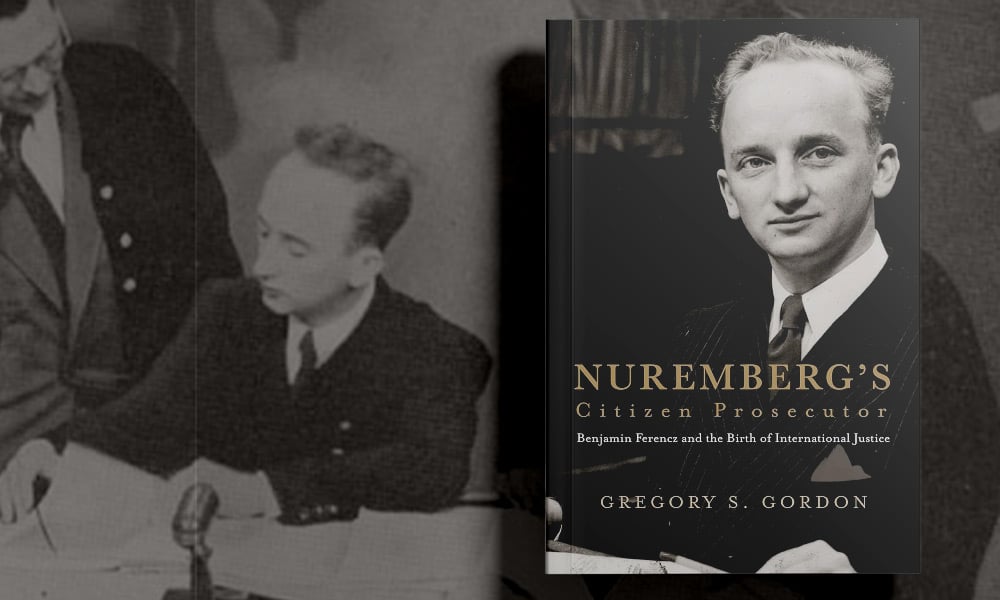
Nuremberg’s Citizen Prosecutor: Benjamin Ferencz and the Birth of International Justice
By Gregory S. Gordon
University of Virginia Press, 520 pp.
“IMMER ALLEIN”—Always alone. In 1945, the 25-year-old Benjamin Ferencz customized a U.S. Army jeep with those German words to tell the Nazis that he was coming, and he was coming alone.
Who was this enlisted soldier, what was he coming for, and what did he find? These are some of the questions answered in the authoritative biography published in late 2025 by legal scholar and former war crimes prosecutor Gregory Gordon, Benjamin Ferencz: Nuremberg’s Citizen Prosecutor.
Ferencz became a renowned prosecutor in the Nuremberg Military Tribunals. In 1947 and 1948, he served as the chief prosecutor in the Einsatzgruppen case, which tried 22 defendants, men who were commanders and senior members of the Nazi Einsatzgruppen mobile killing units. In what has been described as “the biggest murder trial in history,” Ferencz and his team prosecuted those responsible for mass shootings that murdered more than one million people, primarily Jews, across Nazi-occupied Eastern Europe. That he would rise to such heights was by no means clear when this poor Jewish immigrant from Transylvania was growing up in Hell’s Kitchen in New York City.
Gordon traces Ferencz’s trajectory in this biography of a true American hero. Although he never received a high school diploma, Ferencz went on to become a graduate of City College of New York and Harvard Law School and to write many books on international justice. The biography tells the story of “how persons of humble origins…can work hard, dedicate themselves to higher causes, and make an important difference.” That description comes from the foreword written by Ferencz himself, and the book features unprecedented access to his papers as well as interviews with family members that paint a complex and fascinating picture of a long life.
Nuremberg’s Citizen Prosecutor details Ferencz’s singular position as a leader in the investigation, prosecution and restitution of war crimes. In 1945 he was part of the group of soldiers with legal acumen and linguistic fluency—Ferencz spoke French, German, Hungarian, Spanish and Yiddish—who entered concentration camps after their liberation and gathered evidence used in the Nuremberg trials. I’ve previously researched how Ferencz, along with his colleagues, Jack Nowitz and Eugene Cohen, created a legal record of Nazi atrocities after the liberation of the Mauthausen concentration camp.
Gordon devotes a chapter to this subject, explaining how, as World War II was ending, Ferencz and his fellow war crimes investigators created a system on the fly for documenting the atrocities that occurred at the camps. As the Nazis were fleeing and the Russians were charging in, Ferencz and his team secured evidence of the mass extermination for use in the later prosecutions. He did so while confronting the horrors of the slaughter of Jews and others in the camps. Ferencz describes his work in Ohrdruf, the first concentration camp liberated by the Americans, encountering “hundreds of dead bodies, naked or clad in tattered rags that looked like pajamas” and in Buchenwald, “a charnel house of indescribable horrors.”
The methods of investigation required emotional stamina as well as improvisation and creativity, and Gordon shows how Ferencz devised means of obtaining information, often relying on documents hidden by concentration camp captives themselves.
His parents’ decision to come to the United States in 1921 had set Ferencz on a different path from many of his own family members—his grandmother, aunts, uncles and cousins were all murdered at Auschwitz. Indeed, the path to the death camps of another family from Transylvania, that of Elie Wiesel, and how the experiences of Wiesel and Ferencz intersected over their long lives, is a fascinating subplot of the book.
As the title suggests, however, the central event of Ferencz’s life was not the war crimes he investigated in his “Allein” vehicle but the war crimes he later prosecuted. Across several chapters, Gordon describes the events of 1946, when Ferencz worked in the War Crimes Branch office in Berlin, as investigators searched “bombed out Nazi government buildings for evidence” of war crimes. This work occurred while the first Nuremberg trial was still underway. Ferencz, now a civilian discharged from the Army, led a team identifying and cataloging evidence for use by prosecutors in what became known as the subsequent Nuremberg proceedings.
In this section of the biography, the action shifts from a harrowing war drama to an intrepid legal quest. Ferencz received a memo from one of his investigators who discovered the Einsatzgruppen daily reports from the Nazi-occupied Soviet territories that described, in minute detail, the murder of more than a million people. Armed with this evidence, Ferencz burst into the office of General Telford Taylor, who oversaw the subsequent Nuremberg trials. As Ferencz tells the story:
I [went] to Telford and I said, “We have to put on a new trial.” He said, “We can’t.” I said, “Look, I’ve got this evidence here. It’s all together here in a big binder—a million murders!” He said, “We can’t put on a new trial now, Ben. We’ve already got…all the lawyers…assigned. The Pentagon is not going to approve of a new thing. As it is, they’re not very happy with this dragging out.” So I blew my cool…“You can’t let these guys go. This is mass murder! On a scale never before seen in human history. You’re going to say ‘no, you can’t put on a new trial?!?’” He said, “Well, can you do it in addition to your other work?” I said, “Sure.” So he said, “OK, you do it.”
As the 2025 film Nuremberg reminded us, the Nuremberg trials were not inevitable. That they were as comprehensive and successful as they were depended on the motivation, the talent and the chutzpah of people such as Benjamin Ferencz.
Gordon is uniquely positioned to tell the story of Ferencz. A professor at the Peking University School of Transnational Law, Gordon served with the Office of the Prosecutor for the Rwandan International Criminal Tribunal and was author of the acclaimed 2017 book Atrocity Speech Law. Although his admiration for Ferencz’s achievements and his affection for his subject are apparent, Gordon is also a clear-eyed writer who interrogates him with rigor, even when it seemingly brings pain to the author.
In the 75+ years between his first war crimes trial and his death at 103, Ferencz often recalled his numerous successes in prosecuting Nazis. His prosecution led to the conviction of all 22 Nazi defendants. Ferencz’s opening statement in September 1947 at the Einsatzgruppen trial became one of the defining moments of the later Nuremberg prosecutions.
However, the full picture of Ferencz’s contributions to the cause of international justice includes much more than his war experience. That is what makes Gordon’s biography an essential read. Ferencz’s experience as an investigator and a prosecutor prepared him to become a legal expert in reparations, and he represented many Jewish causes in trials against German industrialists. For example, Gordon tells the story of Ferencz’s creative and dogged pursuit of compensation from German companies for displaced Jews who labored, and were, as Ferencz wrote in one of his many books, Less than Slaves.


Ferencz became a celebrated centenarian as the last living Nuremberg prosecutor before passing away in 2023. He was the subject of reports on 60 Minutes and NPR and an excellent 2018 documentary, Prosecuting Evil: The Extraordinary World of Ben Ferencz, all of which describe the efforts throughout his life to create international bodies of law to prosecute war crimes and establish the rule of law over the force of war.
This beautifully written book covers those same topics, but in unprecedented and forensic detail. Writing about his later years, Gordon explains why “law not war” became Ferencz’s mantra and how his legal scholarship and moral force helped advance the movement that led to the development of an International Criminal Court. In defiance of the U.S. position (which voted against the treaty creating the court) the elderly Ferencz continued to fight to criminalize international aggression. He became, as Gordon writes, “humanity’s representative, free to speak his mind and take bold action on behalf of all the world’s citizens.”
Ferencz may have seen himself as “always alone” in his fight for justice, but reading about his extraordinary life as a Jew, an American and a citizen of the world makes me grateful that this singular person was one of us.
Moment Magazine participates in the Amazon Associates program and earns money from qualifying purchases.