
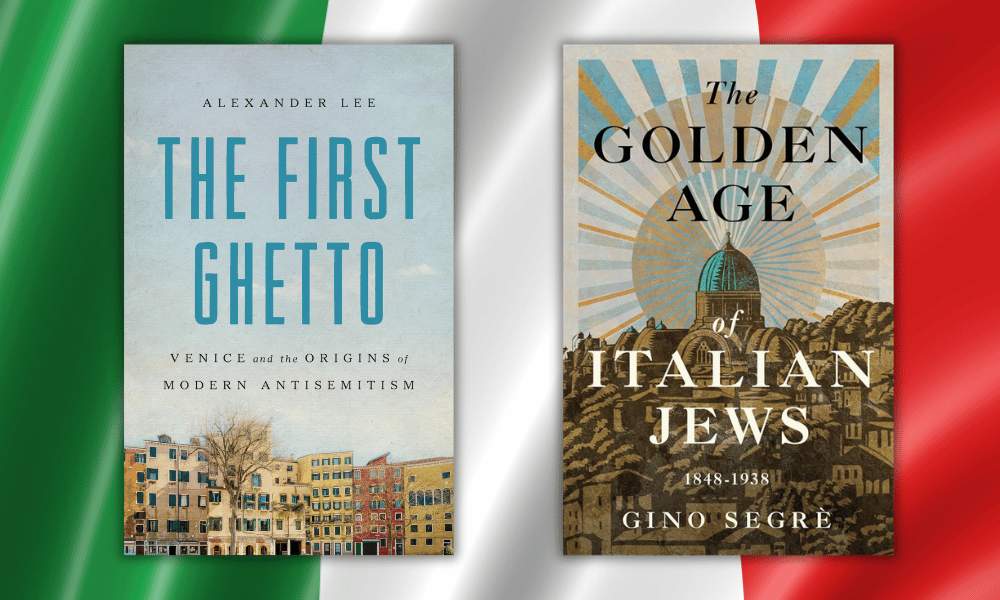
The Golden Age of Italian Jews: 1848-1938
By Gino Segrè
Paul Dry Books, 181 pp.
The First Ghetto: Venice and the Origins of Modern Antisemitism
By Alexander Lee
Basic Books, 432 pp.
At the outset of his combination vices, because the Third Lateran Council history and family memoir, The Golden Age of Italian Jews: 1848-1938, retired physicist Gino Segrè asks, “What has it meant through time to be an Italian Jew?”
Two new books—Segrè’s and another by University of Warwick historian Alexander Lee—more or less agree on a triangulated answer: A good life. A not-so-good life. A sometimes awful life.
Not so awful, mind you, as in many neighboring European countries. Indeed, in The First Ghetto: Venice and the Origins of Modern Antisemitism, Lee goes so far as to claim that by the early 17th century, Venice was “the best place in the world to be a Jew.”
Really? Despite those two traumatizing words in the title, “ghetto” and “antisemitism”? Granted, midtown Manhattan and downtown Tel Aviv didn’t exist as potential alternatives in the early 17th century. But what about Berlin, on its way to the Haskalah, the “Jewish Enlightenment,” a century away?
Lee’s judgment, however, isn’t irrational. If Russia, as Churchill once put it, is “a riddle, wrapped in a mystery, inside an enigma,” Italy, and even more so Jewish Italy, continues to be a kind of shifting film script, drenched in ambiguity, seasoned with hypocrisy.
In The First Ghetto, Lee assiduously chronicles the downs and ups of that first-of-its-kind urban institution and designation, later to become a marker of tragedy with the Warsaw Ghetto and a familiar, then retired, word for America’s inner-city Black neighborhoods.
Ghetto in Italian, Lee says, derived from geto nuovo, a tiny island in Venice’s Cannaregio area. On March 29, 1516, the Venetian Senate ordered roughly 500 to 700 of the city’s Jews to move to that small, cramped, rundown quarter.
Whenever and wherever the larger society declines to attack and vilify Jews, and permits them the same rights, freedoms and kindnesses as everyone else—that is a Golden Age.
Venetians at the time bore all the usual prejudices against Jews. Jews, they believed, were innately “evil at heart,” practiced blood sacrifice and shouldn’t be able to contaminate non-Jewish Venetians.
At the same time, the declining Venetian state needed Jewish financial services, because the Third Lateran Council in 1179 had banned moneylending for profit, and the Church deemed usury a sin for Christians. According to Lee, the ghetto solution allowed Venice’s government to “reconcile religious prejudice” with the city’s “pressing economic needs.”
Venetian Jews, Lee reports, saw themselves as “living under the protection of the Lord.” Much like the Shanghai community and subsequent ghetto that harbored refugees from Nazi Germany in the 1930s and 1940s, the Venetian Ghetto became a Jewish mini-city teeming with both professionals and tradespeople. Venice even became a major center of Hebrew publishing.
As a result, the Venetian Ghetto never experienced the horrors of later ghettos in Italy (there were 41 by the late 1700s) and certainly not those imposed by the Nazis. According to Lee, Venetians “preferred compromise to consistency, and would rarely, if ever, do anything which might endanger their commercial interests.”
Ghetto or no ghetto, Jews and Christians interacted all the time. Jews could hide their yellow badges, first instituted in 1408, under outer garments when convenient. Some Jews achieved great wealth, though many remained poor. Lee writes that the Venetian Ghetto proved a “testament of hope,” more a “refuge” for Venetian Jews than an open-air prison, as well as a safe haven for Jews fleeing worse conditions elsewhere in Europe and Italy.
As more Jews migrated to Venice, though, especially after their expulsion elsewhere, things became more complicated. Venetians deemed many of them Marranos, a derogatory Spanish term suggestive of pigs and dirtiness. All the same, the new immigrants flourished in the businesses Venetians allowed them to enter, such as usury. By 1630, Jews numbered about 5,000 of Venice’s population of 140,000.
The later story Lee relates turns more downbeat. As the Venetian Republic withered financially, so did the ghetto. By the 1750s, poverty overtook it. Napoleon’s army destroyed the ghetto
gates in 1797, liberating the Jews, and the Venetian Republic fell. But Jewish rights alternately rose and fell in the first half of the 19th century, before the Risorgimento—Italian unification—in 1861 launched a Golden Age. Segrè, in his book, dates that age’s actual beginning a little earlier, from the 1848 Statuto Albertino that made all Jews equal before the law.
Segrè’s book explores a wider canvas, reaching as far back as Roman times. He also glances sideways to note the 25,000 Jews who lived in the Kingdom of Sicily by the mid-15th century, and he ranges widely elsewhere. He gracefully presents portraits of important Italian Jewish clans such as the Treves, Roselli and Castelnuovo families in a style reminiscent of Alexander Stille’s classic Benevolence and Betrayal: Five Italian Jewish Families Under Fascism (1991). He also extrapolates Italian history from offshoots of his own prominent Segrè family. More than Lee, he underscores the hostility of Pope Pius IX and the 19th-century Papal State to Italy’s Jews even though many of them were non-observant, in contrast to the Jews of Eastern European shtetls.
Amid the family storytelling, Segrè offers persuasive explanations for the happier side of Jewish life in Italy. He points out that Italy comprised a “veritable Jewish melting pot,” because Italy’s Jews are “as much or more a mixture of Sephardic, Ashkenazim and Mizrahi than in any other country in Europe.”
The underlying unity of their Judaism, and Italy’s own territorial differences even after unification, helps explain, Segrè writes, why Italian Jews, many of them extremely wealthy, “advanced so quickly” between 1861 and the early 20th century.
“An advantage for Jews at this time,” he explains, “was that regional differences mattered less for them than for other Italians. Their common Judaism provided a shared link that transcended internal borders. A Roman might think of a Florentine as alien, but a Roman Jew would recognize a Florentine Jew as kin.”
Segrè deems his chosen period a “Golden Age” because of the way Italian Jews rose to the heights of Italian power and success before Mussolini and fascism destroyed it all. Ernesto Nathan, a Jew, became mayor of Rome in 1907. His mother Sarina is commonly believed to have been mistress and financier to Giuseppe Mazzini (1805-72), one of the Risorgimento’s founding fathers. Sidney Sonnino served as Italy’s minister of the treasury, as minister of foreign affairs and twice as prime minister. Luigi Luzzatti, born in the Venice Ghetto, also served as prime minister. Ettore Schmitz, under the pen name of Italo Svevo, became one of Italy’s classic novelists. Vito Volterra, born in Ancona’s ghetto, won recognition as a world-famous mathematician.
Segrè offers further explanations for why Italian Jews did so well, noting that Italy remained “a troubled agrarian country” with almost 25 percent infant mortality and 30 percent of the population not knowing “the basics of how to read and write.”
“Jews,” he writes, “with their early emphasis on learning, were more likely to have pursued education.” Having been largely expelled from southern Italy hundreds of years prior, their migration to northern Italy “worked in their favor, since the North of Italy was progressing faster than the South in every measure.”
Finally, Segrè notes, “Italian Jews looked like other Italians, dressed like them, and had fought by their side in the country’s wars of independence. Having no separate language such as Yiddish, they also spoke like other Italians.”


End result? Despite Jews representing “only a tenth of one percent of the overall population,” Segrè reports that by the beginning of the 20th century, “they had become mayors of major cities, generals in the Army, leading politicians, wealthy landowners, and successful academics. The emerging nation of Italy had provided an ideal climate for Jews to succeed.”
Mussolini brought all that crashing down in the late 1930s when, observing Hitler’s campaign against the Jews, he turned against them. On July 14, 1938, Mussolini issued the “Manifesto of Race” that claimed Italians were a pure race and Jews a non-European one. Multiple racial decrees and laws followed, banning Jews from attending or teaching in public schools, dismissing Jews from the armed services and limiting their employment and ownership rights.
Eventually, the fascist government would capture, kill or deport to concentration camps some 9,000 Jews, though not with the massive efficiency of the Germans. Giorgio Bassani’s novel The Garden of the Finzi-Continis (1962) and Vittorio De Sica’s Oscar-winning 1970 film based on it, along with the writings of Primo Levi, remain the most famous cultural depictions of that era.
Today, Jews count for about 30,000 of Italy’s population of almost 60 million. “Though well respected,” Segrè comments, “they no longer play the exceptional role they once did.” Ferrara’s extraordinary National Museum of Italian Judaism and the Shoah, built by the state, documents the presence of Italy’s Jews to before the Common Era and testifies to the state’s reconciliation with its Jews. The Venice Ghetto operates as both a tourist attraction and a site of renewed Jewish presence, with Jewish tchotchkes for sale, plaques to stir memories, and some 500 long-term residents among the city’s fewer than 1,000 Jews overall.
Still, Lee reports, in 2024, someone scrawled near the Jewish cemetery on the Lido, “Damned Jews, we will come looking for you house by house…to slaughter you and your children.” The same year, Dario Calimani, president of Venice’s Jewish community, warned that hatred of Jews still festered in the city.
Lee’s and Segrè’s books together stir a thought one might apply not only to Italy but to every country. Whenever and wherever the larger society declines to attack and vilify Jews, and permits them the same rights, freedoms and kindnesses as everyone else—that is a Golden Age.
Carlin Romano, Moment’s critic-at-large, teaches philosophy and media theory at the University of Pennsylvania.
