
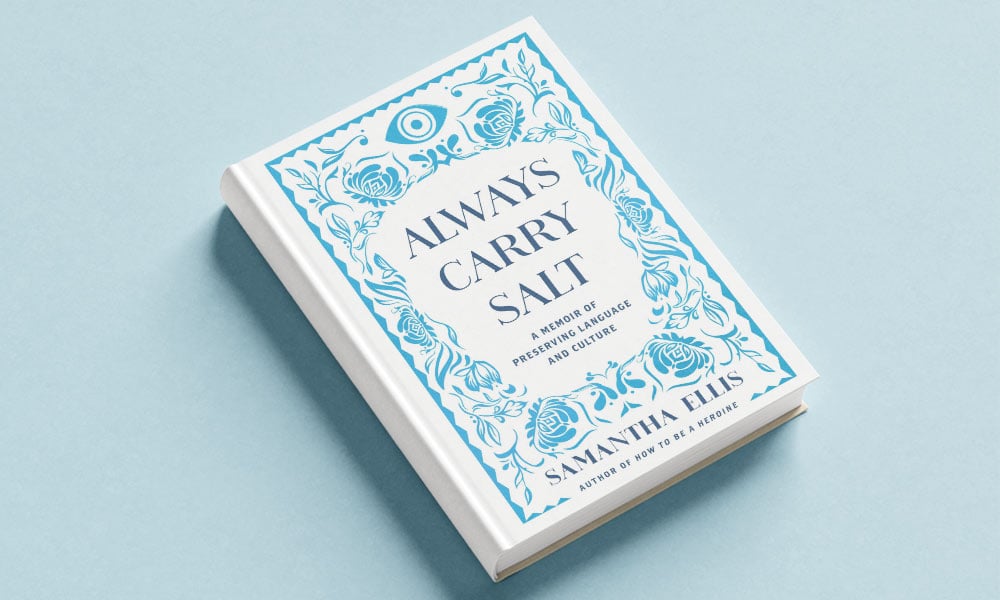
Always Carry Salt: A Memoir of Preserving Language and Culture
By Samantha Ellis
Pegasus Books, 270 pp.
Always Carry Salt, by Iraqi Jewish scholar and playwright Samantha Ellis, has been widely celebrated as a personal memoir—filled with descriptions of her parents’ native land, its history, food, music and physical beauty. So vivid is her writing that it took me a while to realize that Ellis, born and raised in the U.K., had never been to Iraq and knows it only through the stories told to her by her mother—in their Judeo-Arabic language.
At the time she was writing this book, Ellis was most concerned about how to convey her culture to her four-year-old son. The prospects looked bleak. The small community that carried the language is gone, and there is virtually no one with whom Ellis herself can speak. How, she wonders, can a culture continue to exist when the language that reflects its thoughts, carries its history, forms its identities and transmits its values is no longer spoken? Who are we when our language is taken from us, and what does the world lose when a language disappears? And then she has another troubling thought: How might the conveyance of the traumatic events of her Arab-Jewish past damage her son?
As the scaffolding that supports Ellis seems to be crumbling, she becomes even more distressed about the world’s future. Languages, she knows, are disappearing—overwhelmed by conquests, genocide and displacement. A wealth of knowledge and poetry, unique views and values that differentiate and characterize our species will be lost. I remember vividly how, when I was a graduate student in the 1960s, the well-known linguist Uriel Weinreich, chair of the Department of Yiddish at Columbia University, would meet almost daily with another young man to speak Yiddish—a language he feared would cease to exist when the newly established state of Israel chose Hebrew as its national tongue.
These are deeply emotional questions. Ellis addresses them as a scholar, a playwright, a gifted intellectual, a writer and a mother. She can speak to her child in her mother tongue, and she can teach it to him, but with whom will he speak when he is grown? And if she fails to transmit the language, how will he experience the culture? She thinks about the food of her ancestors—perhaps her ancestral food can connect him to her family’s past, but at the time she’s writing this memoir, her son has refused to eat that food. Suddenly another concern strikes her. The traumas of Jewish history are deeply embedded in these recollections; how might these traumas affect him?
Ellis begins by examining the 2,000-year-old history of Jews in Iraq—cherishing the memory of their historical role but uneasily confronting their vulnerability as outsiders by detailing how they sought protection. Always endangered, always “othered,” they had developed strategies for survival—beliefs in special foods and behaviors, amulets and blue beads to protect against the evil eye, incantation bowls that kept demons away and the use of salt, dissolved in water or thrown over one’s shoulder, to purify and protect against envy and malice.
This history is fraught, and in the end all protection failed when in 1941 the Nazis injected their special poison into Iraqi politics to create the Farhud—a holocaust in the Arab world that is far less familiar than the genocide that destroyed six million of their co-religionists in Europe. In 1941, Iraq was caught between its alliance with Britain and the pressure from the pan-Arab movement to support the Germans against the British. The chaos that followed aroused anti-Jewish feeling both in Baghdad and in the countryside. Riots killed several hundred, and in 1948, the establishment of Israel created further animus in the Arab world. The remaining Jews fled Iraq—and today there are none.
So completely forgotten is this history that in 2022, the American Jewish Congress created a podcast series to remind the world that thousands of Jews were slaughtered in Arab states or forced to flee to very different worlds in Europe and the United States.
What remains of Jewish history in Iraq is in Ellis’s heart and literally on her tongue—her mother’s stories told in Judeo-Iraqi and the recipes for dishes, some of which she ate as a child. So intimately is she involved with her mother’s story that it took me a while to realize that the stories were her mother’s memories, not her own, but so closely bound to the author’s identity that it is difficult to know who is speaking. It’s a skillful literary device that underscores her understanding of the manner in which cultures can remain alive.
In fact, born in the U.K., Ellis has never even seen Iraq. Might this book serve, in even a small way, to help maintain a culture through her mother’s tongue? She weaves recipes and reminiscences (are they hers or her mother’s?) through allusive, sometimes almost hypnotic prose.
Some of her recipes jolted my own recollections. My father was a Turkish chef; Ellis’s recipe for kibbuh, kibbe to me, a dish made with minced lamb, made the taste of its seasonings leap into my own mouth. Her difficulty in making this dish mirrored my own inability to wrap a dollop of bulgar-seasoned lamb in a coating of those same seasonings. My father made it look easy, but today I eat kibbe only when I can find it on a restaurant menu.
We were both more comfortable making rice pudding, sometimes scented with rose water and occasionally dotted with pistachios. Ellis writes lovingly of date-sugar sweets and also of incantation bowls, which, like salt, are believed to protect those who consumed them from evil. She notes that an alternative title for this work was Chopping Onions on My Heart, a metaphor that perhaps more adequately reflects the emotional connections it recalls.


In the end, it’s her mother who gets Ellis’s son to eat and love their traditional foods. And Ellis, who at first disdained it, finally learns that eating what she calls “fusion food” does not sever the cords that bind her to her past.
Though deeply personal, Always Carry Salt is far more than a lament for one dying language and way of life—it is a cri de cœur for the many other societies forced to surrender their cultures to a world that has swallowed up so many weaker peoples and cultures.
As an anthropologist looking at the world through an evolutionary lens, I too mourn the loss of cultures and disappearance of languages—while recognizing that our species’ unique ability to imagine the future makes change and language loss inevitable, and that culture can be retained even when language is lost.
This caveat, however, has little effect on my opinion of Ellis and this wonderful book. I loved it for its recipes, its history and its biblical references and because it forced me to think once again about these intellectual and human problems that remain intransigent.
Gloria Levitas is a cultural anthropologist and the author of six books.