
“B’Ivrit: A Hebrew Language Media Roundup” is a monthly look at the news through the eyes of Israeli media consumers.
1. All eyes on Iran
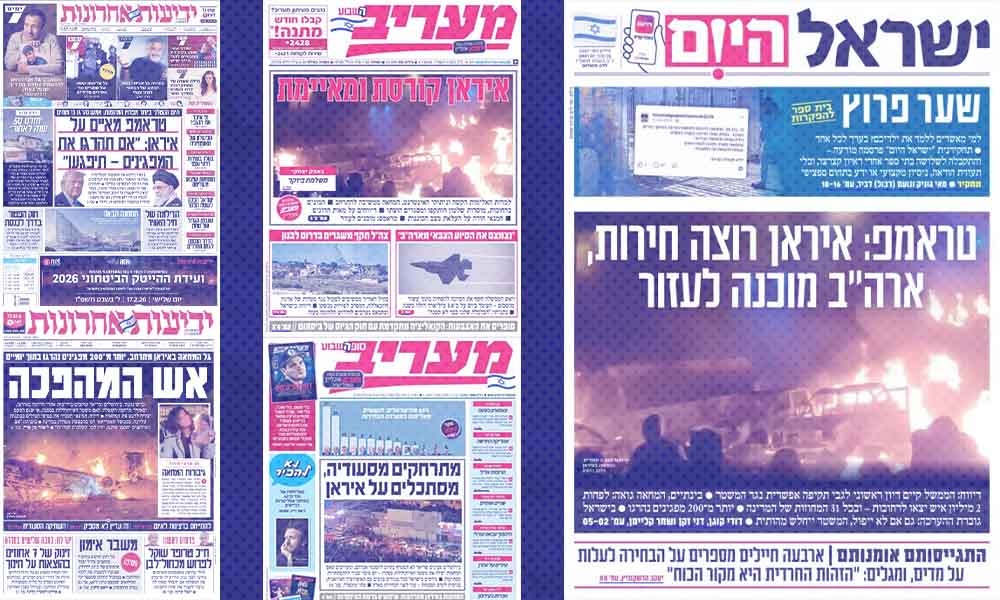
“Iran is collapsing,” read the headline in Maariv, atop a photo of protesters in front of cars in flames. The centrist daily publication devoted much of its coverage Sunday to the unfolding events in Iran. As did all the Israeli press.

Israel Hayom, a right-of-center publication, went with the exact same photo, spread over much of its front page, but highlighted in its headline Donald Trump’s promise to assist Iranian protesters.

Yediot Ahronot, Israel’s largest newspaper, chose a similar photo under a dramatic headline: “Flames of revolution.”

On TV, Israel’s news channels shifted their focus from Gaza, judicial reform and Netanyahu’s corruption charges to endless coverage of the protests in Iran. Experts on Iranian affairs were invited to TV studios to explain the motivation behind the demonstrations and the chances of the regime surviving them. Jewish Iranian expats living in Israel starred in many news stories, reminiscing about the days before their beloved homeland was taken over by the ayatollahs and expressing their hopes for a swift regime change.
The Israeli press has been covering the recent uprising in Iran not as a distant foreign news story, but rather as an issue that directly impacts the lives of their viewers in Israel.
In Maariv, a front-page article described hopes among decision-makers that a post-Ayatollah Khamenei Iran will become an ally of Israel and even reported on nascent ties between Israeli officials and members of the Iranian opposition.

But most media coverage looked at the shorter term and carried an alarmist tone. “Israel on alert,” reported KAN-11, Israel’s public broadcaster, noting the concern that a U.S. attack on Iran would lead Tehran to retaliate against Israel. Globes, a financial daily, reminded its viewers last week that a third of Israeli homes still lack proper protection from Iranian missiles.
And, as always, much of the Israeli media’s coverage was focused on Washington. Trump’s warnings to the regime in Tehran have dominated the news cycle, with Israelis pinning their hopes on the unpredictable U.S. president once again sending his B-2 bombers, this time to finish the job in Iran.

2. How Israelis are learning about the protests in Iran
With a huge appetite to hear every detail about the current state of affairs in Iran and the odds of the mass protests toppling the regime, Israelis are faced with a severe lack of reliable news sources covering the events.
It is a problem shared by the entire world: Iran is, by and large, closed to foreign media and has now enacted a full communications blackout that shut down the internet, access to social media and even telephone communications.
Israeli media outlets have overcome this difficulty by relying heavily on video snippets sent out by opposition activists who managed to bypass the communications ban (many by gaining access to Starlink satellite internet service). These video clips—some of which have later been found to be fake or misleading—provide a sense of the magnitude of the protests and of the regime’s ruthless efforts to quash them.
Another genre that has taken hold in the Israeli media is that of interviews with heavily disguised Iranians. Clearly, speaking to the Israeli media is a huge risk for Iranians, yet some have agreed to share their experiences, making sure their voices are altered to avoid identification. For example, in an interview with Israel’s I24 News, someone identified as a former member of Iran’s notorious Revolutionary Guard Corps called on members of the regime’s forces to cross the lines and join the protesters, warning that “the day after the regime falls, you will be wiped out.”
In an interview with N12, the news website of Channel-12, Israel’s most watched network, one Iranian citizen from the city of Mashhad said he joined the protests because of the dire economic situation and the continuous oppression. “There’s nothing I’m afraid of more than continuing to live under the rule of the ayatollahs,” he said. Another Iranian protester, identified as Hamid from Tehran, told the Israeli interviewer that Iran’s current leaders “are the enemies of the Iranian people, of freedom, of Israel and of the entire world.”
3. Maduro is still big news in Israel
The image of Nicholás Maduro, eyes covered, his cuffed hands clutching a bottle of water as he sat on an American vessel after being kidnapped from his presidential residence in Caracas, was shown over and over all across the world on January 3. Maduro, once the all-powerful leader of Venezuela who’s now in jail in New York awaiting trial, took over the news coverage in Israel as well.
All major publications featured his photo in captivity on their front pages, each with their own take on the dramatic news. “New world order,” read the headline of Israel Hayom, the popular daily owned by GOP megadonor Miriam Adelson. Liberal-leaning Haaretz stuck to the facts with a headline describing the capture and Trump’s promise to “run” Venezuela. Centrist Maariv also refrained from commentary and had equal-sized images of Maduro and Trump share the front page. Yediot Aharonot showed the two leaders in artistically rendered photos adorning the paper’s front page but focused on Trump. “The Sheriff,” read the headline.


Venezuela was largely off the radar of most Israelis until the American operation to capture its president. But once it happened, media outlets were quick to find Israel-specific angles: Venezuela was depicted in the Israeli press as a nation aligned with Iran and its proxy terror-organizations. While factually true—Maduro’s Venezuela was an ally of Iran, among others—it was hardly the main feature of his foreign policy.
The other aspect highlighted in the Israeli media was that once Trump, against all odds, deposed Maduro, could the next step be toppling a regime that Israel cares about more?
“It was a signal to the axis of evil,” a columnist in Yediot Aharonot wrote. “Iran is getting the message—Trump isn’t playing games,” said a commentator on Channel-14, a popular right-wing, pro-Netanyahu outlet.
Wishful thinking or a sober read of Trump’s intentions? The president’s stern warnings to Iran in recent days may indicate that this time, the Israeli media may have been on to something.
4. Battle lines drawn in Jerusalem
There is no issue that gets the Israeli public more riled up than the question of drafting members of the ultra-Orthodox community into the IDF. The blanket release all young Haredi Jews enjoy has long been a point of contention in Israeli society, but ever since 2023, when hundreds of Israeli soldiers have lost their lives in combat and when hundreds of thousands of reservists have had to leave their families and jobs for months, sometimes for more than a year, to serve their country, the question of inequality in military service has been on the front burner.
It reached a boiling point in recent weeks as the Likud-led coalition began advancing legislation celebrated as a first move toward drafting Haredis to the military. But in fact, it is no more than a legislative stamp of approval for their continued release from service.
Members of the Haredi community have taken to the streets to make clear they will not agree to any move by the Knesset that will force them to send their children to the army. “We’d rather die than serve in the military,” is a common slogan in these protests.
Last week, a massive demonstration in Jerusalem took a tragic turn. A 14-year old ultra-Orthodox teen participating in the protests was run over by a bus, as the driver, who was being surrounded and threatened by demonstrators, tried to leave the scene.
“Where were the authorities?” cried a half-page headline in Yediot Aharonot alongside a photo of the victim, Yosef Eizenthal. An opinion column published alongside the story decried the failure of Israeli society and authorities to deal with what the paper described as a “powder keg about to explode.”

And while all mainstream Israeli outlets covered the events extensively, the reporting in the Haredi newspapers took a very personal tone. HaPeles described “a heartbreaking funeral procession,” adding in its front-page story that “everyone feels he was the sacrifice of our entire community.” Yated Ne’eman, another Haredi outlet, reported on the funeral while also running a story accusing the police of “zigzagging,” because it had initially charged the bus driver with murder, only to change the charge at the last minute to involuntary manslaughter. All ultra-Orthodox papers devoted their main headlines, however, to the political front, describing efforts by Haredi parties to “overcome the military draft decree.”


5. Settler violence? What settler violence?
The front-page photo on Haaretz’s Friday edition depicted a teen settler, his face covered with a scarf, facing down a young civil rights activist at the edge of a Jewish settlement outpost in the West Bank. It accompanied a deep-dive article about teenagers leading the violent attacks against Palestinian residents.

Haaretz, well regarded but not widely read, has stood out as the only Israeli media outlet regularly covering these acts of violence, which have significantly increased in recent years. Most in the Israeli press have chosen to turn a blind eye to the issue, basically depriving their audience of any knowledge about an issue that has made headlines all across the world.
This is not all that different from the Israeli coverage of the situation in the Gaza Strip and of the plight of its Palestinian residents. But there’s one key difference: In Gaza, coverage is restricted by the Israeli army, and reporters are not allowed to enter freely. In the West Bank, it is purely a choice. Israeli outlets face very few limitations in covering the region and specifically Jewish settler violence. The only limiting factor is the decision of newsroom editors that this is not a story Israelis should know about or care about.

One thought on “B’Ivrit | All Eyes on Iran”
Are we not all made in G-d’s image? Surely there is SOME GOOD in everyone. There. HAS TO BE SOME COMMON GROUND to begin talking with one another. And no, I’m not naive.