
“B’Ivrit: A Hebrew Language Media Roundup” is a monthly look at the news through the eyes of Israeli media consumers.
1. Who knew what and when?
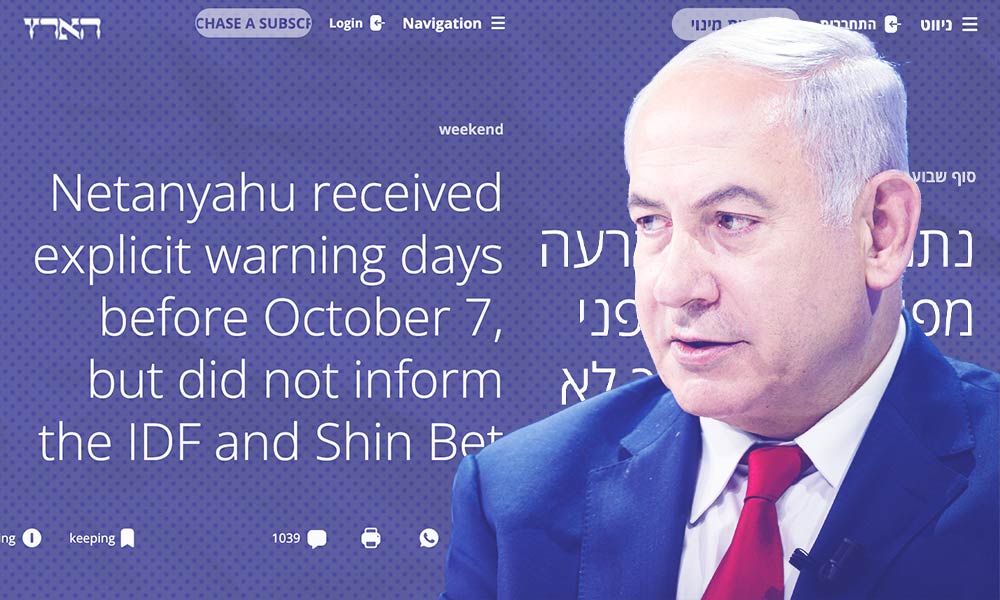
A bombshell investigative report published by Haaretz in early September sent Israel into a spin of accusations and denials.
The story by veteran Palestinian affairs journalist Shlomi Eldar and editor Ruth Yuval, based on their soon-to-be-published book, exposes the fact that days before October 7, Israeli Prime Minister Benjamin Netanyahu received a phone call from United Arab Emirates (UAE) president Mohammed Bin Zayed warning him of an imminent attack. Eldar and Yuval detail the red flags and warning signs brought to Netanyahu’s attention and contended that he had chosen to ignore them and that he did not share the information with Israel’s top defense officials.
The report has shocked Israelis, not only because it suggests that the worst attack in the nation’s history might have been averted had the prime minister acted upon the warning he received but also because of its timing—less than two months before the elections.
Three years after October 7, Israelis are still reeling from the attacks, and many view the upcoming elections as a chance to reach some sort of closure: either give Netanayahu a renewed mandate to rule, thus accepting his viewpoint that the Hamas attack was inevitable and that responsibility for Israel’s failure to protect its citizens rests on the military and intelligence chiefs, or choose to send Bibi packing. A new government would most certainly launch a national inquiry committee, likely supporting the idea that Netanyahu bears greater responsibility than others.
Eldar and Yuval’s report provides, for the first time, tangible proof that Netanyahu could have and should have acted differently before October 7, which explains Netanyahu’s harsh response. The Israeli PM labeled the report a “libelous lie,” repeated his accusations that it was the former heads of the IDF and the Shin Bet who had early knowledge of the threat, not him, and said that he had instructed his lawyers to sue Haaretz. It’s been three weeks since his statement, and a lawsuit has yet to be filed.
The report also triggered a debate in the Israeli media. Most major news outlets quoted the story, credited Haaretz for the scoop and noted Eldar’s strong journalistic record of covering Palestinian affairs and his sources in Gaza. Only a few decided to side with Netanyahu in discrediting the story. Leading the pack, as always, was Channel-14, a pro-Netanyahu network, which was quick to report that “Haaretz’s story is collapsing” and that it was not credible from the start.
Last week, The New York Times corroborated most of the details in Eldar and Yuval’s story. The Atlantic reported the same day on another warning allegedly delivered to Israel, this time by Egypt’s top intelligence official.
On a Saturday news show on KAN, Israel’s public broadcasting network, an anchor lashed out at the American outlets for digging into what Netanyahu knew before October 7. “Why do they care about it? It’s all about meddling in internal Israeli politics,” she said.
2. Bibi takes the world stage
The United Nations General Assembly wrapped up this week, after world leaders all got a chance to take the podium and address members of the leading global forum.
In Israel, especially in the Netanyahu era, these speeches have taken on an almost mythical importance. The press travels with Netanyahu to New York, his speech is aired live on all networks regardless of the hour of the day or night, and commentators gather in the TV studios to analyze and share their opinion about the prime minister’s performance.
This year was no different.
Netanyhu’s speech was scheduled for Thursday, making Bibi miss U.S. president Donald Trump, who spoke on Tuesday and rushed back to Washington for his meeting with China’s Xi Jinping. Israeli reporters covering the visit noted that this was Netanyahu’s shortest trip to the United States: He spent only eight hours on the ground. During this brief visit, they noted, the prime minister failed to schedule any high-level meetings, making do with several one-on-ones with friendly European leaders (such as Cyprus and Slovenia) and newly found supporters from Latin America (Argentina, Bolivia, Paraguay, Panama).
The press did not miss the massive walkout of nearly half the UN delegations when Netanyahu took the stage, and reported extensively on the prime minister’s spat with New York City Mayor Zohran Mamdani.
How good was Bibi’s UN speech? Reports vary, largely based on the media outlet’s political leanings.
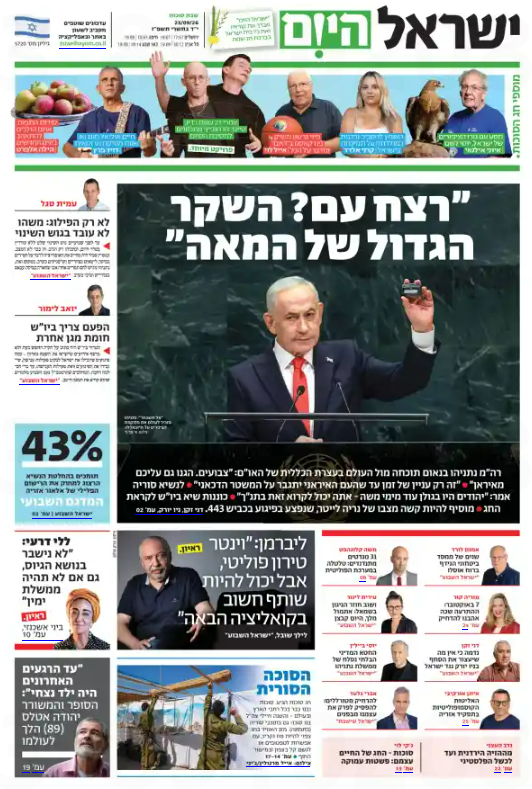
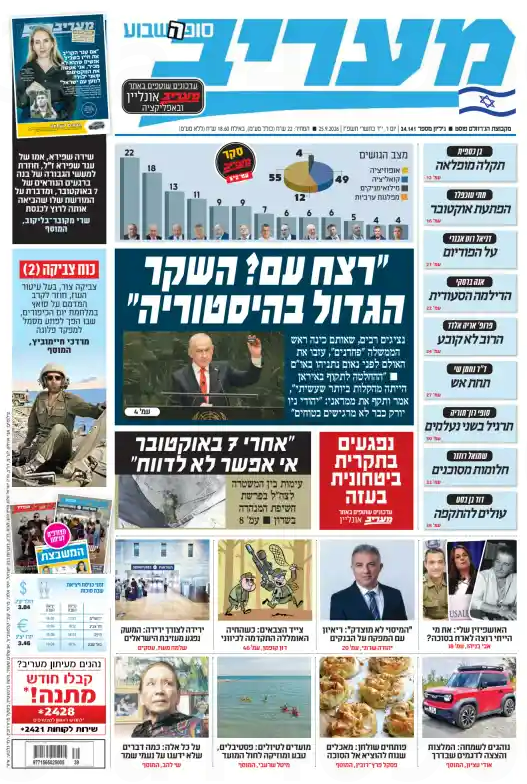
Israel Hayom, a Netanyahu-friendly right-of-center daily owned by Miriam Adelson, led its front page the next day with a large photo of the prime minister at the podium holding a pager in his hand as he recalled the Israeli attack on Hezbollah two years ago. “Genocide? The biggest lie of the century,” the paper’s headline quoted Netanyahu. Maariv, considered center-right in its editorial line, chose the same quote for its front page.
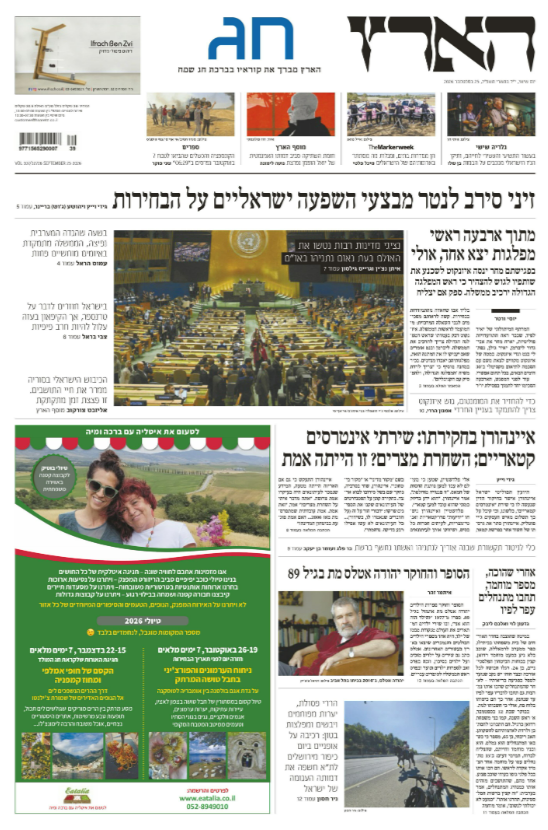
Centrist Yediot Ahronot pushed Netanayhu’s speech to a small corner under the fold, focusing on how Israel’s diplomatic isolation was apparent during the visit. Liberal Haaretz, posted a photo of Netanyahu on its front page, noting only that “many representatives left the hall during the speech.”

3. Rating Israeli students
Not all news in Israel focuses on the wars on all fronts and the upcoming elections. Israelis, just like anyone else, also care about their children’s education, and the recent release of The Organization for Economic Cooperation and Development’s (OECD) country-by-country test scores took over the headlines, at least for a day.
The results of this global measure, known as PISA, were alarming. Israeli students’ scores have plummeted across the board—in reading, math and science.
“The scary PISA data,” read the headline on Ynet, Israel’s most popular news website, which noted that Israel’s ranking dropped to 33rd place out of 38 OECD countries. “An F for the education system,” read the headline of KAN. “Israel’s historic collapse,” reported Mako, the news website of Channel 12, Israel’s most influential TV channel.
The reasons offered for Israel’s declining achievements are varied. According to analysts quoted in the press, just as in other countries, Israeli students are still feeling the adverse effects of the COVID era. But they also had to deal with three years of war, which have disrupted learning; a chronic shortage of teachers; and a decrease in government investment in education, due to increasing budgetary restraints.


4. A rare spotlight on American olim
The community of American Jews who have emigrated to Israel is usually ignored by the Israeli public and by the press. Though approximately 600,000 Israelis hold U.S. citizenship (some born in the United States, others children of emigres), they are not considered a “community” and hardly get any attention in public discourse or popular culture.
The Marker, a business publication owned by the Haaretz group, sought to change this reality and published a lengthy, and quite rare, story on American olim, or immigrants, who have made Israel their home.
“How U.S. immigrants shape Israel’s power center,” was the headline of the story, which not only dived into the demographics of Israelis of American background, but also shed light on how, in recent years, many of them have reached positions of power and influence in Israeli society, from Ron Dermer and Moshe Koppel to Rachel Goldberg-Polin and Micah Goodman.
For Israelis, raised on the stories of post-Holocaust Eastern European immigration, of the North African Jews who faced discrimination and racism, of the massive post-Soviet exodus of Jews in the 1990s, and the heroic aliyah of Ethiopian Jews, this article offers a glance into the group of immigrants who have always been there but were almost never noticed.
In fact, most Israelis don’t even know that Golda Meir, the heroine of American Jewry, hails from Milwaukee, Wisconsin.
5. A day without news
That Israel shuts down on Yom Kippur is nothing new. Who hasn’t seen the video clips of silent streets, not a single car passing by, and of storefronts and restaurants all deserted from late afternoon to sundown the next day?
But it’s not only traffic and business. All Israeli media also grinds to a halt.
What does a day without news look like?
All TV and radio networks are off, news websites do not update, newspapers aren’t printed. No push alerts on your phone, no news on official WhatsApp and Telegram channels. After sundown, once the shofar blows and the fast is over, all media outlets wake up and are quick to post a summary of the missing day’s news.
Truth is, a day without news isn’t as crazy as it may sound. Even in a news-driven country like Israel.
(Top image credit: World Economic Forum (CC-BY-NC 2.0))