
“B’Ivrit: A Hebrew Language Media Roundup” is a monthly look at the news through the eyes of Israeli media consumers.
1. When watchdogs become cheerleaders
The Israeli media was well prepared for the new Iran war. After six weeks of military buildup and increasing tensions—six weeks in which the press focused solely on if and when Trump would decide to attack Iran—the moment finally came early Friday morning. The full-scale, multifront war against the Ayatollah’s regime, which the press had been waiting for, had finally arrived.
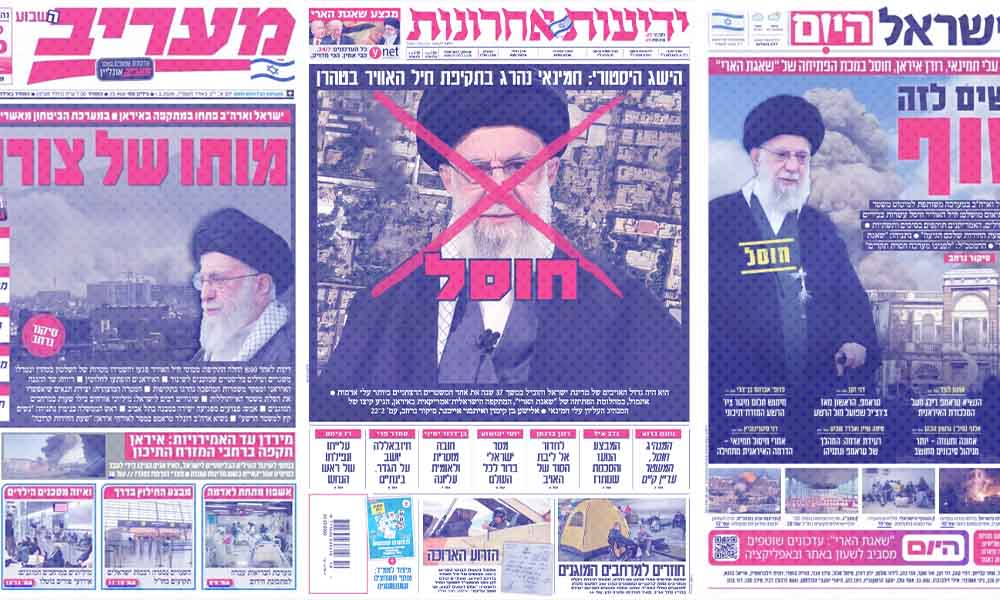
Newspapers in Israel could not contain their joy. Yediot Ahronot, the country’s largest daily, devoted almost all its front page to a photo of former Iranian Supreme Leader Ali Khamenei, covered by a large X sign and a single-word headline: “Eliminated.”

Other publications were just as excited with the news from Tehran.
“Putting an end to it,” exclaimed the right-leaning Israel Hayom on its front page, adorned with a timeline of the late Khamenei, scenes of smoke bellowing from buildings in Tehran, and the subhead: “Historic days.” Maariv, a centrist publication, also joined the celebration. “Death of a bitter enemy,” read the headline, using the Hebrew word tsorer, which is usually reserved for Nazi war criminals. All five front-page commentary columns praised the attacks and predicted a glorious future for Israel, Iran and the world.


Liberal-leaning Haaretz was the only daily to keep its tone matter-of-fact: “Israel and the U.S. launched an attack against Iran; Sources presume that Khamenei is dead.” Haaretz, whose readership is significantly smaller than other dailies’, was the only paper that found room on its front page for other news of the day: an attack by extremist settlers on human rights activists in the West Bank.

The upbeat and celebratory tone continued throughout the first week after the attack. “We control the skies,” read a Yediot Ahronot headline from Thursday, with a photo of two Israeli Air Force pilots fist-bumping. Israel Hayom ran a half-page photo of an Iranian ship engulfed in flames, under the headline: “On our way to a knockout.”


But the real festivities took place at the various TV studios, as all networks broke into 24/7 broadcasts, covering the attacks on Iran and the missiles that immediately began pouring down on Israeli cities. The consensus among anchors, reporters and experts invited to share their opinions was that the war was necessary, the attacks were being carried out brilliantly, and Donald Trump and Benjamin Netanyahu deserved praise for their bold move. Even as the reporters’ cell phones kept buzzing on-air with alerts of incoming Iranian missiles and drones, the mood among those delivering the news remained positive.
After three years of off-and-on wars, the Israeli media seemed to be content with the role of a national cheerleader whose job is to encourage and support Israelis at a time of threats and concerns. And as such, the news channels, daily papers and websites did a great job. There was no discord and no criticism. Tough questions were left outside the studio. The message was clear and almost unanimous: The war is justified, it’s going great, and we all support our brave pilots and just-as-brave citizens bearing the brunt of the Iranian attacks.
2. Criticism? Now’s not the time
This attitude was strikingly different from that of the American media, which grilled administration officials, trying to figure out why America was at war, what the goals of the military operation were and who authorized it.
Israel is, clearly, in a different position. While Americans can look at the Gulf as a faraway and troubled part of the world, Israelis see the real threat posed by Iran, with its missiles and drones, its proxy terror organizations and the nuclear weapons it might potentially acquire if left unchecked.
Yet while the enthusiasm over the idea of eliminating a major threat might be understandable, the Israeli press chose to ignore key questions about the war: Why is Israel striking Iran once again, only eight months after the previous military operation that, according to Israeli leaders, eliminated most major threats from Iran and promised years of peace and quiet on the eastern front? What is the goal of this war? Is it regime change? And if so, how will Israel make that happen and what would be the next phase if the ayatollahs remain in power when military operations are concluded?
All these questions, which have not been asked and remain unanswered, could impact the lives of every Israeli for years to come. But last week, no one in the media seemed concerned about them.
Any questions from the press focused on the more mundane aspects of the war: How could it be that there are still so many Israelis who do not have access to a bomb shelter or safe room? What will happen to all the Israelis stuck abroad now that the airport is shut? And how long will schools remain closed?
3. Serving the public
The main role assumed by the press during these days of war has been as a bulletin board for public announcements. TV viewership has doubled as Israelis sit glued to their screens awaiting alerts of Iranian missiles heading their way. News channels provide reports from the scenes of missile attacks and civil defense instructions from uniformed officers dispatched to all TV network studios.
Israelis have come to depend on their media outlets in times of war, as daily life seems disrupted beyond repair. The news channels and websites provide valuable information on all things that really matter—restrictions on gatherings, school and workplace closures, public transportation shutdown, alongside friendly advice on how to how to keep the kids busy while in the bomb shelter, how to calm your scared pets and even quick recipes for meals that can be prepared in between the sirens.


4. For Bibi, silence is golden
Benjamin Netanyahu’s disdain, or some would argue fear, of the Israeli press is nothing new. During the past two and half years, as Israel went through the most challenging period of its entire existence, the prime minister refrained from interviews with mainstream media outlets and held only a few press conferences.
Last week, as Israel embarked on its most ambitious and dangerous military campaign, Netanyahu kept silent. He released several pre-recorded video messages during the week but refrained from any interaction with Israeli reporters. He did not take any questions, did not hold a news conference, and turned down requests for interviews from all major Israeli outlets.
But he did sit down for one interview. It was in English, with Sean Hannity of Fox News, and Netanyahu couldn’t have chosen a better interviewer. Twenty minutes of softball questions, peppered with praise from Hannity, and filled with endless expressions of admiration, both from Netanyahu and Hannity, for President Trump. Israelis could watch translated clips of their prime minister’s interview but have yet to hear from him directly, in Hebrew, in a real journalistic setting.
5. But Trump is always ready to talk
Trump, on the other hand, has no problem talking about the war. In fact, he can’t get enough of it. True to form, the president not only took questions from reporters in every public event he has held since the war began, he also made numerous on-record phone calls to reporters. In one of them, the president created a political stir in Israel after telling reporter Barak Ravid of Axios and Israel’s Channel-12 that he expects the Israeli president to pardon Netanyahu immediately, while calling Israeli President Isaac Herzog “a disgrace.”
The irony is that while Israelis can only dream of hearing their own prime minister answer questions posed to him by reporters, they are getting much more information about the war from the U.S. president.