
“B’Ivrit: A Hebrew Language Media Roundup” is a monthly look at the news through the eyes of Israeli media consumers.
1. Watching global antisemitism from Tel Aviv
While Israelis are trying to figure out what life outside the bomb shelters looks like and how long the Iran ceasefire will last, attention shifted last week to fellow Jews living overseas.
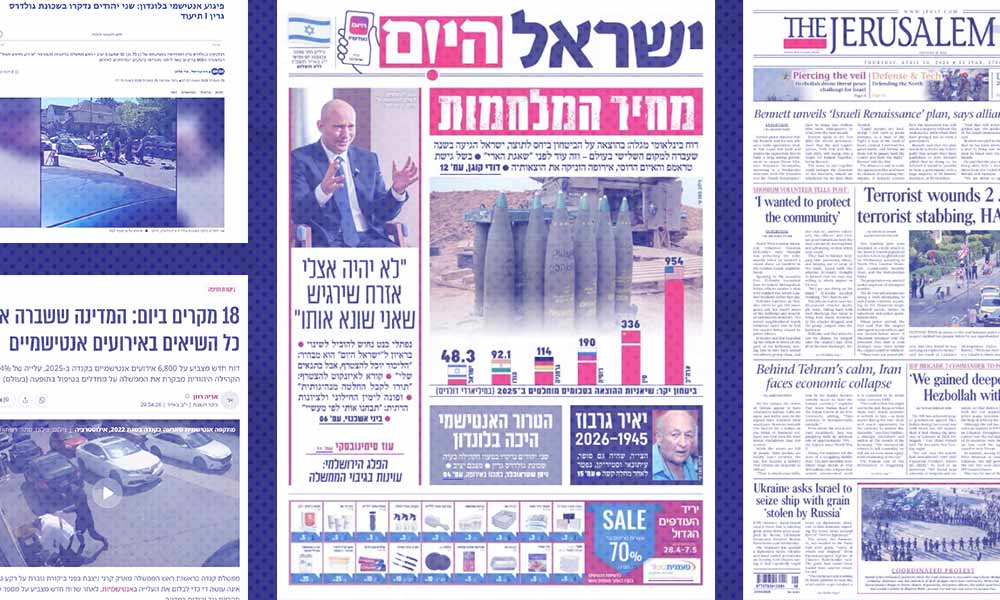
A stabbing attack by a terrorist in London’s heavily Jewish Golders Green neighborhood, in which two Jews were critically injured, grabbed the headlines in Israel.
“Antisemitic terrorism hit London,” cried a front-page headline in Israel Hayom, a right-of-center daily. The Jerusalem Post, an English-language daily also stressed terrorism with its headline: “Terrorist wounds 2 Jews in London terrorist stabbing.”


The antisemitic attack in London spurred a flurry of reports all over the Israeli press about the scourge of antisemitism hitting Jewish communities across the world.
The head of the Jewish students organization in Germany shared with Mako, a leading website owned by Israel’s largest TV channel, recent incidents he and other students endured, including harassment while walking in the streets of Berlin wearing a kippah and graffiti on a college restroom wall calling to “kill all the Jews.”
Channel 14, a right-wing, pro-Netanyahu TV outlet, reported on antisemitic incidents in northern Macedonia, a country that, according to the report, was considered until recently “a safe and friendly destination for Jews.”
Kikar Hashabat, a popular website serving the haredi community, focused on antisemitism in Canada, describing it as “the country that broke all records of antisemitism.”
The extensive coverage of these troubling incidents is understandable and for diaspora Jews it may even feel heartwarming to see Israelis share their pain and concerns. But this sudden interest of the Israeli press in Jewish life outside Israel also highlights the self-imposed limitations on Israeli news outlets when it comes to reporting on the Jewish diaspora. The papers, TV networks and websites are quick to provide full and immediate coverage of tragedies and antisemitic events targeting Jews overseas, while all but ignoring any other facet of Jewish diaspora life. For mainstream Israeli press, their Jewish brethren overseas are worth reporting on only when something awful happens. Flourishing Jewish renewal, cultural events, education challenges and communal life will never make the cut.
Israeli media outlets have largely chosen to adopt the Netanyahu government line, which defines pretty much any attack or protest overseas as being motivated by Jew-hatred.
2. For the Israeli press, anti-Israel equals antisemitism
Within the broad coverage of recent antisemitic attacks—from London to Sydney, from Michigan to Toronto—most in the Israeli press chose to sidestep the debate regarding the differentiation between anti-Jewish and anti-Israeli incidents.
A headline in Makor Rishon, a weekly publication aligned with the settler movement, read: “Antisemitism in Oslo,” but the event described in the story had to do with a decision of a Norwegian center for Holocaust studies to host a discussion about the Nakba, a term used to describe the Palestinian suffering coinciding with the establishment of the State of Israel. The outrage among Jewish residents and scholars was amplified by the fact that the Holocaust center hosting the event was built as part of a collective government fund aimed at compensating and commemorating Norwegian Jews killed by the Nazis. But the idea that discussing Palestinian complaints against Israel may not be a slight against all Jews did not come up in the report.
The right-wing Channel 14, in its report on “Disturbing escalation in the wave of antisemitism,” mixed accounts of blatant antisemitic attacks against Jews in Los Angeles and London with anti-Israel protests in New York.
Blurring the line, or simply ignoring the debate over the difference between antisemitic and anti-Israeli motivations for attacks and protests, is not exclusive to the right-wing Israeli press. All Israeli media outlets have largely chosen to adopt the Netanyahu government line, which defines pretty much any attack or protest overseas as being motivated by Jew-hatred.


3. Election season
While properly covering worldwide antisemitism and the ongoing war with Lebanon and the one threatening to reignite with Iran, if there’s one thing that the Israeli media loves and that Israelis can’t get enough of, it’s political drama.
The last week of April provided that needed drama with a statement that served as the opening salvo of the upcoming election season. Naftali Bennett, a center-right former prime minister who is ascending in polls as a potential frontrunner, and Yair Lapid, who also served as prime minister and who heads the centrist opposition party that has lost much of its support in recent years, announced they are joining forces to form a centrist bloc capable of defeating Netanyahu in the October elections.
Liberal-leaning Haaretz led with the breaking political news, posting a large image on the front page of the two leaders at their joint press conference and noting that both have pledged not to include Arab parties in their future coalition, if they win the elections.

“Joining forces,” read the headline in Maariv, a centrist daily, above a half-page photo of Bennett and Lapid.

Yediot Ahronot, Israel’s largest newspaper, ran with the same story and with the headline: “And now we are two.” Interestingly, Israel Hayom, which is aligned with Netanyahu and his right-wing coalition, chose not to lead with the political earthquake, pushing it to the sidebar on its front page, which was devoted to the war in Lebanon.


The next day, Bennett made the rounds on all major TV evening news shows, and—as was to be expected—all networks rushed to conduct instant polls to gauge how the Bennett-Lapid unification would impact the election race. All reached the same conclusion: It hardly moves the needle. (Polls show the size of the anti-Bibi bloc remains the same after the merger—60 seats. So-called never-Bibi supporters can still go to Eizenkot or to Lieberman, and those more to the left have the Democrats, which is the new incarnation of Labor+Meretz).
But regardless of the outcome of this political merger, it allowed the Israeli press to shift away from war coverage, which has consumed all the attention in recent years, to what journalists and readers really love: horserace coverage and heated political debates in TV studios.
4. Starting to doubt Trump?
Israelis, as polls consistently show, love Donald Trump and believe he’s the best American president Israel could have ever hoped for. The Israeli press, thus far, has been a jolly cheerleader in this game, showering praise on Trump, analyzing his every move, and thanking the American president for being so accessible to the press.
But in recent weeks, Israeli outlets began to reflect a new sentiment: Israelis seem to feel that Trump might have gone a little too far in running the Middle East show.
“Trump decided: A ceasefire,” read the top headline in Yediot Ahronot, following the president’s surprise announcement of a ceasefire between Israel and Lebanon. “The U.S. president forced a ceasefire; Cabinet ministers were not updated about it,” the subheadline explained.

Pundits on TV talk shows echoed this feeling, noting how Trump is the one calling the shots, whether Netanyahu likes it or not. This time, it was clear that Netanyahu wasn’t keen on an early ceasefire, and neither were many Israelis. In the days following Trump’s announcement, mayors and local leaders from Israel’s northern region were all over radio and TV talk shows decrying the move and complaining about how Israel had lost its ability to determine its own future and how the ceasefire imposed by Trump, before eliminating the threat of Hezbollah, would now put residents at risk.
The ceasefire, to be clear, has been hard to maintain, and both sides largely ignored Trump’s announcement. But the discussion isn’t over. Next comes the issue of Iran and whether Trump will decide to end the war now (“and then we’ve achieved nothing,” said a senior military official quoted in all Israeli media outlets) or go back to bombing Iran, a move that could please his supporters in Israel.
Trump may still be way more popular in Israel than he is back home, but this support too seems to be slipping.
5. How Bibi hid his cancer diagnosis from the press
In late April, a short notice from the prime minister’s office, alongside an unsigned letter from Hadassah hospital in Jerusalem, revealed to the Israeli public that Netanyahu had been diagnosed with prostate cancer several months prior and underwent radiation treatment that successfully removed the tumor.
This disclosure, however, came months after the diagnosis, leading the Israeli press to cry foul. KAN, the public broadcasting corporation, reported on how the prime minister hid this major medical finding not only from the Israeli public but also from judges in his criminal trial who inquired about his condition. The report also included experts in the field who talked about possible complications and side effects that might have impacted Netanyahu’s ability to fulfill his role, especially during a time of war.
Netanyahu’s claim that he chose to wait with the disclosure because Israel’s enemies could have used it to harm Israel during the war did not seem to convince anyone in the Israeli press.
Ynet, a popular news website owned by Yediot Ahronot, published a list of still unanswered questions regarding Bibi’s illness and the treatment he received.
Israeli law does not require statutory medical disclosure for the prime minister or any elected official, and some news reports noted that hiding illnesses is common practice in Israeli politics, from Golda Meir’s cancer treatments that were done in secret, to Ariel Sharon’s severe medical issues, which were not revealed until he suffered a stroke and went into a coma.
Still, this time seems different. Netanyahu is leading Israel at one of its toughest times, and Israelis are justifiably angry at the fact that he’s been hiding a medical situation that could have impaired his abilities when the future of the nation is on the line.
2 thoughts on “B’Ivrit │ How Israeli Media Is Covering Diaspora Antisemitism, Bibi’s Cancer and More”
Interesting roundup showing how Israeli media balances war coverage, politics, and concerns about antisemitism abroad. The section about the blurred line between anti-Israel protests and antisemitism was especially thought-provoking.
The Nakba is improperly defined, in my view. It commemorates the failure of the Islamic armies to defeat the new State of Israel. One of its greatest impacts was the suffering of Palestinians, as you mentioned.