
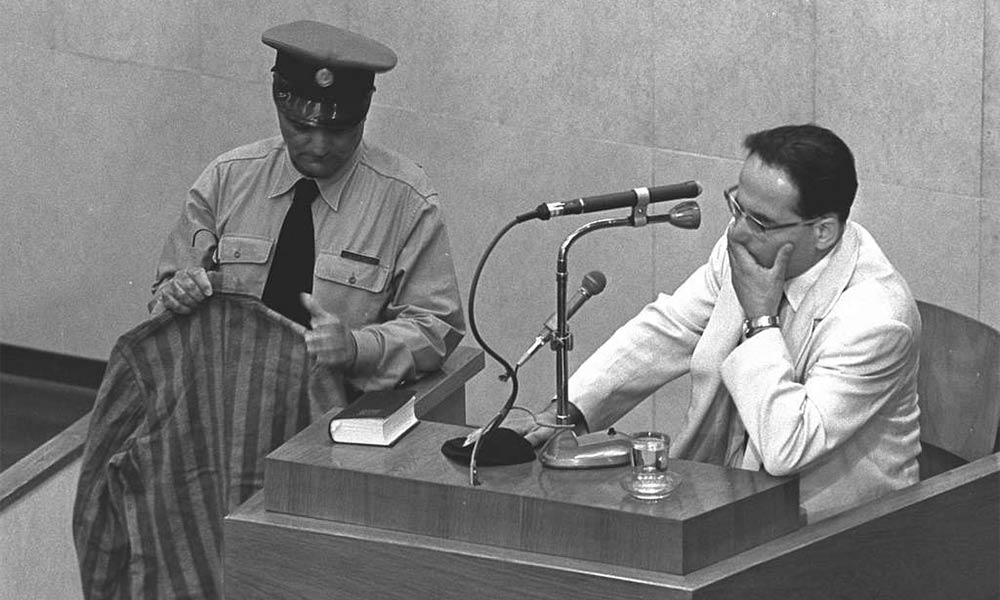
Note: Yehiel De–Nur, also known by his pen name Ka-Tzetnik 135633, died on July 17, 2001. This summer was the 25th anniversary of his death. This personal memoir is meant for that occasion.
There’s a message on my answering machine from a female voice I don’t know, a patchwork of sound bites in Hebrew, English and French. I pick up the essential: “Ka-Tzetnik is dead.” I think: How often must he have died already? This can only be the last time.
Ka-Tzetnik 135633 (the number tattooed on his arm) was the pen name of Yehiel De-Nur, the Polish-born author of House of Dolls, Sunrise Over Hell and other Holocaust novels, who survived the war and lived afterwards in Israel, although “pen name” will hardly suffice for someone claiming to absorb into his writing hand the identity of every human body extinguished in the extermination camp at Auschwitz. In one of his novels, Salamandra, he would write:
Auschwitz was another planet. The inhabitants of that planet had no names. They had no parents and no children….They breathed according to other laws of nature and they neither lived nor died according to the laws of this world.
Above all, De-Nur needed to abstract his own nature from Auschwitz, which was his “home” for two years between 1943-45: change one’s name and alter memory itself to conform to the tactics of survival.
I first met him in 1995, after having written asking for the dramatic rights to his book Shivitti: A Vision. My intention was to write a radio drama with him as the central figure, since I had been struck by the extraordinary experience recounted in this work. He phoned me immediately from Tel Aviv, circumspect, cautious as he was compelled to be, but equally flattered to have his work taken seriously. Would he agree to a dramatization? “Come over to my place and we’ll talk it over.” “But you’re in Tel Aviv and I’m in the south of France.” “A Katzensprung. (A stone’s throw). I’ll expect you on Thursday at three o’clock.”
De-Nur reconstructed the extermination camps according to the principle that they could not be talked about, that we didn’t possess a language adequate to confront them, nor a human vista of comprehension wide enough.
Thursday I rang his doorbell, and there he was waiting for me, younger than I expected, even something of a dandy. If I’d anticipated outward misery and a classical Jewish victim, I was at the wrong rendezvous. He lived alone, his wife had recently died, his workplace was in chaos; she used to filter out interlopers like me, interviewers and Holocaust historians. Now he had to do it all himself, and administration was definitely not his forte.
At the entranceway he embraced me like a son, but as soon as we were seated I was given the once-over. I had written that I didn’t want to adapt his book, but rather to dramatize it “freely.” What did that dangerous word mean? Why couldn’t I just accept the book as it was and put it into dialogue form? I explained that he had already made his story “theatrical”, that his view of his own persona was naturally subjective. I needed to distance myself from him, use him for my own devices, an act of obvious literary vampirism. If that’s the case, he asked, just what is it in the book that makes you want to take it over? This was something I didn’t want to discuss just yet, but he had backed me against the wall.
“LSD.”
***
In 1976, 31 years after his liberation from Auschwitz by the Red Army, De-Nur underwent a therapy in Leiden, Holland, under the supervision of Dr. Jan Bastiaans. This involved the use of controlled doses of LSD in the treatment of what Bastiaans referred to as Concentration Camp Syndrome. De-Nur, carrying Auschwitz forever with him in its aftermath, did not want to face this ordeal, but was convinced by his wife to try it. Bastiaans told him, as he had his other patients, that his method involved “reliving the inferno of their trauma of decades ago, with a difference: this time they will not go it alone in hell.” In effect, this therapist imagined himself as Charon, ferrying his patients across the river Styx for a season in the underworld, but quickly rowing them back onto the riverbank called Valium when the going got rough, as it must have in most cases.
De-Nur stayed six months, but he fought the treatment every inch of the way. He did not want to “go back” to Auschwitz. If we are to read his novels autobiographically, he was made to watch his family go up in crematorium smoke and his 14-year-old sister become “eine Feld-Hure,” or “field whore,” in the Gestapo brothel (House of Dolls). Even more, he did not want to have to revisit those scenes of perpetual humiliation which finally allowed him to survive.
De-Nur reconstructed the extermination camps according to the principle that they could not be talked about, that we didn’t possess a language adequate to confront them, nor a human vista of comprehension wide enough. This led him to create an almost mystical Auschwitz-Wonderland in his books, whose events, in their dreadful logic, are confined to the unfathomable nature of the place:
There was no speech on the Planet. Its inhabitants were all the same – round-headed and hairless – their clothes all of one color with stripes. Those wearing stripes passed without sound – like fish. Swimming, too, like fish in an aquarium – swift, nimble and soundless. The watchful glances of the guards in their watchtowers activated the fish to dart, to flutter about, soundlessly.
There is a legendary moment, caught on film, of De-Nur at the trial of Adolf Eichmann in 1960. He was 45, he had never before appeared in public in Israel, his books were best sellers, required reading in the schools, yet most people—including his two children—did not know who their author was. No one at that time had even seen a photo of the famous “Ka-Tzetnik.” Yet there he was now, speaking before the court in a deathly monotone, “like someone hallucinating and reading out loud from a book,” wrote the court historian. Before the assembled jurists seeking facts, De-Nur talked about “Planet Auschwitz,” claiming that he saw its inhabitants and that they were watching him. When the prosecutor tried to ask him a question, he passed out cold on the floor and was taken away in an ambulance. He would remain paralyzed on one side of his body for some six months after this event.
In describing this scene in Eichmann in Jerusalem, Hannah Arendt clearly has no time for De-Nur’s behavior, but rightly points to the “rare capacity for distinguishing between things that had happened to the storyteller more than 16 years ago, and what he had read and heard and imagined in the meantime.”
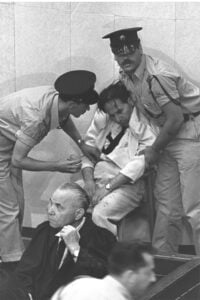
Yehiel Dinor Katznik collapses during the testimony stage, in the trial of Adolf Eichmann in Jerusalem 1961. Israel Government Press Office, Public domain
So, in the end, what can it mean to write about things that cannot be written about or speak about what cannot be spoken in any known language on this planet? De-Nur was, in effect, already on the road to LSD before he received his first injection.
“Who do you see, Mr. De-Nur? What do you see? Speak, tell me, let me in…” This is Prof. Bastiaans trying to get into his patient’s head after giving him 100 micrograms of LSD-25 (a small dose) to liberate his consciousness. On first reading De-Nur’s description of his trips (can they really be called that?) I couldn’t help but muse: if I were stoned on LSD and someone asked me to go into myself and deliver up a scene from my past, I’d immediately get lost in the stripes of that person’s tie or the syntax of his question or the bubbles coming out of his mouth. Yet, at the Leiden clinic, the drug conveniently transports De-Nur to Auschwitz, time and time again, he sees people he knew there, a rabbi from his village in Poland, a certain SS guard. Was he really reliving this? Inventing it on the spot? Or, even more conniving, was he already conceiving his book while undergoing the experience of its primal content?
De-Nur was not a typical Holocaust witness; he was a writer of fiction first and foremost, which meant that even his first-hand concentration camp testimony would be “tainted” with art. The scenes in his novels are so dramatically wrought that they cannot possibly render a taste of Arendt’s “banality of evil.”
What Bastiaans did to De-Nur was, in effect, what in the 1960s would have been termed “laying a bad trip” on him. That this was precisely the intention might go beyond the comprehension of a one-time “acid freak” whose selective memory equates the taking of that substance with mind-expansion. A bad trip was always unforeseen and unwished for; LSD is not supposed to be a downer. Nor is it a “truth-drug,” whatever that may be, designed to elicit specific information from its incipient. The very idea of taking it under “controlled conditions” would be enough to bring on the famous paranoia which is its dark underbelly. De-Nur himself seemed aware of this:
LSD might be just that window that opens our range of vision beyond the limit that our state of consciousness has set, providing one treats the drug with the same reverence that the high priests in the temples of antiquity had for the urim ve-tumim (oracular gems set in the breastplate of the High Priest). For its abuse will incur the wrath of the gods.
All of De-Nur’s LSD sessions were recorded, the point being to analyze their content between doctor and patient when the latter was once again in his “normal” state of mind. I got to know De-Nur’s reluctance with regard to this procedure firsthand. I had brought my tape recorder to Tel Aviv, but he would not allow me to switch it on. Why? “Because this machine listens with the ears of Ashmadai, the god of hell.” Was he afraid it would steal his voice the way some Arabs fear a camera will steal their souls? Apparently not. For he also forbade me to take notes by hand. This was not coquetry; he really feared that his own words would somehow be used against him. Only his own writing on his own paper was to be trusted.
I tried to imagine what it would be like to listen to recordings of all the obsessive LSD-nonsense people (myself included) spouted in San Francisco or in London in 1967. To seek this kind of analytic coherence in the drug seemed to belie its very nature. Yet this was precisely Bastiaans’ method. As reported by De-Nur, he explains:
This substance which I am about to transmit to a certain area of your brain will evoke images and situations that can be compared to hieroglyphs. To decipher them we must look at them; study them.
Hieroglyphs. So far so good. We are in the realm of metaphor and here LSD is certainly at home. It was also very safe ground for the writer Ka-Tzetnik who lived like a hermit crab in the shell of De-Nur. Yet the goal of this therapy—like all therapies—was some kind of cure or liberation. Bastiaans hoped to “decipher” his patient’s hieroglyphs; this was science once again outsmarting poetry with comprehension. Bastiaans also posed endless questions, and De-Nur was forced to remind him that it was one mere question which had paralyzed him at the Eichmann Trial.
I too had trouble asking him questions, and I quickly saw that this was not the way to get to him. He did not readily give interviews, never without his wife at hand, and even Holocaust scholars had a difficult time eliciting concrete information. You simply had to let him talk. In any case, he would never tell you what you wanted to hear. He mostly quoted himself, recounted events which you already knew from his novels. And having these books so recently in my head, I was forced to note how close his discourse was to his written word. That the scenes from his novels were adapted from real life I took for granted. Yet they were so similar in the telling I could only wonder if their detailed reality began in Auschwitz or only later on the page. Or rather, had the writer Ka-Tzetnik transformed the events of the life of De-Nur for his own purposes, leaving De-Nur to live out the rest of his life as a character in the works of Ka-Tzetnik?
I wasn’t satisfied. I hadn’t made this Katzensprung just for what was, in effect, a private reading from the novels. I edged the monologue round to the matter of LSD. De-Nur spoke of the drug with reverence and with the obligatory caution: It’s not for everybody. And what was it like for him personally? “Read my book.”
I’d read his book. In it, he talks about the “color of Auschwitz.” There is also a description which might have been taken from a manual on the use of hallucinogens:
The electrified barbed wire is magnified as under the eye of a microscope, ten thousand times its normal size. The light of this Auschwitz dawn has substance to it, and I can reach out and touch it with my hand. Metallic cobalt-blue light.
Or, this terrible flogging scene:
Every time the cane crashes into Vevke’s naked buttocks salvos of sparks in the colors of the rainbow come spewing out, glowing stars bursting like fireworks and dispersing throughout the darkness of the block.
De-Nur could sense my doubts. What was my interest in this, he wanted to know. This substance had once had a great influence on my own perceptions, I said. I remembered it with great fondness, even if I had certainly been one of its countless abusers once upon a time. And, although I experienced some terrifying private moments, I generally associated its use with pleasure, in the most comprehensive sense of that banalized word. I found it difficult to imagine that one could actually use it explicitly to re-stage a scene from one’s past, and I considered Dr. Bastiaans’ therapy more in line with classical Freudian analysis than with the state of enhanced awareness I associated with LSD.
De-Nur was having trouble following my drift, as I well expected. For him this drug was linked invariably to Auschwitz and had no function other than bringing repressed nightmares up out of the depths. He couldn’t understand what I was talking about when I suggested he might have experienced a classical moment of cosmic laughter: a common word which suddenly sprouts wings and flies away from its accepted meaning, a known face which dissolves into a colony of butterflies. When I asked him if he would ever consider taking LSD outside the “control” of a medical practitioner, he looked at me as if I were mad. As I undoubtedly was, in this dangerous mixing of historical metaphors.
I realized, in the popular language of the substance, that LSD had been essentially a “bummer” for him. Bastiaans always had a syringe loaded with valium “to bring him back”:
I must follow your floating, keep you bound to me by the slenderest string, and when you reach the very end of that string that I hold in my hand, that’s exactly when I must pull you back, or else you could get lost there.
In the heyday of LSD consumption, you were wise to take along a trusted friend, unstoned, to reassure you in your moments of distress. But a good guide was one who let you navigate the ship. De-Nur would never have such freedom, for the goal was never to let his mind simply wander. To be fair, the Professor Bastiaans presented in De-Nur’s book may be an elongated literary version of the real thing. His dialogue seems somehow imposed on him by the author. Yet, in an afterward to Shivitti: A Vision, Bastiaans claimed to give his patients a chance to “free themselves from the prison of their memory.” How was such a thing possible? I wondered. And would it even be desirable? For the writer Ka-Tzetnik there was only memory and metaphor, without it he had nothing to convey. To liberate his synapses in order to put his ego in relief was one thing. But how could he, or anyone else, ever be freed from the ur-dungeons of Planet Auschwitz?
As delicately as I could, I tried to suggest this to De-Nur. Ka-Tzetnik 135633 had personally vowed to carry the corpses of the gassed and the incinerated around in his consciousness and to tell their story, although De-Nur claimed this story could not be told. “De Nur” did not write about the Holocaust; “Ka-Tzetnik” did. “De Nur” couldn’t do so because “De Nur” believed that Auschwitz couldn’t be written about, at least not in any language which any inhabitant of Planet Earth could follow. This was his own calculated and self-imposed schizophrenia; it had allowed him to be and not to be for some 40 years, and no therapy could steal this from him.
I could see in his face that I’d hit a nerve here. I may have broken the code of his personal fiction about himself, this passage between identities, which permitted him to glide in and out of Auschwitz at will. One of these had survived through sheer cunning, in order to permit the other to tell his story. One was the author of several novels, all translated into dozens of languages, the other a solitary septuagenarian living in an anonymous block of apartments in Tel Aviv. To be “freed” from the terrors of Auschwitz was equally to break with his most private myths about his own nature. Naturally, then, he resisted the goal-oriented pressures of psychotherapy.
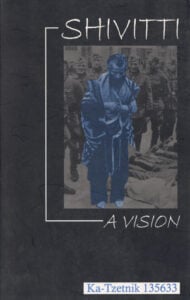
Cover of “Shivitti: A Vision” by Ka-Tzetnik 135633.
Ka-Tzetnik’s book Shivitti: a Vision, recounting the LSD experiences of De-Nur, is perfectly designed. We get the impression that these trips have an overriding dramatic purpose, they are choc-a-bloc with Old Testament references, De-Nur sees the face of God in the Auschwitz sky, nothing at all is missing. Except: chance, accident, the unexpected fly on the wall that becomes hours’ worth of hallucination. LSD lacks dramatic logic.
But there is one proposition in De-Nur’s outlook (or, in acid-speak, inlook) which completely resembles a common LSD occurrence. He speaks of a certain SS guard, “Siegfried,” whose boring daily task it was to accompany a truckload of no-longer-working-capacity Jews to the crematorium. One day, De-Nur was part of the consignment. On acid, he claims:
I stand and stare and see my own face up in the sky, wearing the SS cap superimposed on a swarm of vipers. I am terrified of that SS man – he is me…
Looking into someone’s face—especially if that someone is also stoned—and attempting momentarily to exchange identities is a known and tested hallucinatory phenomenon. The writer Carlos Castaneda in his series of books The Teachings of Don Juan recounts this time and time again, and most people who have taken the psychedelic route will be able to share their stories of transfer. But here, in Auschwitz, we are entitled to a moral, something that gives a new twist of Menschlichkeit to what is otherwise a transitory LSD moment. De-Nur tells us that under inverse circumstances, he could be the one sending the SS man to his death. We’re all fundamentally capable of atrocities; the distinction is not limited to Nazis. Even Jews are capable of it.
De-Nur’s LSD sessions returned him invariably to the truck heading for the crematorium. In its load are living beings as well as corpses, all strewn together. Dead or alive, it’s all the same on Planet Auschwitz. In the approaching smoke of the death chimneys he sees the faces of his mother and sister and brother, all burning. He imagines himself burning with them. When the truck arrives at the site, the tailgate opens and the bodies tumble out. Siegfried jumps down from his post; it is his job now to count the bodies—alive or dead—to be incinerated, because Camp Commandant Rudolf Höss demands exactitude and Ordnung even at the gates of oblivion.
And this is De-Nur’s moment. On the truck platform, just behind the cab, is a small coalbin. It happens to be empty and he crawls inside, unseen by Siegfried. It is so small that he can’t imagine getting his whole body into it, yet survival finds its necessary contortions. When the truck is driven into the camp garage, he bursts out, covered in black soot. The guards, terrified, think he is some kind of black devil, but De-Nur screams out that he is a human being who wants to live. Siegfried lifts his Luger from his holster, but the Camp Commandant shouts for him to desist. He is apparently impressed by this cunning initiative (“ein braver Kerl”) and lets him live.
On LSD, the relived coalbin around his body is so tight that he becomes one with it. He is, at the same time, the thing-in-itself as well as the being inside it. The coalbin is also his greatest humiliation because he thinks, in a moment of guilt, why should I have survived and not the others? Bastiaans obviously notices this and brings him back again and again to the coalbin, then pinning a Jungian interpretation on him: emerging from the bin was a birth out of the womb into the light of day, and in that moment of coming out, his soul had split into its Ka-Tzetnik and De-Nur components.
Another key scene out of De-Nur’s private mythology concerns the notorious Dr. Josef Mengele. It was he who was in charge of the Selektion, where all the Ka-Tzetniks lined up and passed before his determining specialist’s gaze. If he thought you were still fit for work, he pointed to the left; if you were too weak to go on, it was out the door to the “sauna,” the camp’s expression for the gas chamber, or even direct to the crematorium. Others might have been singled out for various scientific experiments, certain women for sterilization, and always without anesthesia.
De-Nur claims he was saved through a certain internal incantation of four letters of the Hebrew alphabet—E.D’M.A.—a kind of religious self-ecstasis:
It was an undying flame locked within me. Dr. Mengele saw it in my eyes. It stopped him from lifting his index finger… by the time (he) regained his composure, I had been shoved aside by his subordinates.
On LSD, he revisited Mengele and imagined the Auschwitz furnaces blazing in the death-doctor’s eyes. Who can ever know if this scene is authentic or just a literary pretense? It hardly matters. We know that De-Nur would certainly have taken part in this common selection process and that he survived it. But it obsessed him still—as did all those moments when he had escaped death by inches—and he needed to tell it to me again as we sat together in Tel Aviv. Mengele, of course, played a special role in the Auschwitz pantheon. Not simply another Nazi officer obeying orders, he was on the “creative” side of the death machine, researching the limits of human tolerance for pain and reassembling body parts like pieces of Lego.
“Do you think Mengele knew about LSD?”
My question astounded him. Why not? I continued. The drug was first discovered in 1938 in a Swiss laboratory, and during the war we know that the U.S. army experimented with it to see if it might be used to elicit information from prisoners of war. Why not Mengele in 1943?
De-Nur started crying. I had apparently dug too deeply without realizing it. He signaled with his hand that he needed a moment to recover. Only when he spoke of his martyred sister had I seen him more moved. Should I leave? No, he wanted me to stay.


Later he would again explain that questions in themselves had the effect of temporarily crippling him. This came, he said, from having undergone torture at the hands of the Gestapo in Katowice in Poland. Yes and no, I said to myself. This man has a hunger to speak, but he is compelled to seek his discourse from a more or less prepared repertoire. When the question fails to press the correct button, there is a temporary pandemonium in his brain, and he will either faint or be dumbstruck for an indefinite timespan. And yet, what can he be hiding from, here and now? Can Mengele still inspire such awe? Apparently.
I was like a tree struck by lightning, standing in flames, and burning.
These were De-Nur’s words for the effect LSD had had on him at the moment he decided to quit the Leiden clinic. He had had enough, had seen what he needed to see, now he wanted out, even though Bastiaans tried to convince him he required more sessions. I asked him why he had so abruptly stopped the therapy. He didn’t give me an answer and I didn’t really need one. The idea that Planet Auschwitz could be addressed in any form whatsoever was the starting point of his lifelong refusal. Bastiaans’ idea that there was a phenomenon he could call Concentration Camp Syndrome, that “results” could be gleaned from facing the nightmare head on, was anathema to De-Nur. How could Bastiaans or anyone else know anything about Auschwitz, much less “cure” its victims of its mystique? De-Nur did not want to be accompanied back to Auschwitz by someone who was essentially a tourist. What the injections of LSD allowed him to do was to rivet down the casing of his camp experience. I suspect he already knew there was a great book in it.
I imagined now that no acid-induced hallucination could have taken this man by surprise. He had already been in places to which the human spirit generally has no access whatsoever. There was nothing his consciousness hadn’t already witnessed or been made to anticipate. Can there be a more “mind-expanding” terrain in modern history than a Nazi extermination camp? Hiroshima maybe. The books that Ka-Tzetnik wrote were already the work of someone struck by lightning and standing in flames, long before he got to Leiden. This was especially true of his Piepel, a novel that is literally unbearable to read. It depicts pedophilia and cannibalism at Auschwitz, leading some critics to accuse the writer Ka-Tzetnik of sensationalism and pornography.
He didn’t want to die. He was not of the same cut as Primo Levi or Jean Améry, Holocaust authors who carried the camps around inside themselves for a time, then chose the road to self-annihilation after the weight became intolerable. In the 1960s, and especially at the instigation of his wife, De-Nur opened his Tel Aviv doors to Palestinians, something previously unheard of in Israel. “I didn’t go through two years in Auschwitz just to sit back quietly and watch Jews oppress Arabs,” he told me. I have been informed, however, in the last years he felt he had failed in this gesture of peace, that there was no way out of that fratricidal impasse.
And yet he held on. To what? I asked myself. With De-Nur I felt I was in the presence of someone who was somehow “not there.” He sat before me, made me coffee, spoke to me in a perceptible language. But held something fundamental back. Something he refused to share with interlopers from Planet Earth like myself: his affiliation in a secret society which had no name and existed without parameters. This was the persona which Auschwitz had written around him, and to which he would cling even in the face of LSD, which surely must have offered him other identities to choose from.
Some months later I sent him the BBC radio play I’d written, Planet of Ashes, with him as its central character, not as he had written about himself, but as I had lived and interpreted him in our Tel Aviv encounters. His only response, on reading it, was: “Who is this person?”
(Image credits: Israel Government Press Office, Yehiel Dinur Katzetnik, public domain)
One thought on “Auschwitz on Acid”
Thank you for sharing this interview. So painful, yet so necessary.