

When my kids were in elementary school and the Jewish holidays rolled around, I was always the mom who volunteered to bring in a holiday-appropriate snack and read a story. The story was my real motive. I loved the idea of introducing Hanukkah or Purim or Rosh Hashanah to a mixed group of Jewish and non-Jewish children, early, when it would do the most good: There was always the chance I’d blow the kids away, read them a story about a seder or a shofar that they’d always remember. Even better, I might work in a tale that braided Jewish and American identity together.
Small children don’t know the multiple threads that make up the fabric of their nation or of their families, Jewish or otherwise. But a good story can make them feel it, either because the story they tell is so amazing (Marian Anderson really did stay in Albert Einstein’s home after being told she could not stay at the Nassau Inn) or because of the writer’s and the illustrator’s delicate touch.
Over the years, I collected a handful of favorites that not only drew the kids into Jewish worlds but also merged Jewish experiences into the American story. This 250th-anniversary-friendly list includes books with Jewish takes on American life going back to the Pilgrims and the American Revolution, and Jewish holidays entwining themselves with what’s most American about America, whether it’s baseball, boxing or welcoming (or being) the stranger. Some of the books are old and hard to find, while others came along recently, after my school-reading days were long past. All carry the message that Jews are deeply enmeshed in the American story and are also part of what moves that story forward.
Hanukkah at Valley Forge by Stephen Krensky, illustrated by Greg Harlin (2006).
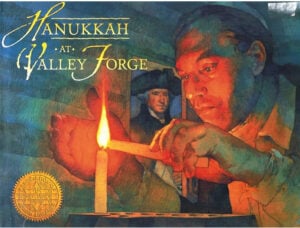
On an icy cold night, General George Washington walks the camp at Valley Forge, haunted by worry about the progress of the rebellion and the suffering of his “army of skeletons.” He spies a young soldier lighting a candle in his tent and stops to talk. The soldier, a Jewish immigrant from Poland, is observing Hanukkah. Answering the general’s questions, he recounts how his people’s ancient struggle for freedom from tyranny mirrors the one the troops are currently fighting—as well as the latter-day religious persecution that brought him from Poland to America.
The story resonates with Washington, who, while fighting for liberty, also longs for a miracle. The book is based on a diary entry by Louisa Hart, stepdaughter of a Jewish family in Easton, PA, where the peripatetic real-life Washington stopped for lunch in 1778. The family was celebrating Hanukkah, and the host began explaining it to the general, who declared that he already knew all about it. This historical footnote is explained in an afterword, while the tale itself is told folktale-style, with dreamy watercolor illustrations that feel magical.
Molly’s Pilgrim by Barbara Cohen, illustrated by Daniel Mark Duffy (1983).
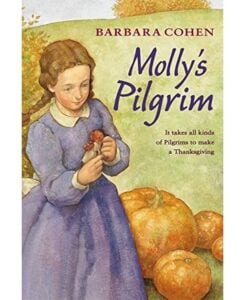
This classic is set in the early 20th century, in a cold, unfriendly New England schoolhouse where the protagonist struggles to fit in—only to discover that she embodies the nation’s founding myth. Molly’s family fled the pogroms in Russia for New York, then relocated to a small town where there were jobs but no Jews. She is bullied for her foreignness (yes, even without social media).
When Thanksgiving comes, Molly stumbles over the unfamiliar word “pilgrim”—and the assignment to make a clothespin-doll Pilgrim for a classroom diorama. It’s Molly’s mother, who speaks only Yiddish, who solves the problem by connecting the Pilgrims’ situation—coming halfway around the world for religious freedom—to Molly’s own. She sends Molly to school with a clothespin doll dressed as her mother in traditional Eastern European garb, leading Molly (and the bullies) to realize that “it takes all kinds of Pilgrims to make a Thanksgiving.”
This book might not suit kindergarteners (it’s long enough to be divided into mini-chapters) but any age will feel the satisfying frisson when the teacher asks the main bully where she thinks the Pilgrims got the idea of holding a Thanksgiving dinner in the first place. “They just thought it up,” the bully guesses, to which the teacher points out that the Pilgrims held the first Thanksgiving dinner after “they read in the Bible about the Jewish harvest holiday of Tabernacles…The Pilgrims got the idea for Thanksgiving from Jews like Molly and her mama.”
Barbara Cohen was a prolific children’s book author better known for the even more iconic book The Carp in the Bathtub (1975), less read nowadays because the family ends up eating the carp for Shabbat dinner. But generations of children remember Molly with no such qualms.
Emma’s Poem: The Voice of the Statue of Liberty by Linda Glaser, illustrated by Claire A. Nivola (2010).
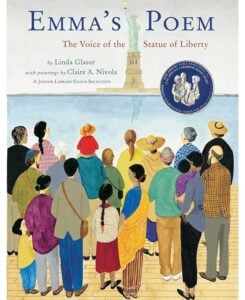 Coming to America as an immigrant is as foundational an American Jewish experience as they come. But opening America’s arms to the immigrant is also part of the Jewish story. And that story wouldn’t be complete without the words of Emma Lazarus, the woman who, unlike many protagonists of these books, grew up in comfort and privilege in old-line Jewish New York. Rather than suffering the rough passages of the “tempest-tost,” she shaped and voiced the welcome that awaited them.
This isn’t the most literary of tellings; there’s a whiff of the didactic in the pages about how “people who had everything” weren’t expected to mingle with the poor, as Emma did, and her personality doesn’t really come through. But the author sensibly builds up to what’s really important, the poem itself. After a few false starts, the author gets the whole thing out, including its most famous lines: “Give us your tired, your poor/Your huddled masses yearning to breathe free…” Any book that lets you read this poem out loud to children is okay with me.
The House on the Roof: A Sukkot Story by David A. Adler, illustrated by Marilyn Hirsh (1976).
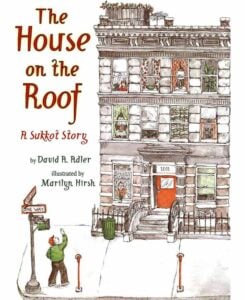 What’s more American than a clash between religious freedom and the zoning laws? In this retelling of an old tale, the landlady of an apartment building mutters with frustration as her elderly tenant brings junk onto the roof—boards, branches, even a table and chair! She takes him to court, where he explains to the judge his religious obligation to build a sukkah. The landlady won’t budge: The rules are clear, no building on the roof. The judge ponders, then tells the old man regretfully that there is no escaping the rules: “You have eight days to take it down.”
Maybe I’m overthinking and should just enjoy the joke, but isn’t there something quintessentially New World about a country where the legal ins and outs of the administrative state are used to help an old man practice his religion, rather than to stamp it out?
A Fist for Joe Louis and Me by Trinka Hakes Noble, illustrated by Nicole Tadgeli (2019).
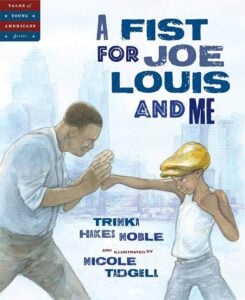 Not every one of these stories is told through Jewish eyes. Set in Depression-weary Detroit in 1938, and based on a true sports event that gripped the public imagination, this lovely book is narrated by Gordy, a Black child whose father has lost his factory job, causing his mother to start sewing piecework for Mr. Rubinstein, a tailor who fled the Nazis. Gordy befriends Ira, the tailor’s shy son, who knows little about his new country but a lot about one surprising subject: boxing. He shares the city’s obsessive interest in the Friday Night Fights and in the fortunes of its homegrown boxing hero, Joe Louis. To Gordy’s amazement, Ira and his father, though newly arrived, know all about the upcoming World Heavyweight Championship rematch in Yankee Stadium between Joe Louis and the German Max Schmeling, billed as the Fight of the Century.
“Plenty I know,” Mr. Rubinstein said. “My people and your people, we have much in common, Mr. Williams. This fight is for us, too.”
I didn’t know what he was talking about. But my father did.
“It’s for all of us,” he said, as he stood and reached out his big hand. Mr. Rubinstein put out his hand, too. I wasn’t sure why, but their handshake felt important…
Noble’s touch is light, the boxing match as metaphor for peacemaking and brotherhood is just quirky enough to resonate, and Detroit’s love and pride in its native son is as strong a theme as the unlikely bonding between its characters, all listening together to the Williams family radio as Louis flattens the stand-in for Nazi Germany in one round. “The Fight of the Century had lasted two minutes and four seconds,” Gordy concludes, “but I knew it would be with Ira and me for the rest of our lives.”

The Singer and the Scientist by Lisa Rose, illustrated by Isabel Muñoz (2021).
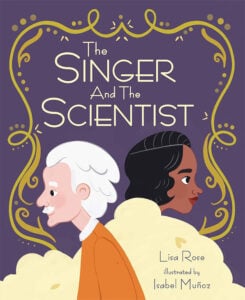 Another semi-recent addition to the genre, this one is set in the same prewar late 1930s as the Joe Louis book, and it too tells the story (a true one) of an unlikely friendship: between Albert Einstein, the scientific genius, and Marian Anderson, the great Black singer. Anderson would become a civil rights icon two years later when she sang a concert from the steps of the Lincoln Memorial before 75,000 spectators after being barred from singing in Constitution Hall because of her race. That dramatic story is referred to only indirectly; this book focuses instead on a lesser-known earlier occasion when Anderson, already famous and exhausted from singing a concert at the McMaster Theatre in Princeton, NJ, is told she cannot get a bed at the nearby Nassau Inn.
In the audience is music lover and semi-recent immigrant Einstein, who was driven out of Germany by the Nazis. Witnessing her humiliation, Einstein invites her to stay at his home. A lifelong friendship begins. Einstein even brings out his violin, and they play and sing far into the night.
“Years later, when the world had changed,” notes the book in its only direct reference to the civil rights movement, Anderson returns to Princeton to sing again. She declines to stay at the inn that once rejected her: “She would be staying at the home of her friend Albert.”
Sophie and the Shofar: A New Year’s Story by Fran Manushkin, illustrated by Rosalind Charney Kaye (2001).
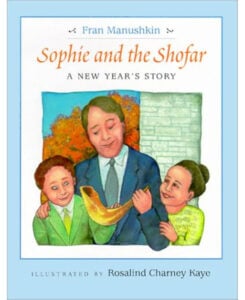 It’s not so easy to dramatize the feel of Rosh Hashanah and Yom Kippur in the American suburbs. But this story captures the familiar buildup to the High Holidays—baking treats, making holiday cards, listening to Dad practice his shofar blasts—through the voice of Sophie, who’s teaching all the rituals to her cousin Sasha, newly arrived with his family from the former Soviet Union. In this late-20th-century chapter of Jewish immigration, Sophie is the tour guide; Sasha, at first sulky and strange, knows nothing about Jewish practices. Teaching him is fun, but then “something horrible” happens: Her father’s shofar disappears, just before it’s needed for services, and Sophie, who had noticed Sasha’s interest in blowing it, accuses him of the theft. The story is about misunderstanding and forgiveness, as befits the holiday, but it’s also about being the Jewish family that’s no longer the stranger, but is tasked with welcoming and embracing others.
Matzah Ball: A Passover Story by Mindy Avra Portnoy, illustrated by Katherine Janus Kahn (1994).
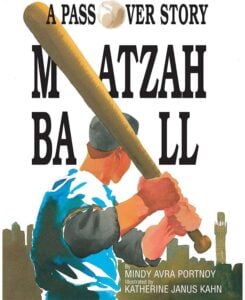 The America enshrined by this book is represented by perhaps its most fundamental subculture baseball. And the book’s main character, Aaron, lives for baseball and for the game’s storied history. Aaron gets invited to Baltimore’s Camden Yards with his friends to watch the great Cal Ripken play, but his enjoyment is dampened by the fact that it’s mid-Passover and he has to bring his own unappetizing lunch, staying in his seat while his friends hit the concession stands.
While they’re gone, an old man sits down next to Aaron and says the brownbag matzah lunch reminds him of his own Passovers at Ebbets Field, the legendary home of the Brooklyn Dodgers. Aaron is impressed and comforted:
And suddenly I saw myself part of the Ebbets Field gang. All those Jewish kids eating their Passover lunches, watching Jackie Robinson stealing second. I didn’t feel so alone anymore.
“I still bring my own lunch,” he said. “Here, would you like another piece of matzah?”
I won’t give away the ending of this charming story, but suffice to say there’s more to the old man’s matzah than meets the eye, and to the old man, too. And if there’s a more elegant melding of the magics of Americana and Judaica, I’ve yet to encounter it.
Next Year in the White House by Richard Michelson, illustrated by E.B. Lewis (2025).
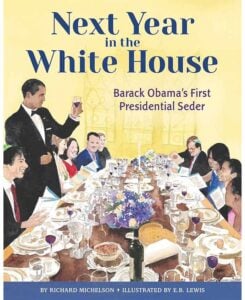 For today’s elementary-school-aged kids, the Obama White House might as well be ancient history. But the first Black president was in fact also the first president to host—and attend—a yearly Passover seder in the White House. The tradition started on the campaign trail in 2008, when a handful of homesick Jewish staffers improvised a seder in the basement of a Pennsylvania hotel.
The affair was spartan—someone’s cousin lived nearby and sent over the basics—but it caught the attention of the candidate, who attended with a handful of top aides and jokingly promised at the end, “Next year in the White House.” And so it turned out. The eight seders held in the White House weren’t networking events but friendly in-house evenings for the original cadre and their growing families.
Michelson gives this story a nostalgic, faintly mythic treatment, with sketches of the down-to-earth seder on the campaign trail yielding to the rich yellow tones and crystal wine glasses of the White House dining room. My favorite page is the closeup of the hotel basement door cracking open to reveal the familiar face: “Hey, is this the seder? Can I join in?”
Michelson, a poet, has written a shelf of books for children about American Jewish cultural heroes, from the collaboration between Martin Luther King Jr. and Abraham Joshua Heschel to Jewish Book Week founder Fanny Goldstein to One of a Kind, a picture-book biography of perhaps the single most significant author of children’s books, Sydney Taylor. Speaking of whom…
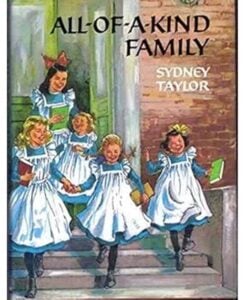 Beyond picture books: American Jewish children’s fiction would hardly exist at all without Sydney Taylor and her All-of-a-Kind Family books—about a poor family with five daughters and a son growing up on the Lower East Side. As you can read in Michelson’s book about her, Taylor’s children complained that they never saw any books featuring Jewish children like them; Taylor began telling them stories from her childhood, then, after an unsuccessful attempt to publish them, put them away in a drawer. (They were published years later when her husband secretly entered them in a contest.)
The books introduced rich Jewish content about, and to, American Jewish children. But they also capture the experience of merging into the American mainstream while still observing traditional customs. The contrast lends charm and also drives the gently episodic plots. In the first book, much of the drama and the book’s thematic unity comes from middle child Sarah’s relationship with the local librarian, a non-Jew who befriends the family and listens with interest to their descriptions of their holiday customs. (Sarah is Sydney’s stand-in and bears her original name, which she later changed.) The librarian, through her friendship with the girls—in fact, while visiting their sukkah—is ultimately reunited with a lost love.
When in the third book the family moves “uptown,” away from the Lower East Side, to an apartment surrounded by gentile neighbors, each chapter brings an encounter with the broader culture. Mostly these are funny, but then Mama gets sick, and the downstairs neighbors, the Healys, come to help cook for Shabbat, occasioning lots of explanation about Jewish rules.
“Ella,” Grace cried, aghast, “What are you doing? You’ll burn everyone’s mouth off with so much salt!”
Ella smiled. “It gets washed off later. This is how we make our meat kosher.”
“Oh, that’s how it’s done,” Mrs. Healy said. “I’ve always wondered.”
But the book gathers to its emotional climax when the outside world takes the reins of the story. It is 1917, and Jules, oldest sister Ella’s boyfriend, goes off to fight in World War I. He trains with a buddy named Bill, who becomes friendly with Ella’s now close friend downstairs, Grace Healy. The girls see Jules and Bill off to war, write to them, knit sweaters and warm socks, wait anxiously…and watch breathlessly from the crowds after Armistice as Jules comes marching home in the victory parade through the new arch in Madison Square. Experiencing such a moment of American history through the Jewish characters we’ve grown to love is almost like living through it ourselves.
2 thoughts on “We’ve Always Been Part of the Story”
These were wonderful choices. I often tell Black fmailies that they have available awesome picture books for their children also. NOne of this was there in the 1950’s. Lets share our books and stories.
Thanks so much for these wonderful (& interesting!) reviews! Have already begun making a list for reading to my grandchildren! So happy to know new books are coming out that help children to learn more about their Jewish identities–& the important history behind them!