
A few minutes after 4 p.m. on October 3, hundreds of Palestinian citizens of Israel marched through Arraba, a small town in the Galilee. An annual march, this one marked 26 years since Israeli police shot dead 13 men during protests in October 2000. Earlier in the day, families, activists and members of Arab political parties visited the graves and memorials of those killed in six other Arab towns in northern Israel.
One of the 13 was Aseel Asleh, a 17-year-old peace activist from Arraba. He had spent the previous three summers at Seeds of Peace, a camp in Maine founded in 1993 to bring teenagers from different sides of conflicts together. In 1997, Israel’s Ministry of Education picked him, then 14, for the Israeli delegation. It included Jews and Palestinian citizens of Israel. The Palestinian Authority picked the campers from the West Bank and Gaza Strip.
Following his first summer at the camp, in March 1998, Asleh sent an email to Seeds of Peace on the occasion of Land Day. Palestinians mark the day each year to remember six Arab citizens of Israel killed in 1976 protests against land seizures in the Galilee, one of them in Arraba. In his message, Asleh spoke of the Jewish friends he’d made in Maine. “A few years from now, they will become soldiers,” he wrote. “They will go to the army to protect their families. But will they stay the same?”
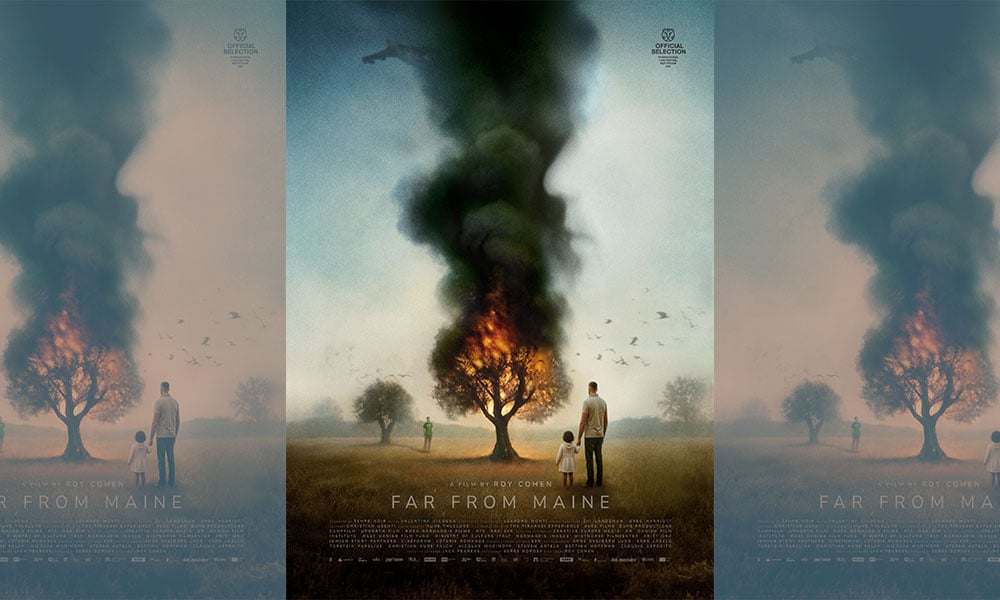
Roy Cohen was one of those friends. He was 13 that first summer and came from Ashdod, 20 miles south of Tel Aviv, the son of a taxi driver born in Morocco. His new documentary, Far From Maine, is addressed to Asleh. It is also about the camp that brought them together, the country whose police killed his friend and about Cohen’s own family today.
Cohen speaks to Asleh in voiceover, as he has for 25 years in the form of letters to his long-gone friend.
Back in 1998, Asleh slept over at the Cohen home in Ashdod one night, and the two boys fell asleep on the couch, head to toe. “I remember thinking, this is what having a brother must be like,” Cohen says in the film. In the years since, he has found that kind of brotherhood in a few close friendships that have lasted decades. “It’s one of the greatest tragedies in my life,” he tells me, “that I haven’t had that chance with Aseel.”
In the film, Cohen speaks to Asleh in voiceover, as he has for 25 years in the form of letters to his long-gone friend. Asleh’s answers are drawn from emails he sent to the Seeds of Peace community as a teenager. They are read by another Palestinian citizen of Israel who attended the camp and asked not to be named in the credits. Sometimes Cohen and Asleh argue.
Looking at Israel today, Cohen tells Asleh: “There’s no way you can look at this place and expect any kind of change.” Asleh answers: “We can’t change what we are, but we can change the way that we already live.” Cohen is not convinced. “What are you talking about? What change is possible here?”
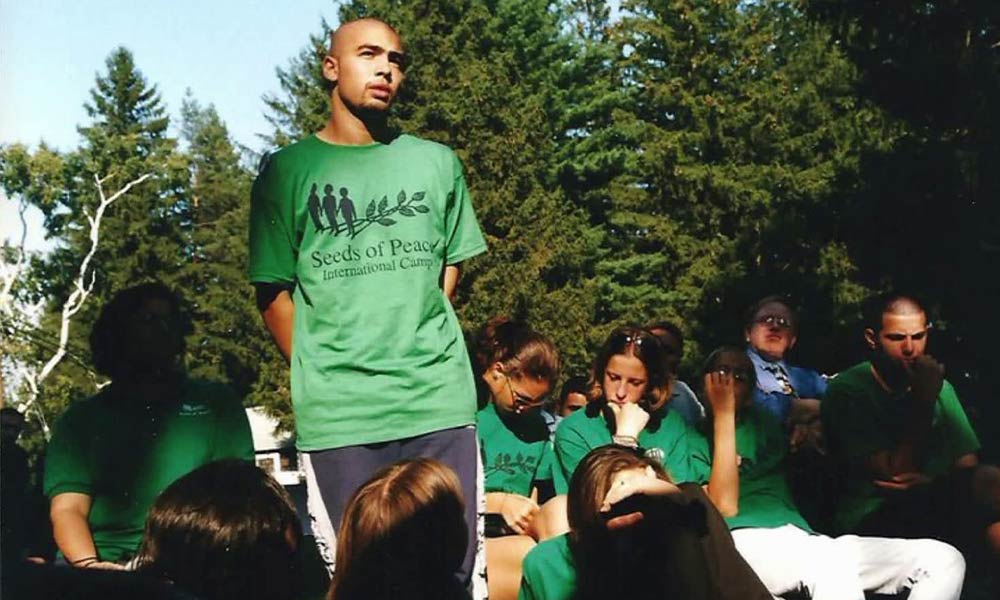
Aseel Asleh at Seeds of Peace Camp in Maine, 1999. Credit: Bobbie Gottschalk
Cohen started making the film before October 7 as a letter about coming home to Israel. He had moved to the U.S. for college, earning a B.A. in neuroscience from Harvard, where he also studied film. His first feature-length documentary was 2016’s Machine of Human Dreams, about the eccentric AI researcher Ben Goertzel. Cohen earned a master’s in connective media from Cornell Tech in 2018 and returned to Israel the following year. During the COVID pandemic, he was named head of the Big Data Department at the Israeli Ministry of Health, where he works on research collaborations between government and academia to this day.
Several years later, the October 7 attacks halted production on Far From Maine. When he and his producer restarted the project, Cohen tells me, they had to be “more honest and transparent about what Israel is and is becoming.” The film now opens with Cohen telling Asleh that Israel is committing a genocide in Gaza, adding, “but I can hardly utter that word. I feel so ashamed.”
Later in the film, we learn that each summer at Seeds of Peace opened with the delegations singing their national anthems. Asleh would not sing “Hatikvah,” Israel’s anthem. “How can I sing ‘A Jewish Soul Yearns’?” Cohen recalls him asking. Many Israeli campers, Cohen tells me, saw Asleh as “ungrateful.” At the time, Cohen thought his friend was partly trying to stand out. Only years later did he understand that Asleh was working out who he was. The Israeli delegation leaders never invited Asleh back, but Seeds of Peace did. He returned on his own, “a delegation of one,” as Cohen puts it in the film.
Hadara Rosenbloom, who ran the delegations at the Ministry of Education, is the official who kept Asleh out, Cohen tells me.
She was also the program’s champion inside the ministry. In the film, Cohen interviews her on camera at the ministry facility in Petach Tikva where the Israeli teenagers met before heading to Maine each summer. Those meetings helped the campers make friends before camp, he tells me, but they were also “a bit of indoctrination.” The message was: “If they tell you about the Nakba, you should tell them about the events of August 1929.” Those were the riots in which Arab mobs killed more than 130 Jews in Palestine, many of them in Hebron.
Rosenbloom is proud of the program. (Incidentally, Seeds of Peace is still operating but stopped working with the ministry in 2018 and now chooses its Israeli and Palestinian campers independently.) She recalls how Jewish parents would call her to say the Arab children were “so intelligent,” but when Cohen mentions Asleh, she says, “I don’t want to talk about him,” adding, “he was always a troublemaker.” She questions why Cohen would mention someone so “pro-Palestinian” when the program produced judges and hospital managers. When Cohen raises his friend’s death, she answers: “He didn’t die by sitting at his computer or staying at home.”
When the Second Intifada spread from Jerusalem into Arab towns inside Israel in the fall of 2000, Palestinian citizens took to the streets to protest Israeli military violence. Asleh was at an October 2 protest in his village, which Israeli police dispersed with tear gas. Asleh was shot and killed in a nearby olive grove. He was wearing his green Seeds of Peace T-shirt. Of the 13 killed in those protests, 12 were Palestinian citizens of Israel and one was from Gaza. An Israeli state commission of inquiry headed by Supreme Court Justice Theodor Or, known as the Or Commission, later found that police had used live fire without justification. No officer was charged.
Cohen did not go to the funeral. “What would I have done? Worn a green T-shirt?” he says in the film. He was drafted soon after and chose the Navy because, he says, he “didn’t want to hold a weapon.” He knew of Seeds of Peace alumni who refused the draft but did not join them. “I guess I didn’t know how to be a delegation of one,” he tells Asleh in voiceover. He watched Israelis who had known Asleh turn their backs on his memory. “There was definitely a lot of shame embedded in being Aseel’s Israeli friend at the time,” he tells me.
Haifa, a Palestinian alumna from Jenin in the West Bank, found warmth with Cohen at Seeds of Peace in 1997. In the film, she recalls a Jewish Israeli boy in her dialogue group telling her, “You’re the only Haifa your parents will ever see,” referring to the Israeli seaport city. When a suicide bomb hit Israel while they were at camp, she says, the campers were gathered to talk about it. No one gathered them when Palestinians were killed.
She sees the same thing now. Some days, after reading the news, she has to remind herself: “I am a human being. My life is valuable.”
Haifa’s mother visits her children abroad but always returns to Jenin. Haifa warns others about leaving. “You know what happens when Palestinians leave, right?” she tells Cohen, referring to the Nakba, the flight and expulsion of more than 750,000 Palestinians in 1948.
Roy Cohen; courtesy of Roy Cohen.
In voiceover, Cohen admits he was raised not to think about that question. It took him years to learn that his hometown, Ashdod, had been a Palestinian village, Isdud, whose people mostly fled to Gaza. “So what happens when Palestinians leave? Israelis move in,” he says in the film. “One of them is also me.”
His Algerian grandmother spoke mostly Arabic. Cohen began calling himself an Arab Jew only recently, he tells me. He wants his children to belong to both Arab and Jewish culture. “Do I feel very Arab? I don’t know,” he says. “It’s what I want. It’s not necessarily how I feel day to day.”
In the film, Cohen goes back to Maine with Shurouq Swaiti, a Seeds of Peace alumna who grew up in Jericho. The cabins are falling apart. On a bunk wall they find “Roy was here,” from 1997, then “Aseel Asleh,” dated July 26, 1998. In the cabin, Cohen tells her about a boy from their 1997 delegation who became an air force pilot. Cohen learned through a mutual Israeli friend that this former camper participated in the bombing of Gaza following the October 7 Hamas attack.
Cohen theorizes that even though that person knew Palestinians at camp and may have even defined himself as a leftist, “he was not immune to the dehumanization of Gazans in the collective Israeli psyche.”
Swaiti answers that the peace they were taught “wasn’t necessarily based on a sense of justice.” She remembers the drive from Jericho past the settlements, and how much more the settlers had.
Cohen returns to the olive grove. There is no footage of Asleh’s death. In archive footage from Israeli television, Asleh’s father, Hassan, shows where his son fell. Attorney General Menachem Mazuz decided not to try any of the four policemen who chased Asleh.
In the film, Cohen realizes those men “were all Arab Jews like myself.” He tells me he had guessed it earlier from their surnames. “They’re my cousins,” he says, and Mizrahi Jews “always had to prove that they were not Arab.” He does not excuse them: “I don’t relate, I don’t respect it…but I know where they came from.”
His sister Galit lives at Kibbutz Yad Mordechai, about two and a half miles north of Gaza, and was alone at home on October 7. In the film, she shows Cohen the land where her daughter will build a house while gunfire can be heard in Gaza.
He asks whether this is really where she wants her daughter to live. “No, this is not what I want, but it feels natural to have my kids move back here,” she says. Then she tells him: “Roy, I can tell you that my opinions have changed since October 7. I have no pity. I ran out. What happens there doesn’t interest me.” Her answer stuns him. He had expected “a mix of empathy and guilt,” the way she sounded before the attack.


Cohen tells me that people believe workers from Gaza gave Hamas a map of the kibbutz. “I can’t speak to the veracity of that claim,” he says. He does not think his sister will feel this way forever, but describes that scene as “a real snapshot of her sentiment,” adding, “I was, and am, scared by what it means.”
Yousef Bashir, a friend of Cohen’s from Gaza, was shot in the spine in 2004 by an Israeli soldier and was taught to walk again by Israeli doctors. He shares in the film that when Israelis tell him they wish all Palestinians were like him, he answers, “I’m this way because I’m Palestinian.”
Asleh’s words are chosen by Cohen, who sometimes makes an old email sound like a reply to a question asked years later. We hear what Asleh wrote, but we cannot know what he would make of his friend today. That limits the conversation the film can offer. “I think nothing is worth dying for,” Asleh wrote in the 1998 email to Seeds of Peace, “but sometimes it’s the only way to save others.”
At home in Tel Aviv, Cohen lives with his husband, Toby Stein, an American who works in tech, and their two children. Cohen had asked Stein to move from New York in 2019. In the film, Stein worries about the pull of the army. He has watched children of progressive parents pick up “racist and ethno-nationalist viewpoints” that he says “are a part of this place.” Cohen agrees. “Israel indoctrinates you from very young,” he tells me. He already talks to his daughter about what different people see in the Israeli flag. Will they leave? “It’s never a concrete plan, and it’s never not a plan,” Cohen says, explaining that he and Stein have agreed the children will not serve in the army, so they must move abroad before they turn 16.
The film ends in Tel Aviv, with Cohen reading Asleh’s words to an Israeli audience gathered to remember the deaths of the thirteen men in 2000.
Asleh did not pretend to know how his friends would turn out. “Only time can answer,” he wrote. Twenty-six years after police killed him, one of those friends has written back.
Far From Maine (95 minutes), directed by Roy Cohen, is now on the festival circuit. A screening tour and a distribution launch are planned for the winter. Information is at farfrommaine.com.
Opening image: Far From Main film poster, courtesy of Temps Noir.