
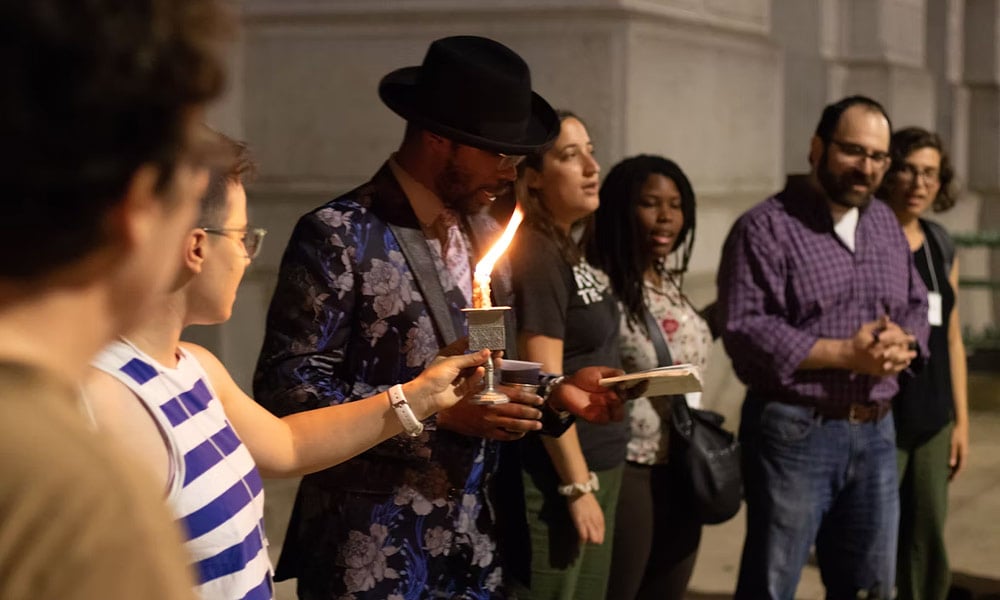
Rabbi Shais Rishon grapples with the question of what it means to be an African American Jew. On his mother’s side, his African American Jewish heritage dates back to the 1780s, and on his father’s, he’s second-generation. He grew up Chabad in Brooklyn (“and got better,” he jokes)—and even lived next door to Rabbi J.J. Hecht, assistant and translator of the Lubavitcher Rebbe Menachem Mendel Shneerson. Yet, his decision to become a rabbi came from his interactions with those who look like him.
Rishon began writing and blogging in 2009 under the name MaNishtana, which is what the section of the Passover seder containing the Four Questions is called, in which Jews ask, “Why is this night different from all other nights?” “The point of my work is asking, ‘What makes this Jew so different from any other Jew?’” Rishon says, highlighting his identity as a Black Jew. He also jokes about his chosen name and his love for comic books: “I had the opportunity to create an alter ego, obviously I’m gonna take that.”
As MaNishtana, he began speaking to Jewish audiences across North America, Europe, Australia and Israel at universities, synagogues, conferences and more, about how the intersection of religious tradition and racial identity manifests in American Judaism. People who followed his writing and speaking would email him with questions and requests for advice, and Rishon says he would respond with a disclaimer, “I’m not a rabbi, and you should still ask a rabbi, but based on these sources, this is what you should do.”
After about a decade, Rishon realized that people were coming to him because they didn’t have a rabbi to go to, or they had one but didn’t feel comfortable asking questions regarding race and religion. He received a private Orthodox rabbinical ordination in New York in 2018. “I pursued my ordination just so I had the peace of mind that people who were asking me these questions were asking someone who was qualified to answer them.”
“Afro-Caribbean Jews didn’t really have a chance to form our own connections and spices and twists on it. It’s more been a sense of survival, just hold on to Judaism enough so that you can pass it on to the next generation.”
Now, Rishon is taking his responsibility a step further with a new synagogue in Washington, DC, for African American and Caribbean Jews. Many Black Jews seek a place where they can express their Judaism simply by showing up, and Rishon hopes to fill this need with Ohel Eidot CHeMDaT”A (OEC). The Hebrew acronym CHeMDaT”A, he notes, stands for “secular, traditional, religious Jews of African descent” (chilonim u’masortim v’datiyyim shel ha-T’futzah ha-Afriqa’it).
African American synagogues are rare—notable among them is Congregation Temple Beth’El in Philadelphia. “[African American Jews] just tend to go to the synagogues that are in our neighborhoods, or more closely aligned with what our minhag [custom] is, or politics, or hashgacha [supervision],” Rishon says. While many African American Jews can find their place in larger Jewish communities, for some, dealing with questions about identity can feel like microaggressions and ultimately distract from the spiritual experience.
The need for an African American synagogue comes from a yearning to belong, says Rishon.
Although the new synagogue is a space created for Black Jews, OEC adds that “everyone who identifies as Modern Orthodox or is the least bit curious should feel right at home.”
Classified as “traditionalist Modern Orthodox,” Rishon explains that while their observance level aligns with that of Ashkenazi Modern Orthodox communities (Shomer Shabbat, Shomer Kashrut, Shomer Taharat Mishpachah, Shomer Mitzvot), the term “traditionalist” transcends Ashkenormative boxes to relate to global Jewry.
OEC welcomes all who adhere to mainstream Judaism—differentiating from Black Hebrew Israelites (who have a complicated relationship with the Jewish community and are not commonly viewed as halachically Jewish). “We tend to get conflated, particularly because a lot of Hebrew Israelite language uses ‘Black Jews or Judaism,’” Rishon says. “So [OEC] is speaking specifically of Afro-Caribbean American Jews who are part of mainstream Judaism.”

Raised with the idea that all minhagim, or customs and traditions, are equally valid (as long as they do not conflict with halakha), Rishon envisions embracing tradition and creating new ones together as a congregation. “There’s no reason why you can’t take a little from here and a little from there to create a palette that suits you.”
Rishon points to Michael Twitty’s African American seder plate, which replaces items on the traditional Ashkenazi seder plate with ones rooted in African American history. The new tradition demonstrates the intersecting identities of Jews and African Americans, especially evident on Passover, when we read a story of slavery and freedom.
“Unlike every other flavor of Jewish culture, Afro-Caribbean Jews didn’t really have a chance to form our own connections and spices and twists on it,” Rishon says. “It’s more been a sense of survival, just hold on to Judaism enough so that you can pass it on to the next generation.”
In addition to being a space for African American Jews to come together, Rishon hopes the new synagogue will help to spread awareness of Black Jews in the mainstream Jewish community. Oftentimes, Black Jews only become a part of the conversation in reaction to something, such as if a white Jewish person says something racist, or a Black person says something antisemitic. That’s when Black Jews are asked to speak, Rishon explains. He wants the world to see that Black Jews exist all the time and wants OEC to be a point of contact for those outside the community who wish to learn. “One of my hopes for this place is [for people] to say, ‘Where can we find them? They have a shul right over there, if you want to go learn, if you want to ask questions,’” Rishon says.
So far, OEC has assembled a small board, has been fundraising and expects to meet its goal by the opening date, March 20, when it will hold its inaugural Shabbat service, Shabbat Rishon [first shabbat]. Their operating budget of $400,000 allows for 10 percent available to distribute to the community in need. Shabbat services will meet weekly in North Dupont, and they also have monthly events planned.
Top image: Courtesy of Ohel Eidot CHeMDaT”A