

Jewish Politics & Power is published every other week. Sign up for our newsletter for updates.
1. A wholehearted yet belated endorsement
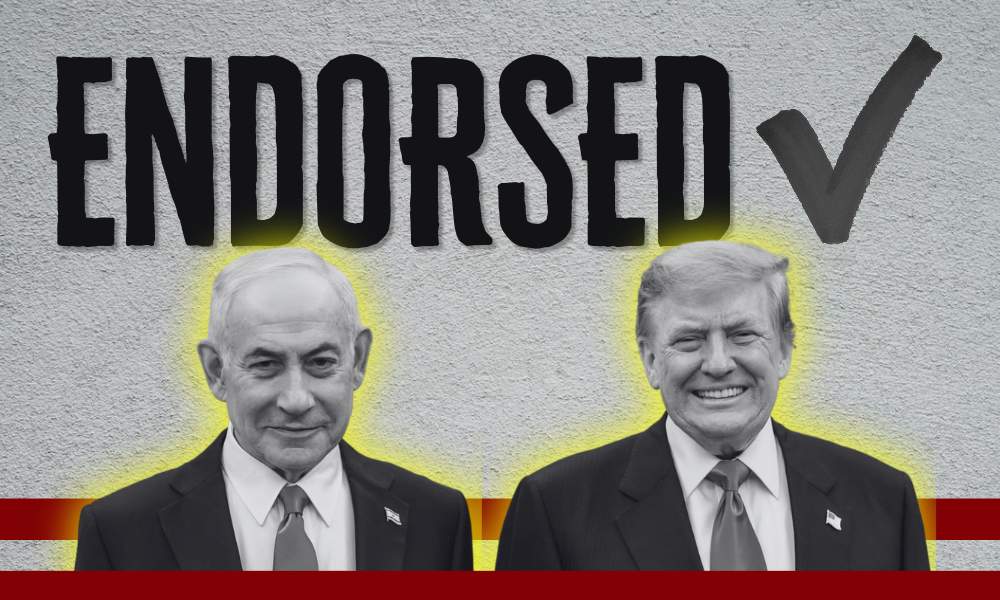
It took President Trump awhile. In fact, some thought he’d never do it, that his comment about being “not involved” in Israel’s political race would hold, and that the president had genuinely decided to sit this one out. But on Sunday, nine days before Israelis go to the polls, Trump issued an endorsement for the reelection of Benjamin Netanyahu as Israel’s prime minister.
It was a ringing endorsement. Full of praise, appreciation and a clear message to Israeli voters that as far as the leader of the free world is concerned, the choice is clear.
“Bibi Netanyahu has been a Great Warrior Prime Minister, and an even greater Partner for Peace in combatting the Islamic Republic of Iran, with its 51 year old chant, ‘Death to Israel, Death to America!’” Trump wrote on Truth Social, praising the Israeli leader for standing up to Iran and describing him as “Strong, Brave, and Brilliant.” Trump emphasized his partnership with Netanayhu, calling him “the kind of Partner that the United States of America is demanding of Israel.” He signed off his lengthy post by making clear what he expects from Israeli voters. “Please let this Letter serve to represent my Complete and Total Endorsement of Bibi Netanyahu in his upcoming Race for Re-Election as Prime Minister of Israel. BIBI NETANYAHU WILL NEVER LET YOU DOWN!”
For Netanyahu, this was a moment well worth waiting for. With polls putting him and his Likud party at a disadvantage, and with dimming chances of forming the next coalition, Trump’s endorsement came at just the right time. It allowed Bibi to go back to a campaign message that served him well in so many previous elections: He is a world-class statesman and the only Israeli leader who has the president’s respect.
Recent years have put this claim into question. Netanyahu is stumbling toward the finish line of this election cycle with Israel isolated internationally more than ever before, as major European partners have all but turned their backs on the Jewish state, and a majority of Americans view Israel negatively. Trump’s statement won’t change this reality, but it will help Bibi mount a counteroffensive to those claiming he has lost his diplomatic magic.
2. Did Trump’s endorsement come with a price tag?
Trump’s Truth Social message contains one telling paragraph, right after he describes the threat from Iran and the U.S.-Israeli war against the Islamic Republic: “Unless they change their ways rapidly, we will soon finish the job,” Trump says of Iran. “If Israel has the wrong Leader, which would be anyone other than Bibi, America will have to do this work ourselves, and I am not inclined to do so.”
Take a moment to read this paragraph again.
Trump seems to be suggesting that if there’s a need for another military round against Iran, he expects Israel to carry it out, and specifically Netanyahu to lead his country to war, because Trump “is not inclined to do so.”
Is that the tradeoff? Is willingness to go out and fight a war for America the price Netanyahu had to pay for winning Trump’s endorsement?
Netanyahu, it should be said, doesn’t really need an incentive to resume attacks against Iran. The Israeli PM believes that military strikes thus far have not delivered the expected results and that only a renewed bombing campaign can bring the ayatollahs to their knees, or at least diminish their hold on the country, leading to regime change. But the whole idea was doing it together with the United States—using Israel’s deep intelligence and impressive air force capabilities, hand in hand with America’s massive presence as a force multiplier and a crucial layer of protection.
Another question that comes to mind is why Trump believes that only Netanyahu would agree to take on Iran militarily. His rivals from the “change bloc” seem—based on their comments and platforms—just as willing to reengage militarily, and they hold views very similar to Netanyahu’s regarding the need to defeat Iran militarily.
3. Will Trump move the needle in Israel?
This is the first time a U.S. president has officially endorsed a candidate in Israeli elections. Previous presidents have, at times, shown their preference in subtle, or not so subtle, ways but always stopped short of issuing statements that would expose them as formally intervening in other countries’ internal politics.
Trump, true to form, brushed aside those concerns and has been extremely generous in issuing endorsements, particularly to conservative candidates worldwide. During his first term it was UK Prime Minister Boris Johnson who enjoyed Trump’s political support, and in his second term Trump endorsed candidates in Argentina, Colombia, Honduras and Japan. But the most interesting case was Trump’s forceful endorsement of Hungary’s authoritarian-style Prime Minister Viktor Orbán. The two leaders had their little mutual admiration society—Orbán showered praise on Trump, and Trump responded with endless mentions of the Hungarian leader as a model of how Europe should treat immigrants and its own democratic institutions. During the 2026 elections, Trump publicly endorsed Orbán and even dispatched Vice President JD Vance to Budapest to campaign for him. But it was all for naught. The Hungarian people delivered Orbán a resounding defeat. Trump’s endorsement didn’t help.
Is there a lesson here for Israel?
Public opinion polls have yet to reflect Trump’s endorsement of Netanyahu, but experts seem to doubt it will make much of a difference. Most voters have already made up their minds, and for those still undecided, the question of Netanyahu’s relationship with the president of the United States is of minor importance. Bibi needs to convince voters he’s not responsible for October 7; that he accepts the idea of accountability; that he’ll draft ultra-Orthodox into the military; and that he’ll unite a broken nation. Trump’s endorsement doesn’t help Netanyahu on any of these key issues that will determine Tuesday’s elections.
4. Eisenkot treads carefully around Trump
Still, Israeli opposition tried its best to prevent Trump from endorsing Netanyahu. They relayed messages to Trump’s advisers and highlighted polls showing Bibi behind, knowing that there’s nothing Trump hates more than a loser.

Having lost this battle, Gadi Eisenkot and his fellow “change bloc” party leaders had to figure out how to respond to Trump’s announcement. They chose the high road, avoiding confrontation with the world’s strongest leader. “I deeply appreciate the president of the United States for his tremendous contribution to the security of the State of Israel and for completing the hostage deal,” said Eisenkot shortly after Trump’s endorsement of Netanyahu. “At the same time, Israel is a democracy and only Israel’s citizens will determine who will be the prime minister and who will be in the coalition.” Eisenkot added that “the U.S. administration will know how to work with any elected Israeli government.”
5. What to look for next Tuesday
Polls will close at 10 p.m. in Israel, 3 p.m. EST in the U.S. But it will take a while to figure out the results. If current polls hold, neither Netanyahu nor Eisenkot will end the day with sufficient seats in their bloc to form the next coalition. It might take weeks, if not months, before a new government is sworn in.
Here are a couple of signs to look for once results are in Tuesday:
– Did either bloc significantly exceed expectations? Any result over 55 seats for the Netanyahu bloc (Likud, far right, and ultra-Orthodox parties) or for the change bloc (Eisenkot, Bennett-Lapid, Lieberman and the Democrats,) would be seen as a victory for that side. Not enough to form a coalition, which requires 61 seats, but a clear lead.
– Which of the small parties made it in? With a threshold of 3.25 percent of the votes, some smaller parties are on the brink of not making it into the next Knesset. If Ofer Vinter’s far-right party crosses the threshold, it could be a win for Netanyahu. If the centrist, economic-focused party of Yaron Zelekha and Yoaz Hendel passes the threshold, they could be the kingmakers, since they did not declare allegiance to any bloc.
– The Arab parties: Both parties, the Joint List and Ra’am, hold the missing seats needed for any future coalition, yet both Bibi and Eisenkot have declared they will not join forces with them. But look for signs on election night—if the change bloc signals it could be open to rethinking its self-imposed ban on cooperating with Arab parties, it will pave the way for Eisenkot to be the next prime minister.
(Top image credit: The White House)