
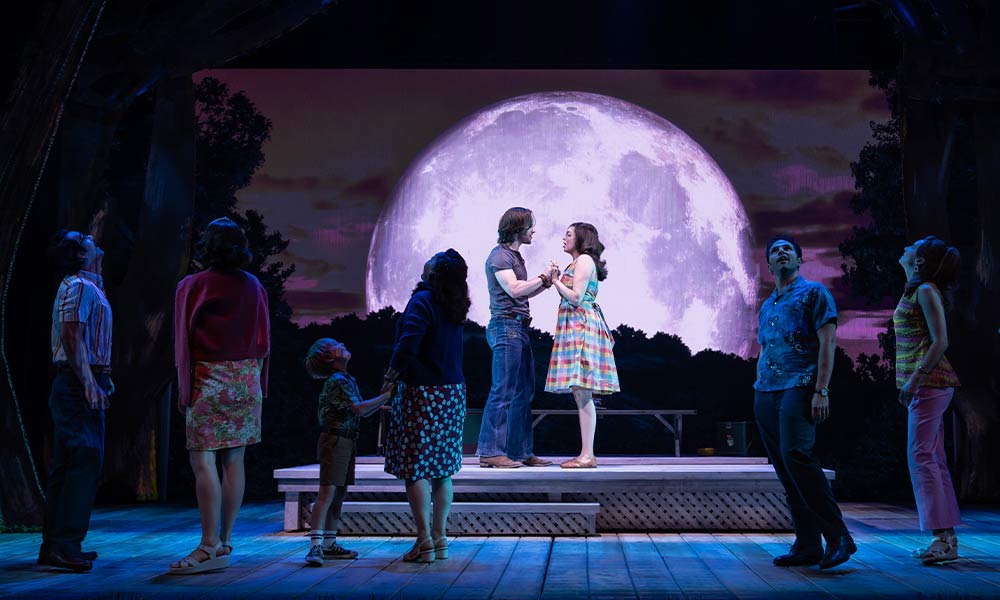
A Walk on the Moon, which opened this summer at the Laura Pels Theatre off-Broadway, is a provocative exploration into the changing cultural tides of America at the end of the 1960s. Adapted from the 1999 film of the same name, the plot follows Pearl Kantrowitz (played by Talia Suskauer), an unsatisfied housewife who comes to terms with her aspirations while summering with her family in a bungalow colony in the Borscht Belt.
1969 was a year marked by both political unrest and the historic achievement of Apollo 11 landing on the moon. Its success embodied the American mantra that nothing is impossible in the land of opportunity, yet this patriotism was countered by the burgeoning hippie movement, which fiercely opposed the war the U.S. government was waging in Vietnam. This contradiction underlies the plot, foreshadowing the confusion to come.
The musical, written by Pamela Gray, who also wrote the screenplay for the film, has been in the making for 13 years, undergoing workshops and rewrites and premiering in San Francisco before opening in New Jersey and later Manhattan. Through all of the show’s iterations, Gray has worked to modernize and adapt the story to fit the current time. Gray explains that Pearl’s teenage daughter Alison’s hatred of President Nixon was a natural bridge between the 1960s and today’s political era: “That’s when I first added the line: ‘He’s going to be the worst president of the United States,’” says Gray, referring to the 2022 production after Donald Trump’s first term. Not surprisingly, the line still gets ironic laughs today.
“I wanted Alison to be more politically savvy,” Gray says. Where in the movie she seems to use politics as a way to rebel against her parents, the show’s Alison (played by Sophie Pollono), is genuinely devoted to her morals, even encouraging her crush Ross (played by Oscar Williams) to find his voice and write a protest song. AnnMarie Milazzo, who wrote the show’s music and lyrics, infused Alison’s songs with Joni Mitchell-esque runs and melodies, which not only made Alison’s character come alive but also established her connection with self-proclaimed “Big Jewish Hendrix” Ross, both being fans of anti-war musicians.
“The protesting this year has also made [the show] more relevant,” Gray says, referring to the large “No Kings” demonstrations against the Trump administration that echo the anti-Vietnam War protests of the late 1960s along with that era’s deep polarization. Gray also cites the rise of antisemitism as a factor in the story’s continued importance.
The Kantrowitzes are a working-class Jewish family from Brooklyn, as are most in the bungalow community. Theirs is not the upscale resort of Dirty Dancing but is instead modest, familiar and women-led, since the men leave to work in the city during the week. The Jewish theme in the show is understated, emerging most strongly in the witty humor, many Yiddishisms, and occasional reference to the pervasive antisemitism that kept Jewish families out of many summer resorts in the Catskills.
“I was asked to de-Jew it at different points during the development of the show,” Gray says. Producers were worried that the use of Yiddish and focus on Jewish life and struggles would alienate non-Jewish audience members. Refusing to give in, Gray explains why she fought to preserve the Jewish themes.
“The idea that people can enjoy spending two hours in the theater with a Jewish family and that they care about Jewish characters was important in the face of antisemitism…I wanted to show a slice of working-class Jewish life.”
Gray grew up in Brooklyn and summered herself in bungalow colonies in the Catskills, so writing the story was a way to pay homage to her upbringing and introduce a wider audience to New York’s Jewish bungalow culture. Despite all the turmoil in the plot, the show remains comedic, a choice that Gray fought to protect throughout the show’s production.
“When I look back on the bungalow colony world, it was funny. There was this camaraderie on the weekends…My parents would go away with the same friends every year, and the bungalows were often attached…There was a hole in the kitchen wall, and every night there would be the same joke: ‘Ben pass the salt!’ and Ben would go, ‘Larry, pepper!’ and this was all summer long. But we always laughed. There was just this familial [essence] and feeling of safety.”
Credit: Joan Marcus
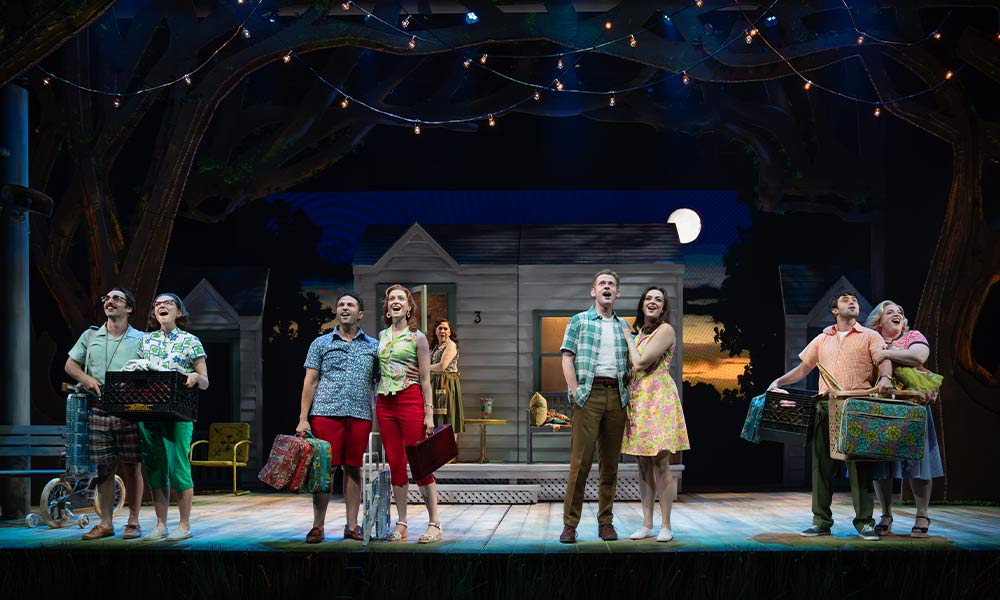
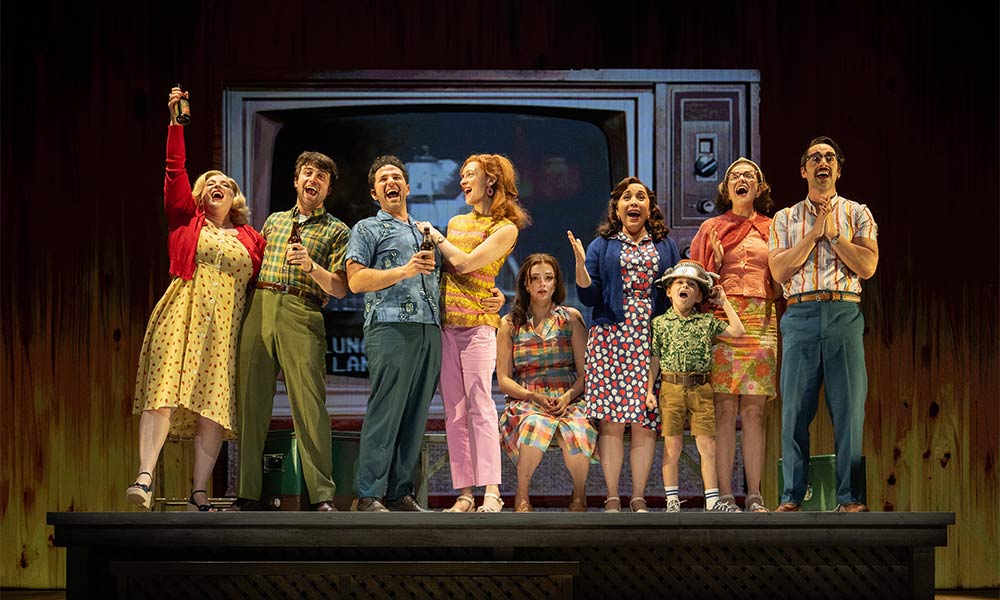
The small auditorium at the Laura Pels Theatre fosters a welcoming and intimate atmosphere, immersing viewers into the tight-knit community of Dr. Fogler’s Bungalows. The set consists of the outside of the Kantrowitz bungalow, their porch with a bench and a TV, and a few chairs assembled outside surrounded by trees. Act I features many ensemble songs that highlight the easy familiarity among the group, especially among the women. The sense of comfort crafted by the cast and director Sheryl Kaller sets Pearl apart from the beginning, as she is the only adult unable to be content breezing through the long days. Talia Suskauer perfectly balances Pearl’s desperate yearning for youth and freedom with her complicated love for her family. Then enters Walker, more often referred to as the Blouse Man, played by Sam Gravitte, offering Pearl a way out of her monotonous life. He’s introduced when he catches on to the women’s tune and sings along with them to sell his shirts.
“Everything changed when the Blouse Man could sing,” says Gray. “It was really important to me to make sure that Pearl’s attraction to him wasn’t only because he’s hot.”
Pearl and Walker’s romance has more depth in the stage adaptation, with the two discussing poetry, their aspirations, and their thoughts on the political state of the country—in addition to all the schtupping, of course. Gravitte’s charisma complements the playful energy that Suskauer brings to Pearl, making it difficult to not root for their connection against your better judgment. The endearing portrayal of the pair blurs the morals of the story and welcomes the mess that Act II exploits. The moon landing scene, which closes the first act, is especially memorable. It conveys the anxiety of watchers all over the country, who were worried for the lives of the astronauts, and intertwines it with the tension of Pearl officially falling for Walker, establishing the point of no return for her life.
Credit: Joan Marcus
Act II is when the show really hits its emotional stride. Gone are the cutesy songs about overworked housewives, the cautious flirting of Walker and Pearl, and the expository ballads about the state of the country. What takes their place are passionate solos and duets diving into the messy Kantrowitz family dynamics. When away from Walker, Pearl is staged behind screens, which visually represent her emotional distance from her friends and family, echoes distort the voices around her, and colorful, psychedelic projections on the set convey her identity crisis and her deepening involvement with the hippie movement. The suspense builds throughout the act, forcing viewers to the edge of their seats.
The drama culminates at Woodstock, the music festival, which Pearl attends with Walker. What follows is a heart-wrenching reminder for audience members entranced by the Broadway appeal of her affair that her fairytale romance has come at a great cost.


The cast brings a lot of passion to this production. Sophie Pollono delivers a gripping performance as a teenager reckoning with the heartbreaking fallout from her mother’s actions while undergoing her own coming of age. Max Chernin as the Kantrowitz patriarch brings an innocence and earnest quality to Marty’s rigidity, and Andréa Burns brings a lot of heart and comedy to grandma Lillian throughout all the chaos.
[Read: “Three Jewish Broadway Performers to Watch.”]
The show closes not with a rousing Broadway finale, but on an earnest solo sung by Pearl. The choice to sit in the discomfort and messiness allows for reflection and mirrors the production’s own uncertain future. Though the show is not currently scheduled to open at another theater, Gray has hopes that the sun is not setting on A Walk on the Moon just yet.
The show is running until August 22 at the Laura Pels Theatre in Manhattan.
Above photo credit: Joan Marcus