
“B’Ivrit: A Hebrew Language Media Roundup” is a monthly look at the news through the eyes of Israeli media consumers.
1. Celebrating the Moment
It was a day like no other.
By 6 o’clock in the morning, Tel Aviv’s Hostages Square was already full, with thousands of Israelis coming together to end the 738-day ordeal. Megatron screens carried broadcasts from all Israeli news networks, which had been on air all night in anticipation of the moment when the remaining 20 living Israeli hostages would finally reunite with their families.
For Israelis, it was a cathartic moment, and the Israeli media was there to make sure everyone could be a part of it.
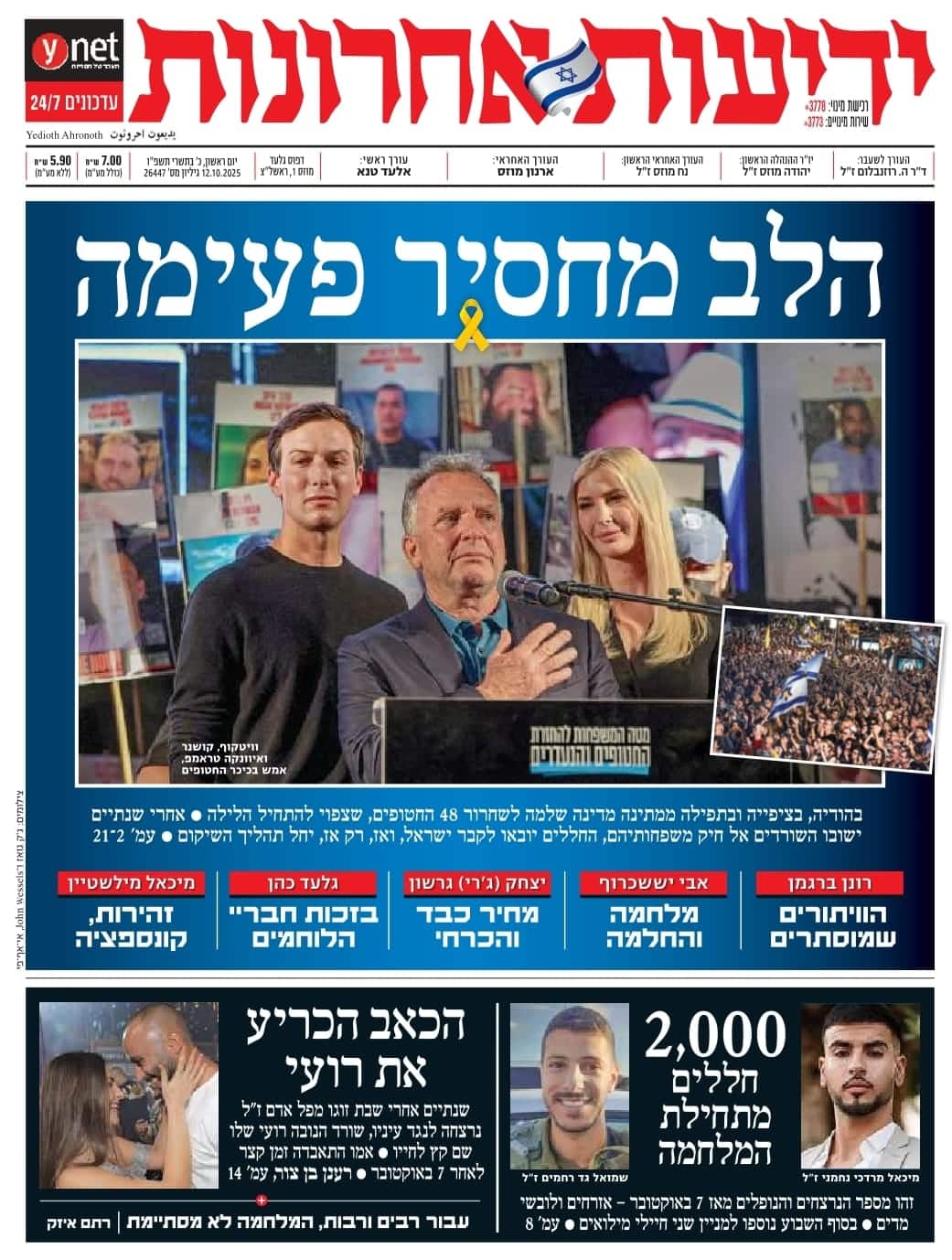
The cover of Yediot Ahronot, Israel’s largest centrist daily, told the whole story. “Welcome Back,” read the headline, in huge alternating royal and sky blue text reserved for joyous events. “An entire nation is holding its breath. The hostages are coming back from hell.” But print newspapers, while great for preserving historic moments, were of little relevance Monday. Israelis were glued to the screens. Some in front of their TVs at home, many others staring at their phones, sharing updates on WhatsApp and refreshing their social media feeds.
Tomorrow, the press will go back to its role, but Monday was a day for reconciliation and healing.
The news trickled out slowly. First came reports out of Gaza indicating that the initial batch of hostages has been transferred to Red Cross custody. This was enough to signal to every Israeli that the hostage nightmare was ending. After a long and tense hour, media outlets reported that the first seven hostages were out of Gaza and in the hands of the IDF. The press followed every moment of the release process: Family members awaiting their loved ones in a military base near the Gaza border shared their feelings on live TV; reporters set up at the homes of each hostage family, interviewing anxious, and later on excited, friends and relatives; broadcasts followed the helicopters taking the released hostages to Israeli hospitals for assessment and recovery. And then came the images: a mother hugging her son after two long years; brothers separated in captivity finally embracing each other; a teary father crying out “Shema Yisrael” as he sees his son; a released hostage playing on the rug with his two toddler girls who had been asking for the past two years “Where’s Abba?”
The news came in mainly from official sources, and most of the images were provided by the IDF, but this wasn’t a moment to complain about the lack of independent media access. The Israeli public and the news outlets accepted that the last thing a young man who has just come out of two years of captivity in a tunnel under Gaza needs is dozens of reporters and photographers in his face.
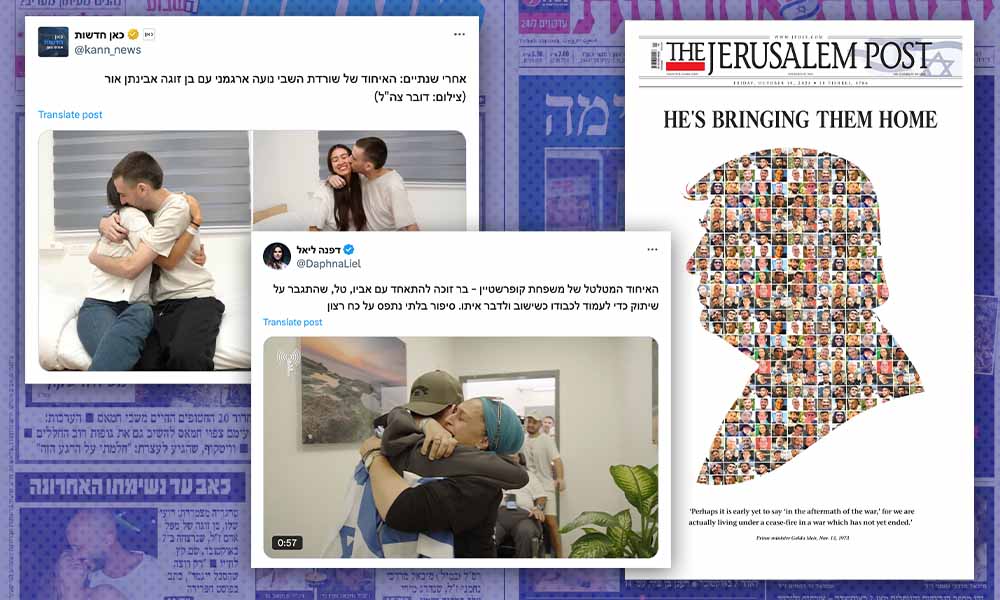
The photos and video clips of the newly released hostages kept flowing all day. Photos of Avinatan Or embracing his girlfriend Noa Argamani, who herself was released from captivity months ago, brought tears to the eyes. A video showing the disabled father of released hostage Bar Kuperstein standing up from his wheelchair to hug his son was repeated time and again on all networks.
Above all, it was a day when a fractured nation united, even if only for a few hours. The media rose to the occasion and allowed the moment to speak for itself. Tomorrow, the press will go back to its role, but Monday was a day for reconciliation and healing.
2. King Trump
As a legacy English-language daily, The Jerusalem Post may not be as popular among Israelis as the Hebrew news outlets, but its cover story last Friday—or to be more accurate, its cover image—reflected exactly where the Israeli media, and the Israeli people, stand right now. “He’s Bringing Them Home,” read the headline, above a full-page graphic portrait of Donald Trump made up of 48 headshots of the hostages whose return was promised in the deal. The unusual cover didn’t go unnoticed by the American press or by Trump’s White House, which posted the cover on the president’s social media accounts.
The cover image may have been unusual, but the sentiment it conveyed was fully in line with all Israeli media outlets.
“A world-class president,” was the title of Yediot Ahronot’s weekend edition. “One man, forceful and willing to break the rules, is solely responsible for the dramatic agreement between Israel and Hamas.”
Maariv, a center-right newspaper, provided its readers with a front-page public opinion poll which found that “two out of three Israelis believe Trump should win the Nobel Peace Prize.”
The Nobel Prize became, due to Trump, a news item in itself in Israel. All Israeli TV news channels carried live the announcement from Oslo, with panels of experts in the studios lamenting the eventual decision not to award Trump the prize.
“When this is over, I don’t want to ever see another TV camera,” a relative of one of the hostages told me last week.
Israel’s Trump-palooza spilled over to his special envoys Steve Witkoff and Jared Kushner, who received full celebrity treatment during their visit to Israel. The press covered every visit and meeting they held, culminating in full live coverage of their speeches at the Tel Aviv Hostages Square rally on Saturday night. “We’ve never seen such powerful moments at the Hostages Square as we’ve witnessed this evening with the speeches of Witkoff and Kushner and Ivanka Trump,” exclaimed the anchor on Channel 12 news. “They brought so much energy and hope to this crowd.”
Trump, who arrived in Israel on Monday for a brief visit, had to share the screen with images of the released hostages who were coming home just as he landed. Still, he heard only words of love and appreciation from Israeli reporters covering his speech at the Knesset.
The media coverage rightly identified the popular pro-Trump sentiment among Israelis, making no mention of Trump’s controversial domestic policies and the deep division among Americans regarding his presidency. During his first term, Trump used to joke that he was so popular in Israel that he could easily get elected prime minister over there. Now he’s even more popular, and the Israeli press is not about to ruin his party.
3. There Are Two Sides to the Deal; the Israeli Press Sees Only One
Sunday was a day of tense anticipation in Israel. The TV screens added countdowns to the hostage release, and daily newspapers portrayed a country on edge.
“Our heart is missing a beat,” was the Yediot headline. “Counting the hours until they return,” is how Israel Hayom chose to describe the situation. Maariv went with “Final hours in captivity.”
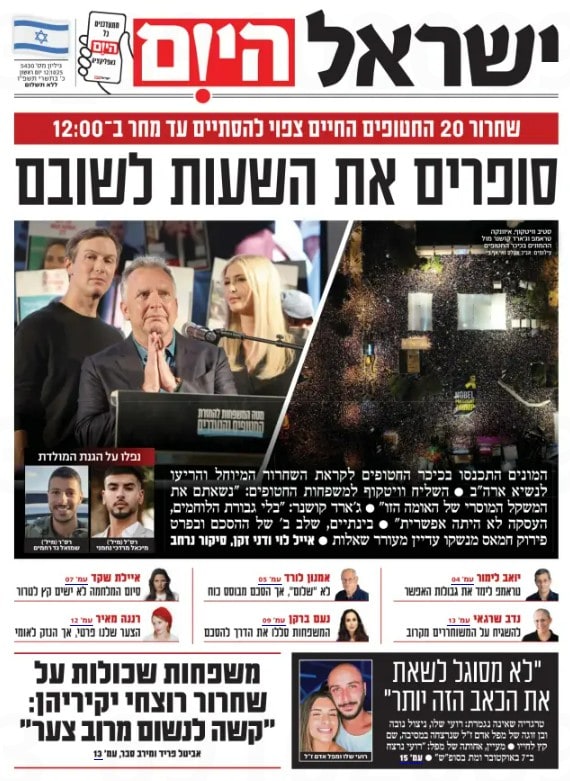

But none of the leading dailies spoke about the other side of the deal: the relief felt on the Palestinian side, the hope for returning home and rebuilding, and an end to the unimaginable humanitarian crisis.
The Israeli media focused on what Israelis care about: the hostages. Even the prospect of withdrawing Israeli troops and having tens of thousands of reservists come back home didn’t make headlines. The deal, as portrayed in the Israeli press, is all about getting the hostages out.
This could be an important point to keep in mind as we move beyond the first phase of the deal. The second part, which involves the demilitarization of Hamas, the withdrawal of Israeli forces and creating a new international body to manage Gaza, will be difficult to achieve. And since the Israeli public—and the Israeli press—don’t seem to care much about it, the chances of implementing the second phase are slim.
4. Hostage Families as Public Icons
They’ve become household names. Ordinary families thrust into the public eye in tragic circumstances.
Early on in this crisis, which no one ever thought would go on for two whole years, some families were reluctant to speak to the press. There were those who felt it might harm their loved ones, knowing that Hamas was likely watching the Israeli media and might punish hostages whose families spoke out against the terror group. Others were wary about voicing their misgivings with the Israeli government’s handling of the hostage issue. But after a few months, it became clear to all that in order to maintain pressure on the Israeli government and on the international community they needed to be out there—at the rallies, on the streets and also in the TV studios.
Their media strategy proved successful.
There isn’t a home in Israel that doesn’t know Einav Zangauker, whose son Matan was taken hostage. Every Israeli can easily identify Gali and Ziv Berman, the 28-year-old twins whose parents have moved heaven and earth to get them back. The names and faces of the hostages are etched into every Israeli’s soul, in large part thanks to the extensive media coverage and to the families’ willingness to share their journey with the press.
This might strike American readers as unusual. How many people, for example, know the story of Austin Tice, a U.S. citizen captured in Syria during the Assad regime and still missing? Or that of Robert Levinson, who was detained in Iran in 2007 and is presumed to have died in 2020? In Israel, their families would be on the news every day, their stories would be known by all.
“When this is over, I don’t want to ever see another TV camera,” a relative of one of the hostages told me last week. They didn’t ask for this fame and most of them still find it difficult to share their angst with the entire world in well-prepared, catchy soundbites.
The media can be very demanding. Israelis were eager to know everything about the hostages, closely following each development and awaiting any word about the released hostages’ situation. The parents, siblings and friends are now tasked with providing the Israeli public with the closure an entire nation is seeking. After that, they can finally retire from the limelight.
5. The Media’s Hour of Reckoning?
If all goes well, by the end of the week a new reality will settle in. All hostages, including the bodies of those who died in captivity, will be returned, the IDF will hold its forces along a new line in the Gaza Strip, displaced Palestinians will return to their homes, or to what is left of them, and humanitarian aid will flow in massive amounts.
The ceasefire is also expected to usher in a new era of media coverage of Gaza. Despite Israeli reluctance, most expect a lifting of the ban on entry of foreign press into the Gaza Strip, thus opening the region, for the first time in two years, to free and extensive media coverage.
It’s safe to say that the images and stories will be harsh. Gaza is destroyed, the magnitude of its destruction is unheard of in recent years, and behind the images of ruins and rubble lie the stories of an estimated 65,000+ Palestinians killed in the war, many of them uninvolved civilians.
The world, which has trusted thus far the reporting of hard-working local reporters, will intensify its coverage with foreign journalists on the ground.
Haaretz, Israel’s sole liberal daily publication, ran a lengthy interview with media researcher Ayala Panievsky, an Israeli who is now based in London. Her take on the conduct of the Israeli press during this two-year war? “When it comes to covering the Gaza war,” she said, “Israeli media is like a doctor hiding the patient’s condition.”
After two years of ignoring the situation on the other side of the border, will the Israeli press now decide to reveal to its patient—the Israeli public—what really happened in Gaza?