
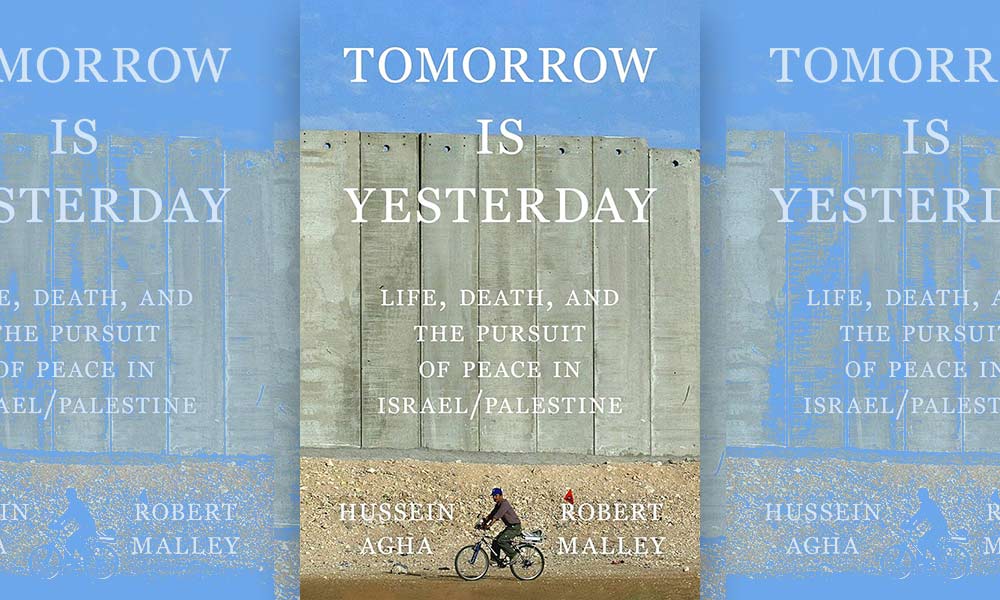
Tomorrow Is Yesterday: Life, Death and the Pursuit of Peace in Israel/Palestine
By Hussein Agha and Robert Malley
Farrar, Straus and Giroux, 258 pp.
Even before recent upheavals, the peace process between Israel and the Palestinians had been essentially frozen for more than two decades, since the failure of the second Camp David Summit in the summer of 2000. If you want to know why, a good starting point is this insightful account by two veteran peace negotiators, who explain, with great clarity and personal commentary, why and how it experienced a slow and painful demise.
The authors, Hussein Agha and Robert Malley—one Arab (originally from Lebanon, who lives in the UK) and one American Jew (who grew up in the United States and France)—were intimately involved as negotiators and advisors in formal and informal talks between Israelis and Palestinians over a long period of time. They write poignantly and personally, based on their extensive experience about the ups and downs, successes (few) and failures (many) of the peace process. They offer detailed and severe critiques of the main actors in the process—the American government, as chief mediator, and the Israeli and Palestinian governments, as the two main conflicting parties.
The authors excoriate the American government for their role in the main failures of the peace process over many years. They accuse both Democratic and Republican administrations of being addicted to the two-state solution, even though it became less and less realistic over the years, due mostly to the Israeli government’s policy of creeping annexation in the West Bank, as well as to the gradual rejection of the idea by disgruntled Palestinian leadership. The authors do not put the blame for the failures of the peace process only on one side. Rather, they offer valuable and insightful criticism of all parties to the process.
The title of the book is trenchant. By calling the book Tomorrow Is Yesterday, they evoke the long and tortured history of the Israeli-Palestinian conflict and argue that nothing much has changed, despite all the efforts to bring peace to the region. In fact, they argue—against the conventional wisdom—that even the massacres and kidnappings of October 7, 2023, were essentially nothing more than a reenactment of history, since the violence and counter-violence between Israelis and Palestinians has been going on for a long time, with anger, frustration and feelings of revenge always fueling the conflict.
The peace process “sought to freeze the past and put it aside,” they write. “It failed. The thaw set in, and the past rebelled until the pretense could exist no more. Oslo (the ‘peace process’) borrowed against history, but history did not simply fade away. It lay in wait. October 7 was its most spectacular mutiny: history’s revenge.”
The authors attempt to set the massacres and kidnappings in historical context. The conflict, they remind us, did not begin on October 7, 2023. There have been decades of horrible violence before it, including the two intifadas and the severe repression of them, many mini-wars with Gaza, the ongoing occupation of the West Bank, the siege of Gaza, the militant ideology and terrorism of Hamas and sometimes also Fatah, and much more. Such context has been very much lacking in many of the analyses of the war and its aftermath, particularly within Israel.
The authors argue that the past has always haunted us and continues to do so today:
A core feature of a return to the past is for Israelis and Palestinians to see no possible shared future. The land is viewed as too slender for the two peoples. Geographic entities and lines born of Oslo have been all but wiped out. The Palestinian Authority is effectively an empty carcass, defunct; territorial divisions with the West Bank are erased. Israel aims to treat Gaza as it does the West Bank, as land it can enter and exit at will; it seeks to treat the West Bank as it does Gaza, an object of population transfer, destructive incursions and strikes as necessary. The signs had been visible for some time, history itching to make a comeback. Illusions prevail, but the odds are stacked against them.
The book is replete with pithy paragraphs like this one, clear and at the same time complex. It reflects the views of two veteran peacemakers on the many facets and chapters of the mostly failed peace process between Israelis and Palestinians, along with its mostly unsuccessful American mediation.
The authors offer some important ideas for rethinking and reviving a peace process in the future. They note the need to involve not only people from the “peace camp” on each side but also from other sectors of the population, such as religious people and hardliners, not only moderates. (In my dialogue work, I have been advocating this as well for many years.)
Rather than repeat the worn-out unrealistic mantra of what they label “the two-state theology,” the authors note the many alternative ideas, such as confederations, that have been discussed in formal and informal talks over the years. Most important, though, is the need to go back to history, to listen to the core historical narratives on both sides, to help to deeply understand one another in fundamental ways, that might actually lead to peaceful coexistence. Without this, the peace process will be superficial and artificial.


This is a challenging and provocative book, written by two serious thinkers and peace practitioners with lots of experience. I believe that their ideas should be heeded and not ignored by the policymakers now and in the future. Their analysis is well-balanced and multifaceted, worthy of serious consideration.
In addition, the authors explain very clearly that the peace process is a very complicated and a very psychological endeavor, one that will take time and much creative thinking. Yet, it should not be abandoned, if Israeli Jews and Palestinian Arabs are going to ultimately find a way to live together in some form of peaceful coexistence in the region in the years and decades ahead.
As someone who has been involved in peacebuilding efforts in Israel/Palestine for more than 30 years, I was enlightened by the authors’ critique of the past as well as by their creative thoughts about the future. As complicated and convoluted as the process may be, we can never give up on peace, since it is in the interest of both peoples who live in the region.
A coda: The current war between the United States, Israel and Iran is, of course, the exact opposite of the peace process. Its leaders seek war, not peace, despite some of their double-think statements to the contrary. Nevertheless, this war will end too, and when it does, perhaps a return to some form of genuine peace process could happen. If so, it will remain helpful to learn from the mistakes of the past, as enumerated in this comprehensive book.
Ron Kronish is a rabbi/educator who has lived in Israel for 46 years and has been active in interreligious dialogue and peacebuilding for more than 30 years.