
I am editor-in-chief of a magazine with a great Jewish legacy, and I have never once in my life used the terms Zionist or anti-Zionist to describe myself or anyone else. Why? When I use a word, I want to know where it’s been and how it’s going to be understood, and with anything Zionism-related, that’s a nearly impossible task.
And so I am going to propose something that may sound radical. It is beyond time to strike the words Zionist and Zionism from modern political discourse and relegate them to history, where they belong. They have outlived their usefulness both as concepts and as terms. This means we must immediately cease labeling ourselves and others as Zionists and anti-Zionists, and use the word Zionism only when referring to the historical political movement.
While some of you are letting out a sigh of relief, it’s more likely this proposition is making you uneasy, although for very different reasons, depending on where you stand on the political and religious spectrums, and whether or not you support Israel’s right to exist or its current government. Let me say upfront that giving up the word Zionism doesn’t mean not supporting the existence of Israel. It means giving up a disputatious term deeply embedded in history, religion and current affairs. I am fully aware that without it, political discourse will feel emptier. And since the term also evokes larger-than-life feelings, the emotional lives of millions of Jews and others who are tied to Israel, either by love or hate, may feel emptier too.
Our investment in the terms Zionist and Zionism is huge. So how could we possibly give them up? We must find a way. Doing so is critical for both the Jewish people and the world.
Like any long-lived historical political movement, Zionism as a concept is burdened with so much baggage that no human being, even the best-informed scholars and the most confident self-appointed experts, can possibly know all the meanings it has accumulated over time.


Let’s start at the beginning. Zionism is connected to but not the same as the millennial longing of the Jewish people for their homeland. The messianic urge for the return to Zion is baked into the text, prayers and lore of Judaism, and seared into the Jewish soul by seemingly endless cycles of persecution and trauma. The name Zion comes from Mount Zion, the hill in Jerusalem captured by King David in the 10th century BCE, a victory that established the city as the capital of the United Kingdom of Israel and Judah. Zion has come to symbolize Jerusalem itself and the land of Israel and is the spiritual heart of Judaism.
We need to strike the words Zionist and Zionism from modern political discourse and relegate them to history, where they belong.
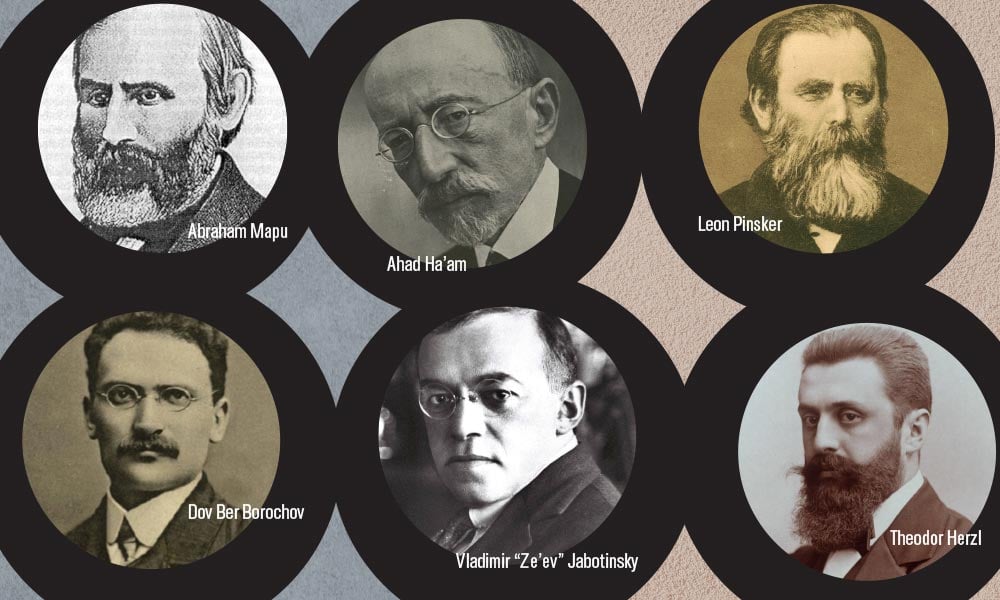
This yearning for Zion is not Zionism. Zionism is another phenomenon altogether, a historical one that arose in the latter half of the 19th century. It is important to note that even before that there were various returnings to the ancient lands of the Jewish people. Among them is one that is often forgotten, the resettlement of Jewish refugees from the Inquisition in Tiberias in the 16th century as supported by the great Doña Gracia Nasi. But pre-19th-century returns were not expressions of Jewish nationalism. Nationalism did not fully emerge as a concept until 18th-century Europe, and when it did, the idea of Jewish nationhood originally took off with the goal of reawakening Jewish consciousness by reviving Jewish culture and the Hebrew language throughout the continent. From this was born the first modern Hebrew novel, Ahavat Zion (The Love of Zion), written by Abraham Mapu, a Lithuanian Jew, in 1853. Set in biblical times, Mapu’s portrait of idyllic Jewish life in the First Temple period inspired young Jews living in European and Russian ghettos and shtetls.
Whether or not this national cultural awakening should take place in Palestine was a matter of fierce debate. Jewish intellectuals and promoters of what was known as the “Love of Zion” movement, such as Leon Pinsker and Ahad Ha’am (Asher Ginsburg), were interested in transforming Jewish life in the diaspora, not in moving to Palestine. Nevertheless, driven by pogroms in the Russian Empire, the first major wave of Jewish emigration to Palestine began in 1882.
All this and more happened even before the Austrian Jewish thinker Nathan Birnbaum coined the terms Zionistic, Zionist and Zionism in 1890, publishing them in a periodical he founded called Selbstemanzipation! (Self-emancipation!). Most people have never heard of Birnbaum, a prominent player in the early Zionist movement who eventually parted ways with it because of its negative view of diaspora Jews. (Later he would become a staunch advocate of Yiddish and an anti-Zionist who opposed the creation of a political state.) The term Zionism would catch fire when uttered by the charismatic Theodor Herzl in 1897 at the First Zionist Congress, held in Basel, Switzerland.
Herzl’s Zionism had nothing to do with the revitalization of Jewish culture and the Hebrew language; he didn’t know Hebrew. His version was “purely political in both theory and practice,” writes Michael Stanislawski in Zionism: A Very Short Introduction. “The Jews as a nation did not need a new culture or language or a new concept of the messianic era, but only one thing: a national polity of their own, whose creation would solve forever the problem of antisemitism both for the Jews themselves and for Europe as a whole…In their own state they could speak whatever language they chose, practice Judaism (or not) in any form, and continue to engage in cosmopolitan bourgeois European culture.”
Historian Fania Oz-Salzberger has labeled Herzl’s Zionism “humanist Zionism.” Herzl’s neutrality toward religion is reflected in the title of his landmark book, Der Judenstadt, which translates from German not as “the Jewish state,” but as “the Jews’ state.” “At its most fundamental, [Zionism] simply says that Jews are entitled to a national home in their ancestral homeland,” says Oz-Salzberger.
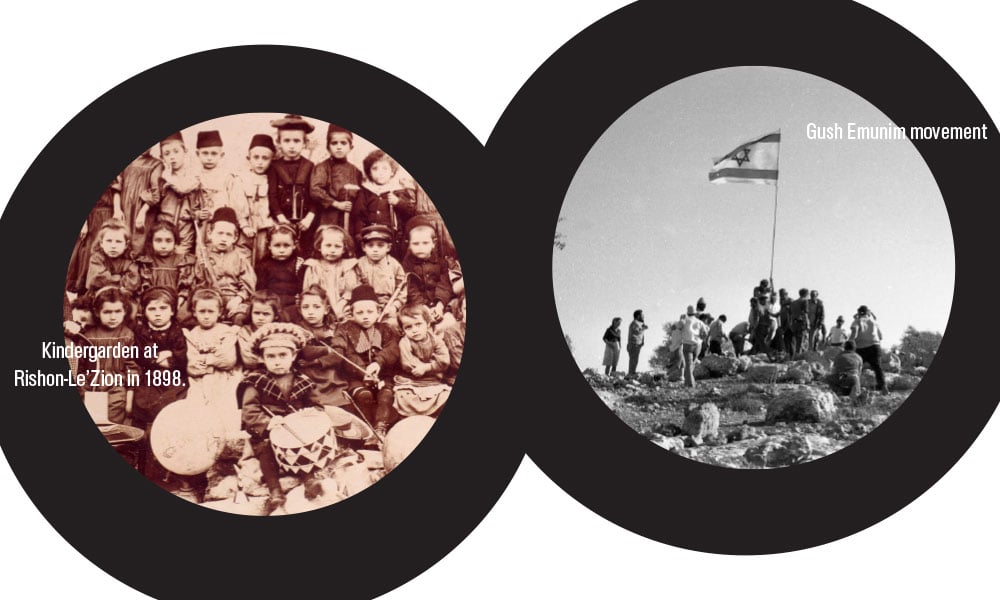
Photo credit: Asher Koralik / Dan Hadani collection / National Library of Israel / The Pritzker Family National Photography Collection
From the start, Zionism, a word that Oz-Salzberger has called “constructively vague,” meant different things to different people. The new political movement confronted and absorbed challenges from the left. The Russian-Ukrainian Zionist leader Dov Ber Borochov synthesized Marxism with Jewish nationalism, while other socialists pushed their own Zionist visions. The right did the same. Most famously, the Odessa-born Ze’ev Jabotinsky championed his “Revisionist” ideal of the strong, masculine Jew who wasn’t afraid to use force to fight for his ambitious—and capitalist—Jewish homeland, one that included Judea and Samaria. I’m simplifying arguments within Zionism here—there are plenty more detours and cul de sacs—but the point is that Zionism was from the start a receptacle for complex historical forces and ideas.
“The Zionist movement quickly became a loose federation of Jewish dreams, hopes and plans,” Oz-Salzberger has said. “Socialist, middle-class, religious or nationalist—all came together under a moderate mainstream. That was one secret of its astounding success.” In broad terms, this secret is also the seed of many of the debates and disputes in the decades to come. This swarm of historical passions continues to be reflected in modern-day politics, fought out in halls of power and forums, from streets to dinner tables to social media, in the Jewish world and elsewhere. This is a valuable meta-framework for understanding Zionism, one that could be applied to many political movements, but it shows the impossibility of using the word to describe one modern movement.
Of course, the trajectory of the term Zionism does not end with the 19th century. The early battles were at the root of struggles, both rhetorical and violent, between various Zionist factions during the pre-state period from around 1880 to 1948. The bitter rift between David Ben-Gurion and Jabotinsky and their followers threatened to capsize the Zionist endeavor in the 1930s, and in the 1940s three different Zionist underground paramilitary groups, including the Revisionist-affiliated Irgun and Ben-Gurion’s more moderate Haganah, fought the British—and occasionally each other. Ben-Gurion’s faction won out and reluctantly agreed to the partition plan, which was anathema to both the Revisionists and more extreme right-wingers. There were divisions on the left too—quarrels between socialists and Marxists and, although mostly forgotten, an outspoken faction including Hadassah founder Henrietta Szold that passionately called for the establishment of a binational state where Arabs and Jews would be equals. These binational advocates were sidelined in 1942 (although their torch has been passed through the generations) at the Biltmore Conference in New York City, when those in favor of a “Jewish commonwealth” triumphed.
Read any biography of the founding generation of Israel’s leaders, and you can’t escape the differences of opinions, the infighting and name-calling. This is true of almost any generation of leaders in any country.
Then came statehood. In an ideal world, the new country—now faced with the challenges of nation-building, imminent war and the absorption of hundreds of thousands of refugees—would have quietly put the word Zionism to rest on May 15, 1948. The political movement to establish a state had succeeded. In its narrowest definition, Zionism meant that the State of Israel’s right to exist and flourish was and is equal to that of any other country.
I strongly believe in Israel’s right to exist, just as any other imperfect modern state has a right to exist. All states have imperfect origin stories, that is to say, they are conceived in multiple sins. Such is the nature of nations. Every inch of border and square foot of land represents a vision or narrative that has triumphed over other visions or narratives. With time, the visions and narratives collapse into the national spirit like so much cosmic dust in a black hole. Nationalist movements are often remembered as singular but are always complex and cast long shadows, even if we don’t see them today. We here in the United States are still arguing about federalism vs. states rights and are playing out this and other debates from our founding decades.
In its narrowest definition, Zionism meant that the State of Israel’s right to exist and flourish was and is equal to that of any other country.
If we believe in the right of people to form nations, which at this point of human development most of us do, then Zionism has long been a moot point. Given Israel’s right to exist, I would go a step further and say that the label Zionism has become outright dangerous. The use of the term by its very nature keeps the question of existence unnecessarily alive. It’s like a scab that keeps forming and reforming and never heals. The Zionist family of terms has increasingly become polarizing for the American public, and even worse, it is unnecessarily splintering the American Jewish community, all at a time of rising antisemitism. Wherever I go, and I travel in many circles, I hear the words Zionist and anti-Zionist invoked and hurled with equal God-like certainty, terrifying self-righteousness and perilous imprecision.
The American Jewish community is as mystified by the meaning of Zionist and Zionism as the broader public. Look at the 2026 survey conducted by the Jewish Federations of North America: Only one-third of American Jews said they identified as Zionist. At the same time, nearly nine out of ten said they supported Israel’s right to exist as a Jewish and democratic state. This is a pretty astonishing finding, reminiscent of the way the word “feminist” played—for years, polling showed that few people agreed they were feminists but almost all believed in equal rights for women. Studies show that a dwindling number of Americans overall support Israel, and it is safe to say that an even smaller percentage of them would identify as Zionist—or could even define what it means. Given its long and complex history, I would argue that the amount of education required to comprehend Zionism’s breadth is out of reach for most people—and of course, any such curriculum would be extremely contentious. Not to mention that the vast majority of us have a limited bandwidth for the topic with so much else vying for our attention. All of this plays right into the hands of Israel’s enemies, who cling to their own narrow interpretations of the term and are masters at manipulating it to obfuscate history and undermine Israel’s right to exist.
Let’s drop back to 1948 for a moment. As I said, this would have been, in retrospect, the time to retire the term. Prime Minister Ben-Gurion actually tried to discourage its use by Jews outside Israel. As he transformed Zionism from a movement for national liberation into a nation-building ideology for the new State of Israel, he asserted that American Jews could no longer call themselves Zionists unless they moved to Israel. “There seems to be a general agreement,” he said in August 1957 at a Zionist conference in Jerusalem, “that a Jew can live in America, speak and read English and bring up his children in America and still call himself a Zionist. If that is Zionism I want no part of it.”
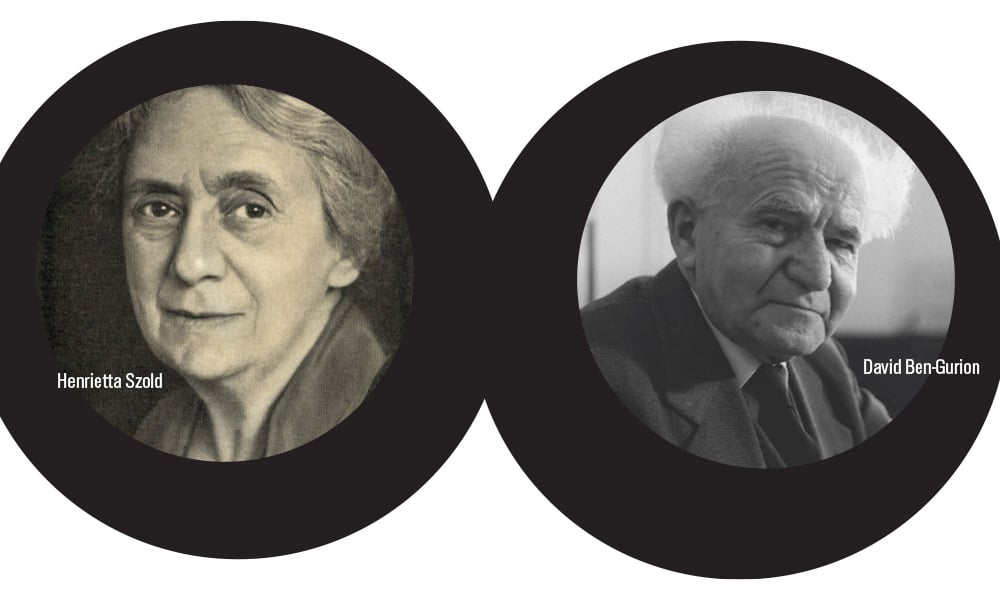
Photo credit: National Library of Israel, Schwadron collection (CC BY 3.0) / Fritz Cohen
Many organizations that had been active in the struggle for statehood were incensed by Ben-Gurion’s comments. For instance, the Zionist Organization of America (ZOA) “went from a minor group on the fringe of American Judaism to one that helped lead to the establishment of the State of Israel,” says historian Michael Berenbaum. “It was their great triumph. They didn’t want to give up their power. They wanted a Zionism that was compatible with America.” Ben-Gurion lost this battle, and Zionism took on a new post-statehood dual identity, reminiscent of the 19th-century divide between Zionists who wanted cultural and linguistic nationhood in Europe versus those intent on creating an actual political entity. Writing in Commentary magazine in 1954, the Austrian-born journalist and Israeli diplomat Benno Weiser identified these two recurring threads in Zionism: the golah (exile) and the halutz (pioneer). These are the Hebrew words describing Jews who don’t live in Israel (golah is more judgmental than the word we use, “diaspora”) and “the self-fulfilled pioneers” who do. “Ben-Gurion’s attitude is an outgrowth of that basic contempt which the halutz has always felt for the other kind of Zionist,” Weiser wrote.
In Israel too, post-state political infighting continued to mirror early Zionist divisions. In the most simplistic terms, Ben-Gurion’s socialist-light blend dominated for decades, doing its damnedest to suppress the Revisionists, who finally got into power with Menachem Begin in 1977. Since then, over the years, the Revisionists, having forged partnerships with the far right and ultrareligious, have done their damnedest to stamp out what came before them. Successive wars and additions of new territory—especially the core biblical lands of the West Bank—have added layers of new meanings to Zionism (and rekindled old ones). In 1974, in the aftermath of the Yom Kippur War, messianic zealots founded the Gush Emunim (Bloc of the Faithful) religious movement, and began to change facts on the ground, settlement by settlement. In doing so, they grabbed onto the amorphous mantle of Zionism and, like many others before them, made it their own.
The following year is the modern watershed for the word Zionism. On November 10, 1975, the United Nations General Assembly adopted Resolution 3379, declaring “Zionism a form of racism and racial discrimination.” Supported by Arab, Soviet and Third World nations, the 72–35 vote reflected intensified anti-Israel international sentiment and Cold War dynamics. (In a recent scholarly work, the writer Izabella Tabarovsky has shown that the resolution’s language was lifted directly from Soviet propaganda.) The resolution was repealed in 1991 after the fall of the Soviet Union, but it has never left the political left. It remains alive and well along with other muddy companion words such as “colonialism.” Antipathy toward Zionism has also seeped into the far right, mingling with antisemitism, as heard in rhetoric promulgated by Tucker Carlson and other provocateurs and evidenced by the slippage of support among young evangelicals, once a source of steady support for Israel.
The new country should have quietly put the word Zionism to rest in 1948. The political movement to establish a state had succeeded.
It’s impossible in a single essay to do justice to the political shifts and wars in Israel, the United States and the world that have further compounded Zionism’s indeterminate nature. Suffice it to say, since October 7, the term Zionist has become more broadly familiar than ever and at the same time more divisive—on the global level, as well as within the Jewish community. (That community is itself now more polarized and polarizing than anytime since World War II.)
There are many arguments against retiring the word, and I’d like to address some of them. One defense is that the term Zionism is necessary until the day when Israel’s right to exist is no longer questioned. But this is circular logic: The use of the term calls into question what is already fact. There is also the position that Zionism is more than the historical political movement to establish a state for the Jewish people, that it is an ideology or set of ideologies that inform government policies. But since an ideology is defined as a system of ideas and ideals, especially one that forms the basis of economic or political theory, I would argue that Zionism has always been too complex to characterize as one ideology—and different strains of Zionism have led to and would continue to lead to very different types of government policies.
Zionism has certainly been an identity to millions of Jews in Israel and around the world. “It was not just the fight for a Jewish state,” Weiser wrote in 1954. “Zionism used to be a Weltanschauung, a way of life, and an expression of Jewish pride—a flight into Jewishness, the opposite of many a Jew’s flight away from it.” Note the words “used to be.” Weiser was arguing seven decades ago that Zionism was losing that significance, although there are many people today who still interpret it as a proud flight into Jewishness (as well as others who see it as a painful obstacle). To those who equate Zionism with Jewishness, I say lean in with pride to being Jewish.
There’s an element even deeper than pride at play. There are people on all sides of the political divides who believe that Zionism is a call for the Jewish people to be a light unto the nations. This may stem from the messianic vision within Judaism, mixed with a shot of Jewish exceptionalism and a dose of the very modern belief that we can solve anything. This utopian dimension to Zionism’s meaning is yet another reason to set the word aside. It leads to double standards and disappointment.
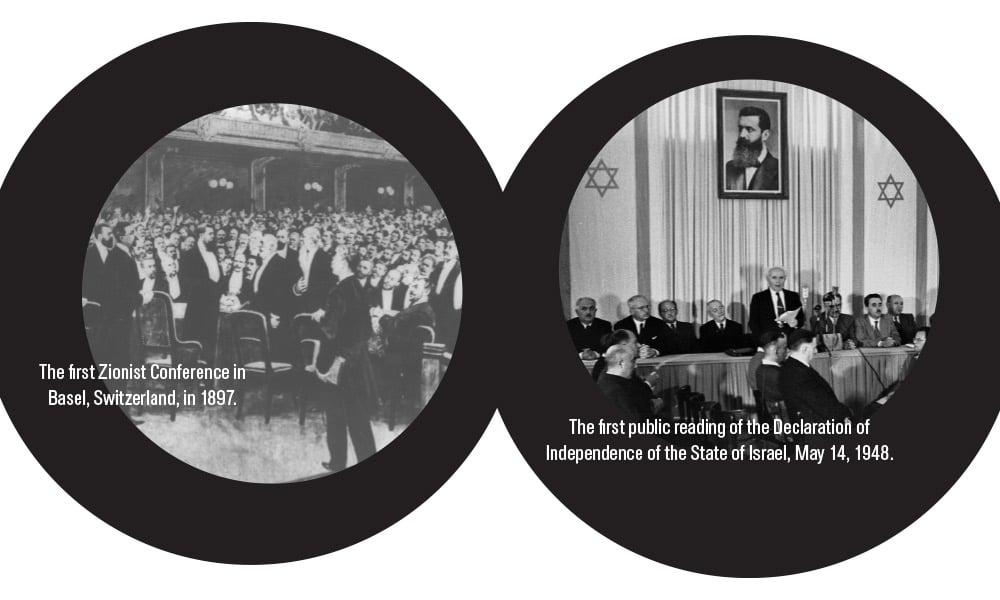
Photo credit: National Photo Collection of Israel
“Zionism describes a series of beliefs, feelings and needs that transcend political reality,” Derek Penslar, a professor of Jewish history at Harvard, has said. “In that sense, it’s like any word that ends in “ism”—liberalism, conservatism, progressivism. These are bundles of ideas and feelings that survive across time, even if their meanings change.” To this I say that terms such as capitalism, colonialism, communism, progressivism and socialism are also hodgepodges that after centuries of use mean too much and too little, and have become unmoored from their historical contexts. Like the word Zionism, they get people excited but don’t do much more than obscure nuance and obfuscate reality.
And they get in the way of the kinds of conversations that build trust. I would argue that anyone unduly preoccupied with promoting any political ideology with the suffix “-ism” is missing the complexity of the world.
Which brings us to feelings. In addition to being a political ideology, Zionism is wrapped in layers of emotion, according to Penslar, whose most recent book is titled Zionism: An Emotional State. He argues that Zionism is an intense, shifting bundle of collective emotions—love, fear, anxiety and hope—that have shaped its practices and global reception from its inception. (This makes it no different from any other nationalist movement, since emotion lies at the heart of all of them.) Penslar believes that the power of these emotions helps explain why a word that was originally associated with territorial aspiration has survived so many years after the establishment of the Israeli state.
To this I say: Emotion is no reason to hang on to a word that hasn’t aged well. Words get old, they break down into meaningless pablum, and once they do, can be toxic to use.
The word Zionism is 136 years old. With so much history hanging over it, the only way to bypass the power of the word and leapfrog over the perils of misuse is to use language that is more precise. That is, one should say: I am for Israel’s right to exist—or against Israel’s right to exist. I am pro-settler or anti-settler. I support the current government of Israel’s policies or I do not. I support Israel as a Jewish state or I do not. (There’s other confusing terminology to avoid, such as “one state,” which is interpreted by different sides to mean very different things.)
And for those who think and speak of Zionism as a badge of Jewish honor, there’s “I am proud to be Jewish.” For those who are not, there is, “My Jewishness is not central to my identity.” And so on. There are many things to be for and against, and we need to clearly say what they are and where we come out on them. (It is also perfectly legitimate to say that we are feeling conflicted about any of the above. None of this is easy to navigate.)
It may be easier to stop using the Z-words in the diaspora than in Israel, where they are more closely tied to national history and politics. My place as a diaspora Jew is not to say what language Israelis should or should not use. But given the wildly competing claims to Zionism I have heard on recent reporting trips to Israel—ranging from a non-Jewish state to Jewish exclusivity veering into Jewish supremacy—I can hope that a future Israeli leader will have the vision to hit the reset button.
And for Israel’s true enemies—those who don’t believe that Israel has a right to exist, who use the term Zionism with equally elastic and uninformed interpretations, as a tool—retiring the word unmasks what they really mean and automatically separates the tangle of history from the conversation. Eventually we need to get to the place where it’s harder to throw epithets such as “The Great Zionist Enemy,” “Zionist entity” and “Zionist Satan” at Israel. If Israel must have enemies, let them call her by her true name. The same goes for antisemites who hide behind the cloak of anti-Zionism. Clarity is essential at a time when we are struggling to agree on one definition of antisemitism.
We desperately need language that can move us forward, not maroon us in the past. The word Zionism is dead. So please join me in what many of us have known for years but have not spoken aloud. Stop using the words Zionism and Zionist. At the very least, before you do, stop and think about what it is you really mean, and say that. This may seem daunting—it will require extra time and more words—but it is not an impossible task.
4 thoughts on “The Word Zionism Is Dead”
This essay has many laudable dimensions, not least its call for candor and clarity. Speaking only about the American Jewish predicament, I agree that the terms “Zionist” and “Zionism” inevitably kick up a dust storm of emotion and confusion over Israel, Jews, national loyalties, and all the rest. As Nadine Epstein argues, we should say what we mean, as specifically as possible, not spit out labels that over time have come to inflame not illuminate. For American Jews, one pressing question is whether Israel represents our values, has temporarily lost its way, or has succumbed to a deeper moral corruption from which it will be difficult to recover. One can hold any of those three views and still believe that the country has a right to exist. One other virtue of Epstein’s piece: Her acknowledgment that nations necessarily are born in sin, whatever glorious ideals their founders and/or rulers claim as essential to national identity. This applies to the United States, of course, as it applies to Israel. Acknowledging this reality does not answer the question of whether the contemporary version of the nation has a right to exist. Instead, it tees up a different question: whether the nation is moving, however haltingly, in the direction of its ideals or is retreating from those ideals — and what can be done to improve that trajectory.
Epstein’s encyclopedic compilation of the various interpretations of the word “Zionism” has driven me to the opposite conclusion: Rather than bury “Zionism” , restore its original meaning beyond a shadow of doubt. I have done it indirectly, by coining the term “Zionophobia” — denying the Jewish people a home in Eretz Israel (See my new book https://bayes.cs.ucla.edu/COEXISTENCE/ ).
In parallel, I define “Zionism” as “The Jewish quest for normalcy”, the corollary being: ” no Jew can be truly equal in the family of man before Israel stands equal in the family of nations.”
Deepest thanks for your passionately thoughtful spotlight on the term ‘Zionism’ and its cousins. Recognizing the power of language, your high beams span an illuminating reach from questions of individual identity to ones of world-stage magnitude. Courageously, your searing light straightforwardly and steadfastly expresses the fragility of a term still trying to serve the compass of Jewish interests as it once did; today, however, vulnerable to manipulation and weaponization. I am grateful to you for the alternative language of particulars you offer in its place. For me, your essay is an inspiring gift: a passion for clarity and connection coming at a dangerously divided time, made more so by unthinking simplifications in the desperate attempt to navigate its turbulence.
May the words you have chosen, with such care, intelligence, and awareness, be a reminder and a guide to others who would build a better world. With deep appreciation!
This article offers a profoundly thoughtful and nuanced exploration of a complex and deeply significant topic. Nadine Epstein’s clarity, insight, and careful historical context illuminate the evolution and layered meanings of Zionism, inviting readers to engage in reflection with both intellect and empathy. The piece strikes a rare balance between scholarly rigor and accessible writing, making challenging ideas approachable without sacrificing depth. It is evident that the author has approached this subject with both care and courage, providing a perspective that educates, provokes thoughtful dialogue, and enriches our understanding of Jewish history and contemporary discourse.