
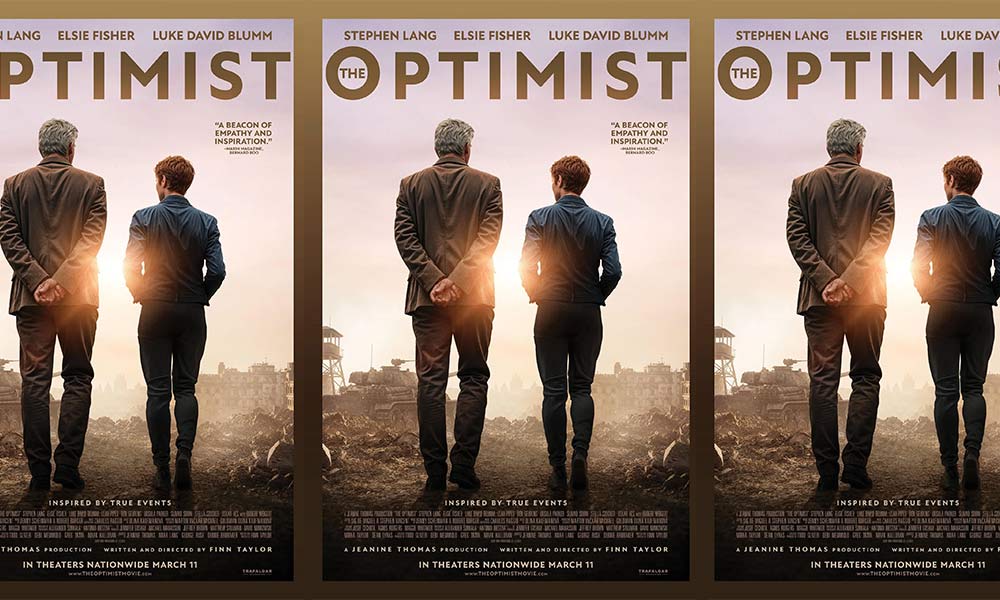
In sunny Marin County, CA, in 2004, it might seem like nobody had much to be sad about. Life was more affordable and Mark Zuckerberg hadn’t even moved to the area yet. Few cell phones were in sight, and perhaps we didn’t know how good we had it. But even in the most beautiful or rose-colored of places, amidst sun and redwood trees, people can still be fighting inner battles you know nothing about. The Optimist is a movie about such people. Herbert Heller (Stephen Lang) is an elderly survivor of Auschwitz who keeps his traumatic history a secret, even from those closest to him. It isn’t until an unexpected friendship with a young woman named Abby (Elsie Fisher) decades later that he begins to heal, or embrace these old scars.
Abby has been in a residential treatment therapy center lodged in a California Redwood forest, having suffered an unspeakable tragedy herself. She meets Herbert through her therapist, who has a background in working with Holocaust survivors. She has the sense that they could help each other. From looking at Herbert, you wouldn’t know that he had ever survived something so traumatic. Sure, he’s the right age, and he has an identifiable accent, but he presents as just a normal guy. As the viewer, one notices how he hides his pain and shame in a masterful way—he deals with it by being very outwardly positive. He owns a toy store with seemingly unending amounts of free chocolate to hand out to his little customers. He seems not to have an ounce of temper waiting to unload on anyone. He seems to love providing children with the sort of innocent play and fun that was cut so short for him as a young person. But the viewer knows that, to a certain extent, this outward presentation of joy and optimism is a kind of noise—one meant to drown out a darkness that must be somewhere inside of him.
The Optimist made me think about what sort of Holocaust stories resonate at this point in our history.
Much of the movie consists of Abby interviewing Herbert for a video project she’s working on. In an era when more and more survivors are passing away, it seems urgent to get their stories down on camera as quickly as possible.
The movie presents Herbert’s retelling of the terrible days of the Holocaust in flashback. We meet young Herbert and his family in Prague, living a happy middle-class life and minding their own business. After spending some time with them, one realizes that the title of the movie may refer to his father who, despite the increasingly worrisome red flags, remains steadfast in his belief that this will all blow over soon; the Nazis will tire of harassing Jews and leave, after which everything will go back to normal.
I couldn’t help but think of situations around the world today, when bad actors seem to keep on moving the goalposts of normal, constantly changing our perception of what is tolerable and what isn’t. Are we all being naïve? Will history look back at us and see us in the way that we see Herbert’s father? How do we understand history?
The Optimist also made me think about what sort of Holocaust stories resonate at this point in our history. When Jesse Eisenberg’s directorial debut A Real Pain came out in 2024, it felt as though it started a brand new conversation about what types of Holocaust stories were important to tell. By focusing more on the legacy of the Holocaust on the so-called “third generation,” (grandchildren of survivors), audiences and viewers such as myself had a direct road in. Other movies about the Holocaust, such as Jonathan Glazer’s The Zone of Interest (Loosely based on the 2014 novel by Martin Amis) and László Nemes’ Son of Saul, brought completely new perspectives by narrowing the focus of the story. These movies said so much more by showing so much less. But with a movie like The Optimist, we are subjected to the sort of content that we’ve all seen many times before—a re-enactment of sorts. The families getting separated, the camps, the yellow stars, the starvation, the work, the viciousness of the Nazis. It’s well-trodden territory, and at a certain point I wondered if I had become totally desensitized to it. In a way, I have. Sometimes the more you see, the less you feel.
The rest of the flashbacks follow Herbert as he struggles to survive Auschwitz. We know that he survives since he is now an old man, but it is the how that keeps the viewer locked in. Even as a young man, Herbert valued hard work (at one point the elderly Herbert takes pride in his store and jokingly whispers “work will set you free,” a reference to the famous sign above the entrance to the Auschwitz Concentration Camp). His father taught him the value of hard work, and it is his hard work that helps him maintain focus and purpose at Auschwitz. This presents the viewer with an odd dilemma. In some ways he was able to pass the tests the Nazis were giving. He was a good, strong and determined worker. Does that mean that his life was more valuable than the ones who never made it out? It is an unsettling question.


Lang and Fisher are talented actors. My first introduction to Lang was as General George Pickett in the 1993 film Gettysburg, which as a young Civil War buff I watched repeatedly growing up. He did such a convincing job playing a staunch, Southern Confederate general that I spent most of The Optimist wondering how it could be the same actor. Perhaps best known as the villainous Colonel Miles Quaritch in the Avatar films, Lang grabs the opportunity here to play a good guy for once, but the script and the story structure only present him and Fisher with opportunities to give wooden performances. As the saying goes, for a good story, “show, don’t tell.” Here, there is a whole lot of more telling than showing, even with so many horrific flashbacks. So much of the movie’s conflict is established in the first act, it makes the rest of the movie a somewhat predictable and deflating experience. One gets the sense that the movie could have used more editing—or perhaps some fleshing out.
Even so, the viewer may find The Optimist ultimately worthwhile as a story of an unlikely friendship. Herbert Heller was a real person (he passed away in 2021) who would speak often about his experiences at Auschwitz to local schools. He touched the lives of so many young people. One imagines this script as an amalgamation of all of those occasions.