
To read and/or print this story in PDF format, click here.
To read more Daniel Pearl Investigative Journalism Initiative reports, click here.
On a cold but sunny January morning, two protesters stand outside a Tatte Bakery & Café location in Washington, DC’s Adams Morgan neighborhood. It’s still under construction, so there aren’t any customers, but plenty of people walking by. The protesters are friendly and smiling, handing out flyers that say “WHY WE BOYCOTT.” The flyers declare that the popular East Coast chain serving food with Israeli and Middle Eastern influences is “soaked in Palestinian and Syrian blood.”
Both protesters wear winter hats and sunglasses and Palestine flag pins on their coats. One of them, Maria Ellis, sports a keffiyeh and earrings in the shape of red triangles, a symbol used in Hamas military videos that has become an internet meme supporting violent resistance to Israel.
They receive a warm reception from many passersby. Some say they are already boycotting the business. “I would never go to Tatte because I don’t support the occupation and genocide,” a woman wearing Doc Martens boots and a black wool coat says. “Fuck Tatte!” says another.
“We’re encouraging people to buy local, to buy small and not allow people—an entity that’s allowing genocide to happen on their watch—to be in your neighborhood,” Ellis tells me. She is not targeting Jews, she says. “It’s not even about the religion. It’s more about Israel, and that it’s an illegal occupier.” Noting that she was involved in boycotts as a kid, Ellis asks: “How did we bring down apartheid South Africa? It was through boycotting.” Now, she says, “financially, bringing down the Zionist entity is the main objective.”


Ellis says she has encountered people who have accused her of antisemitism. But she has a ready rebuttal: She doesn’t believe in antisemitism. “If anything, we are pro-Semitic,” she says. “Why? Because Palestinians are Semitic.” When asked whether she is familiar with antisemitism and Nazism, she says yes, but adds that what Israel is doing to Palestinians is “way worse…I could argue that the Nazis went and set up shop in Israel.”
The second protester outside Tatte declines to provide her name. When I tell her I’m writing a story about protests of Israeli-owned businesses, she corrects me: “Zionist businesses. We’re focusing on Zionists.” I ask her what, in her view, a Zionist is. She lets out a long sigh. “We all know what Zionism is. Just like we are swimming in a sea of white supremacy, we’re swimming in a sea of Zionism.”
The scene is not entirely unusual—it is one of many protests targeting Tatte. Ellis and her companion are low-key, but some protests have involved acts of vandalism such as smashed windows, graffiti and posters stuck to the windows and walls.
Often they are far more dramatic: On May 8 of last year, protesters wearing keffiyehs and waving Palestinian flags dumped gallons of fake blood on the sidewalk outside a Tatte in downtown DC, holding up photos of emaciated children and signs reading, “While you eat, children starve.” Inside, dozens of customers sat at small European-style café tables under the glow of gold-toned light fixtures, looking out at the protest through floor-to-ceiling windows. On another afternoon last fall, a man stood outside a Tatte in Rockville, MD, wearing a Benjamin Netanyahu mask and holding a plastic milk jug filled with red liquid. “When you buy from Tatte, this is what you are funding,” the masked man says in a video posted to Instagram before tipping the jug and emptying the fake blood onto a second protester’s head, soaking her hat, shirt and pants. The rest splatters on the cement pavement. “When you buy from Tatte…you are funding the killing of babies!” he says.
The accusations against Tatte are also personal, targeting the chain’s founder Tzurit Or and Ron Shaich, a Jewish entrepreneur and founder of Panera Bread who owns a majority stake in Tatte. Or was born on a kibbutz in northern Israel and did military service in the IDF more than 30 years ago. According to the flyers handed out by protesters in DC, Or was complicit in “murdering and ethnically cleansing Syrians” during her service. (Or says she never fired a shot in combat.) Shaich has served as chair of the Board of Directors of Combined Jewish Philanthropies (CJP) of Greater Boston, which directs communal funds to hundreds of Jewish causes annually. The website tatteboycott.com highlights donations CJP allocated over a decade ago to Israel-related nonprofits such as Friends of the IDF and Birthright as proof of its—and by extension Shaich’s and Tatte’s—complicity. “It’s ignorant,” Or tells me, adding that the Israeli embassy has asked her to host events and donate gift cards, and she has refused. “We never use any Tatte money to support any sides…Tatte is an American business that has nothing to do with anything that happens in Israel. That’s it.”
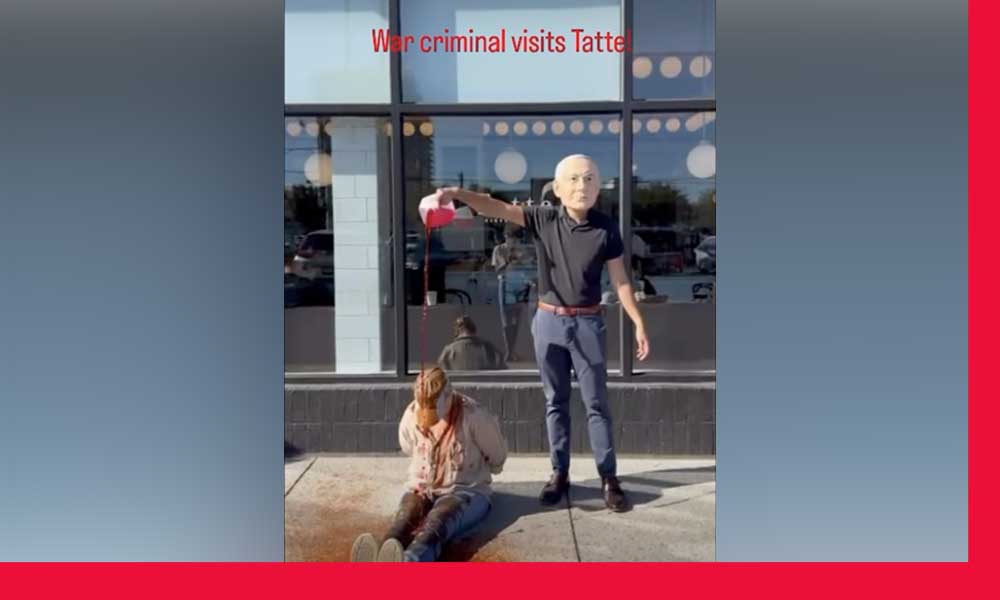
Protest outside a Tatte in Rockville, MD. (Photo credit: Instagram screenshot)
Tatte is far from the only chain or establishment that has been singled out. With the conflict thousands of miles away, protesters look for targets close at hand: near their homes, workplaces and universities. In the past, boycotts were generally focused on large companies and institutions as well as food co-ops, but since October 7, 2023, Israeli and Israeli-owned restaurants, and those perceived to be linked to Israel, have become magnets for protest—from Sydney to Athens to London and beyond. And the litany of allegations doesn’t stop at complicity in genocide and apartheid or links to Israeli institutions; it also includes colonialism, white supremacy, food theft and cultural appropriation. Other times the tie-in is much more amorphous, stemming from a perceived support for Zionism—a word protesters associate with evil. “It’s not only Israel that’s seen as illegitimate,” says Lesley Klaff, a British law professor and editor-in-chief of The Journal of Contemporary Antisemitism. “It’s Zionism itself, and anybody associated with it.”
The protests have hit many of the restaurants hard. Over the past year, multiple Jewish- or Israeli-owned businesses outside of Israel have closed, citing, at least in part, the steady stream of boycotts, protests and harassment. An Israeli restaurant chain in Belgium, Boker Tov, shut down and filed for bankruptcy earlier this year following “a sustained wave of hate messages, review-bombing, harassment and death threats,” according to the Israeli news site Ynet. “The hatred is so widespread. Anything that smells, looks or sounds Jewish or Israeli is now fair game for boycotts,” co-owner Tom Sas said. In February, an Ethiopian-Israeli restaurant in New York’s Harlem, Tsion Café, closed its doors to walk-in customers after what the owner, Beejhy Barhany, described as repeated threats of violence because she supports Israel. After October 7, “everything kind of changed,” Barhany told The New York Jewish Week.
In Washington, DC, the Mediterranean fast-casual chain Shouk was the target of a prolonged boycott and protest campaign. “We found ourselves caught in the crosscurrents of a toxic political climate surrounding the Israel/Gaza war,” Shouk owners wrote in an email to customers. “More and more, customers have chosen to avoid businesses connected to Israel.”
Shouk came on the DC restaurant scene in 2016, offering vegan street food such as mushroom shawarma, falafel and hummus. It was part of a broader wave in the late 2000s and 2010s, when modern Israeli restaurants—ranging from high-end dining rooms to casual neighborhood spots—surged in popularity around the world. Shouk’s plant-based burger, made of flaxseed, legumes and vegetables, was considered one of the best in the nation’s capital. Dennis Friedman, one of the co-owners of Shouk, tells me that he and his business partner Ran Nussbacher, who is Israeli, tried to be sensitive to political concerns around Israel. The word “shouk” (street market) was featured in their restaurants in both Arabic and Hebrew lettering. “It was meant to be a gathering place for all. Food brings people together,” Friedman says.
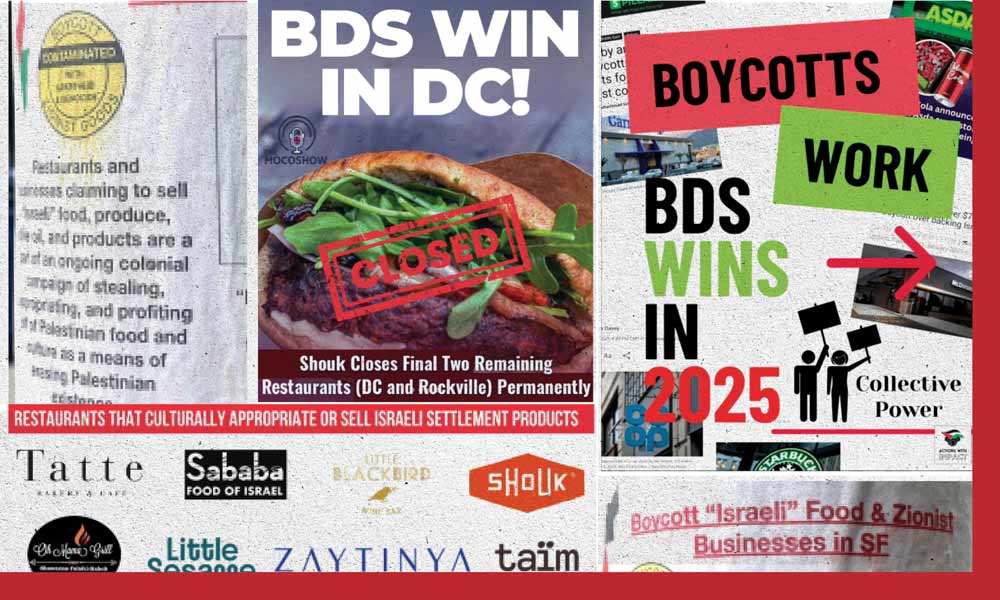
In early 2025, Shouk was one of eight DC restaurants and chains (including Tatte) named on a boycott list called “Apartheid? I Don’t Buy It.” The list was put out by DC for Palestine, a grassroots group with a robust online presence “organizing to push DC institutions to sever ties with companies and organizations that profit from or support Israel.” The group charged that Shouk was engaging in cultural appropriation. “Much of what Shouk serves is Palestinian & they import Israeli ingredients,” read an online flyer advertising the boycott.
Jinan Deena, an American chef of Palestinian heritage, helped organize the boycott with DC for Palestine. She grew up in Ohio but spent some of her teenage years in Ramallah, where her family is from. “As a teenager I saw the occupation, I experienced it,” she says, adding that some of her family was killed by Israeli forces. To Deena, restaurants like Shouk that label hummus and falafel as Israeli are engaging in “appropriation and food theft.” She suggests European Jews who settled in Ottoman or British Mandate Palestine were not accustomed to eating foods that originated in the Middle East, and neither they nor their descendants have a right to claim them as their own. And so it bothered her that Shouk referred to its offerings as “Tel Aviv street food”—“They could have just said, ‘Arab food.’”
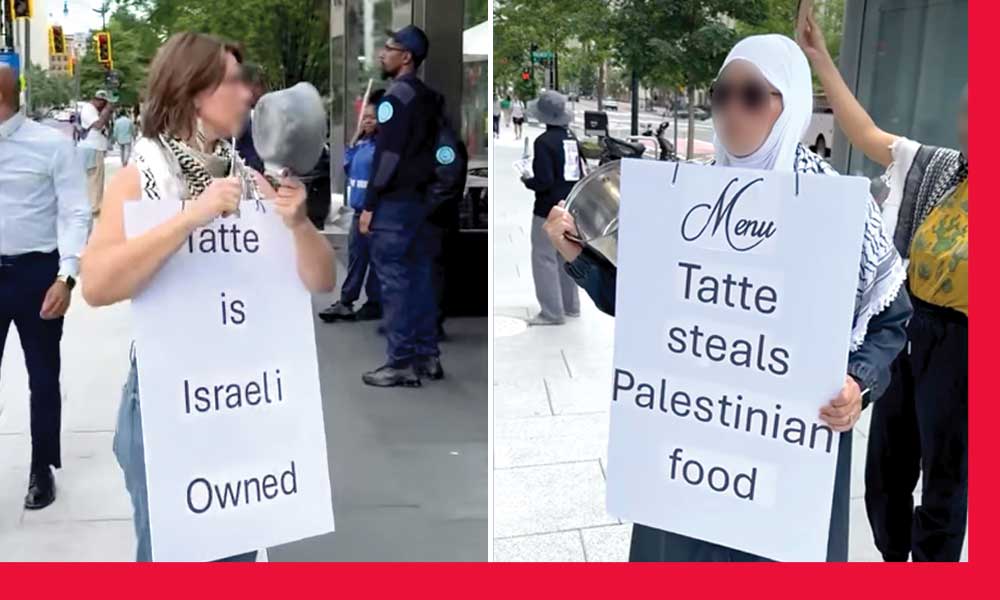
A Tatte protest in Washington, DC. (Photo credit: Instagram screenshot)
The boycott, Deena stresses, is not meant to target a specific group of people. “I wouldn’t care if these Israeli restaurants were selling, you know, schnitzel and pastrami and matzah ball soup and things that are very core European Jewish foods,” she says. “The fact that they take foods that are North African and Arab and rename them as their own is the problem for me. It’s a part of the ethnic cleansing campaign that has been happening for over 80 years.” Of the fact that a large proportion of Israeli Jews have ancestors originating in Arab countries, Deena insists their foods would more accurately be described as Moroccan or Tunisian, not Israeli. She describes what she wants in blunt terms: “My goal for those businesses is not to exist anymore.”
Protesters went after Shouk, particularly its location near Georgetown University. Ironically, just a couple of years prior, Shouk had been praised for being an exceptionally ethical business—the restaurant was fully vegan, utilized wind power, sourced sustainable ingredients and offered disposable cutlery only on request. In the spring of 2023, an op-ed in Georgetown University’s student paper began with a lede that today feels out of date: “At Shouk, you can feel good about your falafel.” By 2025, that halo was long gone. “On a daily basis for a while, we would come in and there would be posters or pictures of horrific images, like dead babies, posted on the windows,” Friedman recalls. “They were put on with some sort of adhesive that was nearly impossible to get off, like wallpaper glue. We’d have to use a razor to take them off.”
Many times per day (Friedman says ten or more), somebody would open the door and yell “Free Palestine!” or walk in and tell people they shouldn’t be eating there. He described it as a “constant barrage.” Protesters ranged from older people to students and even children.
Friedman recounts the day two young kids came into the restaurant during a busy lunch service and started chanting “Free Palestine!” He noticed adults outside, whom he presumed to be their parents, filming through the glass. “I couldn’t believe it,” he says.
Protests disturbed customers and became so frequent that law enforcement officials deputized plainclothes police officers to monitor the Georgetown location from unmarked cars. Finally the owners gave up: In September 2025 they announced that the business was closing, in part because of the political climate surrounding Israel and Gaza.
Friedman says he understands people’s frustration about the deadly war in Gaza, where more than 70,000 people—civilians and combatants—have been killed, according to the Gaza Health Ministry and recently confirmed by the IDF. “People didn’t want the war, and they were looking for a place to take out their emotions, express their feelings,” he says. “Shouk became a target for that.”
For DC for Palestine, Shouk’s closure was a major victory. “LOCAL BDS WIN IN DC!!” the group posted on Instagram. “While our campaign is just getting started, we see this as a testemant [sic] to the people of DC, who are shopping with their conscious [sic] and refusing to support businesses with ties to Israel’s genocide, apartheid, and occupation of Palestine.”
“Blood is in the water,” a pro-Palestinian activist wrote in another Instagram post, touting the success of the Shouk campaign and urging protesters to turn their attention to Tatte. “We have a golden opportunity to punish israel [sic] for the genocide of the Palestinian people. I encourage everyone who sees this to boycott Tatte but also if you live or work near one, go in and disrupt! Scream Free Palestine! Give people flyers about Tatte’s complicity. Give people directions to other, often better, bakeries!”
For protesters, the closures of businesses such as Boker Tov, Tsion Café and Shouk represent a major win in the Boycott, Divestment and Sanctions (BDS) campaign. Founded in 2005, the BDS movement was launched by a coalition of Palestinian civil society groups calling for an end to Israel’s 1967 occupation, “recognizing the fundamental rights of the Arab-Palestinian citizens of Israel to full equality” and the right of Palestinian refugees and their descendants to return to the homes and lands from which they or their ancestors had been forcibly displaced and dispossessed in 1948.
Inspired in part by boycotts used during the struggle against apartheid in South Africa, the campaign urges governments, institutions (like universities) and individuals to boycott Israeli goods, divest from companies linked to Israel and impose sanctions until certain political demands are met. Supporters frame BDS as a nonviolent human rights strategy, while critics argue it demonizes Israel and that its agenda is to strip Israel of its Jewish identity. The BDS movement calls for “more than 7.25 million” Palestinian refugees, most of them descendents of the roughly 700,000 people displaced in 1948, to return to Israel, which would end the country’s Jewish majority. The movement is decentralized and is loosely coordinated by the BDS National Committee, but there is no single membership structure or centralized authority directing campaigns.
Part and parcel of the BDS movement since its founding has been “anti-normalization”: the principle that Israeli institutions, cultural exports, “initiatives” and “activities” should be boycotted unless they represent a form of “co-resistance against the Israeli regime.” The movement describes “normalization” as “an attempt by the oppressor to colonize the mind of the oppressed with the notion that oppression is a fact of life that must be coped with, not resisted.” According to BDS, working with or associating with Israelis who have not explicitly agreed to terms they’ve set out is a form of normalization.
In recent years, anti-normalization campaigns have been launched against Israeli universities, musicians, filmmakers, publishing houses, athletes, academics and chefs. In one striking case last year, the Palestinian Campaign for the Academic and Cultural Boycott of Israel (PACBI) called for a boycott of the Israeli-Palestinian Oscar-winning documentary No Other Land, which details the demolition of Palestinian homes in the West Bank by the Israeli military, because “some of the [film] team’s Israeli members are not on record supporting the comprehensive rights of the Palestinian people,” PACBI said. For similar reasons, PACBI has also called for a boycott of Standing Together, an Israeli-Palestinian activist group that opposes the occupation of the West Bank.
Normalization is “a powerful weapon employed by oppressors to whitewash their crimes,” PACBI wrote in its statement explaining the boycott of No Other Land. “Palestinians do not need validation, legitimation or permission from Israelis to narrate our history, our present, our experiences, our dreams, and our resistance.”
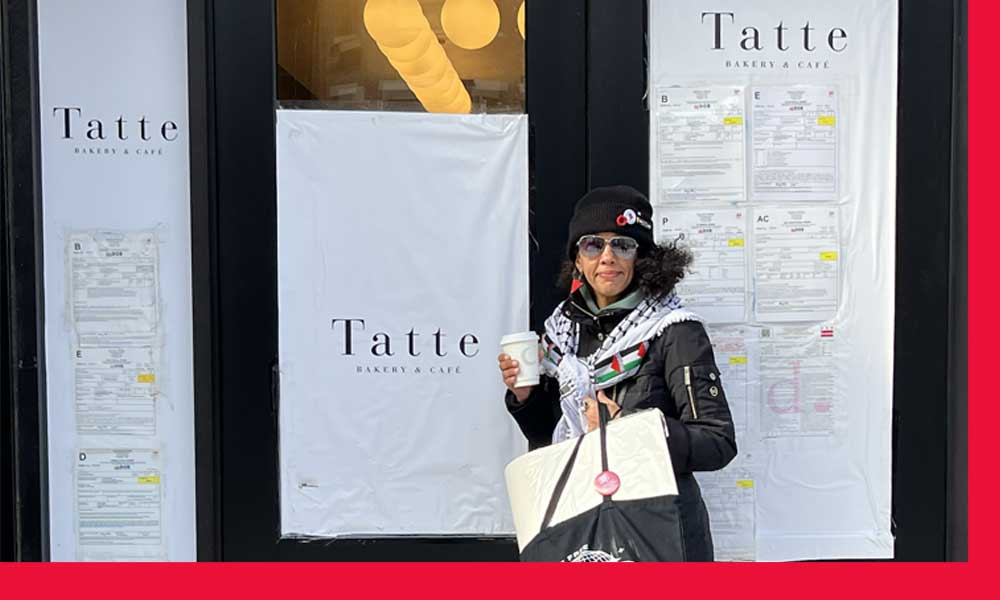
Protester Maria Ellis outside a Tatte location under construction in Adams Morgan. (Photo credit: GaryRobertsphotography)
The bestselling Irish author Sally Rooney, who even before October 7 refused to have her work translated into Hebrew by an Israeli press, is a prominent figure associated with anti-normalization. But since the outbreak of the Israel-Hamas War, blanket cultural boycotts against Israel have surged, resonating beyond committed anti-Israel activists deep into the progressive cultural zeitgeist, winning the support of people with star power. Last fall, more than 1,000 movie professionals, including actors Emma Stone, Joaquin Phoenix and Elliot Page, signed a statement pledging not to associate with the vast majority of Israeli film institutions that the statement claimed are “implicated in genocide and apartheid against the Palestinian people.” Around the same time, more than 1,000 musicians, including MJ Lenderman, Björk, Japanese Breakfast and Hayley Williams, pledged to block their music from streaming in Israel in an effort to “delegitimize Israel as it kills without consequence on the world stage.”
Among the critics of anti-normalization is Ahmed Fouad Alkhatib, a Palestinian-American writer, originally from Gaza, who has lost dozens of family members to Israeli air strikes during the Israel-Hamas War. Currently a resident senior fellow at the Atlantic Council, he has emerged since the start of the war as a prominent critic of the anti-Israel protest movement as it’s constructed today, particularly in the United States and Europe.
Alkhatib once supported BDS as a means to change Israeli policy, particularly in the West Bank, where Israel has expanded settlements, often violently, into territory important for the future establishment of a Palestinian state. “I would have been very, very happy to make the settlement enterprise a costly endeavor, because the United States wasn’t exercising any pressure,” Alkhatib says. “But then the accompanying rhetoric with BDS started veering more and more into the delegitimization of the very existence of Israel.”
Ironically, he says, many Palestinians he knows—including his sister, who earned a medical degree at Hebrew University, an institution boycotted by PACBI—aspire to form professional connections inside Israel. He said his family has been quiet about his sister’s connection with Hebrew University out of fear. “Instead of her being celebrated as a role model of success for young Palestinian women, we have to hide the fact that this young, Muslim, hijabi, Gazan woman is in Israel doing incredible advanced cancer research,” Alkhatib says.

Alkhatib was harshly critical of Israeli military tactics throughout the Israel-Hamas War, critiquing the high civilian death toll and the destruction of infrastructure from IDF bombardments. “Thousands of homes, like my family’s, are being destroyed,” he wrote in an op-ed in The Forward. “Entire families killed.” He is also critical of U.S. state laws that target individuals and businesses supportive of BDS, describing such laws as “extreme” and provoking a backlash.
But on anti-normalization, he points to what he calls a “bourgeois activist class” that trumpets extreme positions that do little to curb the violence over the long term. “BDS has shifted from being a strategy into being more of a cult,” he says, with leaders who “enforce their vision of maximal purity in which they hope to make Israelis disappear.”
The Journal of Contemporary Antisemitism’s Klaff agrees that the BDS movement has become increasingly extreme over the past 20 years. “The apartheid analogy is still very important to the boycott movement, but now they’re promoting more than that,” she says, describing accusations that include ethnic cleansing, colonialism, genocide and “every human rights abuse under the sun.”
BDS activists want to “permanently erase the very idea of Israelis living in peace, unless they bow down to an extreme anti-Zionist agenda,” Alkhatib says. “I think elements of it are immoral. I think it’s ineffective. And I think it pushes away prospective allies.”
The anti-normalization strategy of targeting restaurants owned or associated with Israelis predated October 7 but intensified dramatically in the months that followed. The protests follow a similar pattern in cities across the world and often rely on public displays of outrage by activists who use spectacle as a tactic. The main motivation, says Klaff, is public shaming. Protestors “may, or they may not, achieve their aim in shutting the place down, or ostracizing patrons. But what they do is they promote their anti-Zionist libels.” She describes a recurring protest at London’s Miznon, part of an Israeli fast-casual chain with locations in New York City and around the world. Protesters also targeted its location in Melbourne, throwing chairs and smashing a glass door while chanting anti-Israel slogans. They said one of their reasons for doing so was that restaurant co-owner Shahar Segal was a volunteer spokesperson for the Gaza Humanitarian Foundation, a controversial aid group backed by the Israeli government. They were also incensed that Miznon shut down its 16 restaurants in Israel on October 7 to prepare food for IDF soldiers.
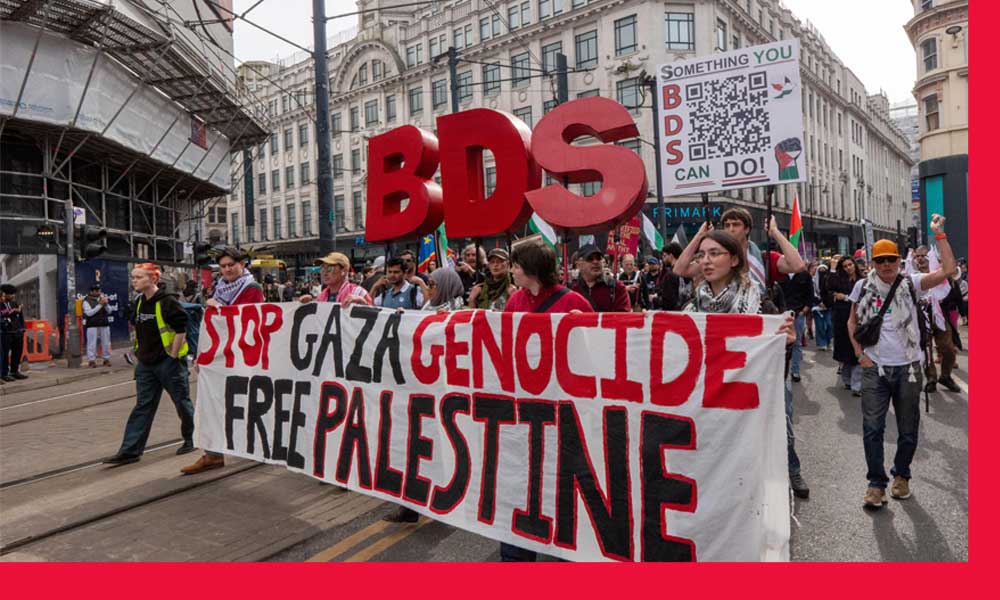
A BDS protest in Manchester, UK, March 2025. (Photo credit: Alamy)
The protests against Miznon were spearheaded by the International Jewish Anti-Zionist Network (IJAN), an anti-Israel group fiscally sponsored by the WESPAC Foundation (Westchester People’s Action Committee). WESPAC is a New York-based nonprofit that has supported some of America’s most vociferous anti-Israel organizations, including Students for Justice in Palestine and Within Our Lifetime, which praised the October 7 attacks. Founded in 2007, the IJAN advocates for the dismantling of Israel and Zionism, which it sees, respectively, as an apartheid state and a racist movement. During the 2008-2009 Gaza War, six members chained themselves to the gates of the Israeli consulate in Los Angeles, and the organization has since held protests and marches around the world. The role of the Jewish anti-Zionist, IJAN co-founder Sara Kershnar has said, “lies in expediting the dismantling of Zionism—both its genocidal, colonial expression and expansion in Palestine and its fortification through organizations and institutions across the globe.”
The IJAN described Miznon as “genocide enablers” and put quotation marks around the word “Israeli” in a document describing their protest, a convention used by anti-Israel activists to challenge Israel’s legitimacy. The IJAN considers it “a deeply urgent moral and political obligation to target and expose Zionist institutions in our communities for facilitating, funding and profiting off of genocide.”
In San Francisco last summer, a protest turned violent. During an action against ICE raids in the city, demonstrators zeroed in on the Jewish-owned café Manny’s—a frequent target of anti-Zionist protest, even before October 7. They smashed windows and wrote “fuck Zionism” and “Death to Israel is a promise” outside the café. The owner, Manny Yekutiel, is a progressive Jew who has Israeli heritage and family in Israel and hosts events at the coffee shop in support of Israeli-Palestinian coexistence. His political leanings make no difference: To San Francisco’s far-left protesters, Yekutiel is simply a Zionist.
In the case of Breads Bakery, a labor dispute took a surprising turn. Employees at the Israeli chain in New York City attempted to form a union and demanded not only improvements in their working conditions, but that the company cease its support for “the Israeli occupation of Gaza.” How was Breads Bakery supporting the genocide in Gaza or the occupation of Palestine? Among the accusations presented was that the company had participated in a Jewish food festival on Governor’s Island called the Great Nosh, an event “connected to organizations that donate millions each year to the IDF.”
To BDS activists, the unionizing efforts, protests and demonstrations represent what they consider to be a principled stand against a colonizing country, Israel, engaged in a genocide against Palestinians. “It’s hard for me to imagine anyone in Israel not really knowing that they’re already on stolen land and that they’re living under a fascist state,” said Deena, the DC for Palestine organizer, explaining why, in her view, Israelis anywhere are fair game for protest.
Tzurit Or opened her first brick-and-mortar Tatte location in 2008 in Brookline, MA, after selling baked goods at farmers’ markets. The name Tatte comes from her daughter, who was about a year old when she pronounced the Hebrew word for grandmother, “savta,” as “tatte.”
The café sells freshly baked pastries as well as Mediterranean fare like Jerusalem bagels and shakshuka. Or says the restaurant innovates in its menu “around anything that is, you know, comforting. Any menu item that I grew up eating, or making, or enjoyed during travel.”
Or finds the accusation that she was complicit in murder upsetting. She served in the tanks division in honor of her father, who did the same and was killed during the 1973 Yom Kippur War. “I wanted to experience some of his service,” she tells me. She describes her role as something like a social worker for hundreds of new recruits who cycled in and out of training. She served the same function in combat zones in the Golan Heights. “I never hurt a soul,” she says.
The protests targeting Tatte have not affected the business’s bottom line—but they have caused stress among her staff. “When a crazy person goes outside with his megaphone and screams, or goes into a Tatte with signs and screams that their founder is killing people, I can’t even imagine how they feel having to be present when that whole scary thing happens,” Or says. The portrait of her painted by protesters, to her mind, bears little connection to reality. Of Tatte’s staff, “They know my story. Whoever knows me knows it’s so far from me.” But Or worries about those who don’t know her and, as the protests show no sign of abating, what the future holds for businesses like Tatte.
Gabe Stutman is the news editor of J. The Jewish News of Northern California.