
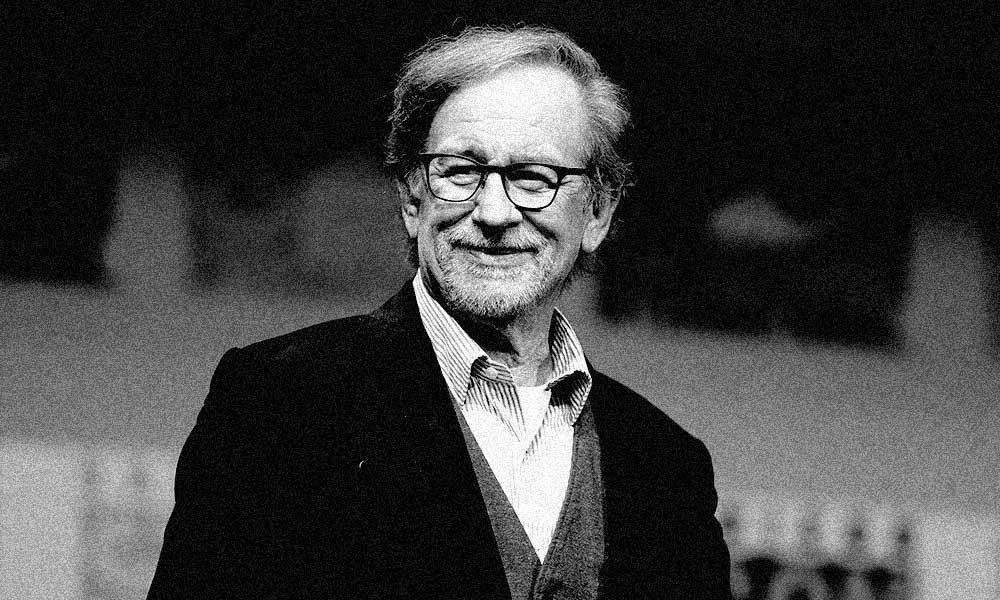
The glowing finger of a small alien. A huge boulder chasing Indiana Jones down a narrow stone hallway. An old man staring down at a gravestone at Normandy. Steven Spielberg has been making movies for more than 50 years and is responsible for some of Hollywood’s most iconic images of people grappling with something bigger than they can imagine. As we celebrate America’s 250th birthday and consider all of the events and people who have made this country special, it’s a good time to highlight one of Spielberg’s lasting legacies—as a master storyteller and keen interpreter of the American story.
Spielberg burst onto the scene in the 1970s with Jaws, employing the craftsmanship of the New Hollywood while laying the foundation of the summer blockbuster era to come. He kept the thrill ride going in the 1980s with the Indiana Jones films and E.T., pure popcorn entertainment for the Reagan era. But during this period he also made films like The Color Purple, an adaptation of Alice Walker’s novel about a young Black woman coming of age in the Jim Crow south. It may have seemed like an odd departure at the time, but it showed an early desire to transcend blockbuster filmmaking and make a movie that contended with the harsher realities of American history.
Following his most recent film, Disclosure Day, he has committed to making a western, the most American of all movie genres.
In 1993, his career arc changed forever with the release of Schindler’s List. One of the most acclaimed dramatic films about the Holocaust ever made, it connected hugely with American Jews and was later designated as “culturally, historically or aesthetically significant” by the Library of Congress and preserved in the National Film Registry. A year later he established the USC Shoah Foundation, dedicated to filming and preserving the accounts of survivors and witnesses of the Holocaust.
Spielberg’s next films were Amistad in 1997 and Saving Private Ryan in 1998. With Amistad, he fashioned a true story about a 19th-century slave ship revolt into a moral courtroom drama in the vein of To Kill a Mockingbird or the films of Frank Capra, such as Mr. Smith Goes to Washington. Saving Private Ryan tells a story about sacrifice, honor and the fight to rid the world of tyranny, which Spielberg modeled heavily after John Ford’s The Searchers. Indeed, Spielberg looked to some of his most renowned predecessors, American filmmakers who also sought to tell truthful stories about their country. In fact, both Capra and Ford had gone off to World War II to help shoot films for the war effort, and their experiences set the ground for the rest of their careers.
In the ensuing decades, Spielberg established himself as a preeminent narrator of American history—with Band Of Brothers (2001) and movies such as Lincoln (2012), the Cold War-era Bridge of Spies (2015), and The Post (2017) about the publication of the Pentagon Papers.
Spielberg has always considered himself a storyteller with a certain responsibility to his audience. He grew up with a father who had served his time in the military during World War II as a communications operative—which would influence his son’s career as a master technician. With his father’s legacy in tow, Spielberg carried the patriotism of the baby boomer generation with him. Whether touting the essential value of a free press in The Post or fighting back against Red Scare doctrine in Bridge of Spies, his has always been a patriotism that is about seeing America as a place defined by liberal values, where everybody can live freely. The only assimilation is through embracing the shared values written into the Constitution—that all are created equal.
Jewish Americans have long held an outsized footprint in film and entertainment. Perhaps our general outsider status makes us keen to the construction and perpetuation of the American dream. We know what it is, what it means not to have it, and what it means to have it sold to us. We know what the story is, so we know how to package it. Yet this packaging is not a cynical ploy for Spielberg. It comes straight from his heart.


There’s a telling scene in 2022’s The Fabelmans, a loosely autobiographically inspired film about the coming of age of a young Jewish artist in the middle of the 20th century. Sammy (or Steven) finds himself a new student at a high school in California, where he is the target of antisemitic bullying. However, as a budding filmmaker, he is tasked with creating a film for his school, one in which he highlights the “main-character energy” of one of his bullies. This unexpectedly shakes up the bully’s sense of self, and he is driven to confront Sammy. Why would one of his victims pick up a camera and make such a flattering portrait of him? He responds shruggingly, saying, “All I did was hold the camera and it saw what it saw.” But even he knows that this is a little untrue, adding, “Or, I did it to make my movie better.” He knows that he is guiding the stories he wants to tell—and he knows that a story with a hero is far more satisfying. “I made you look like you could fly,” he says, to which the bully responds, “But I can’t fly.” Sammy, like Spielberg, is attuned to American mythmaking.
With a career spanning five decades, Spielberg just keeps making movies. Following his most recent, Disclosure Day (currently in theaters), he has committed to making a western, the most American of all movie genres. Interestingly, Spielberg has never made a true western. Going strong at 79, one senses he’s got more American history to add to his filmography in the years to come.
(Top image credit: Gage Skidmore (CC BY-SA 2.0))