



TAKE ME OUT TO THE BALL GAME
Music by Albert Von Tilzer; lyrics by Jack Norworth (1908)
“Take Me Out to the Ball Game” is one of those songs everybody knows and almost nobody thinks about beyond the game. It feels as if it has always been there: the 7th-inning stretch, the ballpark crowd, the summer afternoon, the ritual of rooting for the home team. But when you look closely, it becomes something much deeper than a baseball tune. It becomes a song about America and, more specifically, about the Jewish longing to enter America—not to conquer it or stand apart from it, but to belong to it.
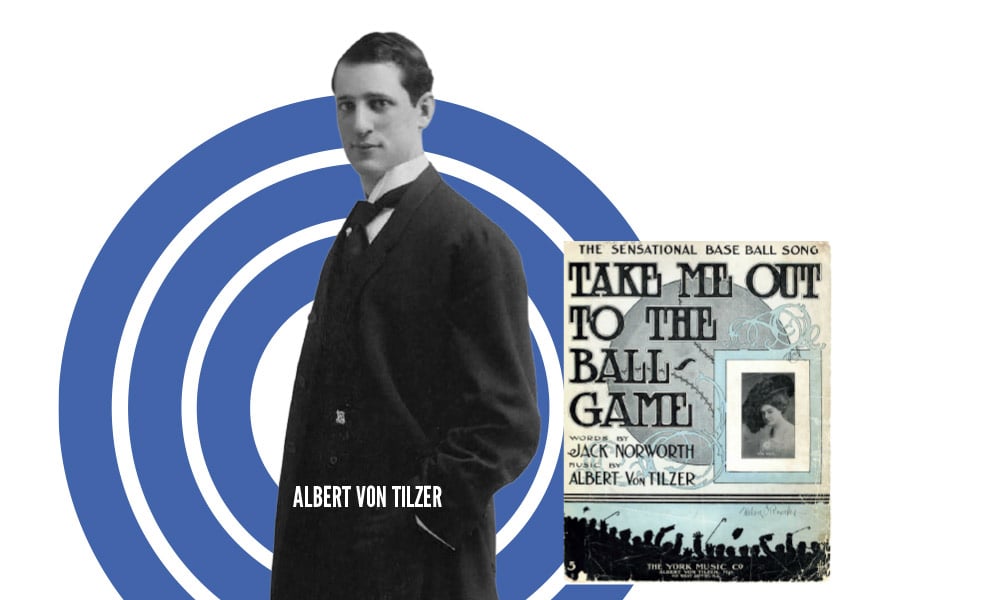
Albert Von Tilzer, who wrote the music, was the younger brother of Harry Von Tilzer, an early employer of Irving Berlin. Like many songwriters of that era, Albert was untrained but had the instinct and facility to write songs for any occasion. Popular songwriting then was practical and immediate. If something was in the news, if a holiday was coming, if a public craze was taking hold—someone wrote a song for it. Songs were made for vaudeville, dances, public events, sheet music sales and the general marketplace.
Around 1908, baseball was becoming part of the American story. To help orient the waves of Jewish immigrants—who wanted to understand the country’s codes, rituals and games—the great Yiddish newspaper The Forward ran articles explaining America’s pastime. (What was baseball? Why did Americans care about it? What did it mean?) Von Tilzer, who was not a baseball fan and, by most accounts, had never been to a baseball game in his life, decided to write a song.
On its surface, “Take Me Out to the Ball Game” is playful (“Buy me some peanuts and Cracker Jack”); the singer wants the food, the noise, the ritual, the shared language of the ballpark. But underneath that is something more profound. You can hear it in the lilting melody if you slow the song down. Von Tilzer and his co-author Jack Norworth were writing about people searching for a home. (While not Jewish himself, Norworth was married to Nora Bayes, the famous Jewish vaudville star who first popularized the song.) When they say, “I don’t care if I never get back,” they’re not simply talking about going to a ballgame. They’re not just searching for a diversion, but a crowd in which to immerse themselves.
“Take Me Out to the Ball Game” stands, for me, as a stake in the river of Jewish-American music. It comes from a moment when immigrants from throughout Europe were pouring into New York, facing a new industrial world whose outcome could not have been predicted. And from that moment came a song about a game—but really, a song about wanting to be inside the dream.
—Ben Sidran is the author of several books on popular music, including There Was a Fire: Jews, Music and the American Dream.
Listen to “Take Me Out To The Ball Game” here
GOD BLESS AMERICA
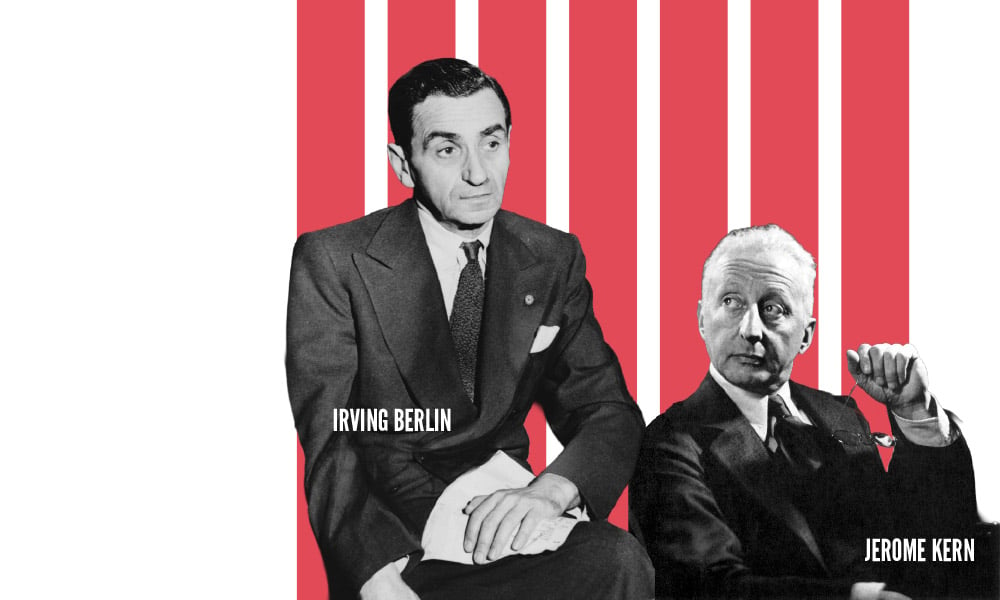
By Irving Berlin (1918, revised 1938)
Berlin first wrote “God Bless America” in 1918 while serving in the army at Long Island’s Camp Upton. It was to be the finale of a soldier revue called Yip Yip Yaphank, but he set it aside. Twenty years later, with fascism rising in Europe, Berlin pulled the song back out and revised it. Originally, for example, the first verse was: “God Bless America, land that I love/Stand beside her, and guide her/To the right with the light from above.” Realizing that by 1938 “to the right” had become a partisan reference, and wanting to unify Americans rather than divide, he changed it to “through the night.”
Kate Smith first sang the song on her radio show on November 10, 1938, an Armistice Day broadcast. That same night, as Americans were hearing a Russian Jewish immigrant’s prayer for his adopted country, news of Kristallnacht was reaching the United States: synagogues burned, Jewish businesses destroyed, people beaten in the streets. Broadcasts like Smith’s included news, and while the surviving record does not say exactly what each listener heard that night, it is possible that some Americans first encountered “God Bless America” in the same radio hour that brought them news of the Nazi assault on Jews in Germany and Austria.
A Jewish immigrant, whose family had fled persecution, had given America an invocation just as the world was being reminded how fragile refuge could be.
The song was incredibly popular and there was even a campaign, albeit unsuccessful, to make it the national anthem. In 1974, in his last public appearance, Berlin sang “God Bless America” at the White House in honor of POWs returning from Vietnam. And on September 11, 2001, following a moment of silence on the steps of the U.S. Capitol honoring the victims of the worst terror attack in the nation’s history, members of Congress broke into a spontaneous and moving rendition. For a time after that, the song became a staple at sporting events, especially at Major League Baseball games during the 7th-inning stretch.
One of Berlin’s first big hits was “Alexander’s Ragtime Band” (1911), a sheet music phenomenon that helped turn American popular music into a major cultural and economic force. Berlin took ragtime, street language, theater and the sounds of modern New York and gave the whole country a way to celebrate holidays, rituals, patriotism, longing and belonging. “Ignorant as I am, from their standpoints,” he once said of songwriters with more formal training, “I’m doing something they all refuse to do: I’m writing American music.” He was also redefining what it meant to be Jewish in a country where he was finally allowed to belong.
And so Berlin’s “White Christmas” (1942) begins with the words “I’m dreaming”—not a report from inside Christmas but a longing for what Christmas seemed to represent in American life: warmth, home, family, acceptance. Berlin was also writing in sunny Southern California, imagining a Northern Christmas. The longing was personal too; Berlin’s infant son died on Christmas Day in 1928.
I’m often asked why so many Jewish composers (Johnny Marks; Mel Tormé and Robert Wells; Sammy Cahn and Jule Styne; Jay Livingston and Ray Evans) wrote Christmas songs but not Hanukkah songs. The answer is pretty simple: No one was hiring them to write Hanukkah songs, but there was a market for Christmas and Easter tunes. (Berlin also wrote “Easter Parade.”) Philip Roth put it perfectly in Operation Shylock: “Berlin ‘de-Christs’ both holidays. Easter becomes a fashion show, and Christmas becomes a holiday about snow.”—Joe Alterman
Listen to “God Bless America” here
OL’ MAN RIVER
Music by Jerome Kern; lyrics by Oscar Hammerstein II (1927)
“Ol’ Man River” was written for the musical Show Boat, which opened in 1927. Jerome Kern said that hearing the “organ-like tones” of Paul Robeson’s speaking voice inspired him to compose the song for Robeson to sing. Interestingly, he did not originate the role on Broadway; Jules Bledsoe did. But Robeson became the singer most closely associated with the song, especially through the 1928 London production, the 1932 Broadway revival, the 1936 film version, and the concert performances that followed.
As a young African American performer, Robeson attended synagogue services in New York led by a cantor who, in one of those almost unbelievable American music coincidences, happened to be the immigrant grandfather of Jerome Kern. There, Robeson fell in love with Jewish sounds.
And so with “Ol’ Man River,” you have a Jewish composer writing for a Black singer who had already learned to hear the kinship between Jewish prayer and Black spirituals.
That kinship sits inside a much more complicated history in American entertainment. Jewish songwriters benefited from whiteness in ways Black artists did not. But many were also not fully accepted as white Americans in the way Anglo-Saxon Protestants were. They lived and worked in immigrant neighborhoods, often near Black communities, and entered businesses, theaters, clubs and publishing worlds that more established Americans had not yet claimed or did not want.
But closeness is not the same thing as authority. The original lyrics came out of a theatrical world still shaped by minstrelsy and white assumptions about Black speech and Black suffering. It leaned on dialect in imagining a Black man worn down and nearly defeated by life. Paul Robeson—Rutgers valedictorian, Columbia Law graduate, son of a man who had escaped slavery and become a minister, and one of the great bass-baritone voices of the 20th century—was not going to stand onstage and simply embody resignation. Instead, he turned it into resistance.
For example, Hammerstein had written “Git a little drunk/An’ you land in jail.” Robeson changed it to “You show a little grit/And you lands in jail.” In Hammerstein’s version, the man gets into trouble through weakness. In Robeson’s, he gets into trouble for standing up for himself. According to one account, Hammerstein objected fiercely to what he saw as a performer altering his artistic creation. Robeson sang his version anyway.
The great irony is that “Ol’ Man River” helped make Robeson immortal, but today the song is so burdened by its racial history that many singers understandably avoid it; the song that once carried his voice into the center of American culture now risks pushing him out of view.
Kern and Hammerstein gave America one of its greatest songs. Robeson gave it its conscience. The river keeps rolling, but Robeson made sure the man beside it was no longer only weary. He was still fighting.—Joe Alterman
Listen to “Ol‘ Man River” here
HAPPY DAYS ARE HERE AGAIN
Music by Milton Ager; lyrics by Jack Yellen (1929)
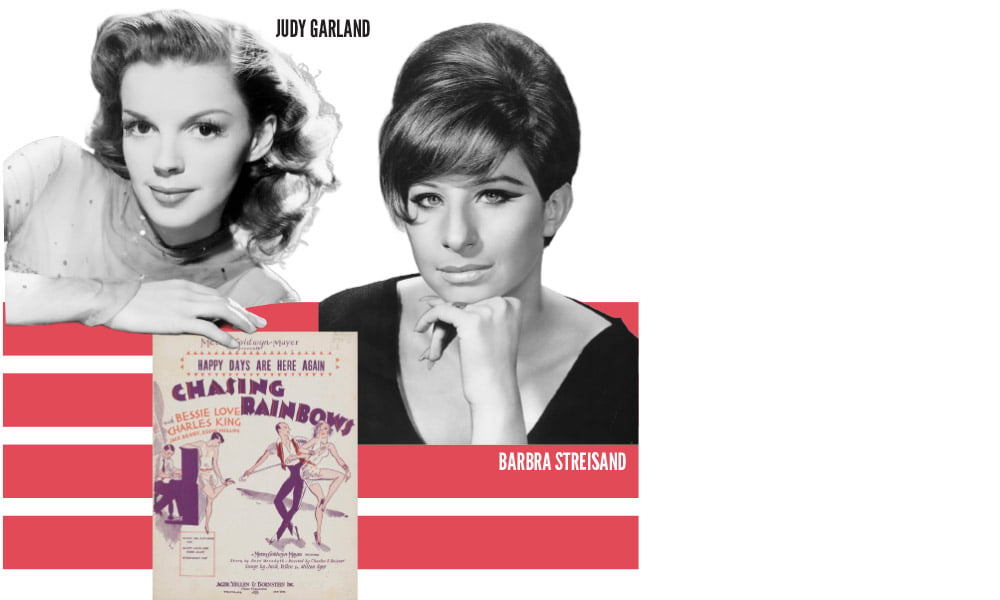
Recorded in 1929, “Happy Days Are Here Again” was featured in the 1930 film Chasing Rainbows and was FDR’s 1932 campaign song, used as a buoyant anthem of hope for Americans living through the Great Depression. My relationship to it is the amazing Judy Garland/Barbra Streisand medley performed on The Judy Garland Show in 1963. Garland is singing “Get Happy” (1930; music by Harold Arlen; lyrics by Ted Koehler), which was one of her signature songs, and Streisand sings “Happy Days.” It’s an iconic duet on broadcast television, where the legendary Judy is basically passing the torch to the young, belting superstar Barbra. Ager and Yellen’s declaration (“The skies above are clear again/So let’s sing a song of cheer again/Happy days are here again”) is up against, and combined with, Arlen and Koehler’s plea to forget your troubles and chase your cares away (“Shout hallelujah/Come on get happy/Get ready for the judgment day”). I’ve sung both sides of that duet and feel like it captures so many moments where people are up against hard times and finding it tough—but are still trying—to be happy.
—Julie Benko is an actress and singer who portrayed Fanny Brice in the Broadway revival of Funny Girl in 2022 and played the role of Emma Goldman in Ragtime earlier this year.
Listen to “Happy Days Are Here Again” here
BROTHER, CAN YOU SPARE A DIME?
Music by Jay Gorney; lyrics by Yip Harburg (1932)
Social justice is a central tenet of Judaism, and the Depression-era “Brother, Can You Spare a Dime?” brought that moral consciousness into American music. It was a new kind of popular tune, the first socially conscious American soul song, told from the point of view of a man who helped build the modern city, only to find himself standing outside the world he helped create.
Once I built a tower up to the sun
Brick and rivet and lime
Once I built a tower, now it’s done
Brother, can you spare a dime?
The song was written for the satirical Broadway musical review Americana and the melody was based on a Russian-Jewish lullaby. While I wouldn’t call it a hit in the usual sense, the song became known all over the country, which was notable because popular music was supposed to entertain, not hold up a mirror to the breadline. It became, in some ways, a model for other songs that were not afraid to speak about historical events and situations candidly—not just metaphorically. That was Yip Harburg’s gift: He made history singable without making it less true.
The American promise was that if you worked hard, built things, served the country and believed in the future, there would be a place for you. Then the system collapsed, and people who had done exactly what they were asked to do were treated as disposable. The man in the song is saying: I built the railroads. I built the towers. I fought the war. I believed in the promise. “Say, don’t you remember? They called me ‘Al.’” That’s the real crisis in the song. It isn’t simply that he is poor; it’s that he has been erased.
There is something deeply Jewish in that perspective—in speaking from the edge of society and asking the center to account for itself. It insists on memory. It refuses to let America forget the people who built the world around it.
Harburg grew up with the Gershwins and with second-generation Jews who went into songwriting. He had the gift, but at first he did not want to take the chance, so he became a businessman. He built up a very nice business, and then he lost it in the crash of 1929. He would later say that losing his appliance company was the best thing that ever happened to him. It forced him into the work he was meant to do. And because he had felt the ground give way, there is no condescension in “Brother, Can You Spare a Dime?” The man in the song is not a tragic prop. He is a builder, a soldier, a citizen, a believer.
That is why the song lasts. Beneath the politics and the Depression setting, there is a simple human cry: You knew me once, but do you know me now?—Ben Sidran
Listen to “Brother, Can You Spare A Dime?” here
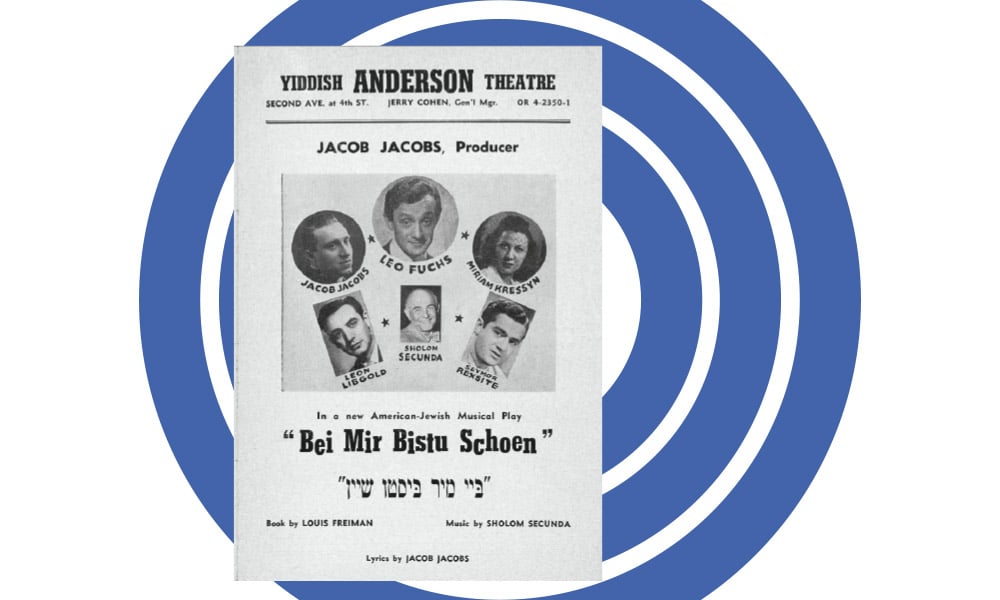
BEI MIR BISTU SHEIN (TO ME, YOU ARE BEAUTIFUL)
Music by Sholom Secunda; lyrics by Jacob Jacobs (1932)
Songwriting is a fickle enterprise. Some songs require hours of honing and revision, while others emerge in near finished form. Some songwriters pen dozens of hits, while others write one or two and fade away. So, when the song “Bei Mir Bistu Shein” was written for a 1932 Yiddish theater production, composer Sholom Secunda and lyricist Jacob Jacobs could not have foreseen its future—much less a life beyond the Yiddish stage—as one of America’s most popular songs and a metonym for American Jewish culture. Indeed, the song barely made it to the stage intact.
Its raison d’être was a show starring the comedic master Aaron Lebedeff, who didn’t like the song and demanded it be changed. But the writers held firm and convinced Lebedeff to sing it as written. Some accounts tell of a bet between Lebedeff and Secunda that if Lebedeff performed it as written and the song fell flat, they’d change it and do it his way. But the audience liked it so much that Lebedeff was called back for multiple encores.
Sheet music was printed and sold, but a few years later Secunda and Jacobs sold the rights—common practice at the time—to a publishing company for $30 (just over $700 today). Accounts vary as to what happened next, but the most common one holds that the song wound up on stage at the Apollo Theater after the Black singing duo Johnnie and George learned it at a hotel in the Catskill Mountains and put it in their act. Songwriter Sammy Kahn was there, saw the audience reveling in the song, and went to the publisher and bought the rights. He and his writing partner Saul Chapin wrote English lyrics that riffed on the song’s Yiddish title, which translates to “To Me, You Are Beautiful.”
The song was recorded in the fall of 1937 by The Andrews Sisters—at the time an unknown singing group—and made it onto the B-side of a 78 RPM record with George Gershwin’s “Nice Work If You Can Get It,” which was expected to be the main driver of sales. But “Bei Mir Bistu Shein” proved to be more popular, and the song made it onto radio stations around the world—including in Nazi Germany, where the Yiddish was mistaken for a German dialect. Stores everywhere sold out of copies. The American Society of Composers, Authors and Publishers deemed it the most popular song of 1938. Leading artists of the day lined up to record their own versions: Ella Fitzgerald, Judy Garland, Benny Goodman, Tommy Dorsey and many others.
Rights to the song reverted to Secunda and Jacobs in 1961, 28 years and $3 million later. It remains one of the most recorded songs of its era, and in 2008 it was added to the Library of Congress’s Recording Registry—one of 25 songs the institution recognizes annually to highlight the range and diversity of America’s recorded sound heritage. By any measure, “Bei Mir Bistu Shein” is a triumph of American Jewish music. But it is rarely done in Yiddish. Becoming the biggest hit of 1938 and history’s leading Yiddish theater crossover required a clever English lyric and a detour through Harlem.
—Jeff Janeczko is the curator of the Milken Archive of Jewish Music, which recently debuted its latest documentary film, Immigrant Songs: Yiddish Theater and the American Jewish Experience.
Listen to “Bei Mir Bistu Shein” here
SUMMERTIME
Music by George Gershwin; lyrics by DuBose Heyward (1935)
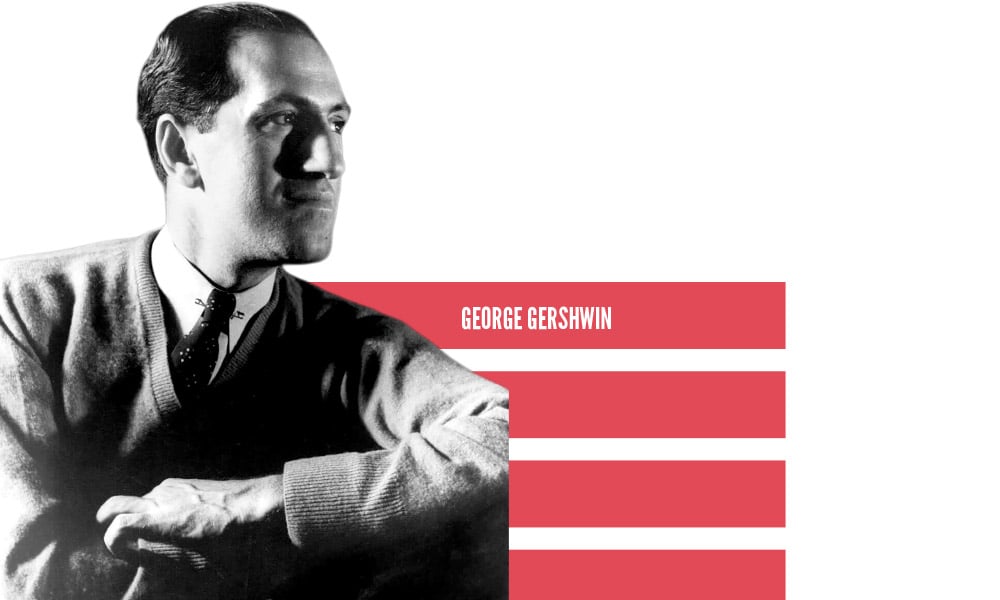
George Gershwin’s “Summertime” first appeared as part of Porgy and Bess, an all-Black “folk opera” that premiered on Broadway in 1935. Although neither he nor DuBose Heyward was Black, they were determined to present African American culture as authentically as possible. Gershwin spent time exploring Black communities in South Carolina in preparation for writing the score, including participating in religious services. “Summertime” owes a great deal to the African American spiritual tradition, especially to “Motherless Child” from the late 1800s (the shape of the first phrase, “O, sometimes I feel like a motherless child” is nearly identical to “Summertime, and the livin’ is easy”).
Musicians, scholars and critics have heard echoes of other traditions in the song. Musicologist Hans Keller felt it was closer to Czech composer Antonín Dvorák (who often mined rhythms and melodies from the folk music of Moravia and his native Bohemia) than to African American traditions, and film composer Bernard Herrmann heard Yiddish influences. Eubie Blake thought Gershwin had stolen the tune from Fats Waller.
Written as a dreamy lullaby that opens the opera, Heyward’s lyrics stand in stark contrast to what so many Americans were experiencing deep into the Great Depression.
Summertime, and the livin’ is easy
Fish are jumpin’ and the cotton is high
Oh, your daddy’s rich and your ma is good-lookin’
So hush little baby, don’t you cry.
As for the early reception of Porgy and Bess, most critics agreed that it lacked the authenticity the authors desired and that it was too long, even though they liked some of the music. Some in the Black press were disturbed by a white production team’s appropriation of Black culture and the show’s perpetuation of damaging stereotypes, even if they applauded the talented cast. Given the history of blackface entertainment in the United States—and Jews’ role in that history—their reaction was understandable.
Porgy and Bess closed after only 124 performances, and George Gershwin died in 1937. But the show was given new life by producer Cheryl Crawford, who (with Ira Gershwin and Heyward’s blessing) retooled the show so that it was closer to a Broadway musical than an opera. The Porgy and Bess that opened on Broadway in 1942 was a sensation, launching “Summertime” and other songs into the Broadway canon. A number of famous Black musicians, including Louis Armstrong, Ella Fitzgerald, Harry Belafonte and Lena Horne, released albums based on the music, with “Summertime” always playing a prominent role.
Any discussion of “Summertime” would be incomplete without Miles Davis’s landmark recording on his Porgy and Bess album from 1959. His timbral control and exquisite phrasing bring out the tune’s lyricism and grace in the opening chorus, while the harmonic progression forms the basis for his subtly expressive improvisation. Most scholars consider this track to be the epitome of “cool jazz,” a style Davis developed in response to the lightning-fast virtuosity of bebop. “Summertime” and the rest of Porgy and Bess allowed Davis to showcase the expressive capabilities of jazz performance, and it remains one of the most famous recordings in the jazz canon.
“Summertime” has been covered thousands of times—including Janis Joplin’s bluesy 1968 version—and sampled in Sublime’s 1997 song “Doin’ Time,” which Lana Del Rey covered in 2019.
—Naomi Graber is an associate professor of musicology at the University of Georgia.
STRANGE FRUIT
By Abel Meeropol (1939)
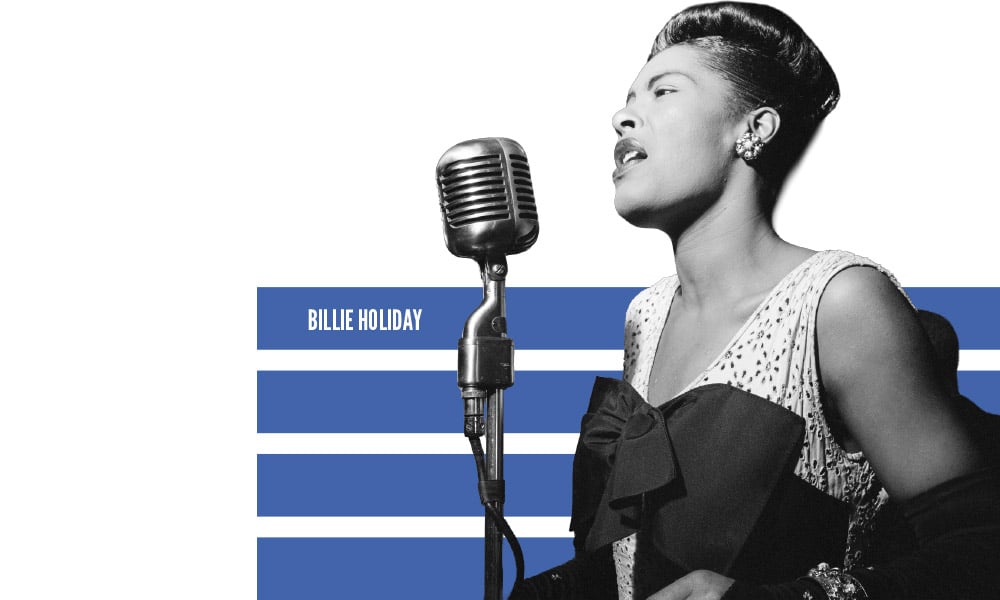
Abel Meeropol, a Jewish schoolteacher from the Bronx who wrote under the name Lewis Allan, published the poem “Bitter Fruit” in 1937 after seeing Lawrence Beitler’s haunting photograph of the 1930 lynching of Thomas Shipp and Abram Smith in Marion, Indiana. Two years later it was recorded as the song “Strange Fruit.” You can feel the photograph in the opening lyrics, which begin not with explanation but with an image:
Black bodies swinging in the Southern breeze
Strange fruit hanging from the poplar trees.
Meeropol was not the only Jewish voice responding to lynching at the time. Jewish writers in the Yiddish press were also publishing poems, essays and protest pieces about anti-Black violence in America. In other words, “Strange Fruit” did not emerge from nowhere. It grew out of a larger moral conversation.
Still, a song is not only written. It has to find the right room, and then the right voice. That room was Café Society in Greenwich Village, New York City’s first integrated nightclub. Its owner, Barney Josephson, created it so Black and white artists could work together onstage, and Black and white audiences could sit together to listen. That alone was radical.
There are different versions of exactly how “Strange Fruit” reached Billie Holiday. In one version, Josephson heard the song and asked Meeropol to play it for her. In another, Robert Gordon, who was directing Holiday’s show at Café Society, heard it at Madison Square Garden and brought it to her. Either way, the song’s path to Holiday ran through Café Society.
Holiday understood the danger of singing it. This was not just another number. This was a Black woman standing in front of integrated audiences and singing about lynching in America. Many club owners didn’t want her to do it. Some forbade it. Columbia, her label, wanted nothing to do with recording it. It was too dangerous for business.
So Holiday went to Milt Gabler, the Jewish owner of Commodore Records. Gabler understood that the song had to be recorded. As the story goes, he said something to the effect of: I don’t care if it makes a dime—we have to put this out. Columbia gave Holiday a one-session release, and Gabler recorded it.
At Café Society, Josephson made sure “Strange Fruit” always closed Holiday’s set. The waiters stopped serving. The room went dark except for a single spotlight on her face. There was no encore. Josephson wanted the audience to leave America’s first integrated nightclub with that song as the last sound, the last image, the last feeling they carried out into the night.
Ahmet Ertegun, the Turkish-born co-founder of Atlantic Records and one of the most important record men of the 20th century, later called “Strange Fruit” “a declaration of war” and “the beginning of the civil rights movement.” Time named it the Song of the Century. It forced lynching into American popular music, into the nightclub, into the record store, and into the ears of people who might have preferred not to know.
Holiday paid for that courage. Harry Anslinger, the racist head of the Federal Bureau of Narcotics, targeted her relentlessly. In 1947, she was arrested for narcotics possession and sent to prison. Afterward, she was denied the cabaret license she needed to perform in New York clubs. Even on her deathbed in 1959, federal agents came to her hospital room, arrested her for drug possession, handcuffed her to her hospital bed, and placed her under police guard. A judge later ordered the handcuffs removed, but Holiday remained under federal watch. Doctors had begun treating her with methadone, but under pressure from the federal narcotics agents guarding her room, the treatment was stopped. She died soon after.
Meeropol wrote the song. Josephson created the setting where it could be heard properly. Gabler made sure it was recorded when Columbia would not touch it. But Billie Holiday gave “Strange Fruit” its force. The song became inseparable from her not simply because she sang it, but because she kept singing it, even when club owners, record companies and, eventually, the government itself wanted to silence her. That is the extraordinary thing about this story: Three white Jewish men helped make it possible for one of the most important songs about the Black experience in America to reach the woman who could tell the truth inside it. Once Holiday sang it, it became hers forever.—Joe Alterman
Listen to “Strange Fruit” here
OVER THE RAINBOW
Music by Harold Arlen; lyrics by Yip Harburg (1939)
The MGM fantasy musical The Wizard of Oz opened in August 1939. Early in the film, a sepia-toned 16-year-old Judy Garland, as Dorothy Gale, sang the yearning ballad “Over the Rainbow” to her pet terrier, Toto. A new standard was born.
Written by composer Harold Arlen and lyricist Yip Harburg, the song became Garland’s signature throughout her career. It later evolved into a gay anthem and, with more than 1,770 covers, became one of the rare songs known and loved by almost everyone. It is the classic “I want” song, expressing an aching desire for a better life and a better world.
Arlen wrote the music first—reportedly after much struggle and then, in a sudden burst of inspiration, as the final song he composed for the film. Initially, Harburg had difficulty finding the right lyric. He thought the song too bombastic and florid for a Kansas schoolgirl. The two men took the song to their friend Ira Gershwin, who suggested that Arlen play it more simply, stripping away the embellishments he had been using. That convinced Harburg.
From the beginning, Harburg had decided Dorothy would sing about rainbows, which would symbolize the only vivid colors she would know in her drab and dusty world. It was a world that Americans who’d suffered through the Dust Bowl could well relate to. A lifelong socialist, Harburg saw a metaphor for prosperity and income equality “over the rainbow.” (He was later investigated by The House Committee on Un-American Activities and blacklisted from 1950-1962.)
The music itself is as close to perfect as a popular song can be. It begins with an octave leap that embodies Dorothy’s longing. The melody then returns to its bass—or home—note before leaping again, this time reaching a step lower. It returns once more and rises again, each ascent falling slightly short, creating an aching pattern of aspiration and disappointment. The bridge rocks gently back and forth like a child’s lullaby, offering a tender contrast to the yearning verse. Finally, in the closing tag, the melody reaches upward once again and at last attains the hoped-for high note.
Among the Arlen papers at the Library of Congress is a brief lyric sketch in Harburg’s hand: five lines torn from the bottom of a yellow pad. Those lines offer a revealing glimpse into the song’s evolution. For what eventually became “Someday I’ll wish upon a star/And wake up where the clouds are far behind me,” Harburg first wrote the more awkward and ominous “Someday I’ll wish upon a star/+ wake + find the darkness far behind me.”
Shockingly, MGM executives wanted to cut “Over the Rainbow” from the film, believing it slowed the action and was too dark and sophisticated for Dorothy’s character. After what amounted to a mutiny by many involved in the production, the studio relented and restored the song.
It went on to win the Academy Award for Best Original Song, and its legacy has only grown since. “Over the Rainbow” has been recorded in virtually every imaginable style and instrumentation, from ukuleles and banjos to full symphony orchestras. It has become a staple of choruses and has been performed by singers across every genre, including jazz, opera, country and rock.
—Mark Eden Horowitz is a senior music specialist at the Library of Congress and the author of Sondheim on Music and The Letters of Oscar Hammerstein II.
Listen to “Over The Rainbow” here
LINCOLN PORTRAIT
By Aaron Copland (1942)
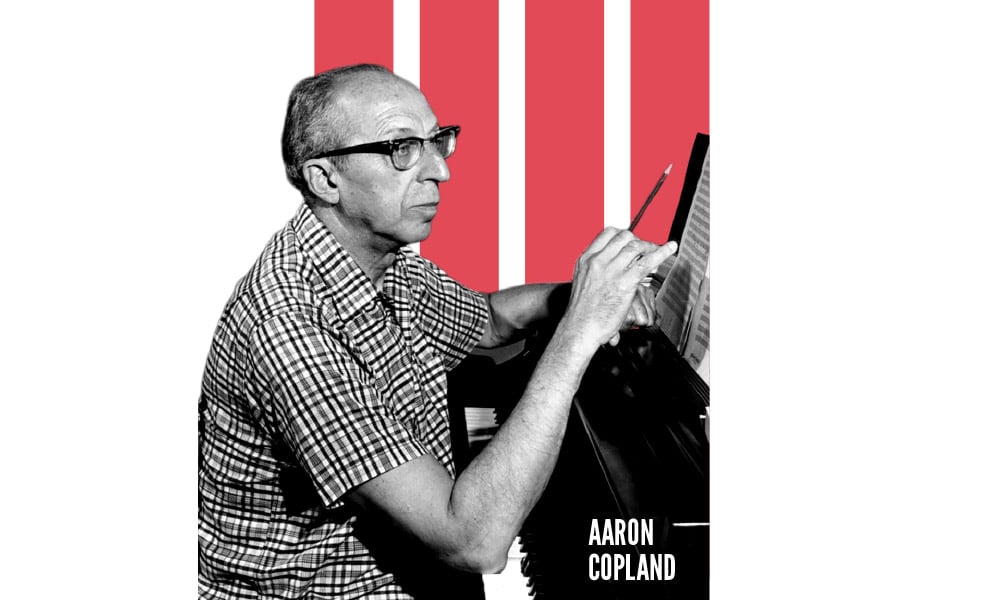
In the wake of Pearl Harbor, conductor Andre Kostelanetz commissioned three composers to write musical portraits of eminent Americans in order to boost American morale and celebrate democracy as World War II raged on. After initially choosing poet Walt Whitman, Aaron Copland selected Abraham Lincoln. His patriotic orchestral “Lincoln Portrait” incorporates the original American folk songs “Camptown Races” and “On Springfield Mountain,” along with spoken excerpts of Lincoln’s writings and speeches.
“Lincoln Portrait” premiered with the Cincinnati Symphony in 1942 and has since been performed countless times around the country. Orchestras enjoy playing it, because the music itself is powerful, and then when you add the words, it’s even more moving. And at 15-18 minutes, it’s a great opener for a concert.
The impressive roster of people who’ve performed the narration—famous singers, poets, presidents and other politicians, academics, actors and athletes, even an astronaut and a sportscaster—also speaks to its genius. In 1980, on his 80th birthday, Copland himself narrated, with Leonard Bernstein conducting the National Symphony Orchestra at the Kennedy Center in Washington, DC.
Copland’s other symphonic works, such as “Appalachian Spring,” are played all around the world, but “Lincoln Portrait” is especially American; it has an open feel to it, with Copland’s use of certain intervals and open fifths. He had an affinity for the American “Wild” West, evidenced in scores like Billy the Kid (1938) and Rodeo (1942). He was often asked how a Jew from Brooklyn could write such good “cowboy” music and his reply was, “All American boys love the West!” You can definitely hear some of that love in “Lincoln Portrait.”
The spoken part begins: “‘Fellow citizens, we cannot escape history.’ That is what he said. That is what Abraham Lincoln said.” The refrain, “That is what he said,” repeats as the narrator recites different Lincoln quotes. From the Lincoln-Douglas debates he evokes the “eternal struggle between right and wrong,” saying of the latter, “Whether from the mouth of a king who seeks to bestride the people of his own nation and live by the fruit of their labor, or from one race of men as an apology for enslaving another race, it is the same tyrannical principle.” The piece ends with the last line of the Gettysburg Address, in which Lincoln resolves “that these dead shall not have died in vain—that this nation, under God, shall have a new birth of freedom—and that government of the people, by the people, for the people, shall not perish from the earth.”
Copland’s portrait is about history and humanity. It’s for everyone, no matter what side of the political spectrum people are on, what their beliefs are, what their religion is. That’s why this piece endures, no matter what’s happening in this country, or around the world.
—Nurit Bar-Josef is the concertmaster of the National Symphony Orchestra, which performed “Lincoln Portrait” at the Kennedy Center in June.
Listen to “Lincoln Portrait” here
OKLAHOMA
Music by Richard Rodgers; lyrics by Oscar Hammerstein II (1943)
The opening song of the Broadway musical Oklahoma! is “Oh, What a Beautiful Mornin’.” And you can imagine that when the curtain went up on opening night, the audience gasped, because there was no chorus line, there were no dancing girls. There was just an old woman at a butter churn, and then a guy rides up on his horse singing about how beautiful the morning is. And it was a waltz! That gave the opening a nice forward motion, sunny and sincerely optimistic, and very different from anything Broadway audiences had seen before.
Scholars debate whether Oklahoma! was the first truly “integrated” musical—that is, employing lyrics, music, dialogue and dance to work together to tell a story and develop characters. If it wasn’t the very first, it was certainly the most successful to that date, and it ran for five years—an unheard-of run at the time.
The play and the title song that closes the show are really a pat on America’s back. When the song “Oklahoma” (which, for some reason, doesn’t carry the exclamation point) ends with “Oklahoma, O.K.,” the sentiment is, Gosh darn it, you know, we’re okay. America is doing fine. It was an assertion the country needed, that the military people needed, because it was 1943, and we were smack-dab in the middle of American participation in World War II.
One thing that made the show such a sensation were the large numbers of servicemen and women who came to see it. Many of them were away from home—stationed in New York City or on leave there—and the America that was reflected in the show was the America they missed, that they thought of as home. They carried those songs and the news of the show back home and in letters to their folks, so it became a national phenomenon. There were no Tony Awards then, but the show won a Pulitzer, only the second musical to have done so.
The music by Richard Rodgers matches Hammerstein’s lyrics in affirming the promise of America and the goodness of American life, with wide intervals between notes evoking wide-open spaces. Early western explorers, such as those on the Lewis & Clark expedition, had seen vast meadows before, but with Oklahoma!, especially the title song, audiences experienced a vision of the Great Plains—“where the wind comes sweepin’.” They envisioned prairies that stretched for miles and miles in lyrics like “We know we belong to the land/And the land we belong to is grand!” The show ends with “Oklahoma” and everybody yelling “Yippee!” and throwing their hats in the air.
There is some darkness in this incredibly sunny musical in the character of Jud, which gives it depth and staying power. Jud’s the villain of the piece but also sort of an underdog, and there’s some empathy for him evoked by the song “Lonely Room.” But most of all, Rodgers and Hammerstein wanted optimism. They wanted to be life-affirming, to be America-affirming.
—Murray Horwitz is a playwright, lyricist, NPR broadcaster and arts administrator.
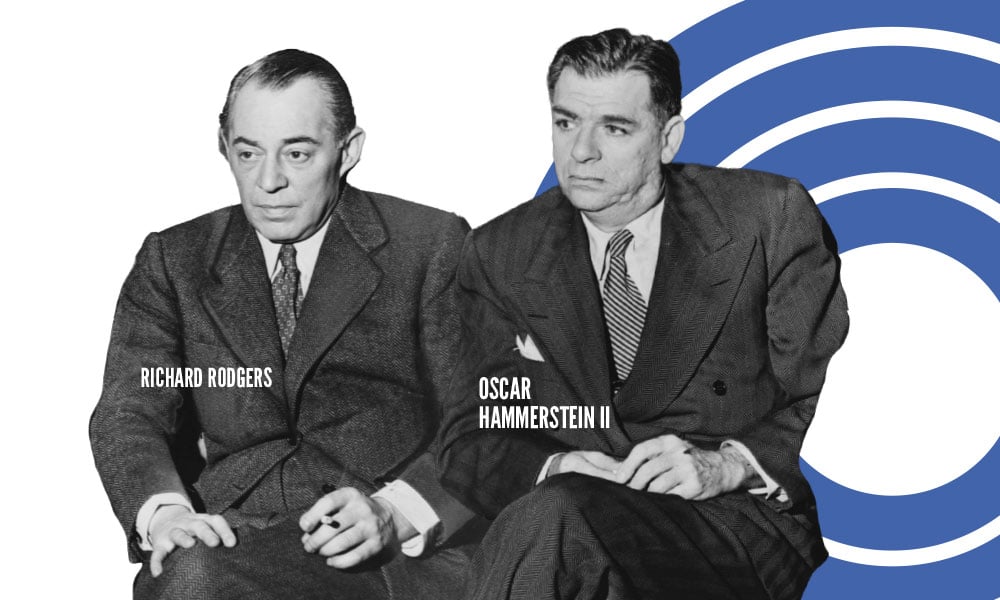
SOMEWHERE
Music by Leonard Bernstein; lyrics by Stephen Sondheim (1957)
As we celebrate USA 250, it’s impossible to deny that we are at a contentious moment in our history. However, this is not the first time Americans have reckoned with race, wealth disparity, immigration and the rest.
West Side Story is a musical about the immigrant experience in 1950s New York viewed through the lens of two rival gangs: the Jets (white, settled Americans) and the Sharks (Puerto Ricans, recently arrived). The song “Somewhere,” appearing in Act II, encapsulates the universal immigrant experience of dreaming of a place where “Peace and quiet and open air/Wait for us, somewhere.” It expresses the aspiration to escape persecution and find a place that offers freedom.
The duality of celebrating a newfound home while mourning the loss of the good things left behind animates another Bernstein/Sondheim classic from the show, “America.” It’s also about the struggles of assimilation and the cost of starting over: “I like to be in America, OK by me in America, everything free in America, for a small fee in Amer-i-ca!”
I played the role of “Anybodys” (a “tomboy” who desperately wants to join the Jets) on the national tour of a 2009 Broadway revival of West Side Story. Anybodys sang “Somewhere” in that production, which was an interesting choice because in the world of the play, Anybodys, a Jet wannabe and an outcast, belongs nowhere. To have this character sing “There’s a place for us/Somewhere a place for us” renders the yearning for inclusion and belonging all the more powerful. These are themes that are intrinsic to the human condition, of course, and connected to the promise of America.
The original creative team of West Side Story was Jewish: Arthur Laurents (book writer), Jerome Robbins (choreographer), along with Sondheim and Bernstein. Each of these men was the child or grandchild of Jews who left their home in Europe with the hope of a better life in America. Though these artists were not immigrants themselves, the experience of their forbears inevitably made its way into their art. Case in point: West Side Story was originally conceived as East Side Story and was going to be about Jewish and Catholic gangs on the Lower East Side. The gangs and setting changed when Laurents joined the creative team. He felt that the subject of Jews vs. Catholics had been done before and wanted to write something fresher.
Art is a mirror of society, and in 1957 when West Side Story was written, America was reckoning with the civil rights movement, the Cold War, McCarthyism and labor and economic battles. Americans were having so many of the same conversations we are having right now. However, immigrants today are facing unprecedented challenges in the pursuit of the life, liberty and happiness that America was founded upon 250 years ago. Songs like “Somewhere” and “America” are reminders of how precious and challenging it can be to seek a better life.
—Alexandra Frohlinger is a Manhattan-based actor, singer, dancer, stunt performer and dedicated arts educator.
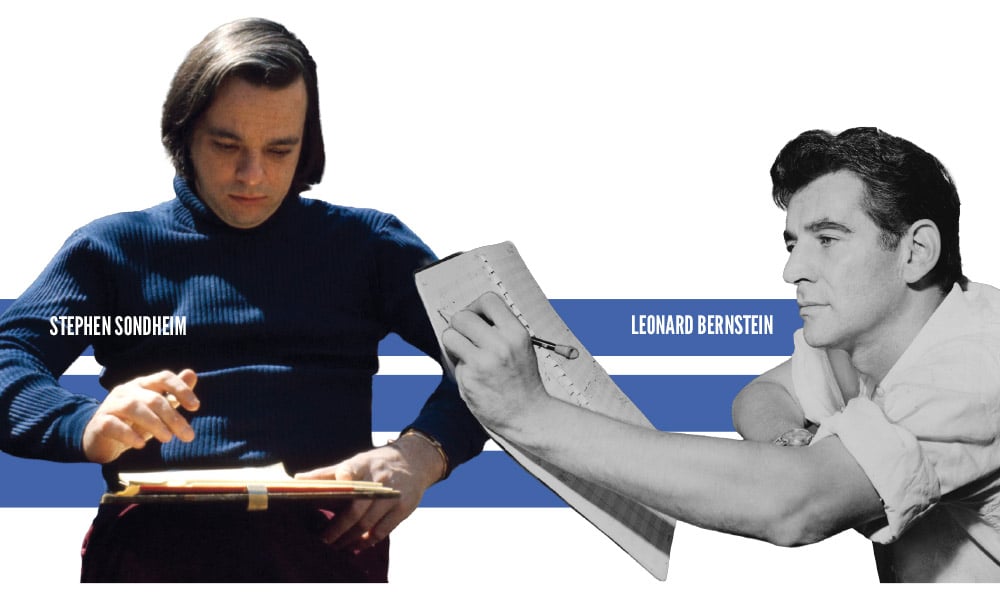
HIGHWAY 61 REVISITED
by Bob Dylan (1965)
“Highway 61 Revisited” is many things, among them a dark gangster comedy about hucksterism run amok in an empty American landscape. In this song we meet a strange cast of characters: Georgia Sam, Poor Howard, Mack the Finger, Louie the King, the Roving Gambler, the Promoter, the Fifth Daughter, the First Father, the Second Mother, and the Seventh Son, a mystical figure who appears across cultures and continents gifted with an array of powers ranging from the ability to cast and cure evil hexes to divination and second sight. They meet up to engage in the sort of intrigue that really shouldn’t be talked about in the daylight. They wheel, they deal, they set up a roadside stand so they can sell “40 red, white and blue shoestrings and a thousand telephones that don’t ring,” and they build some bleachers out in the sun, no doubt to ensure that there’s a place for the audience to sit when their loose talk about starting the next World War catches fire.
Clearly this is a dysfunctional America. (As it was, so it is.) The song doesn’t celebrate this. It doesn’t expose it, criticize it, or comment on it. It looks at the dysfunction and it laughs. Perhaps that’s the most terrifying thing in this litany of terrors. It’s like a Marx Brothers movie about the apocalypse.
—Joe Levy is a music journalist and the former editor of Billboard and Rolling Stone magazines. Learn more about how the real Highway 61, which runs from New Orleans up to Minnesota, ties north and south together and Levy’s take on the song in the MomentLive! interview at momentmag.com/soundtrack
Listen to “Highway 61 Revisited” here
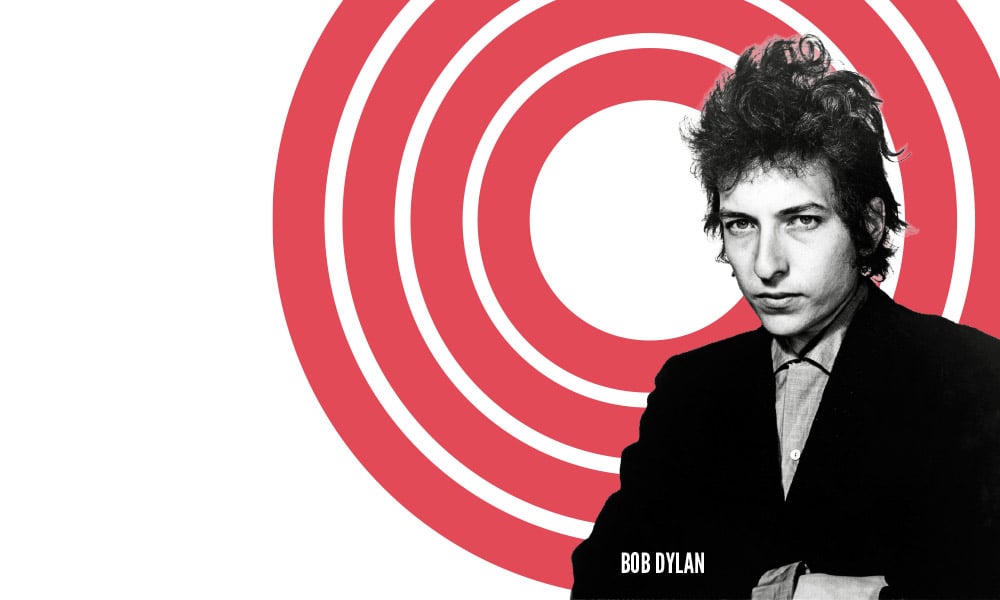
WHAT A WONDERFUL WORLD
by George David Weiss and Bob Thiele (1967)
The year was 1967. The Vietnam War raged on. There were riots in the streets, political turmoil, the struggle for civil rights. The nation was still reeling from the assassination of President John F. Kennedy.
It was in this environment of uncertainty and unrest that record producer Bob Thiele had an idea for a song that could help unify the fractured country and provide a sense of hope. He also knew that there was only one artist who could deliver such a message and make people believe it: Louis Armstrong.
Thiele tapped professional songwriter George David Weiss (“The Lion Sleeps Tonight,” “Can’t Help Falling in Love”) and gave him the concept. The result was “What a Wonderful World.” Thiele eventually got the song to Armstrong, who connected with it on a much more personal level, noting that it brought to mind his beloved Queens neighborhood (where he lived from 1943 until his death in 1971).
I see friends shaking hands
Saying, “How do you do?”
They’re really saying
I love you.
Thiele commissioned an arrangement by Tommy Goodman and assembled a star-studded studio orchestra, complete with angelic choir, to back up Armstrong’s singing. There was one problem, however: Thiele didn’t run the idea by his boss, ABC-Paramount Records President Larry Newton, who was expecting something more like Armstrong’s peppy 1964 chart-topper “Hello, Dolly!” (written in 1963 by Jerry Herman). Newton reportedly blew his top when he saw all the musicians assembled to record “What a Wonderful World,” and as the recording progressed he had to be physically restrained from entering the studio, a deeply ironic visual as Armstrong recorded an anthem of peace and harmony just a few feet away.
When the single was released in September 1967, it received good reviews in the music trades, but Newton sabotaged the release by curtailing its radio airplay and limiting its publicity, causing it to sink without a trace in the United States. It caught on overseas, however, and in April 1968, “What a Wonderful World” raced past the Beatles, the Rolling Stones and others to become a No. 1 hit in England.
Some cynical listeners rolled their eyes at the message inherent in “What a Wonderful World,” such as John S. Wilson of The New York Times, who called it “a dreary bit of sentimental claptrap.” Armstrong remade the song in 1970 with a spoken word intro:
Some of you young folks been saying to me, “Hey Pops, what you mean ‘What a wonderful world’? How about all them wars all over the place? You call them wonderful? And how about hunger and pollution? That ain’t so wonderful either.” Well, how about listening to old Pops for a minute. Seems to me, it ain’t the world that’s so bad but what we’re doin’ to it. And all I’m saying is, see, what a wonderful world it would be if only we’d give it a chance. Love, baby, love. That’s the secret.
“What a Wonderful World” gained a new audience in 1987 when it appeared in the film Good Morning, Vietnam, in which director Barry Levinson used it to score an emotional montage depicting the war’s brutality. In 2023, six decades after it was written by Weiss and Thiele and recorded by Armstrong, the song was certified 5x Platinum for selling over five million copies.
It’s now 2026. War is raging around the world, there’s violence in American streets and a mood of constant tension and uncertainty fills the air. We still need a message of unity and hope. We still need “What a Wonderful World.”
—Ricky Riccardi is director of research collections for the Louis Armstrong House Museum and the author of two books on Armstrong.
Listen to “What A Wonderful World” here
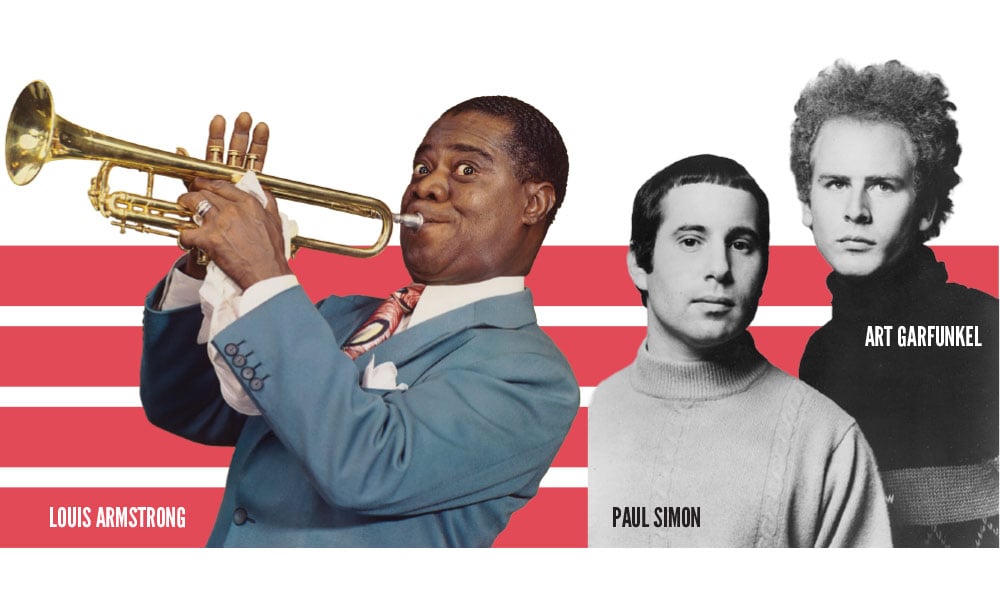
BRIDGE OVER TROUBLED WATER
By Paul Simon (1970)
Paul Simon wrote this song in the spring of 1969, and Simon & Garfunkel recorded it the following year, with Art Garfunkel handling the vocals. Simon credited the Swan Silvertones, a gospel group from the South whose record he was listening to at the time, with the title image. “I’ll be your bridge over deep water/If you trust in my name,” their line went.
When “Bridge Over Troubled Water” came out in 1970, Americans had just closed out a decade filled with some of the most “troubled waters” our nation had ever known: multiple assassinations; America’s entry into the deadly and costly war in Vietnam (which was ongoing); and riots in the streets of Los Angeles, DC, and at the Democratic National Convention in Chicago. The 1960s had also brought the Civil Rights Act, the Voting Rights Act and fair housing legislation. Woodstock and the moon landing were just around the corner when Simon penned the song. Standing at the cusp of a new decade, he recognized the possibilities and the need for a bridge, not just to the next decade, but to a renewed sense of wholeness.
When you’re weary, feeling small
When tears are in your eyes, I will dry them all
I’m on your side, oh, when times get rough
And friends just can’t be found
Like a bridge over troubled water
I will lay me down.
On November 30, 1969, CBS aired the television special Simon & Garfunkel: Songs of America. This was the eve of the very first Vietnam draft lottery, broadcast live on TV and radio. (I was number 11 in the dreaded draw.) The special featured Simon & Garfunkel’s hit songs and showed the duo in the studio and on tour. It also included footage of decaying housing projects, bloodied antiwar protesters and other scenes of discord. This was several months before “Bridge Over Troubled Water” was officially released, but the song was in there, accompanied by a montage of John and Robert Kennedy and Martin Luther King Jr. Apparently, Simon had told the producer that he wanted the show to feel like a home movie depicting the state of the nation as he saw it.
Songs of America was criticized as opening a wound that needed to be dressed and healed. But “Bridge Over Troubled Water” endured. Simon declared it his greatest song. It was indeed the duo’s biggest hit, and has been covered by hundreds of famous performers, including Aretha Franklin and Elvis Presley. I hear people sing it at karaoke and in jam sessions, and there is a sincerity in their voice. You can see it in their eyes. Music is a bridge.
There’s another type of bridge common in Simon’s songs, where the individual’s existential experience intersects with their ideals. In “America” (1972), two young lovers travel cross-country by bus to “look for America.”
“Kathy, I’m lost,” I said, though I knew she was sleeping
I’m empty and aching and I don’t know why
Counting the cars on the New Jersey Turnpike
They’ve all come to look for America.
The narrator’s melancholy mixes with wanderlust, widening to include everyone out on the American highway searching for opportunity or perhaps chasing an ideal.
—Mike Stein is emeritus cantor of Hamakom LA and was in the original Broadway cast of Jesus Christ Superstar.
Listen to “Bridge Over Troubled Water” here
YOU’VE GOT A FRIEND
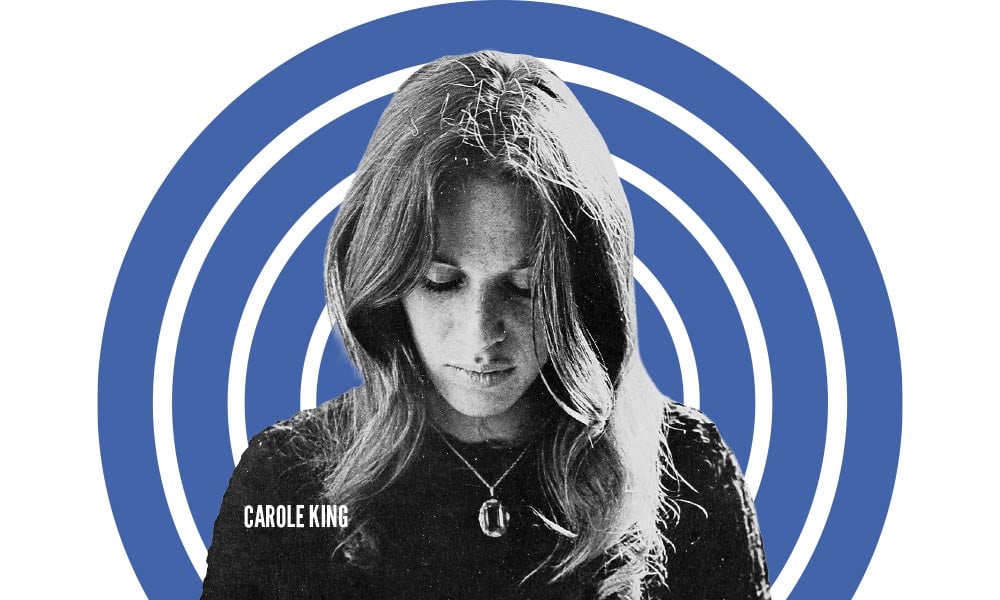
By Carole King (1971)
To some degree, Carole King wrote this song in response to her dear friend James Taylor’s song “Fire and Rain,” in which he laments the death of someone close to him. The message of friendship and loyalty in King’s song inspires people, and it’s emblematic of the dynamic between her and Taylor.
In fact, Taylor recorded “You’ve Got a Friend” first (he won a Grammy for Best Male Pop Vocal Performance and she won for Song of the Year). King had written it and played it for a few people, who didn’t have the strongest reaction. She later played it during a sound check for a concert she was doing with Taylor. He and his manager were blown away. Taylor asked if he could record it, and she said yes. Only later did it become her signature.
King had come out of the Brill Building era, which gets its name from the building in Midtown Manhattan where music was created in an almost factory-like setting, with lyricists, composers, producers and distributors each contributing to the creation of a song. It was here that King and her first husband Gerry Goffin collaborated on a slew of American hits in the 1960s, including “Will You Love Me Tomorrow,” “The Loco-Motion,” “Up on the Roof” and “(You Make Me Feel Like) A Natural Woman.” She later moved to Laurel Canyon in California, where she found something closer to a commune of artists who were performing their own songs rather than only writing for someone else. A master at melody, King created chords that gave her music depth and texture. There’s even one that musicians call the “Carole King chord.”
“You’ve Got a Friend” was written in the aftermath of King’s painful divorce from Goffin, who’d had an extramarital affair (which even produced a child) and suffered from bipolar disease. Her parents had also had a rather rocky relationship. Not to psychoanalyze too much, but you can see a darkness in this section of the song:
Ain’t it good to know that you’ve got a friend
When people can be so cold
They’ll hurt you, and desert you
And take your soul if you let them…
The song’s reference to the pain relationships can bring surely reverberated along with the affirming importance of friendship. (“Winter, spring, summer or fall/All you’ve got to do is call/And I’ll be there.”) King often describes love and loss and despair and confusion in her songs, but she more often ends with something heartwarming, which was a real balm to the American soul in 1971. Other singer-songwriters were talking about social upheaval, and here she was extolling friendship on an individual level, but also on a societal level. It was important and even countercultural.
—Jane Eisner is a journalist and former editor-in-chief of The Forward. Her latest book is Carole King: She Made the Earth Move.
Listen to “You've Got A Friend” here
I AM WOMAN
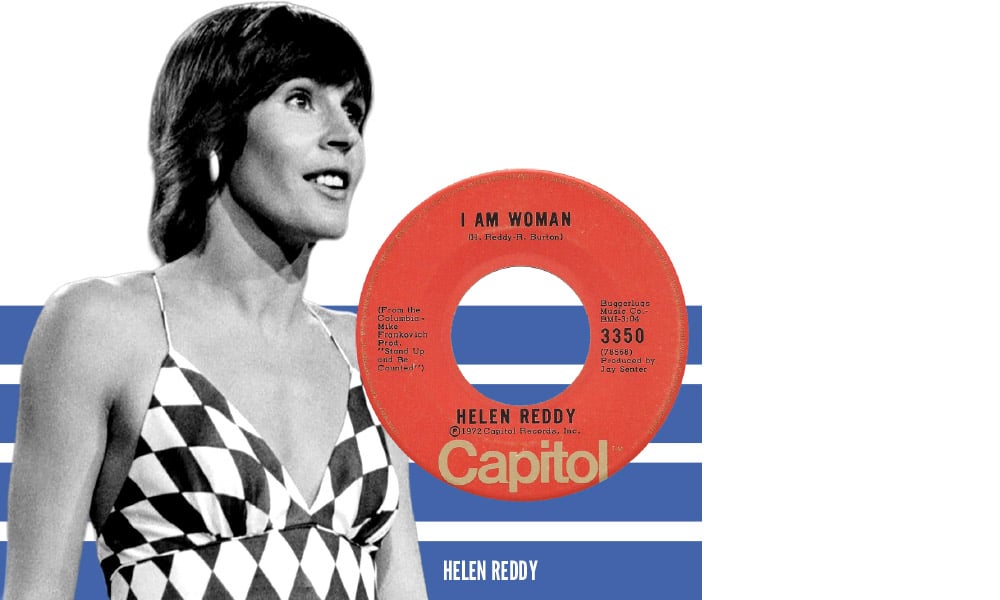
Music by Ray Burton; Lyrics by Helen Reddy (1972)
I grew up not being allowed to listen to anything other than Jewish or classical music, but I do remember Helen Reddy’s “I Am Woman,” which came out at a time when the women’s movement was gaining strength. I thought it was a little corny, but I appreciated it. (The song that I liked perhaps even more was Lesley Gore’s “You Don’t Own Me.”)
“I Am Woman” was both a protest song and a song of affirmation. It came at an important cultural moment. It was a time when we were transitioning very rapidly from women facing a certain amount of scorn or pity if they weren’t married by the time they were 24, a time when a woman couldn’t get a credit card or a mortgage unless her husband co-signed. I remember men would say things to me like, “Well, I don’t want my child going to daycare, not my child.” Or, “I want my children breastfed for three years,” as if they had the right to dictate without taking into consideration what I might like to do with my life. When I was in graduate school, there was a male professor who invited all the male graduate students for lunch, for coffee and to his home for dinner. I was never included as the only woman in the cohort. “I am woman, hear me roar,” Reddy sang, “In numbers too big to ignore.” I often felt like roaring.
What did I think was corny about the song? I guess simply that one would need to say, “I am strong, invincible. I am woman.” Why has it held up? Because we still don’t have the kind of respect and equality that we would like to have and that we should have.
For example, there have been stories about the sexual harassment that women have had to endure in the U.S. Congress. Last year, Sarah Emhoff and I published The Woman Question in Jewish Studies about women’s experiences being in the field, which included some horrific stories. The problem isn’t limited to Jews or to America, obviously, but I think we need a national reckoning around attitudes toward women and how men construct their masculinity, especially in the workplace. I hope that this song can still be heard and help motivate us to think more deeply about this problem.
—Susannah Heschel is an author and professor of Jewish Studies at Dartmouth College.
FREE TO BE…YOU AND ME
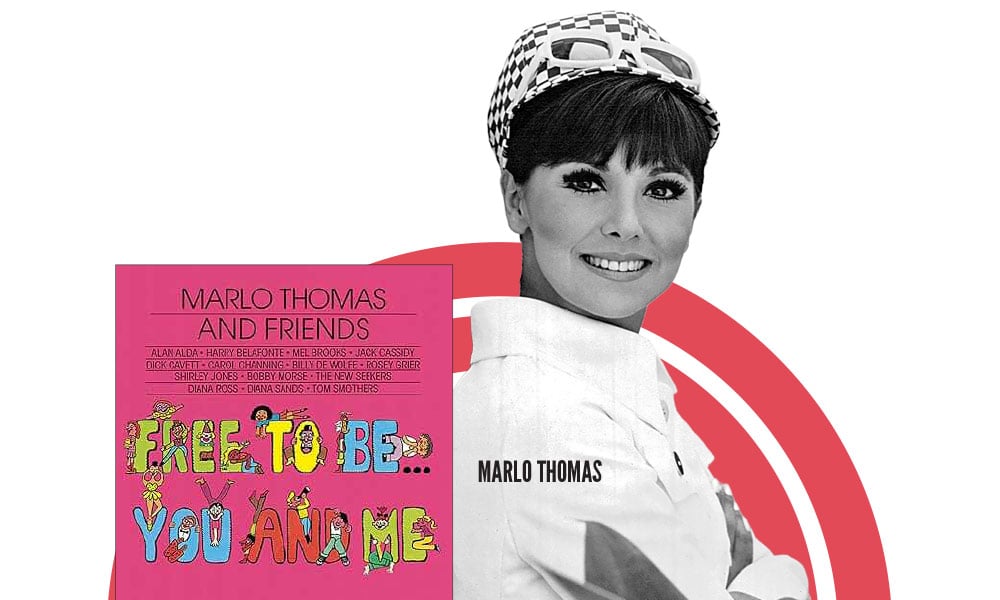
Music by Stephen J. Lawrence; lyrics by Bruce Hart (1972)
Freedom is one of our nation’s foundational values, but when the song “Free to Be…You and Me” was written, Americans’ public and private lives were still being policed by rigid gender norms, in pink and blue ghettos of outdated assumptions about the “right way” to be a girl or boy, a man or woman. Parents, schools, commercials, children’s books, toys, games and TV shows were brainwashing kids into sex-typed activities, behavior and careers.
That was the world into which actress Marlo Thomas and the Ms. Foundation for Women introduced the stereotype-shattering 1972 record album that both heralded and popularized a life-enhancing shift in American culture, and proclaimed everyone’s freedom to become their best selves. Its eponymous song, “Free to Be…You and Me,” is the opening track.
There’s a land that I see
Where the children are free
And I say it ain’t far
To this land from where we are.
…Every boy in this land
Grows to be his own man
In this land, every girl
Grows to be her own woman.
As editorial consultant on Free to Be…You and Me, I played a small part in actualizing Marlo’s vision as she corralled dozens of her famous friends to contribute their talents to the project. Writers such as Judy Blume, Shel Silverstein, Carl Reiner, Carol Hall and Sheldon Harnick; actors Dustin Hoffman, Alan Alda, Cicely Tyson, Mel Brooks and Carol Channing; and singers like Harry Belafonte, Dionne Warwick, Roberta Flack, Kris Kristofferson and Rosey Grier made real her unique concept—a nonsexist, multicultural family entertainment.
Without a shred of preachiness, the album delighted children and made grownups laugh. Kids memorized it in their classrooms and bedrooms, played it at birthday parties and b’nai mitzvah, playacted its stories. Adults listened to it and sang it in the shower long after they’d outgrown “Rubber Duckie.”
Free to Be became a gold record, a bestselling book, and an award-winning TV special because of its quality, but also because Americans in the 1970s were hungry for change and open to its message.
The title song is emblematic of the freedom theme, while the rest of the album animates and particularizes freedom in song and story. For example, “Parents Are People” (written by Carol Hall; performed by Marlo and Harry Belafonte) reminds children that the moms and dads who love them also have lives of their own and should be able to live them fully. “William’s Doll” (lyrics by Sheldon Harnick; performed by Marlo and Alan Alda), is about a little boy who wants a doll to play with, love and care for, but he gets teased for it and keeps receiving “boy” gifts—bat, ball, mitt, marbles—that don’t interest him at all. I’ve been with Marlo many times when an older man recognizes her and stops her on the street, emotes with the elation of a child, and thanks Marlo for Free to Be, then breaks into that song: “William wants a dah-ahl, William wants a dah-ahl/Cause someday he is gonna be a fa-ther, too.” It always makes me well up.
The pursuit of happiness is an exhilarating hike, but it dies at the trailhead without freedom and equality. The past 60 years of feminist struggle, organizing and activism have opened many doors that were closed to my generation. But power is never surrendered without a fight, and those wedded to hierarchy and threatened by equality continue to oppose and erode the progress gained by women and men.
My association with Free to Be…You and Me has always made me proud. My three children were raised on its values, as were my six grandchildren. It played a key role in making them feel free to become who they are and to move toward wherever they wish to be.
—Letty Cottin Pogrebin is the author of 12 books, most recently Shanda: A Memoir of Shame and Secrecy, and a founding editor of Ms. magazine.
Listen to “Free To Be...You and Me” here
TIE A YELLOW RIBBON ROUND THE OLE OAK TREE
by Irwin Levine and L. Russell Brown (1973)
I knew Irwin Levine, and Larry [L. Russell] Brown is one of my dearest friends. And I’ve known Tony Orlando, who sang the original version of the song, from when he was a record executive at April-Blackwood Music, where I was signed as a staff songwriter back in the 1960s.
“Tie a Yellow Ribbon Round the Ole Oak Tree” has both a catchy melody and a strong lyric idea. Melodically, it’s a traditional pop song in the manner of the 1920s or ’30s. The story is about a guy returning home from prison after three years who’s written to his love that if she still wants him, she should tie a yellow ribbon around an oak tree he’ll be passing.
If I don’t see a ribbon ’round the ole oak tree
I’ll stay on the bus, forget about us
Put the blame on me…
You could say it’s a love song, but it also taps into themes of wanting to belong, of seeking home. The word “home” is filled with emotion for most people. What does home mean? It’s a great starting point for a song. A return is also a great thing.
Larry was inspired by a story he read in Reader’s Digest called “Going Home” by Peter Hamill, which told a very similar tale (in his, it was a yellow kerchief). Hamill himself had been inspired by a story someone had told him, but he filed an infringement case against Larry and Irwin, which was dismissed after archival versions of the folklore tale surfaced. There’s also an old marching tune, copyrighted by George A. Norton in 1917 with the title “’Round Her Neck She Wears a Yeller Ribbon (for Her Lover Who Is Fur, Fur Away).” It’s possible a later version of that song, which appeared in the John Wayne movie She Wore a Yellow Ribbon, contributed to the idea of a yellow ribbon symbolizing longing for a loved one serving in the military. But 1973’s “Tie a Yellow Ribbon” was about an ex-con.
Regardless, it connected so well with guys who were coming home from Vietnam, facing the antiwar movement and not being welcomed with public pride. Then, in 1980 during the Iran hostage crisis, the wife of one of the people being held in the U.S. embassy in Tehran tied a big yellow ribbon around the oak tree in front of her Maryland home. It caught on, and people started tying yellow ribbons around trees all over to show solidarity, and it became a symbol for soldiers missing in action and POWs. During the Gulf War, yellow ribbon lapel pins and stickers were part of the “support the troops” messaging and have since been used for various health awareness campaigns.
Who would have guessed that people would have taken this song and applied it in so many different ways? That’s the magic in a great song.
It’s also universal—“Yellow Ribbon” reached No. 1 in ten different countries and is one of those songs with hundreds of covers, including by Bing Crosby, Frank Sinatra, Perry Como and Dean Martin. It’s a melody that cannot be denied—it could have been about cake and ice cream with that melody—but the story it tells, that’s what took it over the top.
—Billy Vera is a singer, songwriter, actor, author and music historian.
Listen to “Tie A Yellow Ribbon Round The Ole Oak Tree” here
SANTA FE
by Jonathan David Larson (1996)
“Santa Fe” is a quintessentially American song from Rent, the Broadway rock musical that reimagines the opera La bohème in the AIDS-era East Village of New York City. In “Santa Fe,” three main characters—Angel, a street musician living with AIDS; Tom Collins, an anarchist NYU professor; and Mark, a Jewish documentary filmmaker who serves as the narrator of the show—dream of moving to Santa Fe, New Mexico, to open a restaurant.
We’ll pack up all our junk
And fly so far away
Devote ourselves to projects that sell
We’ll open up a restaurant in Santa Fe
Forget this cold Bohemian hell.
The song explores the desire to leave the chaos, and on some level the failure of where you are, and head somewhere wide open to start over. The fantasy of westward expansion and reinvention is so American—it’s the founding myth of this country, and I think Rent’s creator Jonathan David Larson knew exactly what he was invoking when he wrote it. The characters singing it are broke. Some of them are sick, queer, and on some levels shut out of mainstream American prosperity. We’re seeing the American dream refracted through the lens of people who are left out. The song explores the tension between the promise that America makes and the reality that it delivers to so many of its people.
I performed this song eight times a week on Broadway when I played Mark, and it still lives in my body; the song’s choreography that Marlies Yearby set upon us really physicalized that sense of yearning.
Even after reaching what one might consider success, I still feel a deep sense of longing—for space and air, and the desire for the hustle to drop away. Because being an artist is a hustle, being a New Yorker can be a hustle, being an American can be a hustle. Living in a dog-eat-dog, ruthlessly capitalistic society can make one dream of that idea of Santa Fe. Perhaps even the people who live in Santa Fe dream of it.
—Adam Kantor is a Grammy- and Emmy Award–winning actor.