
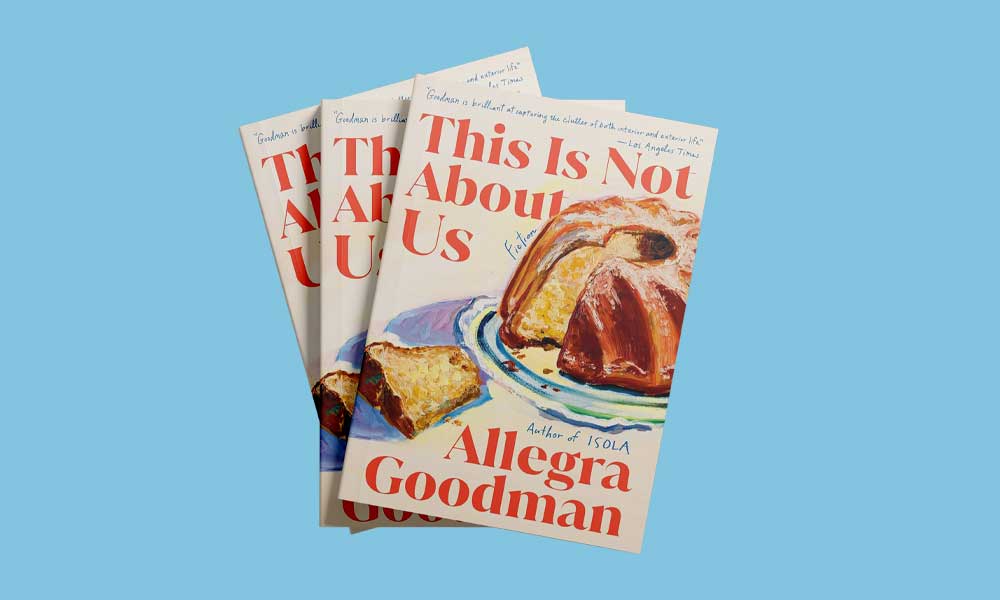
This Is Not About Us
By Allegra Goodman
The Dial Press, 336 pp.
If novels, as Henry James so memorably put it, are “loose, baggy monsters” while the short story is “a little gem of bright, quick, vivid form,” what do you call a collection of short fictions that revolve around the same group of characters, set in the same time and place? Linked stories? A story cycle or sequence? A novel-in-stories?
None of these dry terms fully captures the rich, kaleidoscopic pleasures of Allegra Goodman’s 11th work of fiction, a series of interconnected narratives that follow the ups and downs of the lives of three generations of an East Coast Jewish family over the course of two ordinary, tumultuous years. Each of the 17 stories in This Is Not About Us stands alone—indeed, half a dozen of them were previously featured in The New Yorker—and yet the recurring characters and themes come together with novelistic depth and force. In all, they add up to a whole that is far greater than the sum of its component parts.
Is it ever truly possible, the story asks, to understand another person?
This Is Not About Us opens with a destabilizing event: the death of Jeanne, who at 74 is the youngest of three sisters who are the mothers and grandmothers of the other characters in the book. The opening story, “Apple Cake,” nimbly sets up the collection’s themes. The family gathers in anticipation of Jeanne’s death, but she takes her time: Neither life nor death can be predicted or controlled. Sardonic Jeanne endures her family’s attempts at comfort as they fret over guessing what she wants. (A bagel? A rabbi? To listen to music? To be buried or to have her ashes scattered to the winds?) Is it ever truly possible, the story asks, to understand another person? Why is it that we so often hurt those whom we love the most?
The book’s title is ironic: Empathetic and caring as we may try to be, Goodman suggests, we can’t escape ourselves. Like warring siblings, we can’t stop our primal vying for attention, our yearning to be seen. In “Apple Cake,” the rivalry takes the form of competitive baking, with middle sister Sylvia one-upping oldest sister Helen’s apple cake recipe as they await their sister’s death. Helen refuses to speak to Sylvia after that. Goodman traces the family feud with humor and insight:
“Helen never listens to me,” Sylvia declared in front of the entire family assembled at Jeanne’s bedside. “I’m invisible to her.”
Amazed at this mixed metaphor, Helen said, “Obviously I see you.”
Grief pulls the sisters farther apart. “As for Jeanne’s sisters,” the narrator says at the end, “they would not forgive each other for her death.”
The stories offer a 360-degree perspective. We see their world through the eyes of Sylvia’s newly divorced son Richard, his 12-year-old daughter Lily and his ex-wife Debra. Other stories are told from the points of view of Jeanne’s granddaughter Phoebe, Phoebe’s great-aunt Helen, and Helen’s daughters, Wendy and Pam.
A pair of stories offer a glimpse into the struggles of Jeanne’s son Steve as he is laid off from his job in publishing and of his wife Andrea, a college counselor whose son, a high school senior, refuses her help. We follow the perspectives of Jeanne’s son Dan and his wife Melanie as Dan goes overboard in trying to accommodate the family’s Passover seder to their eco-warrior daughter’s vegan dietary constraints. We witness Richard’s new baby’s bris from Sylvia’s anxious, disapproving, loving point of view. A few stories shift deftly in and out of multiple points of view—most pleasurably, a dog’s.
These shifts in perspective, rather than plot, give the narrative its depth and power. Goodman is a master of revealing those interior monologues that clash with what we permit ourselves to say out loud. She is brilliant at anatomizing our human yearning for approval, the deceptions that we nurture to ward off guilt and pain. With wry humor, the title story makes this dynamic clear. Basking in the glow of newfound love for his daughter’s bat mitzvah tutor, Heather, Richard promises to hold off telling his ex-wife about the relationship until after his daughter’s big day. “In due course he would tell her and she would be…okay. Probably. Meanwhile, they were not going public because they were focusing on the bat mitzvah, which Heather said is not about us. Richard had never been with anyone so sane.” Goodman’s characters try, and succeed, and fail to love each other. They’re torn between their own needs and desires and the demands of others. In the way of every loving family, they do the best they can.


There is a uniquely Jewish pleasure to these stories, which are steeped in the particularities of a certain kind of secular American Jewish culture in our time. The characters bake rugelach and honey cake, listen to classical music, send their kids to Camp Ramah. Religion and politics remain in the background. But we feel acutely the longing for connection and continuity along the generations, l’dor v’dor; the pride in a child’s d’var Torah; the questions around the “right” way to honor the dead, fast on Yom Kippur, navigate Christmas or organize a seder or a bris.
The three matriarchs of This Is Not About Us were born in Kaaterskill, NY—the setting, as it happens, of Goodman’s 1998 novel, Kaaterskill Falls. Likewise, with this book, Goodman circles back to the form of her breakout short story cycle, The Family Markowitz (1996). It’s a book that, once you finish it, will leave you wanting to circle back to read it all over again.
Margot Singer is a professor of English and director of creative writing at Denison University and the author, most recently, of Secret Agent Man.
Moment Magazine participates in the Amazon Associates program and earns money from qualifying purchases.