
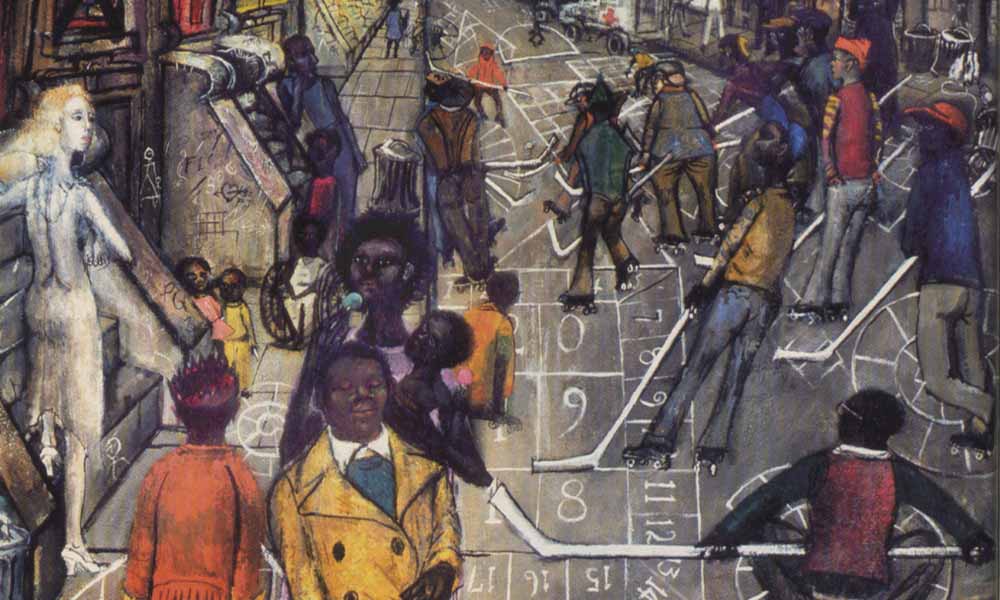
The following story won First Place in the 2002 Moment Magazine-Karma Foundation Short Fiction Contest, which was founded in 2000 to recognize authors of Jewish short fiction. The 2002 stories were judged by Pearl Abraham, Rachel Kadish and Harvey Grossinger. Moment Magazine and the Karma Foundation are grateful to Abraham, Kadish and Grossinger and to all of the writers who took the time to submit their stories. Visit momentmag.com/fiction to learn how to submit a story to the contest.
To see the story in its original context, click here.
I
Bookbinder is about to order another tea. He looks anxiously at his watch, gazes again at the empty door and signals for the waitress. She walks tiredly to the table: the brightest thing about her is her white orthopedic shoes. She begins to smile but seems to decide, better not. He points to his tea glass; she nods, turns her back on him and wearily heads toward the kitchen. Their exchange done, Bookbinder again checks the door. Nothing. There is a young couple; they seem to Bookbinder, like all young Israelis, to be bursting with thighs, buttocks and breasts. He is carrying an Uzi but wears no uniform. Bookbinder would rather not wonder what he is defending; plenty to protect, and anyway, he’s not Fass. In comes a thin dark woman, very well dressed, very nervous, who sits down, immediately lights a cigarette and looks at herself in the cafe mirror. Also not Fass. Bookbinder’s eyes skim over the beggar with the sunglasses. He rattles his cup at each table, but doesn’t bother with Bookbinder. A man pushes a baby carriage through the door and leads three small boys, a matched set in khaki windbreakers and knitted skullcaps. Gush Emunim is represented, but not Fass. Bookbinder’s watch says he is at least an hour late. There is nothing to do but sip the tea. He is beginning to consider either a third cup or a trip to the bathroom when Fass is there, framed in the door. He is breathing hard, his blue beret crooked on his head, his belted raincoat unbelted, his face splotched with red as if someone just finished slapping him. Something is wrong.
Fass sees Bookbinder after a moment and runs toward him, his hand skewering his beret to his kinky hair. “Bookbinder,” he begins, just as Bookbinder cries, “Fass!”
They stop, Bookbinder reflective, Fass breathless. Bookbinder waits.
“You’ll never believe what.” The waitress comes with their tea. Fass stops, calmly orders coffee and cheesecake and sits down. “Guess,” he continues.
“Since the Second Temple there are no prophets,” Bookbinder says. “Tell me.”
Fass absently takes a sugar cube and pops it in Ills mouth. “Bender is dying.” Just like that, no preamble. “Very sick. Gross’ son called long distance from New York. He heard from Gimbel, that idiot from The Jewish Monthly, Gross wants we should know.” Fass eyes the cheesecake and addresses the waitress in courtly Hebrew. “Would you have such a thing as a fork?”
The waitress shuffles off, affected neither by his sarcasm nor his erudition, probably to get the fork. Meanwhile, Fass sticks his finger in the cake and licks it off. “In any case the speech for the Kulturklub is out. In two weeks he’ll never be all right. According to Gross’ son, out of the question.”
Bookbinder sits, struck dumb. His face is pale wherever Fass’ was red. His heart beats so loudly he is sure Fass can hear. He feels the entire Ta’anug cafe fade out, as if he had switched the sound off on a television set. The picture is wobbly, too, with a lot of interference. Fass seems to be speaking, he can’t be sure. All he absorbs is the pounding of his own heart and a feeling like nausea creeping from his belly up to his throat. His eyes fall on Fass’ mutilated cheesecake; abruptly, he stands up. He runs straight to the bathroom and throws up. Of course, there is no toilet paper, so he washes Iris face and wipes it on the sleeve of his coat. In the piece of warped mirror over the sink the crinkly blue eyes, the upturned nose, the bowed lips, his entire impish face, do not exude their famous charm. In fact, he does not even see them. Instead, he sees the noble brow of Bender, the majestic arc of his nose. Bender dying. He throws up again.
When he returns to Fass, Fass is standing, his coat belted. “I have to go,” he says. “I don’t want to miss the lecture. A very fine professor on the poetry of the Middle Ages in Spain. This is a great interest of mine, as you know. I just want to suggest we should send a telegram to Bender.”
“No telegram,” Bookbinder hears himself, to his own surprise.
“Why not?” Fass asks. “It’s not so expensive, the treasury can afford it.”
“No telegram to Bender,” Bookbinder repeats. “I myself am going to New York to see him. I will wish him well in the name of the Lamed Shapiro Yiddishe Kulturklub. Apart from this I have business of my own with Naftali Bender. Business of an imperative nature.”
Fass seems less surprised than Bookbinder him self. “Nu, a good journey,” he says shaking hands. “Call me when you return to Eretz Yisroel. And tell Bender for me…well you know what to tell him.”
“Yes,” Bookbinder agrees, conviction entering his voice for the first time. “I will know what to tell him.”
II
Bookbinder hauls himself up three flights of stairs to his apartment. He hears a door open stealthily and then a pregnant pause before it clicks shut again. Mrs. Kapulsky checking, seeing only Bookbinder, and losing interest. The second floor landing is crammed with plants; Bookbinder has to step over a narrow, spreading puddle that makes him wonder if one of the plants is urinating. His own door is scuffed and dirty. Usually he takes pride in this symbol of his resistance to the bourgeois incursions of his building. But today his mind is only on Bender.
The apartment is dark as usual. His two rooms have the worst directions, north and west, but Bookbinder doesn’t pay any attention to the dark or to the ram that slashes his windows all winter long and seeps through the walls, leaving black mildew stains. He is frozen throughout the winter; two of the neighbors refuse to pay, so there is no central heating. Bookbinder is one of them. He is fond of his small kerosene heater, whose odorous smoke has blackened the ceiling to match the walls.
Bookbinder always says that all he needs are his books, which in any case cover most of the mildew. Like volumes locked up in a summerhouse all winter, they have absorbed the odor of neglect. Bookbinder enjoys this smell. He has a large desk, brought with him when he retired and left New York, a relic of the U.J.A Landsmanshaften office: a couch that once cost so much he never intends to buy another: a library reading lamp a lady friend aspiring to permanence once gave him: and the four walls full of books. That is his living room. There is a wall which is a sliding door, leading out to a terrace. This deprives him of book space, but Bookbinder has solved the problem by stacking books on the terrace in cartons. The shutters of the terrace window are in any case always shut against the rain and north wind in winter, and heat and desert wind in summer. Here, too, moisture seeps in through the gaps in the window-frames, and imparts to the books their special musty perfume. Esther Porush never visits him without bewailing the lack of a terrace.
“It could be so nice, Avram.” He can hear her pleading voice. “A little fresh air, you could have some plants.”
Bookbinder has perfected his withering glance and scornful tone. “What am I, an agronome? Let the disciples of A.D. Gordon wallow in plants and air. I am a man of books. This,” he flaps the dank pages at her, “is my fresh air.”
His bedroom is a plain wooden bed with a slab of foam rubber for a mattress; he calls it his kibbutz bed. On the walls, as he tells Esther Porush on the rare occasions when they make love, under his bare light bulb on his hard bed, are the members of his kibbutz. Pictures of Lamed Shapiro, I.L. Peretz, Haim Nahman Bialik, Zalman Schnoeur, Jacob Glatstein, Perez Markish, Shaul Tchernichovsky, and Naftali Bender.
“I am but a lowly member,” he tells the nodding Esther Porush, as she tries in vain to find a comfortable position, “in this kibbutz of immortal talents.”
He finds himself waiting eagerly for her denial of his humble status. If she were not to offer him her “Oh, no, Avremel, you are a true artist yourself. Your book of poems is so beautiful and sensitive,” he would feel angry and deprived for the rest of the day. She, for her part, must sense that her words incite in him an ardent responsiveness which her body does not. For she continues, “And your translations, Avremel, they bring works to life which until now were dead to those who do not read Yiddish. You are a member of that kibbutz, Avram,” she concludes, satisfied, for he kisses her with true affection.
Nevertheless, he knows quite clearly that his book of poems, published by the Hadar Press, would never have emerged from his top drawer dollars for Asher Tapuz’ publisher’s fee. Tapuz has gone bankrupt and fled the country before the court could confiscate his property. Bookbinder’s translation of Bender’s epic poem, Der Goldener Troiyer, will remain where it lies, entombed. Nobody wants The Golden Grief, a hundred and fifty fanatically literal pages of translation. Nobody even wants Bender’s original masterpiece about the death of his brother in Kielce, after his return from Auschwitz, at the hands of Polish peasants. Who cares, except for a few Yiddish newspapers scattered over the world—fewer each year—and a smattering of groups like the Lamed Shapiro Yiddishe Kulturklub, comprising several ardent geriatric admirers? They are all doomed, artist, translator and audience alike. But as far as Bookbinder is concerned, Bender is the most graced of men. Hey may be obscure, known only to the dying, but he is a great writer. This alone matters. The worm in Bookbinder’s rose is not that he is unwanted, but that he is fourth-rate. Bender is one of the immortals.
In fact, Bookbinder believes, Bender is the last of their immortals. There will be no more. If he is dying, their world is ended. There will truly be nodiing but the past. He must see Bender, come close to him, perhaps even—dream of dreams—be known to him, before Bender disappears off die globe and their joint universe dark ens and diminishes forever.
There is a rap on the door. Bookbinder considers whether to answer; for this reason he has never fixed his bell. He can always say he did not hear die door. The knock is timid: Esther Porush. He decides he’d better talk to her. Someone must empty his refrigerator after he is gone.
He opens the door and greets Esther’s anxious little face with his habitual grimace of annoyance. She immediately looks apologetic.
“You might as well come in,” he says, leaving her to close the door behind her.
Esther stands uncertainly in her neat little coat, holding her shiny handbag in front of her like an offering.
“Avram, I just want to check what time you’re leaving tonight for the club meeting. For Malka’s presentation. I promised her we won’t be late.”
Bookbinder’s eyes sweep over her bleached hair, that to him always looks like groomed straw, down to her tiny feet in their pretty shoes. Somehow Esther seems to feel she must assuage him, for she says, “You know you’re the only one who really knows the subject. Without you there will be no discussion.”
This loosens Bookbinder’s tongue. “There will have to be a discussion. Let it be one of amateurs. I will not be there.”
He enjoys the collapse of Esther’s face.
“Avremel, what are you saying? You are the president. You never miss a meeting. Even with the dysentery you came…”
“Something more important has come up.” Bookbinder begins to rummage on the terrace for his suitcase. He finds it and empties it of books and papers. That done, he fills it with other books and papers.
“What could be more important?”
Bookbinder turns dramatically. In his own eyes he is a bit ridiculous. In fact, he is aware that with Esther he is generally an arrogant cockscomb. But Esther never seems to notice this, or if she does it is apparently not in her interest to let on.
“Naftali Bender is dying,” he says, “and I am going to New York. I will represent the Lamed Shapiro Yiddishe Kulturklub and Avraham Bookbinder, one of his greatest admirers and his truest translator.”
Out of all this Esther grasps only one fact. “You’re leaving.”
“I must see Bender,” Bookbinder says. “Fass says that Gross’ son says that he is dying.” Suddenly he grabs Esther’s hands, urgently seeking her dim, bereaved eyes. “Bender is dying, Esther. His body is failing. His work is eternal, but the man is dying. I must see him. He must tell me…before he goes. There is something I must find…”
In his need, Bookbinder has knocked Esther’s shiny pocketbook out of her hand. It crashes to the floor, where it spills all its contents. Money, tissues, powder, pills, string shopping bag, pour out as if Esther had suddenly violently heaved up her insides on Bookbinder’s cracked and smudged tiles.
“You’re leaving?” she cries, her voice thin and pained. “When? Are you coming back?”
Esther has touched what is, for her, the core of truth, but Bookbinder turns away with a wave of disgust.
“I was going to make your favorite for Shabbat,” she grieves,”sweet and sour tongue.”
Her face looks cracked: something vital is seeping away through its lacerated wrinkled surface. She looks at Bookbinder’s back, then bends and scoops all her things back into her purse. She loudly snaps it shut. When she lifts her face from the floor it is partially smoothed out, and though her smile is only on her mouth, she holds it there.
“I understand, Avram,” she says. “Such a great man. Of course, a poet like you understands this better than I can.” Bookbinder’s back softens a bit. “You will represent us, that is fitting. Meanwhile, I can help you?”
“I’m leaving now,” Bookbinder says, still not turning to her. “My passport is always in order. I won’t have time to clean out the refrigerator, clear up a little…
“Of course, don’t worry about it,” Esther says. Bookbinder does not. He is too busy looking at a clipping he has come across of Bender and Genya Rubenkin to notice that Esther’s voice is soothing, but dead. If he noticed, it is doubtful he would think about it twice. Esther swallows this knowledge as if it were nitroglycerin, a poison she must absorb into her system to live.
Bookbinder looks at Bender’s large-browed, cold-eyed face, and then at Genya. Her dark head hovers above Bender’s like a smoldering rain cloud, her eyes black, her lips stormy, her hair a luminous cascade. He can feel his heart pound again. He does not even hear Esther head toward the kitchen quietly to begin clearing up his souring lebens, and molding breads. His eyes are on the curve of Genya’s long snake-like fingers resting lightly on Bender’s shoulders. Bender looks out at Bookbinder, his nose powerful, his mouth calm with knowledge. Bookbinder slips the clipping into his suitcase. Whether he forgets his pajamas or not, his packing is complete. Pajamas one can acquire anywhere. The truth he has just seen one must preserve carefully, like a dangerous exhilarating potion. It is the drink of the gods.
III
Bookbinder is trying to finish the dinner Bronka has put in front of him without eating it. So far he has no solution. There is no dog, no cat, not even a plant to fertilize—better it than him. To make matters worse, Bronka keeps checking his plate to see if he wants more soggy kugel and blackened meat.
“What’s the matter you didn’t touch the tsimmes?” she asks. He can see her skin is mottled and her hands are shaking a bit. She has certainly been cooking for at least two days in honor of his arrival.
“I’m so full, you know, the plane—and the delicious soup,” he points to the watery remains floating in the tureen at the center of the table. The cloying orange mass of tsimmes makes him look back with nostalgia at the soup. Watery he could handle. Leibel is placidly eating everything, a satisfying smile on his face. Bookbinder suspects he hasn’t eaten so well in years.
“Better food you get in Eretz Yisroel?” Even Leibel puts down his fork at the tell-tale tremor in Bronka’s voice.
True her hair is now a bright red, like a traffic light, and she wears make-up and pants. But Bookbinder saw at first glance the same Bronka from all those years ago in Holon, when he was the visiting American and she the Israeli. The same Bronka who, thin as a stick, her hair fallen in clumps from her head, raised her blue-tattooed arm and hurled a fork at him when he involuntarily spit out a mouthful of cake tasting of moldy newspaper. “My cake isn’t good enough for you?” she shrieked then. “Some of us didn’t have a chance to be so choosey. We ate rotten potatoes, grass, anything. In America you learned to be better than us?”
Now, as then, Leibel intervenes genially, with a perfect timing born of long practice. “Bronka the man is tired, such a long trip. Probably he isn’t used to such rich food like we have it here.”
Bookbinder nods eagerly, adding for good measure, “I can’t remember when I had meat last.”
Bronka begins to look calmer. She even sits down for the first time. “Naturally,” she says. “This is America.”
With this Bookbinder cannot argue. He looks around the crammed living room with its plastic-covered, spindly legged furniture and dripping-crystal chandeliers. The small dark windows are draped and fringed with yards of crimson velvet. With the white wall-to-wall carpet he is already acquainted. Bronka first waited for him and Leibel to remove their shoes, and only then kissed him with her hard, faintly mustached mouth. Now Bookbinder wiggles his toes in their socks. His feet feel like they are in a mosque, his eyes tell him he is in an antechamber of Franz-Joseph’s court, and his nose assures him he is back in Brooklyn.
Bronka begins to talk about the trials and tribulations of her children. Yossel now calls himself Joe and is living with a married woman with children, this isn’t bad enough, she’s a Chinaman.
“A woman can’t be a Chinaman,” Leibel says mildly.
“I didn’t go to a gymnasium,” says Bronka, her eyes narrowing, “I don’t know so much like you. But her I know very good, exactly what she is.”
Leibel decides to concentrate on his compote. Unable to do this, Bookbinder begins to nod vigorously whenever Bronka’s eyes signal that her story has reached a crisis. Meanwhile, he stops listening and tries to plan a strategy for meeting Bender. First he must find Bender’s house. Then he will know what to do.
He turns to Leibel. “After such a delicious meal,” he says, “I could use a little walk. Maybe we could go to the boardwalk?”
Bronka and Leibel look as if he has made an indecent remark. “At night you don’t go to the boardwalk,” Bronka says flatly. “The shvartzes are waiting for a naar like you to cut your throat and maybe some other things.”
“It’s not so bad since the Russians came,” Liebel interjects peaceably.
“Sure, a six-foot Cossack they’re afraid of,” Bronka waves contemptuously. “Avramel they’re waiting for. Such a prize comes their way only once in a blue moon.” She stands up. “By me a guest in house doesn’t come to enter the next world. Better watch some television and tomorrow morning we could all take a walk in the fresh air.”
Bookbinder realizes there is no appeal. He gets up, begins to stack the dishes; he and Leibel trudge toward the kitchen while Bronka hurries to the living room. Soon Leibel begins a dirge about his failing candy store and who has died, to the muted music of the elevated subway outside and the canned laughter within.
IV
The three of them walk arm in arm. Bronka is literally taking in the air; Bookbinder is reminded of a carp slapped on a counter, gasping for its life. Leibel explains about a health show on cable television, from this Bronka learned to breathe. Bookbinder is about to say that without television he so far knew how to breathe, but Bronka loudly braises television for its benefits to her lungs, her bowels, and her heart. The fresh air, she states challengingly, makes the blood pump.
Bookbinder is dubious. He has no faith that this air, scented with car fumes, reverberating with metallic train rhythms, lightly laced with smog and overlaid with the faint aroma of garbage, can benefit anyone’s lungs. Still, people fill the park, loaded as if for a day in the country. They carry aluminum folding chairs, collapsible bridge tables, bags full of food. They settle on the grass, the women’s heads like dried autumn flowers in shades of red and gold. The men all seem to be wearing hats with tiny holes that assure ventilation. What Bookbinder notices is that they are all his face, and all wear their parents’ faces.
Looking at Leibel he finds it hard to remember the young student, the player of Chopin, the delicate boy wandering Warsaw’s parks with a volume of poetry; instead he sees Uncle Yosef, his father’s brother. Just this way Yosef’s hair receded over faintly veined temples. Just this way the creases ran from his nose down to his mouth. Bookbinder himself looks in the mirror lately and sees his father’s face taking over. Sometimes the image rises of his father’s body lying on the big bed, the dark-suited hevre-kaddisba swarming around him like an insect army intent on purification. Then the face—so eerily silent and still on the bed—becomes his own. All that is left of his father is this face; with Bookbinder’s passing, his father will leave nothing.
They reach the boardwalk. Bookbinder’s heart momentarily lifts. Almost, he might be back in his youth. The old men are still playing chess, there is still the row of newspaper readers.
Whole families crowd into a little restaurant grandly called Moscow Gastronome. The air smells of hot cheese and fried meat. The sea stretches with the blue immensity of the seas of childhood. Old ladies with white paper nose-guards shelter under tasseled umbrellas. A young couple jogs past as a man in checkered shorts says, “I’m always carrying five dollars to give a mugger.” Another in a pink shirt jabs his cigar in the air, “What’s five dollars today? For under a hundred they’ll slice you up. This is why I don’t like to leave Florida. Paradise. A ganeden, absolutely.”
No, Bookbinder thinks, Odessa it isn’t. Still, if he ignores the peppery smell of Spanish food, the brightly dressed Puerto-Ricans dotting this part of die board walk like exotic birds, and concentrates on that mammoth sign over there—BRIGHTON BATHS— he can feel the steam rising on long-ago Friday afternoons, can hear the pre-Sabbath cacophony of Communists, Bundists, Labor-Zionists and plain Jews, can see his father’s slippery back, hairy exactly where his is now. They remain alive in his reveries, but like the shvitz vapors, like everything else, they are fading fast. They are all gone: just as soon he will be gone, along with Bronka, Leibel, and the entire throbbing circus of this boardwalk. And, unlike Bender, none of them will leave an enduring mark.
Suddenly he sees them. Bender and Genya walk slowly past, on the opposite side of the boardwalk. They turn, begin the descent down the wooden ramp to the street. Bender is smaller, thinner, lessened. Genya seems to have taken on size and color. Her face in the sunlight is brightly painted, her hair a shoe-polish black. A violet scarf circles her neck. As they retreat, Bookbinder loses sight of Bender. All he can see is Genya’s flowing black cape, wrapping Bender like a shroud.
Bookbinder turns to stone, mouth agape, skin cold. Leibel bumps into him. Bronka stops her breathing to watch him.
Bookbinder wakes. There is only one thing on his mind. “I must go,” he cries, fleeing down the street, indifferent to Leibel’s puzzled expression and Bronka’s mounting color. He runs toward the Avenue, seeking the tail of Genya’s black cape, ready to follow wherever it may lead.
V
On Brighton Beach Avenue the elevated crashes over him with a fearful noise; the train grinds to a halt, sparks flying. Under the shadow of the raised tracks, Genya and Bender have disappeared. The street is cluttered with people, jammed in stores. Bookbinder looks into each one, hoping against hope. Russian bookstores. Chicken outlets. Fruit stores peopled by Korean shopkeepers and Jewish pensioners. A salami emporium. A cream-cake festival. A jumble of odd shoes. A display of flowered housedresses hanging gloomily on headless models. Dark restaurants with technicolor pictures of Georgian food. He seeks, but finds only wizened faces, soured by old age: buxom women flashing gold teeth and trailing a robust musk of sweat: black boys carrying huge radios whose violent music battles with the thunder overhead. He trudges past a pungent fish store and a tiny storefront synagogue advertising its beatific cantor. He has almost given up. At the Café Zodiac he peers through the curtained windows. The tables wait blankly. Reflected in the glass he thinks he sees the swing of a black cape. He knows he is dreaming, but turns anyway. There, down a side street, are Genya and Bender. It is no dream. He has found them. By the time he runs in front of a car and behind a bus, they are turning into a building of brown brick.
The building faces a parking lot, which faces the sea. It is entered through a courtyard; women in housedresses perch on the ubiquitous aluminum chairs, like suspicious sentries. They are indifferent to Genya and Bender, but Bookbinder interests them. Perhaps because his eyes, following the pair’s slow progress into the dark hall, are glazed with the intensity of revelation.
When Genya and Bender are gone he lifts his eyes to the scrolled crest over the entryway: HAMPTON COURT. If Bronka and Leibel lived there he would laugh. Instead he stares, rapt, at the third floor windows; behind the shabby curtains there is an unmistakable flash of black and violet. Within him are the first flickerings of a peace he has not known since leaving the Café Ta’anug. He has come home.
VI
Bookbinder walks. Daily he trudges up and down Brighton Beach. Daily he stops at Hampton Court. Loitering, he might be reported as a Peeping Tom, a potential burglar or just an ordinary pervert. Better to keep moving along. So he forces himself from the brown brick building, to the boardwalk, to the park. He reminds himself of the Christian pilgrims he has seen schlepping through Jerusalem, guidebooks clamped to their breasts, deaf to the Arab hawkers and vendors pressing their flesh. They stumble ecstatically down the cobbled stones, their faces dazed with belief. Brighton Beach is his Via Dolorosa: the park, library, fruit store, his Stations of the Cross. So far he has been, as they say, unredeemed. In other words, nothing. No Bender, no Genya. Since the day of that vision, darkness.
Days he kills with these walks, with long visits to Leibel and Bronka’s candy store, where Leibel makes him egg-creams and Bronka suspiciously eyes the black teenagers with their sneakers and shvartze combs sticking from their scalps. Every time she survives such a visit she has to sit down and hold her chest, to calm her abused heart. To Bookbinder the boys look perfectly harmless except for the combs, which remind him of cannibals. But Bronka insists they are all throat-cutters. He listens to her stories of muggings, beatings, and assorted horrors with his ears; his mind is possessed by the tall dark shape behind the curtains, which is all he is given.
Nighttimes he stands in the alley across from Hampton Court, absorbed in that shadow. In the freedom of the nights he sees it glide, dance, hover in that radiant square. True, if someone should catch him hiding in the black alley, gazing up, he’d maybe be arrested. He does not care, because the night guarantees him that shadow; even though there is no shorter, dignified, slow-moving presence. Watching Genya nightly move in and out of the shadows is like seeing a star without ever glimpsing the sun which gives it a glow. Still, who is he to complain about a star?
He lives in this silent nighttime world. His daytime life is a shadow. Leibel and Bronka appear to him like figures in a television comedy in a foreign language, going through their antic motions without ever making sense to him, sporadically causing him to laugh—probably for the wrong reasons. In any case they are very far away, without color and easily tuned out. While that window vibrates with color and meaning, its contrast of black sky and golden square seeming to contain all the deepest and most passionate intensities of color Bookbinder has ever experienced.
Therefore it comes as no surprise when one night Genya opens the window, gazes out and waves. Her hands call, beckon him into the light. Something in him says, maybe she’s just taking air, maybe it means nothing. But he is already walking into the hall of Hampton Court; the rest of him knows that this is a signal for which he has been waiting, perhaps all of his life.
He climbs the stairs and stops on the third floor. He knocks confidently on the door, finally emerging from the wings, into his role, ready for a foolproof performance. Genya opens the door.
Her face appears like a mask of Genya Rubenkin, larger even than his dreams. She is painted as if for her greatest part. The eyes are black as a suicide sea. The lips are the purple-red of royal blood. Her teeth, glimmering behind the parted lips, are whiter than bone. She, too, has her moves down pat. With long curving hands she draws him in, her fingernails a shockingly tender pink that overwhelms him with a sweet, trembling desire for tears. It is as if her face and hands encompass all the feelings he has failed to experience throughout his life.
He enters the dim corridor. It is crowded with photographs, the teeming tiny bodies of Genya’s past, pressed and displayed under glass. There is Genya with Joseph Boroff, all the Adlers lifting champagne glasses around her luminous head. They are all so small; only Genya, a perfumed presence behind him in the dimness, is large. She is behind him like a wind, he is blown into the living room, which is a kaleidoscope of images of Genya Rubenkin—from the side, full face, laughing, weeping, young, older, never old. It is a bit like the funhouse a few blocks away in Coney Island, except that it is the funhouse of a goddess.
He turns to her; she stands amid the toppling piles of scrapbooks, blazing back at him. He waits for her sign. He is afraid to speak first for fear that he will say the wrong thing, for fear that he has misunderstood everything, from start to finish. But she stands immobile, exuding her perfume, which he inhales, a deadly, addictive ether.
Bookbinder waits. Genya waits. The very air waits. Bookbinder suspects he must declare himself. Genya’s very bones tell him she knows, that he need explain nothing; her silence demands an answer. He stops thinking. He says, “I have come for Bender.”
This seems to be the correct answer. Genya smiles calmly, nods graciously, a perfect hostess. His own words stun him. “I have come for Bender,” as if he wished to carry Bender off. He knows at once that this has all along been his desire: to abscond, not with bender himself, but with the secret he carries, for which Bender will have no use where he is going. Bookbinder wishes to steal away for himself some of the magic that will keep Bender in the world long after his particular lineaments have gone, never to appear again. He thirsts for the immortal essence of Bender.
Genya’s voice rouses him, Genya Rubenkind’s voice which has cast its rich spell on audiences from Johannesburg to Uruguay, from Buenos Aires to Second Avenue. That voice, which the critic Tabenkin called “a harp of the night”: he trembles to its dark vibrations. That voice, caged for so long within these Brooklyn walls, making its music for Bender alone, now resonates for him.
For the first time Genya raises her eyes to his face. His skin is suffused with heat, as if he were dangerously close to the sun. Her eyes say he has spoken the words for which she called him into this incandescent center.
“I will take you to him.” Her Yiddish wraps him like an element. As he follows her long robe, trailing down the dusty hall, he is tempted to pick it up as if he were a page. He trembles with anticipation, with gratitude, with hunger. His body hums with desire.
As she opens the door books rise up, surrounding her head like an aura. It is the aura of Bender. The books rise before his eyes in a cloud; he breathes in the sacred air until his brain swims. Genya turns. Her face, partially covered by her black hair, gives off the glow of an eclipsed moon. She draws closer. He can hardly breathe for her perfume.
“Bender is waiting,” she whispers. She moves back and he can see banks of flowers, flowers everywhere, in vases, jam jars, aluminum pots, soup cans. Amid them, Bender lies on a tapestried couch, asleep. As Bookbinder gazes reverently at the high brow, the fearless nose rising above a sea of flowers, he realizes that something has withdrawn from this face he knows with the precision of envy and dreams. Bender waits no longer. What we all wait for has passed on, taking with it the spirit of Naftali Bender and leaving behind this icon, absolute and eternal in its silence. Bender does not sleep. Bender is dead.
Genya stands tranquilly beside Bender’s form, which dominates the room and, it seems to Bookbinder, the universe.
“We must call the doctor,” Bookbinder says. But he knows, without a doubt, that there is no question of doctors. There is a quieting edge to Genya’s perfume. At first he thought it was the over-ripeness of flowers; now he knows it is the aroma of decay. Bender has not died today, perhaps not even yesterday.
The hevra-kaddisha,” he mutters. “Riverside Chapel…”
Genya lifts her palms, warding him off. “But this is Naftali Bender,” she cries. “He cannot die. This is illusion only. He will live forever.”
He shivers, feels the world shift until it is absorbed completely and contained by her shining face. His faith rises in him like blood. Doors open in her eyes; he enters them. Her voice fills him; he cannot make out the words at first, but he slowly begins to decipher. Her voice is his true language, his native tongue. All other languages fall from him until he is naked, then reborn. She speaks only of Bender; of his youth in Odessa: of his elegant, doomed mother: of his flirtation with Hebrew: of his passionate embrace of Yiddish: of his difficult friendship with the brilliant young poet Sutzkever: of his impossible wife: of his lyrical evocations of a lost world. The tears spill down Bookbinder’s face. Flame courses through his limbs, bringing them to true life for the first time.
Genya’s face is the source of life, it is the resurrection. The spirit of Naftali Bender illuminates her every bone. He reaches out, touches her shoulder. Her robe falls aside; her flesh dazzles him with the light of divinity. Bender breathes through her white shoulder, through her dense speaking breath.
Slowly, they descend to the flower-strewn carpet. Upon the petals of paradise, he is merged with Genya, in the fields of eternity they are Bender. From the flower-strewn couch streams an energy which obliterates Bookbinder. He is consumed. Bender surges above him, through him, in him. He blazes into Genya, subsumed on her pyre. They burn under Bender’s discarded body, kindling for him an eternal fire, immortal at last.
Reena Ribalow was a poet and writer who lived in Jerusalem. She was born in New York City and educated at the Yeshiva of Central Queens, Hunter College High School, and Queens College. She attended the University of Iowa Ph.D. Program and Writer’s Workshop on a Danforth Foundation Fellowship, after which she traveled through Africa and Europe, until arriving in Jerusalem, where she has lived ever since. Immortality was conceived during a two-year hiatus spent in Brooklyn among the people of Brighton Beach.