
 you take the long view—and it’s a very long view—relations between Jews and China make the word “complex” seem too simple. The Chinese government’s recent attitude toward Israel might lead one to think that a very ordinary word—“bad”—captures the dynamic. But that would be like judging an immortal novel by an out-of-sync last line.
To be sure, there’s a fair amount of unpleasant business to note, especially since Israel’s war against Hamas began. At the United Nations, China always votes to support Palestinian efforts and a two-state solution based on pre-1967 borders. It never refers to Hamas as a terrorist organization, has delivered ballistic missile fuel components to Iran and even helped the Houthis in Yemen.
Looking further back, in 1975 China supported UN Resolution 3379, which declared Zionism a form of racism. And while Israel had quickly recognized the People’s Republic of China (PRC) in 1950, China established diplomatic relations with Israel only in 1992.
On the other hand—we did say “complex”—China remains Israel’s second largest trading partner. Israel’s longtime military, weapons and IT business with the PRC is so extensive it has sometimes worried U.S. security officials, as when the United States pressured Israel in 1999 to rescind its sale to China of a Phalcon airborne early-warning radar system. In 2000, Chinese President Jiang Zemin paid a state visit to Israel, laying a wreath in honor of Holocaust victims at Yad Vashem. And in 2015, Israel transferred management of 148 acres of Haifa’s northern port for 25 years to China’s state-owned Shanghai International Port Group (SIPG).


That, however, would never have happened without a Chinese-Jewish bond that runs far deeper than international policy posturing. It is a bond embodied in a Shanghai institution that symbolizes what can only be described as a historic lovefest between the Chinese and the Jews who came to live among them.
The Shanghai Jewish Refugees Museum, at No. 62 Changyang Road in the city’s Hongkou District—a neighborhood full of modern glass and steel buildings amid the older brick architecture—is a site of pilgrimage regularly visited and supported, since its 2007 founding, by survivors, children and grandchildren of the roughly 30,000 European Jews who found refuge here from the Third Reich in the 1930s and 1940s. At a time when most of the rest of the world closed their doors to Jewish refugees, those who made it to Shanghai called it the “Shanghai Ark.”
A brick-and-mortar testament to the remarkable embrace provided by wartime Shanghai, the museum—its outward street-facing wall brightly displaying a gold menorah—is now packed with artifacts donated by the international diaspora of “Shanghai Jews,” who continue, with their descendants, to contribute items, stories and money. The meticulously documented museum has been visited by Israeli Prime Ministers Yitzhak Rabin, Ariel Sharon, Benjamin Netanyahu and Ehud Olmert. Olmert’s father, Mordechai, emigrated with his family from Samara, then part of Soviet Russia, in 1919 to Harbin, China. Mordechai grew up there, co-founding the local Chinese branch of the Zionist youth movement Betar before moving on to Palestine.
When Olmert visited Harbin in 2004 to pay respects at his grandfather’s tomb, he recalled of “Motia,” his father, “When he died at the age of 88, he spoke his last words in Mandarin Chinese.”
Three years before Olmert’s trip to China, Susan Sontag and I chatted with him at a reception honoring her as winner of the 2001 Jerusalem Prize. Olmert, then the mayor of Jerusalem, spoke of his family’s roots in China, the “deep bond” between Jews and the Chinese people, and the amazing refuge that Shanghai provided to Jews during World War II. Sontag, no fan of Olmert’s politics, remarked afterward that his surprising emotional connection to China helped her see him more sympathetically.
The connection between Jews and the Chinese comes as a surprise to many—it’s a subject not regularly written about by world media. Except, that is, in recent years, when the Chinese government has excoriated Israel for some new perceived misdeed. Just this past December, in a harshly worded statement, China criticized Israel for permitting an unannounced visit to Jerusalem by the deputy prime minister of Taiwan.
 Sometimes,” says Li Keiner, 31, the Chinese public-relations manager of the museum, who boasts a master’s in Mideast studies and spent a year studying in Jerusalem, “I’ve accompanied people who are not even direct descendants. But they have friends whose grandparents or parents were in Shanghai during the war. And when they find the names, they cry.”
“I like to tell people,” she adds, “that they had, as refugees, a normal life here. They went to school, they married, they had families.” The Jews of Shanghai adjusted to rickshaws and Chinese charcoal stoves and debated the usual Talmudic rules, adapted to local circumstances. A common dispute was over whether it was okay to take a rickshaw on Shabbat.
For Ben “Big Ben” Yuan, the charming 69-year-old local who handles the gift shop most days, it’s a pleasure to banter with visitors and sell them items that can “help them understand even more” about the wartime Shanghai community. Videos for sale include Memories of Shanghai and Shanghai Salvation, featuring interviews with many survivors who are now gone.
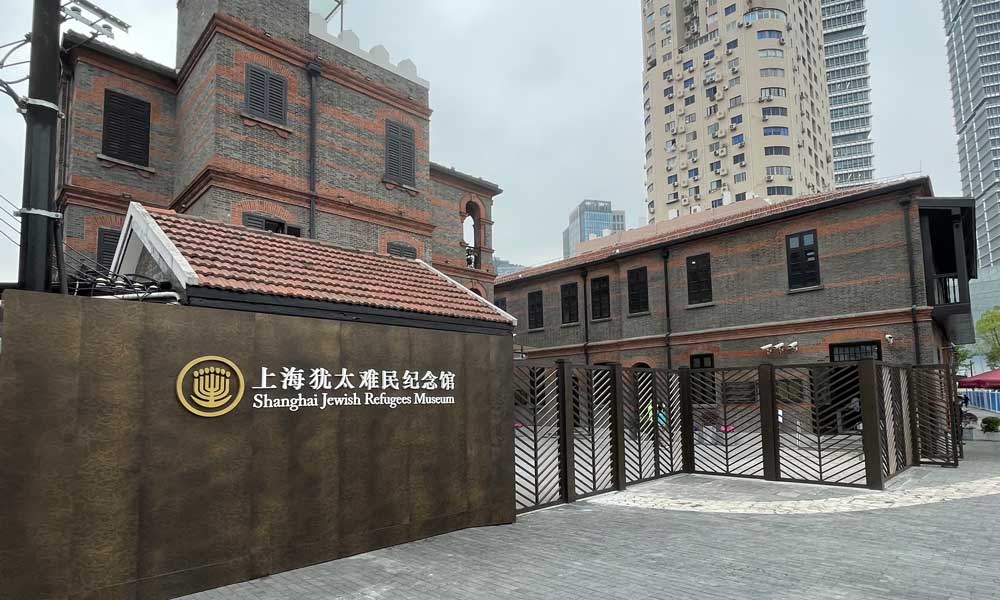
The Shanghai Jewish Refugees Museum was founded in 2007 by survivors and relatives of the European Jews who found sanctuary in the city in the 1930s and 1940s. (Photo credit: Ssyoung (CC BY-sa 4.0))
Peter Ehrich, a 43-year-old German high school teacher from Frankfurt, sitting in the museum’s café with his German friend Oliver, found the exhibits powerful because of their concrete links to specific families. “For my generation,” he says, “it’s a question of responsibility and historical awareness. We were having coffee here and talking about our family histories.” He had an uncle incarcerated in Buchenwald for criticizing the Nazi party. Oliver, for his part, says his maternal grandfather “was 17 in 1945 when he needed to take part in the last three months of the war. Luckily, he survived.”
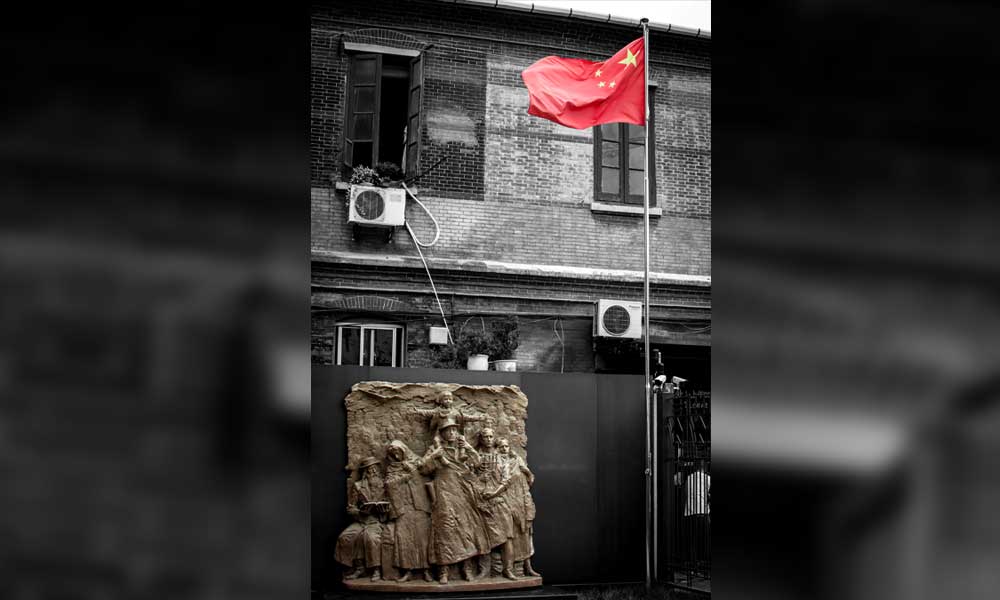
Keiner, after watching the two German visitors talk about their visit, recalls another German visitor a while back: “He came with a bunch of flowers, and he simply put them at the foot of the statue over there.” She’s referring to the sculptor Lu Qizhang’s bronze representation, unveiled in 2022, of the family of Hollywood magnate and producer Mike Medavoy (The Thin Red Line, Black Swan), who was born in Shanghai in 1941.
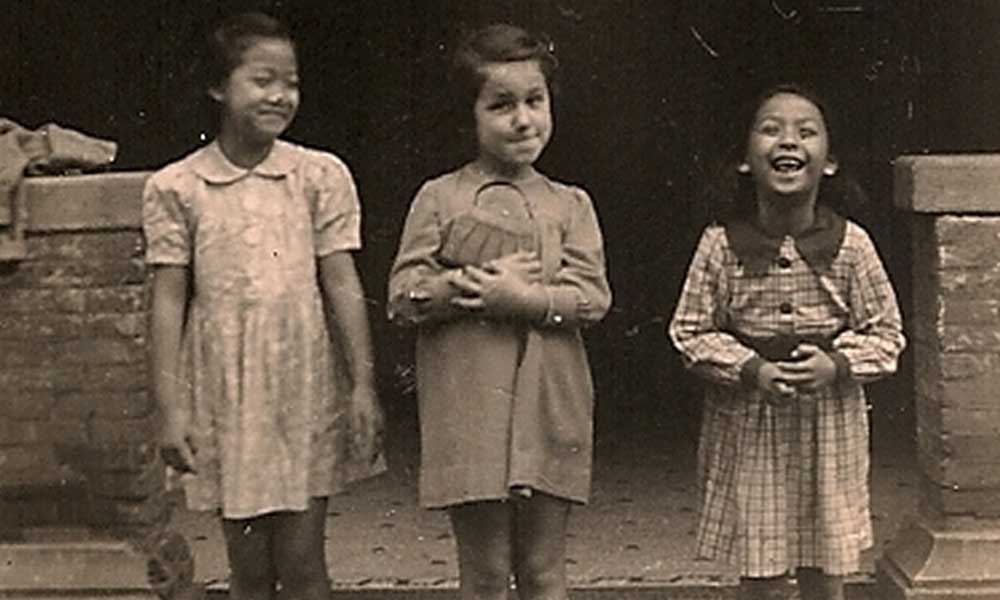
A Jewish girl and her Chinese friends in the Shanghai Ghetto during WWII. (Photo credit: Nadine Epstein)
The Shanghai local government, which owns the museum, completely renovated it in 2020. And in 2025, also after much restoration, it reopened one of the city’s two remaining synagogues, the on-site Ohel Moshe Synagogue, built by the Russian Jewish community in 1927. In addition to welcoming visitors, the museum hosts talks and tours by survivors and experts. A “Refugees Wall of Names” inside the museum, unveiled in 2014, lists 18,578 individuals in gold lettering on a black wall, just some of those who sheltered in Shanghai during the war.
“We are much larger than before,” notes Keiner in reference to the museum’s renovation. “Now we have room to show many more things.”
She says the museum draws about 100,000 visitors a year.
Most of the museum documents the 1930s and 1940s, though it also describes the earlier Jewish presence in the city. The WWII sojourn was complicated in 1941 by the Japanese occupation of Shanghai. In 1942, the Gestapo sent Col. Josef Meisinger to the city to propose that the Japanese impose a “Final Solution” on its Jews. The Japanese rejected the proposal. Instead, in 1943, they declared the Shanghai Jews “stateless refugees.” They forced more than 14,000 who had arrived after 1937, including the entire Mir Yeshiva of Poland, into a designated ghetto area in the Hongkou neighborhood, which already contained some 100,000 Chinese. Before the war in the Pacific ended, an accidental American bombing of the Jewish ghetto in July 1945 killed 31 and injured 250.
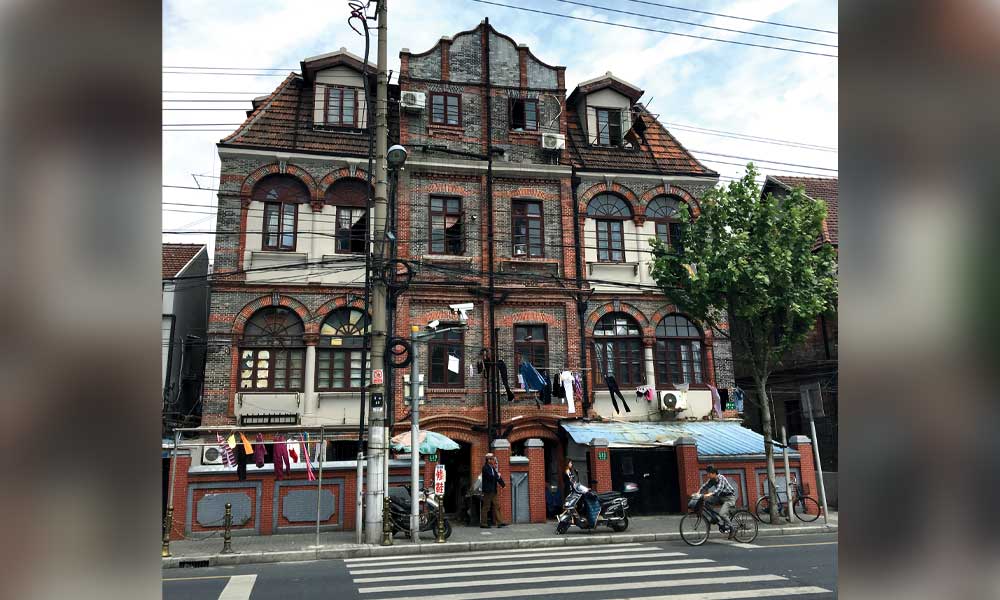
Shanghai Ghetto today. (Photo credit: Nadine Epstein)
As the original refugees pass away, their children and grandchildren donate family mementos from that time. The museum’s glass cases, displayed in a series of small rooms off its gray and brown brick corridors, teem with an amazing array of items. One sees photos, maps, posters, passports, visas, menus, shawls, dinner invitations, ocean-liner ads and tickets, ID cards, newspapers and magazines, eyeglasses, suitcases, prayer books, report cards, playbills, Chinese-language ketubahs—the concrete remains of a society within a society, all accompanied by descriptions and explanations of where they came from and the family stories behind them. Newsreels also bring the era alive.
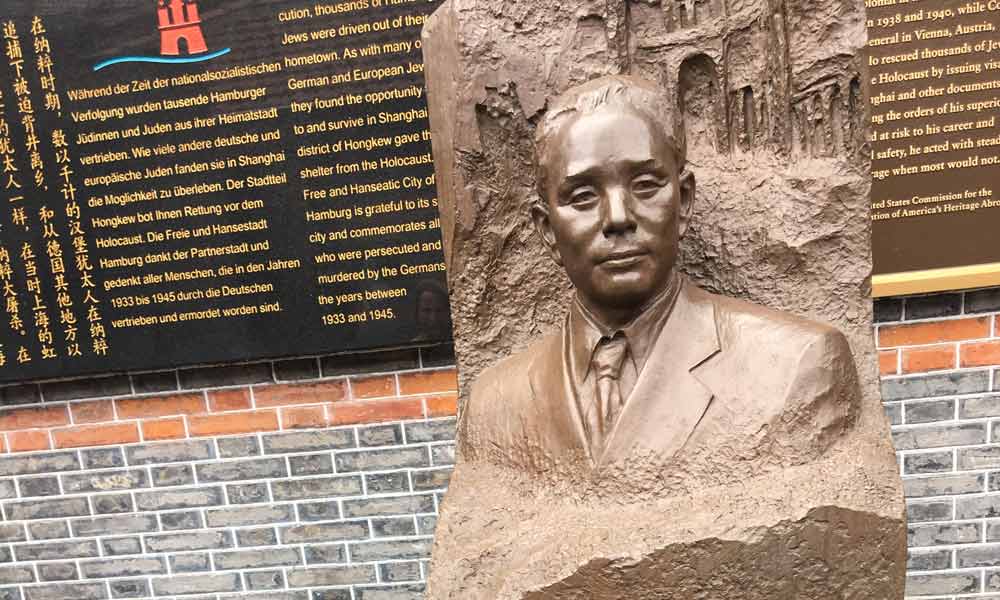
Memorial bust of Ho Feng Shan, the Chinese consul in Vienna who issued hundreds of visas to Jews seeking refuge from the Nazis. (Photo credit: Nadine Epstein)
“When they come to the museum,” remarks Keiner of visitors connected to the refugees, “they sometimes see artifacts and say, ‘I have that too.’ And they want to donate them to the museum.”
The original refugees have kept their own memories alive with many reunions over the years—Kiamesha Lake, in the Catskills region of New York; Salzburg, Austria; San Francisco; Philadelphia and elsewhere. Multiple academic meetings, exhibitions and scholarly works around the world have explored Shanghai’s Jewish community. Mainstream authors, too, have seized on the evocative time, with Kristy Manning’s The Song of the Jade Lily and Waina Dai Randel’s The Last Rose of Shanghai among the novels drawing on the period, and Taras Grescoe’s Shanghai Grand and James Ross’s Escape to Shanghai two of the nonfiction works.
All in all, the positive emanations sent forth by the museum about the Chinese-Jewish dynamic sync well with what, until recently, most observers saw as a healthy transactional relationship between the People’s Republic of China and Israel.
Keiner diplomatically says that the museum is not about contemporary politics, and that government support of it remains strong. One reason is that whatever the friction and international policy posturing between China and Israel at the moment, the longer story of Chinese and Jews amounts to a kind of historic romance compared with what Jews elsewhere in the diaspora experienced. When some 30,000 European Jews poured into Shanghai in the 1930s and 1940s, it wasn’t as if Jews came from Mars and Chinese from Venus. Jews had been living and working in China for centuries, laying the groundwork for cooperation and mutual empathy in a time of crisis.
The best scholarship puts the first Jews in China by way of the Silk Road in the 8th-century Tang Dynasty, and certainly by the subsequent Song Dynasty. The Jews of Kaifeng, China’s most notable community, built a synagogue in 1163. According to a 1489 stele in Kaifeng bearing much information on Chinese Jews, when flooding destroyed Kaifeng’s Jewish community’s Torahs, the Jewish community in Ningbo gifted two Torahs to the Kaifeng synagogue.
Connections grew even tighter in the 19th century, following the First Opium War, as Shanghai became a treaty port. The French founded their concession there in 1849, and the British and Americans consolidated theirs as the Shanghai International Settlement in 1863. As China’s commerce with the West took off, Indian and Baghdadi Jews formed the first Jewish influx to the treaty port. Wealthy families took their businesses to Shanghai, creating multiple Jewish organizations and erecting prominent buildings. A second wave of Jews, Ashkenazi and notably poorer, arrived in the late-19th and early-20th centuries from Russia, driven by pogroms.
In 1845, David Sassoon, a Sephardi Jewish businessman, established the Shanghai branch of David Sassoon & Co., a major trader of textiles and opium. Seventeen years later his donation helped found Shanghai’s first Jewish cemetery—the Israel Cemetery. In 1865, he helped create what is now the HSBC bank. And in 1887, he funded the establishment of Beth-El, Shanghai’s first synagogue. Eventually the Sassoons, regarded as the Rothschilds of Asia, owned scores of Shanghai buildings and companies. By 1900, the Sephardic Jewish community in Shanghai numbered around 800—composing a majority of the Jews in the city.
Various Sephardic employees of Sassoon also broke away to found their own successful companies, most famously Silas Aron Hardoon (1851-1931), a real-estate king who married a Chinese woman and helped create the great thoroughfare of Nanjing Road, Shanghai’s “Fifth Avenue.” Sir Eleazer “Elly” Kadoorie (1867-1944), another tycoon, served as president of the Shanghai Zionist Association for 13 years. Other Jewish businessmen streamed in. Max and Leon Friedman, who fled antisemitic pogroms in Romania, founded the China Motors Corporation and pioneered car sales of Dodges and other American cars in Shanghai.
One key upshot of that powerful Jewish presence, and a notable aspect of the pre-1930s and 1940s interaction of Chinese with Jews, was a pronounced familiarity of Chinese leaders with Jewish culture and overt support for their aspirations.
China saw no pogroms against Jews—on the contrary. Pan Guang, the leading Chinese scholar of the Shanghai Jews, writes in his Eternal Memories: The Jews in Shanghai that “no indigenous anti-Semitic activity has ever taken place in Shanghai, even in the whole of China.” The people of China, he continues, “are proud of the fact that when Jewish people were on the verge of death and struggling for survival, the Chinese city of Shanghai accepted over thirty thousand Jewish refugees…Shanghai took in more Jewish refugees than Canada, Australia, New Zealand, South Africa and India combined.”
The support of the Chinese for the Jews was evident throughout the early 20th century. In 1920, Sun Yat-Sen, founder of the Republic of China, wrote a letter to N.E.B. Ezra, editor of Israel’s Messenger, the widely read newspaper launched in 1904 by the Shanghai Zionist Association. In it, he praised Zionists and their hopes: “Though their country was destroyed, the Jewish nation has existed to this day…[Zionism] is one of the greatest movements of the present time. All lovers of democracy cannot help but support wholeheartedly and welcome with enthusiasm the movement to restore your wonderful and historic nation, which has contributed so much to the civilization of the world and which rightfully deserves an honorable place in the family of nations.”
In 1938, Chen Lu, the Chinese government’s vice-minister of foreign affairs, communicated to Kadoorie, head of the Shanghai Zionist Organization, the government’s respect for the Balfour Declaration. And in 1947, when the British in Mandate Palestine executed four members of the Irgun for their attacks on British soldiers, Madame Sun Yat-sen (Soong Ching-ling) led an 8,000-person protest, the largest pro-Jewish protest in the history of Shanghai, against the executions.
Even more remarkably, in 1939, Sun Ke, president of the Republic of China’s legislature and chairman of the country’s Supreme National Security Council, got the Council to approve a bill to offer 100,000 European Jews refuge in Yunnan Province in southwestern China. Officials, however, never implemented the plan because of insufficient funds.

If the old saw holds that “familiarity breeds contempt,” in China, familiarity bred admiration, even philosemitism. When one reads the many Chinese books on the Shanghai Jewish community, one finds a mutual-admiration society that, on the part of the Chinese, sometimes slips into clichés about Jewish business prowess and control, a longtime part of the antisemitic toolbox but in the Chinese context an always complimentary judgment.
In his 1991 book, Shanghai Jewish Cultural Map, Wang Jian, deputy director of the Center for Jewish Studies Shanghai (CJSS), writes of Jews, “Most of them have the extraordinary commercial sensibility and sharp consciousness of investment and development. They are talented in discovering commercial opportunities, in analysing the market and then in seizing the chance and garnering profits.”
Jewish business acumen is a leitmotif throughout his book. The Jews “were gifted at business and rapidly accumulated wealth,” Jian writes, noting that Shanghai Jews were the first in the city “to drive cars and owned the best and most expensive.” Elsewhere he observes, “Their family business network shared similarities with its counterpart in Chinese business culture…all liked to put their relatives into the important positions.”
Jewish business success eventually left a huge mark on the infrastructure of Shanghai. Jewish real-estate tycoons built high-rises, and today many historic buildings in the city are former buildings of the Jewish community. The enormous Sassoon House is now the Peace Hotel. The B’nai B’rith Hospital, founded in 1934 by Sephardic Jews, became the Shanghai Jewish Hospital, then the Shanghai EENT Hospital. Sir Elly Kadoorie’s home, the Marble Hall, is now the Shanghai Children’s Palace. The Shanghai Jewish Club is the Shanghai Conservatory of Music.
Shanghai Jews also characteristically launched a slew of organizations and publications: the Shanghai Ashkenazi Jewish Communal Organization; the Shanghai Jewish Boy Scout Troop; the Shanghai Jewish Recreation Club; the Jewish Sacred Burial Society; the Jewish Education Assistance Society; the Shanghai Jewish School; the Shanghai Zionist Association; and Israel’s Messenger, one of almost 50 newspapers in the community in different languages. All receive recognition in the museum, as do countless embedded stories of families and their struggles, and officials and their challenges.
One of the most moving involves Ho Feng Shan, the Chinese consul in Vienna from 1937 to 1940. Chinese scholar Pan Guang notes of the early 1930s that “Anyone could come to Shanghai at that time without a visa,” including German Jews. After sacrificing their goods to Nazi officials, they might make it out with a shipping ticket and a large red “J” stamped in their passport. Later, however, and after Kristallnacht in 1938, matters became more desperate—Germany and Austria required a visa for Jews to exit.
In a reflection of the Chinese sympathy for Jews, Ho issued thousands of visas to them. It was a time just before the infamous 1939 case of the SS St. Louis, packed with more than 930 German Jewish refugees, which steamed to Havana and Miami only to be denied entry by Cuba, the United States, and then Canada. Forced to return to Europe, about 250 of the passengers later died in the Holocaust.
According to the tale laid out in the museum, few except the Jews who received Ho’s visas knew of his courage. And few knew his name. Pan began trying to track down Ho and his story—as he puts it, “China also had a Schindler.” He finally found Ho’s daughter, Ho Man Li, in 1998, just a year after Ho himself had died in California at the age of 96.
According to his daughter, Ho, who had earned a PhD from the University of Munich, “never talked about it.” In a memoir, Forty Years of My Diplomatic Life, he wrote only briefly about his actions, saying that after the 1938 Anschluss that united Germany and Austria, “I spared no effort in using any means possible to help, thus saving who-knows-how many Jews.” Yad Vashem honored him as one of its “Righteous Among the Nations” at a 2001 ceremony attended by his daughter.
 lthough the museum stands as the central place for visitors wanting to recall Jewish Shanghai, other Jewish sites draw them as well. Over the years, survivors have revisited the rooms and apartments where they lived. (Chinese families living there now usually accommodate them.)
One refugee who fled to wartime Shanghai as a boy and later became prominent is W. Michael Blumenthal, President Jimmy Carter’s treasury secretary, now 100 and living in Princeton, NJ. Blumenthal’s family arrived in Shanghai in 1939, and he returned in both 1970 and 2015. In an interview on one of the museum videos, Blumenthal talks of how he and his family arrived with no money—he delivered bread as a child to get an extra half loaf for his efforts. “We were always hungry,” he says. A plaque now identifies where he and his family lived at 59 Zhousan Road.
Survivors also flock to see what’s become of the former site of the JDC (the American-Jewish Joint Distribution Committee) that helped so many of them. And the Roy’s Roof Garden restaurant café atop the Broadway Theater, owned by Polish refugee Kurt Wendriner, where so many enjoyed Jewish entertainment. And the popular White Horse Café, opened in 1939 by Rudolf Mosberg and his wife. And the whole neighborhood Shanghai Jews called “Little Vienna,” along Huoshan and Zhoushan Roads, where refugees opened shops and created a commercial center much like that at home. A monument to the community, in Hebrew, Chinese and English, now stands in Houshan Park. A four-hour tour of “Jewish Shanghai” is bookable through the museum.
Many of the Shanghai Jews moved on to Israel, Australia, the United States and other places by the late 1940s. But, according to Pan, “Shanghai has begun to see the reappearance of a Jewish community made up of business people, diplomats, experts and students.”
Today Jews in Shanghai number in the low thousands, many, including Israelis, in the city for just a few years to study or do business. They worship and celebrate holidays at the progressive Kehilat Shanghai or at Chabad Shanghai, which hosts regular Shabbat meals cooked in a kosher kitchen run by local Chinese staff. There, Chinese-Jewish cooperation continues. According to Chabad Rabbi Shalom Greenberg, the local kitchen workers have learned kosher preparation. They separate eggs that pass inspection from those with blood marks, and keep the latter to use later in their own kitchens.
Those craving pita instead of challah can beat a path to Haya’s Mediterranean Cuisine, at 3219 Hongmei Road, where the Israeli owner provides all the hummus, falafel and shawarma a Shanghai Jew could want.