
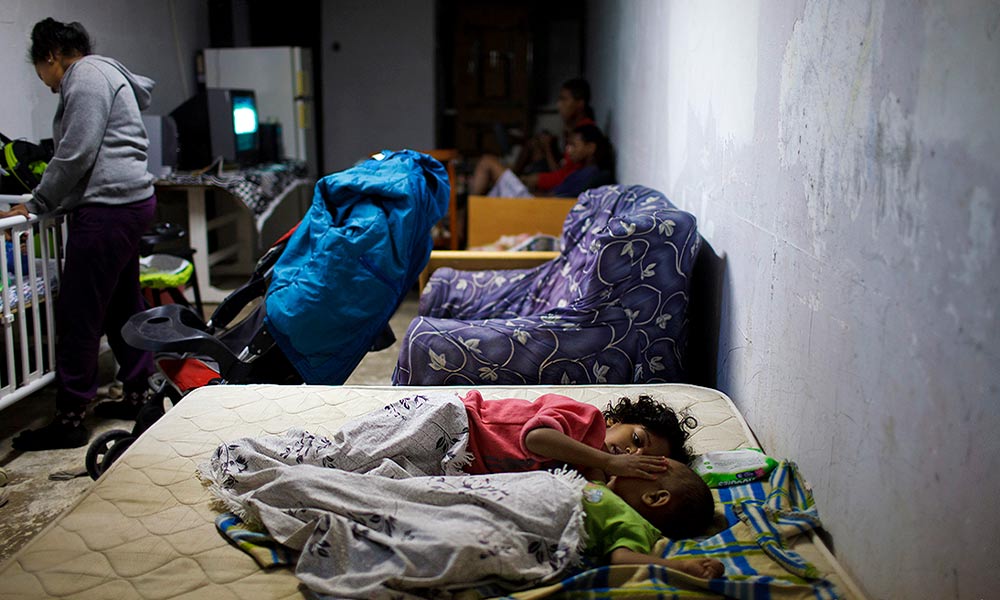
Israelis have long known that the war with Iran was coming “any minute.” The tens of thousands of murdered Iranian protesters, Prime Minister Benjamin Netanyahu’s declarations, President Donald Trump’s threats, negotiations that didn’t seem to be going anywhere—the writing has been on the walls of our safe-rooms for a long time.
Round one was the “Twelve Day War” last June. This is round two, and we all know the drill.
First, there is a screeching push alarm on our phones. In Israel the war is called the Roaring Lion, but I imagine the sound of the push alarm was designed to mimic the screech of a wounded rhinoceros. Verbal and written messages in Hebrew, Arabic, English, Russian and Amharic appear on our screens, warning that if you are not in a saferoom, shelter or at least some relatively safe place, you should be. Now.
National infrastructures are sagging, the educational system is failing, the high-speed rail is still pending and fiber optics are uneven. But the existential dread transmission is pretty-much foolproof, able to determine where the rocket from Iran (nearly 1,600 miles away) is heading and to penetrate every cellphone in that area. Most Israelis still aren’t sure whom they will vote for—we don’t even know when elections will be—and we don’t believe campaign propaganda, but that alarm is very convincing. We can’t agree on what should be open on Shabbat or where the best hummus joint is. But we share an a-historical, multi-partisan consensus: When that sound blurts out of your phone—run!
So we run, scooping up kids and pets (including goldfish). We wait for the sirens, then for the booms, trying to guess if we are hearing the Iron Dome taking down the rockets or the rockets taking down a nearby building. Flipping the old joke, yes, it is rocket science. At some point, we will receive a text telling us we can come out now.
Alarm—run—wait for booms—analyze and debate—wait for all clear—exit. Repeat. It’s a new form of interval training. Throughout the country, dozens of alerts today, and the night is still young. At least I’ve been getting my steps in.
Our trademark humor and quirky when-the-going-gets-tough coping style are back. A popular GIF is designed to spoof the Home Command with a popular children’s song that repeatedly tells us, “Sit down, get up, sit down, get up.” We review the cast of characters in the shelter: the hipster who brings his Moka pot and a hotplate (that inevitably blows the electricity in the shelter); the grandmother who brings huge pots of food to hand out to everyone; the dog who stares unblinking daggers, making chomping sounds like the crocodile in Peter Pan. There is a persistent rumor that someone (probably a veteran of an IDF cyber unit) developed an app that can tell who in a given shelter is single. Another one, based on all sorts of algorithms, assesses if you have enough time to wash your hair.
In the eerie quiet that follows the warnings, sirens and booms, I face what I really think about this war. This is not a normal way to live, and none of this is funny.
We supply our safe rooms with everything we need for an extended stay. I make sure my laptop and Kindle are charged (in case the electric grid collapses) and stock up on sourdough pretzels and other comforting carbohydrates. Several weddings have taken place in underground parking lots that double as mass shelters. An apartment building in Tel Aviv has turned its shelter into a permanent assisted-living residence, with designated spaces for children’s games, sleep, yoga and mindfulness (most of us are pretty mindful of being in a closed, concrete reinforced space). There are power banks for charging devices and an improvised kitchenette with hotplates, eco-friendly disposable dishes, gluten-free snacks, a small refrigerator, cutlery and staples.
All non-essential businesses have been closed (except for coffee shops, which Israelis consider essential) and public gatherings have been banned. Schools are closed, although some are opening slowly. Food columns and blogs offer recipes that can be interrupted (stir-fries and salads) and cookies and muffins that bake quickly. IT mavens tell us how to buck up the Wi-Fi in a shelter. Newspapers offer military analyses along with suggestions on how to talk to small children about war.
As the holiday of Purim approached, we collectively thought, finally a Purim with the hostages home and feeling OK about having fun. Purim celebrates the survival of the Jewish people over a plot to annihilate them 2500 years ago in Persia, now known as (wait for it) Iran. A kind-of Jewish combination of Mardi-Gras and Halloween, it’s usually celebrated with chaotic hilarity, outlandish costume parades through the streets, and getting drunk. Not this year.
Muslims have been celebrating the holy 40 days of Ramadan, which is ending in late March. But through the entire holiday, the faithful, who fast all day, couldn’t celebrate the Iftar (the break-fast), traditionally held in large family gatherings, or say the traditional Taraweeh night prayer together.
Humor provides a bit of relief, bravado offers some energy, and carbohydrates are comforting. But in the eerie quiet that follows the warnings, sirens and booms, I face what I really think about this war. This is not a normal way to live, and none of this is funny.
More than a dozen people have been killed in Israel and over 2,000 wounded. More than 700 Lebanese are dead and the vast numbers of dead and wounded in Iran and the Gulf countries are unknown.
[Photo essay: “Life in the Safe Room”]
I do not mourn for Iran’s supreme leader, Ali Khamenei, or for Iran’s national security chief, Ali Larijani, and I have no hope that Khamenei’s successor, his son, Mujtaba, will take positive steps to put an end to this war. The Iranian regime has threatened Israel and others with annihilation, destabilized the entire region, massacred tens of thousands of its own people, obliterated women’s rights, hanged homosexuals from cranes and misled and lied to the world about its construction of nuclear and conventional weapons. Nor do I mourn the loss of Hezbollah militants in Lebanon, who have served as Iran’s proxies in the region.
From a purely military standpoint, the strikes into Iran have been astonishingly successful, both in terms of strategic physical damage and the crippling of its command structures. But is Israel making the same mistake we so often make: counting on our tactical and technological successes without defining clear strategic goals?
Indeed, what are the goals of this war? Prime Minister Benjamin Netanyahu has held only one live conference in Hebrew, in mid-March, and only a few in English. Mostly, he has provided only pre-recorded messages in which he praises himself as an esteemed leader able to enter into this war together with U.S. President Donald Trump. Journalists were not allowed to be present at the live press conference; Netanyahu apparently did answer one or two pre-recorded questions from journalists believed to be supportive, but they are not part of the official transcript or video and are unavailable. Once again, the public is left with no information from its elected leadership.
On June 24, 2025, as the Twelve Day War against Iran and Lebanon drew to a close, the prime minister’s office reported that Israel had achieved “all the objectives of the operation, and far beyond” and had removed the dual immediate existential threat, referring to both the nuclear sphere and the ballistic missiles. Was that a lie?
Netanyahu also promised that he had destroyed Iran’s proxies—referring to Hezbollah and Hamas—and created a new geopolitical reality. So what do we make of those weapons that Hezbollah is lobbing at Israel’s north and center, and why is Hamas obviously still active in Gaza? Was that, too, a lie?
Now Netanyahu is telling the public that the goal is to “replace the Iranian regime.” Past attempts to replace the regimes in Afghanistan and Iraq are examples of just how unlikely this is. I see this notion as little more than a declaration by arrogant, autocratic men who believe they can design history, are convinced that they and the state are one and, as a result, think that assassinating a leader is the same as replacing a regime.
Even if we believe that this war is necessary or, at a minimum, unavoidable at this point in history, it is our moral duty to ask: Were proper global and domestic risk-minimalization assessments performed?
Have Trump and Netanyahu thought about the global economy and the increases in oil and natural gas prices or the possibility of a worldwide economic crisis when most of the countries of the world are not actively in support of this war?
Closer to home, wasn’t it obvious that Hezbollah would enter the fray? Iran has always counted on its proxies to generate coordinated pressure on Israel that will strain our military and domestic resources, and, even though Netanyahu promised us months ago that Hezbollah was no longer a threat, it is doing its assigned job very well. And given the extremists in the government, who will guarantee that we won’t send more land forces into Lebanon and once again sink into its quagmire?
And when the fighting ends, and even if the regime in Iran is replaced—and who guarantees us it’ll be replaced with something better ?!—is there a long-term plan? Does Netanyahu have a thought-out program that will lead to peace or at least provide us with a modicum of security, quiet and the chance to live normal lives, if only for a few years?


An elected leader’s first and primary role is to keep their country safe and secure. What have Netanyahu and his government done to prepare Israeli society for this war or for its aftermath? According to Israel’s state comptroller, one-third of Israelis do not have access to standard protective shelters—and close to 20 percent have no access to any shelter at all. Furthermore, the government hasn’t even begun to reconstruct the homes that were destroyed in June or to find permanent solutions for the tens of thousands of Israelis displaced by the Israel-Gaza War and the Twelve Day War. How many more will be displaced before this war is over? And why should we believe that the government will care for them any better than it has until now?
Did the government take into account that places of work are opening in order to keep the economy afloat but most schools remain closed, leaving families in untenable positions and children in emotionally and physically precarious situations?
Did they think about the emotional toll on a society whose nerves have been cruelly frayed since October 7? Do they even know that tens of thousands of Israelis are leaving, and even more planning to leave, because they see no hope on the horizon? Do they realize that mental health services are dangerously underfunded and understaffed, already unable to provide services for the growing numbers of soldiers and civilians suffering from acute and chronic PTSD? Do they care?
And what should I make of the fact that in mid-March, in the midst of the war, the cabinet found the time to allot 5 billion shekels ($1.6 billion) to Haredi yeshivas and schools and to the building of new settlements in the West Bank?
The only risk assessment Netanyahu cares about is his risk in the polls. Netanyahu is a classic elected authoritarian, who believes that he is entitled to stay in power and will do anything to guarantee that he does. He has built his entire career on conflict, externally and internally. Abroad, he presents himself as a statesman, saving the West from itself. At home, he presents himself as a great warrior-king who will bring victory to his people. He demands that we all rally around him, because there is an existential war going on, and anyone who opposes the war, that is, anyone who opposes Netanyahu, is a traitor.
And contrary to Trump, who is already signaling that he may consider bringing the war to an end, Netanyahu would like nothing better than to prolong this war, the cost to Israel be damned, until the time is right for him to call for new elections. He wants to run with an image of an imaginary “Supreme Commander in Arms”, responsible for Israel’s stunning victory in Iran while hoping we forget that this self-defined and self-crowned “commander” is the prime minister who failed on October 7 and in the disastrous Gaza War.
As I finish this piece, there’s another cell blast. And I’m not sure I have any sourdough pretzels left.
(Top image credit: Dima Vazinovich (CC BY-SA 3.0))
5 thoughts on “Seeking Safety, Confronting Insanity”
Eetta once again captures the Israeli mood in all its nuances, complexities, and frustrations.
Eetta, such an excellent reflection on what I feel happening here!Will send it to my friends and family in the states. Thank you
Wonderful description of what is going on in the hearts and mind of the Israeli people. You really painted it clear understandable picture are those of us living in that diaspora. Even your humour fit in with the mood Israeli. I hear the same response and description from my family as you have here presented.
I long for the end of this war and for the safety of all of you.
Excellent piece!
Etta has not only captured the mood of Israelis, she also reflects the reality that Netanyahu really has no idea how this war ends and with his funding of Haredim, also signals that he cares little about what price Israelis who are serving in the military, as well as their families, will have to pay until the war does finally end.