
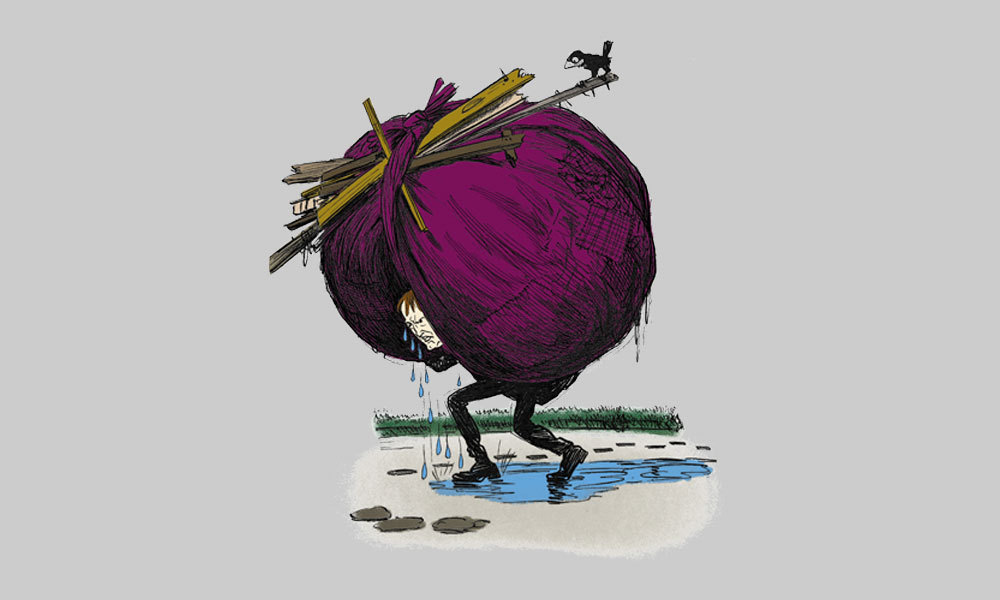
In 2008, a group of Jewish Democratic political operatives had an idea: If young Jewish voters traveled to Florida, they could convince their hesitant grandparents to vote for Barack Obama, thus ensuring a win in the vital swing state. The team dubbed the get-out-the-vote effort “The Great Schlep” and chose comedian Sarah Silverman as the face of the campaign. Her promotional video became a viral sensation. Viewers picked up on the connotations and humor of “schlep” without needing even a baseline understanding of Yiddish.
“The Great Schlep” used “schlep” in its noun form, defined as “a long, laborious, tedious journey,” according to the Oxford English Dictionary. But when “schlep” first appeared in the American lexicon in 1911, it functioned as a verb, a stand-in for the verbs “to drag” or “to haul,” according to Merriam Webster. This is how it turns up in James Joyce’s Ulysses, published in 1922, where the sun “trudges, schlepps, trains, drags, trascines her load.”
“Schlep,” however, isn’t exactly synonymous with “tedious journey,” “drag” or “haul.” “‘Schlep’ adds that element of struggling, of taking something that doesn’t quite want to be taken,” says Yiddish scholar and creator of the Yiddish Cultural Dictionary Dovid Katz. Thus, the object that one schleps might be too heavy or too difficult to carry, or it could be that the person who is burdened with the journey ahead just doesn’t feel like making the trip. “Schlep” also has humorous, self-deprecating undertones. “All Yiddish words that start with schl-”(or shl-, a phonetic base in Yiddish, like schmooze and schvitz) “are potential words for making fun and having fun,” says Katz.
Evolving from the Middle High German sleppen and the Middle Low German slepen, “schlep” found its way into Yiddish before implanting itself in the English language. When it came to America in the early 20th century, “schlep didn’t have a great English equivalent,” says Sarah Bunin Benor, author and founder of the Jewish English Lexicon, a project that collects data on Jewish spoken language.
But when it took root here, she says, its usage changed. In Yiddish, “schlep” requires a direct object, as in the transitive “I schlepped myself all the way to the DMV.” In English, it transformed into the more resonant intransitive, as in, “I schlepped to the DMV.” Benor says there’s nothing unusual about such a shift in a word’s usage between two languages. “Any language is always changing,” she says. “That’s the sign of its health.” The word’s spelling evolved as well. While Yiddish speakers and scholars such as Benor and Katz write it phonetically as shlep, 20th-century English language lexicographers spelled it the German way, hence the added ‘c.’
Whichever spelling you choose, “schlep” is certainly one of the most popular Yiddish words to have entered English. People love it because it sounds like what it is. The word, in fact, is so common that many English speakers don’t realize they are using a term from another language. It is one of those Yiddish words that have spread through English like a virus: Use “schlep” in conversation and people who aren’t familiar with it “catch” it and then use it with their friends, who “catch” it too. “Those overlapping networks lead to a Yiddish word becoming part of mainstream American English,” says Benor.
“Schlep” is also omnipresent in popular culture. Benor points out that in the 1950s and 1960s, Jewish comedians such as Allan Sherman used Yiddish words like “schlep” in their stand-up sets, where another meaning of the word also caught on—a “schlep” or “a schlepper.” A “schlep” is a person who is always struggling with “one thing or another,” says Katz. In the 19th century, calling someone a “schlep” or a “schlepper” was an insult denoting lower-class status. But, he says, a “schlep” is not a bad person. “It’s not a dishonest person, it’s not a lazy person. It’s a person not blessed with professional success who has to keep struggling to make a living.” By 1971, the “schlep” was so embedded in American culture that a character named Schleprock was featured in a Flintstones spin-off, The Pebbles and Bamm-Bamm Show. Suffering from chronic bad luck, Schleprock would say his signature line “Oh wowsy, wowsy, woe, woe is me!” as he stumbled from one fiasco to another.
While “schlepper” has fallen out of vogue, “schlep” in its noun and verb forms remains as popular as ever. In 2014, “schlep” was featured in an Elite Daily parody advertisement. “Looking for the next best app to pick you up that’s not a Lyft or an Uber?” begins the video, which has nearly 700,000 views. “Introducing Schlep, the first on-demand car service that uses Jewish geography navigation.” Chaos ensues as Jewish mothers pick up customers who become frustrated when they are forced to decline offers for food, a jacket or to be set up with drivers’ marriageable daughters.
A quick Google search reveals a long list of real-life companies that incorporate “schlep” into their names, from game manufacturers to engineering firms to delivery service platforms. Perhaps the longest schlep of all has been the etymological journey of this lowly Yiddish word.
Tricia Crimmins is a journalist and comedian living in New York City. You can find her on Twitter @TriciaCrimmins.
Opening picture: Adapted cartoon from Newberry Library
5 thoughts on “Jewish Word | What a Schlep!”
What’s missing from this wonderful article on Schlepp is the term nochschlepper — a tag-along, generally an unwanted one.
“I used to be a schleppah, now I’m Miss Mazzepa, with my revolutions in dance . . . “
I was taught that shlepper is somebody that dressed too informal for the occasion. it meant badly dressed. Also doing things half way, not finishing them or doing them badly.
I was once invited to lunch with the Austrian delegate to the United Nations. He was being recalled to Vienna to take another position. He said he would miss New Yorkk “die Stadt der Staedte”, as he put it, but wondered why so little German influence remained in a city that once had a substantial German presence. “At least one thing remains”, he sighed, “the verb ‘to schlep’.” I didn’t have the heart to tell him that “schlep” was absorbed into American English not from German but from Yiddish.
Solon, as the article states it does come from the German word sleppen.