
by Deborah Altman
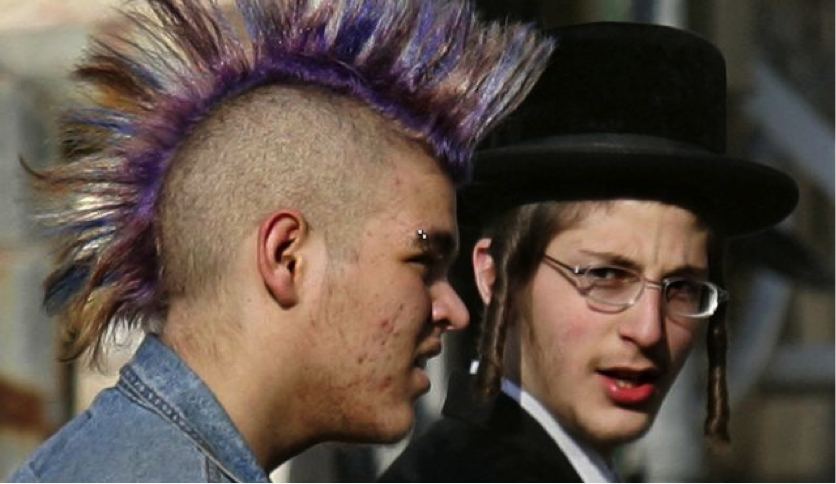
Every strand of Judaism has its misfits: A collection of individuals who imagine themselves within a particular Jewish community while expressing themselves outside of its rules. Even amongst the insular, strictly structured Orthodox communities there are the hidden black sheep who get swallowed by louder hums. These are the Punk Jews. Experimental and nonconventional, they make up the muddled chaos of New York Orthodoxy—the faces that don’t come to mind when you think of tzitzit and payos.
Jessie Zook Mann’s documentary Punk Jews isn’t a biopic on mainstream Jewish rock stars like Lou Reed or the Beastie Boys. It’s a here-and-now depiction of everyday outcasts: The Hassidic punk rock musicians, activists, street artists, and rap prodigies that walk among us. The film, which was screened at Sixth and I on June 22 and is making the rounds internationally, documents the rebels and outcasts who choose to explore Judaism in bold ways.
 Yishai Romanoff, the lead singer of group Moshiach Oi!, is perhaps the most traditionally punk out of everyone documented, describing his music as “a punch in the face of godliness.” For Romanoff, screaming
the Kabbalah-based mantra “NA NACH NACHMA NACHMAN NEUMAN” is not only empowering, it provides a spiritual connection. As a teen Romanoff turned to rock music and drugs, having found traditional services to be boring. It wasn’t until his late twenties that he rediscovered his faith through hard-core punk.

“Real Judaism is very in your face,” he told The New York Times. “The world is chasing after desires for money and sex and drugs and materialism, and Judaism is the opposite. Judaism is like, this world is nothing. This world is only to serve God and bring light and redemption. To me that’s very punk rock.”
Mann and producers Evan Kleinman and Saul Sudin do not limit the definition of punk to music. The documentary highlights various manifestations of the DIY subculture. Kal Holczler, the founder of Voices of Dignity, which raises sexual assault awareness within Orthodox communities, forced a taboo topic into the open in his Hassidic community. The Amazing Yoga Yenta is a performer who contorts while discussing Jewish concepts for her audience.
“The essence of ‘punk’ means to stand up for what you believe in, which is evident in every one of the chronicles in ‘Punk Jews,’ Kleinman writes. “The goal of ‘Punk Jews’ is not to provide answers but to start a dialogue, an exploration, a call to action if you will that will bring together people from all walks of life, who share a common heritage and ask the same question: ‘What does Judaism mean to me and how can I bring it into my world?’”
 Although the film was made in 2012, Kleinman and Sudin are still doing screenings around the country. “The subject area focuses on Jewish identity and how one can participate on one’s own terms,” explains Lisa Rivo, Co-Director of the National Center for Jewish Film. “[The film] doesn’t feel dated. We could still be watching it in ten years. I think we’ll be having the same conversations. The film is really just the beginning, instead of the end.”
The movie sells itself as a depiction of an underground movement. However, one critique is that it solely chronicles individuals, never wrapping them together in a unified, cohesive way. Nonconformity is not in and of itself a “movement.” The film gives the impression that while these NY Jews mutually appreciate one another’s exploration of Judaism, they don’t have the collective goals that mobilize and inspire broader support. In that way, the documentary almost feels falsely advertised.
That said, as a college student, surrounded in political and philosophical discussions about my Jewishness, the documentary struck home. Not only does it shatter illusions about an evasive and somewhat sheltered community, it also illustrates the incompleteness of the labels we use to identify as Jews. It gives us an introduction into thinking outside the Jewish categories, and perhaps the opportunity to be a little “punk” ourselves.