
Rabbi Eva R. Cohen is the spiritual leader of Or Emet, a Humanistic Jewish congregation in the Twin Cities of St. Paul and Minneapolis, MN. She grew up attending Or Emet and started teaching there after graduating from Brown University in 2009. As part of her rabbinical ordination by the International Institute for Secular Humanistic Judaism, Cohen earned her master’s in classical and Near Eastern studies from the University of Minnesota.
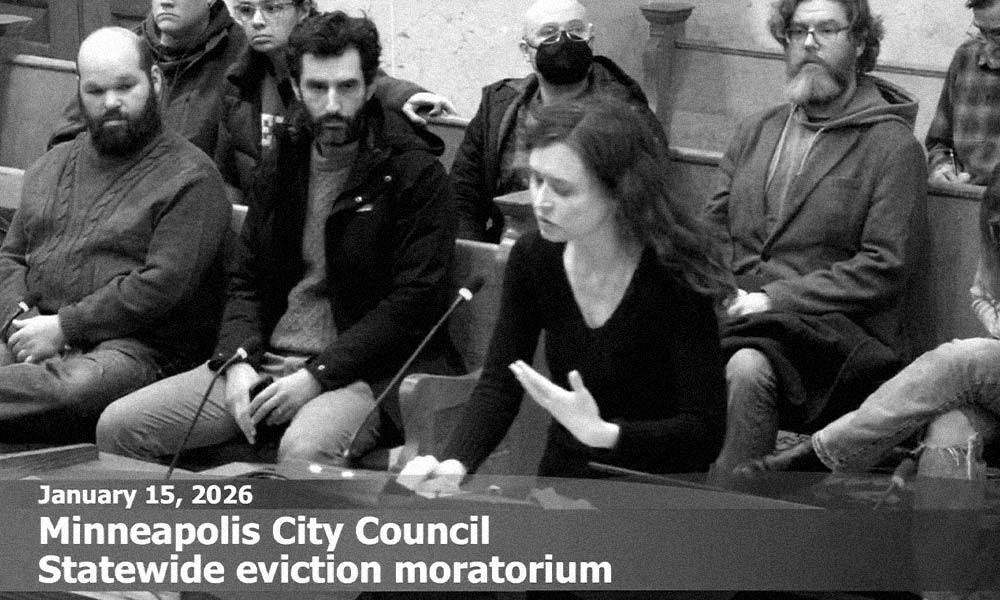
Since December, when the mass mobilization of U.S. Immigration and Customs Enforcement (ICE) began in her state, Cohen has been a public-facing voice among clergy involved in the ICE Out movement. In December she testified before the Metropolitan Airports Commission, calling on its members to make deportation flight information more transparent and protect airport workers from an operation she said was immorally targeting Minnesota’s Somali and other immigrant communities. Last month, she spoke at a press conference at the Minneapolis-St. Paul International Airport organized by unions representing airport workers who have been targeted by ICE agents, and she was one of 49 Minnesota rabbis and cantors to sign a letter testifying to the devastating effects of ICE actions. And on January 15, Cohen addressed the Minneapolis City Council in support of a resolution calling on Minnesota Governor Tim Walz to issue a statewide moratorium on evictions. “The Mishnah—the oldest collection of rabbinic law—asserts that renters can’t be evicted during the rainy winter time between the fall festival of Sukkot and the spring festival of Passover,” she said. “There’s a recognition that it’s not ethical to kick someone out of their home when the weather outside is bad, when it’s dangerous to be unsheltered. Right now in Minneapolis, not only is it winter and not only is it freezing, ICE is adding a whole other level of coldness and danger. Let’s do everything that we can to keep our neighbors safe and warm in their homes.” (The council unanimously passed the resolution and has since allocated $1 million to assist those impacted by the ICE crackdowns.)
The following interview has been edited for length and clarity.
The murder of George Floyd in 2020 put the racial justice spotlight on Minneapolis and brought international attention to Black Lives Matter and the movement to ban abusive police tactics. Last year, two Minnesota state lawmakers were shot in their homes by a man described as a far-right zealot. And now your city is ground zero for the Trump administration’s anti-immigrant mass deportation agenda. Did the George Floyd era give birth to a sense of civic resolve that is fortifying residents today?
I think that’s true. Networks of mutual aid that formed in Minneapolis in 2020 have in a sense been brought back online.
In Minnesota generally, we vote at higher rates than pretty much every other state, and we also have very high rates of volunteerism. The Twin Cities are quite progressive and have a strong culture of civic involvement, including social justice activism and a long and strong commitment to immigrant rights and to refugee resettlement. The Somali community is especially big in the Twin Cities, along with the Hmong community. [Having originated in China, the Hmong people migrated to Southeast Asia to escape conflict and genocide. Hmong refugees from Laos began to settle in Minnesota (as well as Wisconsin and California) in the 1970s.] Many Minnesota churches, synagogues and other faith communities have a history of supporting refugee resettlement. Today, those networks are organizing to get ICE out and end this occupation.
“So many times in Jewish history, Jewish people have been targeted, marginalized and discriminated against, and we are committed to the ethical notion that we do not want this to happen to other people.”
How do you describe the ICE Out movement?
It’s important to characterize it as really broad based, encompassing many sectors in the Twin Cities and the state: labor unions, faith communities, immigrant communities, small businesses. January 23 was an enormous day of action, organized to be both a general strike—a day of no work, no school, no shopping—and of massive protests, the largest one being in downtown Minneapolis, with satellite protests all around the metro area and around the state. There were hundreds of businesses (estimates ranged from 500-1,000) that closed that day, and I’ve seen statistics that somewhere in the neighborhood of 25 percent of Minnesotans either didn’t go to work or school or had a close family member who didn’t. Beyond that specific day of action, the ICE Out movement involves various forms of mutual aid, protest and monitoring to flag unconstitutional practices.
I’ve heard some people describe it as both leaderless and leaderful, which is important because the MAGA version of how organizing happens often puts the focus on a leader. Here, it’s an enormous, diverse constituency, with all kinds of people stepping up into different positions of leadership and working together to organize this resistance.
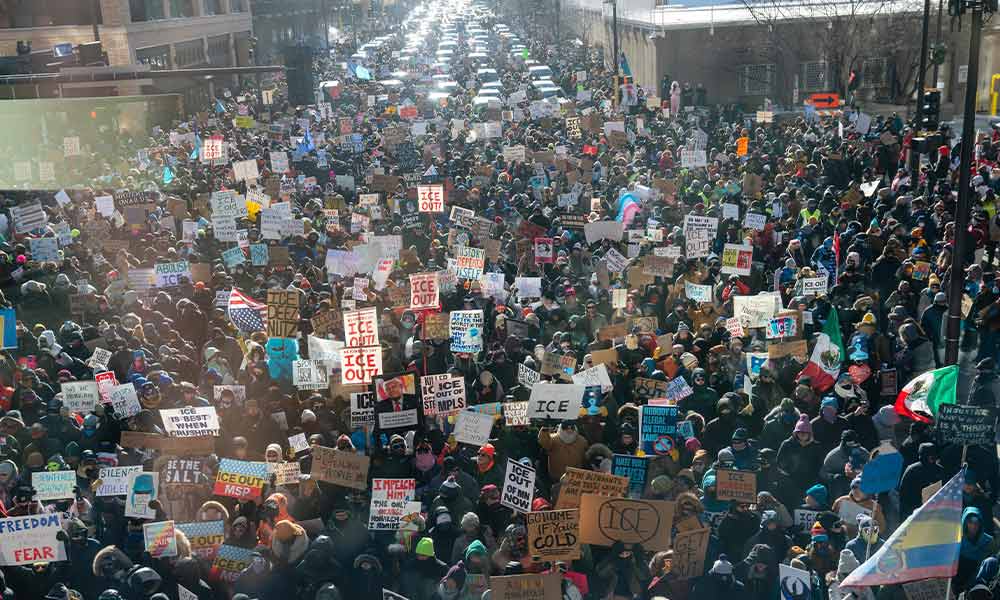
Downtown Minneapolis ICE protest, January 23, 2026. Lorie Shaull (CC BY 4.0)
What has been your and your congregation’s involvement?
Our executive committee and I encouraged people to participate in the January 23 general strike if they were able to. I led a group of my B Mitzvah students, along with their parents (and in one case, a grandparent). We made protest signs and marched together.
The morning that Alex Pretti was murdered, I was leading a Shabbat service, part of which was addressing the ICE situation. It was the day after the big strike. During the service, we regularly have a moment where we open things up for people to share. And in that moment, one of my congregants said, “I don’t know if people have heard, but ICE killed someone else.” We were all just trying to process that together.
I’ve been offering myself as a resource to my congregation in terms of pastoral care, supporting those who are struggling to cope with the awfulness of this, but also helping people get connected to different opportunities to help, for example by packing and delivering food or training as observers of ICE. In my sermons, at Shabbat services, and in other remarks, I’ve stressed the importance of standing with immigrants, loving the stranger and so on.
Parents and grandparents in my congregation are standing watch outside schools, outside of daycares and preschools where their children or grandchildren go. They’re feeling a lot of fear and concern for children there. I have a daughter in the Minneapolis Public Schools, where many of her fellow students are immigrants. Many of her fellow students are kids of color, and as we’ve seen, ICE has been targeting people of color indiscriminately. We just got news this morning that a parent of one of the students at her school has been detained. This child is now staying with a friend, and the school community is doing everything it can to support this child and the family.
So many people responded to the story of the five-year-old boy, Liam Conejo Ramos, and his father, who were detained and taken to Texas. This was a case of a family that had an active asylum case; they were proceeding through the legal channels. There was no justification for them being taken. They were in this terrible facility for several weeks, and finally they were able to come home. But since that story got so much media attention, other parents and children from Liam’s school have been taken in. ICE has been showing up with greater force at pick-up and drop-off times to harass teachers and parents. What is happening right now is really targeted and frightening.
The killings of Renee Good and Alex Pretti by ICE agents have also been covered widely and sparked outrage. With stories like Liam’s, it sounds like you’re saying that if these stories get too much attention, it can have negative effects.
That’s the tension that everyone is trying to navigate. To spotlight these terrible injustices, to try to help reunite families and channel donations, but then also being fearful of retribution. The school Renee Good’s son attended has been targeted with violent threats. They’ve had to take their website offline and implement a bunch of additional security protocols.
Where do you think those threats have come from?
Not from Minnesota. They’re coming from people who are supportive of what ICE is doing and who want to harass and intimidate.
Does Humanistic Judaism have a strong tradition of social justice action?
Humanistic Judaism places a strong emphasis on the idea that every human life has profound dignity and value, and that assault on that dignity or value is something we don’t condone or tolerate. Humanistic Jews are not invested in a God concept—we don’t pray or invoke a supernatural power in hopes that that force would take positive action in the world. We’re very invested in the idea that we humans need to save each other.
We also draw strongly on Jewish history and on Jewish tradition. So many times in Jewish history, Jewish people have been targeted, marginalized and discriminated against, and we are committed to the ethical notion that we do not want this to happen to other people.
Has the greater Jewish community in Minneapolis and surrounding areas come together to take a stand on the ICE situation?
The Minnesota Rabbinical Association penned a powerful statement from a diverse group of Minnesota rabbis and cantors that was published on TC Jewfolk, a Twin Cities media hub. I signed it (I’m the only Humanistic rabbi in Minnesota) along with Reconstructionist, Reform and Conservative rabbis and one Modern Orthodox rabbi, Max Davis. Many Twin Cities rabbis have been active in other ways around this issue. Emma Kippley-Ogman, the Jewish and interfaith chaplain at Macalester College in St. Paul, was among the clergy who were arrested at a demonstration at the airport on January 23 intended to disrupt what are reported to be deportation flights leaving from there. Rabbi Arielle Lekach-Rosenberg, who leads a Reform synagogue in Minneapolis, has been very active around this issue and helped organize out-of-town clergy who came in for that big day of action and was one of the featured speakers at the large rally afterward. Many others have spoken at vigils and taken other leadership.
The Trump administration recently announced that they’ll remove 700 federal immigration agents from Minneapolis. Several thousand will remain. Do you see any change yet or do you think a de-escalation is going to happen soon?
Removing 700 officers makes an incremental difference, but it is not enough. It’s still a massive, terrible, unnecessary presence.


You participated as a private citizen and Minnesota voter in Moment’s Jewish Political Voices Project back in 2024. When you were interviewed two months before the presidential election, you said: “My greatest fear about Trump winning is that this country would cease to be a democracy. Basically, we could become like a dictatorship, like a failed democracy, and all of the repressive and terrible stuff that would come with that.” How does it feel to hear that today?
Speaking as a private citizen, what I expressed at that time was what so many people were thinking. And now here we are. The repressive and frightening authoritarian overreach we are currently experiencing in Minneapolis is exactly the kind of thing that I and so many other people were fearful would happen.
Is there anything else you’d like to share with Moment readers?
This isn’t Jewish, per se, but some good friends of mine have a local Americana band called The Gated Community, and they wrote and recorded a protest song for this moment called “Hope to Hell.” I helped on a final edit of the lyrics, and they’ve now released it online. You can stream, donate and download the song, and donations are going to MIRAC [the Minnesota Immigrant Rights Action Committee] and other organizations resisting ICE and supporting the community. Stand With Minnesota is also a great directory of places to donate.
So many people in my life are involved in different ways, around mutual aid, resistance, and so on. I’m very inspired, and, you know, I’m fearful for a lot of people. But I’m hopeful that people outside Minnesota who are inspired by the organizing that’s been happening here can draw lessons for building networks of solidarity. What we’ve done here, you can do in other places too.
Top image: Rabbi Eva R. Cohen addresses the Minneapolis City Council on January 15, 2026. Screenshot from the City of Minneapolis.
3 thoughts on “Q&A | Minneapolis Rabbi Eva R. Cohen Stands with the Stranger”
Thank you for making information that we all need to see available.
Todah rabbah, Eva, to you and your many allies there! We can all do something to defend our neighbors who are immigrants and people of color being targeted by the Trump Administration and its Gestapo-like immigration round-ups and illegal actions against the US-born and anyone they choose. Let’s all keep our hearts full of hope and love to act for a better tomorrow, and get everyone registered and ready to vote! Your colleague and friend, Ben in DC
Wonderful comments, Rabbi Eva! Thank you for testifying publicly and supporting all people under threat!