
On Friday mornings, I often see my temple’s senior rabbi in cardio tennis class at our gym. Minutes after exchanging greetings of “Shabbat Shalom,” we face off in drills. At first I expected him to be, well, rabbinic, maybe hitting soft lobs or easy groundstrokes to invite me to engage, just like he does in Torah study or my daughter’s bat mitzvah prep. Instead, he fired off a passing shot and claimed his spot as “king of the court.”
“You’re not ‘you’ in cardio tennis,” he said, when I expressed surprise. “You’re just a person on the other side of the net.”
This from someone who has blessed my children on the bimah and led kaddish for my grandparents? Who assured my son that it was okay to sing Christmas carols in kindergarten and supported my daughter after the tragic loss of her friend? In turmoil, we often turn to rabbis first. But of course, they live in our world—as spouses, parents, competitive athletes. When another cardio classmate learned that our opponent (and her neighbor) was a rabbi, she scratched her head and said, “But—I’ve seen him wheeling out his garbage bins.”
As Us Weekly might claim, “Rabbis: They’re just like us.” My childhood rabbi would respond to anyone’s offhand “Oh, God!” with “No; just His field representative.” But this field extends far and wide, with everyone watching and weighing in.
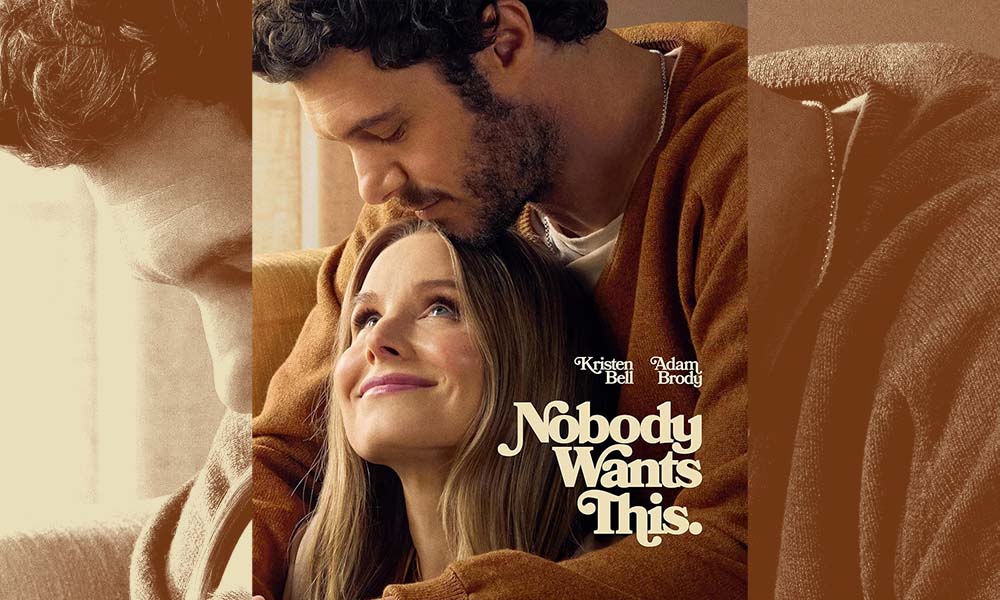
This friction between the public and the personal, as well as the sacred and the sexual, keeps audiences glued to Nobody Wants This, the Netflix series in its second season and recently greenlit for a third. In a way, the snappy and self-aware dialogue mirrors how Noah and Joanne (played by Adam Brody and Kristen Bell, respectively) use language and introspection to engage their own followers—whether from the pulpit or the podcast mic—to demystify topics not often brought to light.
Today, those stories command (and demand) a larger platform than ever. Erin Foster, the show’s co-creator, who converted as an adult, explains that the story is “based on the only good decision I ever made: falling for a nice Jewish boy.” She continues: “I wanted to tell a Jewish story, but from an outsider’s perspective, for someone who chose Judaism.”
And even though interfaith marriages are becoming increasingly more common, the rabbi as love interest raises the stakes. When Joanne (the agnostic podcaster) says to Noah (the Reform rabbi) in Season One, “it’s weird dating someone who has God as a third wheel,” she articulates our sense that being a rabbi is more than just a job. But it’s not as though rabbis are actively “rabbi-ing” all the time. Noah relishes playing basketball (yes, on a team called the Matzah Ballers) and gets plenty of fresh air. In the Valentine’s Day episode of Season Two, Noah invites Joanne and her sister Morgan (Justine Lupe) to a pasta-making lunch and wine tasting. Determined to uphold the sisters’ own V-day tradition of “drunk lunch,” Morgan grabs a bottle of wine from behind the counter. Joanne protests, “We’re here with a rabbi. We have to be cool.” Morgan sighs and says, “God, Noah is such a narc.” But he’s not perfect either; he’s just as prone to gossip, insincerity and the occasional f-bomb.
Rabbi Angela Buchdahl of New York City’s Central Synagogue recently told Vogue, responding to questions about the series’ accuracy: “I think there’s something kind of nice about portraying rabbis as leaders who are also human beings and not somehow holier-than-thou.”
Meanwhile, Joanne takes Noah’s faith so seriously that she struggles to find the spiritual hunger, the spark of passion for Judaism, that will make conversion feel not only sincere but legit. When Morgan breezily sketches Joanne’s hypothetical children’s deprivations—“No bacon. No Christmas. Praying for fun!”—Joanne looks pained, then imagines a compromise typical for mixed marriages: celebrating Christmas at Aunt Morgan’s house.
Still, the “elders” in Nobody Wants This—the chief rabbi of Temple Chai (Stephen Tobolowsky), Noah’s mother Bina (Tovah Feldshuh), even Noah’s sister-in-law, Esther (Jackie Tohn)—disapprove of Joanne not being Jewish. Some viewers struggle with the show’s stereotyping of Jewish women, which only heightens the “other-ness” of Joanne. As the New York Times observed, “the overbearing, judgmental Jewish mother and the frigid, controlling wife” clash with “the freewheeling non-Jewish podcasting sisters…who suddenly destabilize their social order.”
As we try to “market” Judaism in a fractured and diverse America, where inclusivity can be a lightning rod, how easy should we make it to belong?
Bina is convinced that Joanne has sabotaged Noah’s career path at Chai. Happily, the family who hired him for a baby naming knows of an opening at Temple Ahava. (Although, as my husband said, “I wouldn’t love if the rabbi we hired for our naming started making out in my yard.”) At progressive Ahava, he is welcomed with open arms; his non-Jewish girlfriend is an asset, not an obstacle. In one sense, this highlights our new consciousness of dismantling systemic bias, lowering barriers, embracing diversity of thought. (Why turn people away? “Kippah it casual,” as Ahava’s rabbi, played by Seth Rogen, says.) Yet before long, Noah grows dismayed that Ahava’s lax, anything-goes ethos seems to erode the meaning and morality that guides him. (At Ahava, movie releases trump Shabbat services, and you can regift something from your bubbe without guilt.) It’s a dilemma that so many rabbis and congregations face: As we try to “market” Judaism in a fractured and diverse America, where inclusivity can be a lightning rod, how easy should we make it to belong? What is the price of admission into our tent? And how much should we maintain, or relax, a double-standard?
Early in the series, Noah and Joanne bump into one of his congregants (who’s with his mistress) at a sex toy shop while picking up a dildo for Joanne’s podcast. The writers conveniently cancel out one “shanda” with another, resulting in mutually assured discretion. But is one man’s commandment breach as scandalous as another’s curiosity? Maybe, the series implies, if you’re a rabbi dating a shiksa. And yet Joanne’s podcast–also called “Nobody Wants This”–exists to broaden her followers’ horizons, encourage self-expression, and question the status quo. That’s precisely why Noah admits that she makes him “a better rabbi.”
It’s another instance of the series’ proposition: that clergy are not above the fray. Admitting they do not have all the answers—wrestling with doubt and dissatisfaction and even false dichotomies—places them squarely in the Jewish tradition. In that way, Joanne and Noah are kindred spirits.
“I love analyzing things from every direction,” she tells him.
“I know,” he replies. “It’s very Jewish of you.”