
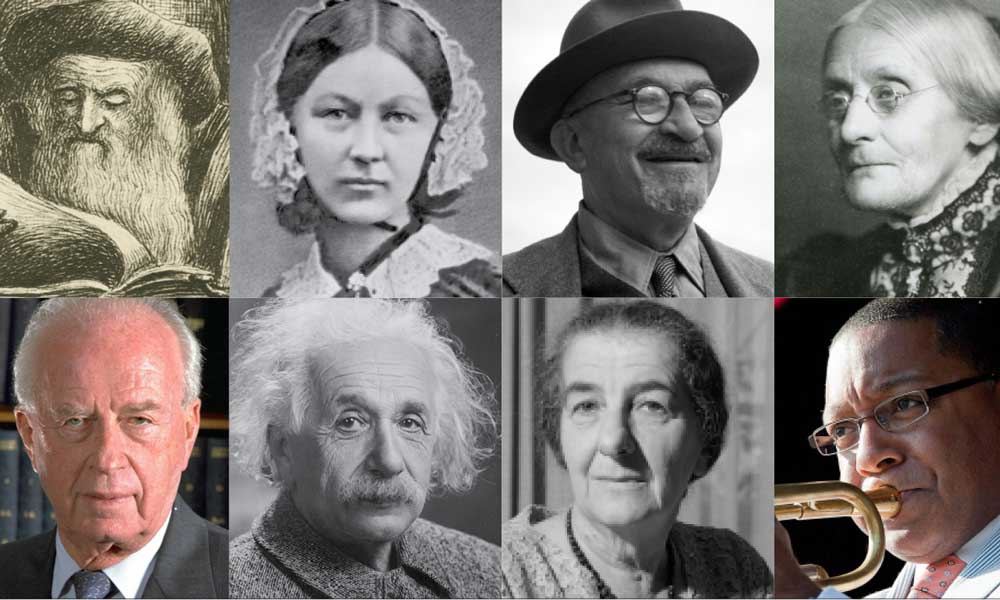
Lately I’ve been giving a lot of thought to people who are “irreplaceable.” I’m not referring to loved ones whose loss leaves a hole in our private lives that can never be filled by anyone else. I’m talking here about public figures who are or were perfectly cast for the role they seemed destined to play at a particular moment in history.
Two things triggered my interest in the world’s irreplaceables. First, my daughter Robin’s article in The New York Times about Wynton Marsalis stepping down “after nearly 40 years as the charismatic founder and recognizable face of Jazz at Lincoln Center.” Robin quoted Gordon Davis, the jazz program’s founding chair, who put Marsalis’s achievement succinctly: “Jazz was dead in this country. Wynton raised it up to make it what it should be: a true art of American culture.” The JLC board has given itself two years to find his successor. But the man is fundamentally irreplaceable.
My second trigger was the advent of Purim and my reading of this oft-quoted verse in a scroll familiar to Jews all over the world, The Book of Esther: “And who knows but that you have come to your royal position for such a time as this?” (4:14) That’s the sentence Mordecai speaks to Queen Esther after he learns of the edict by Haman, the evil prime minister of Persia during the reign of King Ahasuerus (486-465 BCE), to annihilate all the Jews. Mordecai doesn’t just tell Esther what to do, he strongly insinuates that God preordained Esther to become Ahasuerus’s queen in those particular circumstances, to address that particular threat, so she could facilitate Jewish survival. Which, reportedly, she did.
To my mind, the words Mordecai spoke to Esther could serve as the whispering conscience that motivates someone to vault over normal or normative behavior into the realm of extraordinary daring, creativity and bravery. Similarly, the trajectory of Wynton Marsalis’s life and work could be that of every inventor, entrepreneur or activist.
Once I started shuttling down this track, other irreplaceables chugged into view. The supernovas, of course: MLK Jr., FDR, Florence Nightingale, Clara Barton, Harriet Tubman, Susan B. Anthony, Frederick Douglass, Rosa Parks, Jackie Robinson, Harvey Milk, Greta Thunberg—you get the idea.
Would our world be the same if Nightingale hadn’t seen with her own eyes that more Crimean War victims were dying from unsanitary conditions, typhus and cholera than in combat? If Anthony had let raging misogynists cow her into quitting the fight for women’s suffrage? If Robinson had given up baseball in the face of his own teammates’ racism? What if Parks had lost the courage to sit at the front of the bus, or Milk’s spirit had been broken by homophobic violence and vitriol, or Thunberg’s by powerful despoilers of land, air and sea?

In the Jewish cosmos where I grew up, there was another list of irreplaceables: Rashi, Maimonides, Theodor Herzl, Chaim Weizmann, Henrietta Szold, David Ben-Gurion, Golda Meir, Albert Einstein, Yitzhak Rabin. Whether or not the long-term outcome of their influence is to everyone’s liking, it’s hard to imagine anyone else achieving what they did in response to their generation’s threats, problems and promises.
But what if Herzl hadn’t witnessed the Dreyfus trial, where he got fired up to fulfill his Zionist vision? What if Meir’s husband Morris had convinced her to stay home with their kids in early 1948 instead of gallivanting across America and raising $90 million to fund the Haganah and the establishment of the Jewish state? What if Einstein had been killed as a toddler by a horse and buggy in Munich?
Though I may seem to be echoing Thomas Carlyle’s simplistic “Great Man Theory”—that history is made by extraordinary figures with innate, heroic traits—my sense of the phenomenon is a little different. I believe each of those notable individuals possessed an utterly unique—Mordecai would call it “God-given”—admixture of origin, experiences, personality, ideas, aims, courage and chutzpah. That magical combination happened to be in sync with the mood of their era. And then they had to act on it—to try their best to repair some aspect of our troubled world.
Of course, a negative version of this vision is also possible. The wrong person can change history in profoundly dangerous ways. Certain unmentionable autocrats lately have led astray their populations’ better angels—one can only hope not so far astray that they can’t soon reclaim their collective sanity and their nations’ honor.
Among the questions I’m grappling with now: Will we ever see the likes of the great-greats again? Were they recognizable as such in their own time or only in retrospect? If mostly in hindsight, are we walking, working and living among comparable one-of-a-kinds who might have a similarly seismic effect on the future? If we could identify them, how might we best support their wild-eyed visions, missions and dreams?
The answer comes to me at a slant. According to Talmud tractate Sanhedrin 97b, in every generation there are at least 36 “righteous individuals”—lamed vavniks, or, in my translation, irreplaceables—upon whose good works the whole world rests. None of us knows who they are, and they themselves don’t know that they are, but each of us must conduct ourselves every day of our lives as if we are one of them.
Letty Cottin Pogrebin is the author of 12 books, most recently Shanda: A Memoir of Shame and Secrecy.